Date
Author
Александра Левинская

Preserved copy
Translated material
Agnia is released from a colony that sewing clothes for security forces
Preparing the last research cycle in the history of Samizdat, we went to Perm to study how and why women kill home tyrants, what happens to them later and who helps them after leaving the zone. In the first part, we tell the story of the former prisoner Agnia, which twice visited the colony, and now, together with the local human rights activist, helps convicted women killers.
Research: why women kill and who helps them
I.
Like a crocodile and heroin twice sent Agnia to a colony
II.
The stories of women who planted a knife in their husbands
III.
The opening of the first Center for Assistance to Women's Associated
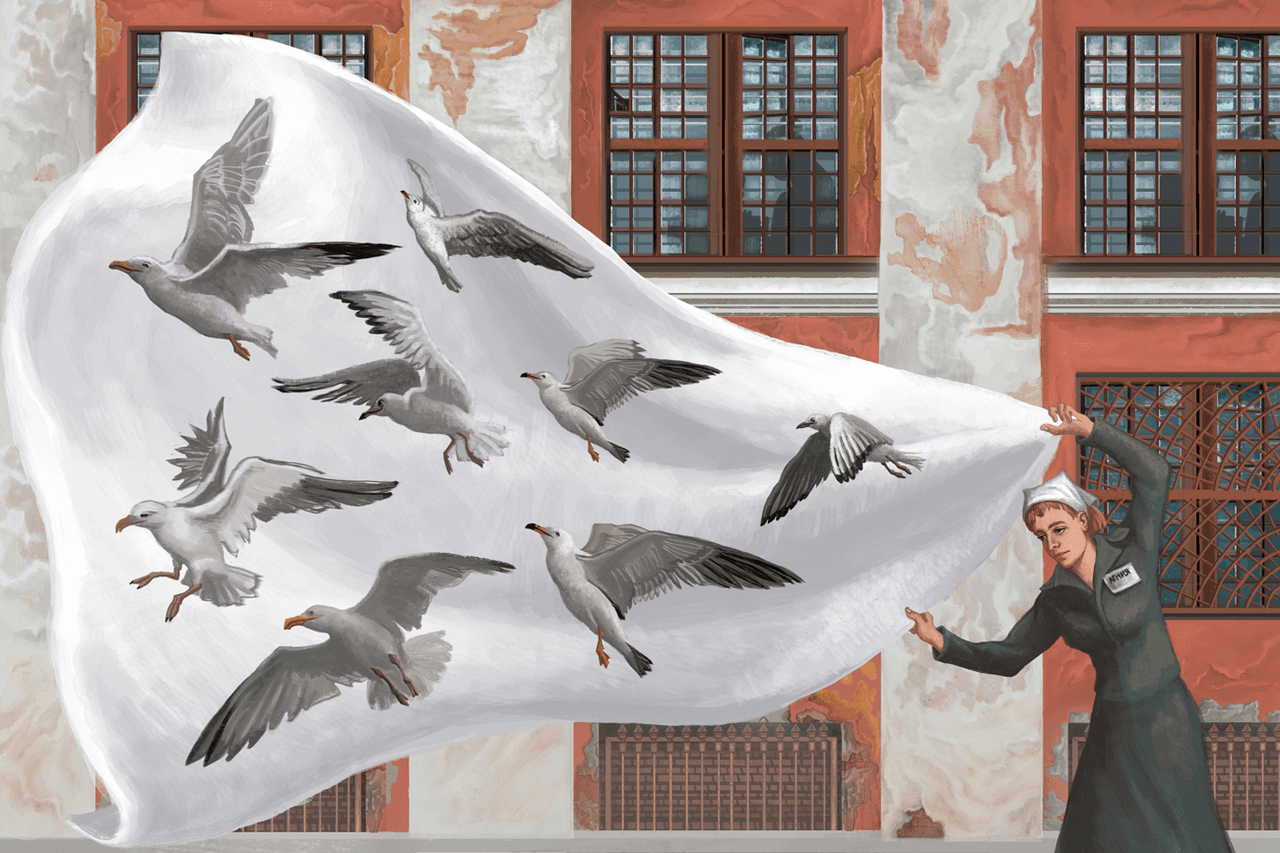
Agnia Urakova stands near a four -story building with grilles on the windows - a women's colony in Perm. In the same she spent the last eight years.
“Here I practically lived,” says Agnia, pointing to sewing machines behind the glasses. “We have eleven.” In the seven rise. In eight charging. Then breakfast, and then work. And that's it. We work up to five, then we stay in processing. You can leave on time, but it all depends on work. If you have a lot of it, what will you go, or what? No, you won’t go. There is a norm. But in any case, you will make more norms so that you do not fall. You sew, for example, one by five seamstresses. They must be sheathed so that they have work, so that each of them can make its norm. This is like tin.
Near the colony there is an abandoned house with knocked out glasses. On the contrary-a small square and a monument to the warrior participating in the Great Patriotic War. Very quiet. Birches are noisy over the alley. Occasionally cars are driving along the road. The female colony shares the building with a sewing factory. The workshop of convicts is occupied by the third and fourth floors. Below, in the first two, there is a "free factory". There is also a store where any textiles are sold: school uniform, winter jackets, camouflage suits, shoes, gloves, hats, tablecloths and pillows. But the main products of the factory are overalls for law enforcement agencies. Among customers are the Federal Security Service and the Ministry of Defense.
Agnia returned to the colony to get on a date to her "family", Marina (the name changed). So in the colonies they call the closest friends with which they share the table, money and household duties. Agnia and her familys organized life as follows: each did what she likes more. Girlfriends freed Urakov from washing dishes, and she agreed to take on cooking.
Together with Agnia, human rights activist Anna Kargapoltseva, president of the interregional public organization of social warning of offenses “Choice”, came to the colony. She says that the colonies dictate certain conditions: in order to survive, women have to unite, and they not only create communes, but also enter into a relationship with each other. Agnia laughs: “I very often came across this. If a long time, then they begin to compensate. They still try. Someone remains in this, someone does not remain. But everyone lives in the zone. And then they, you know, come out and say: “Well, that's all, but I don’t.” Come on!" She does not mention her experience. “Do you know how I think? Regardless of what you are, the main thing is that you have inside. In principle, no one should worry anyone with whom you share your bed, ”she argues.
Agnia goes into the date of the date, and I remain to wait for her at the checkpoint-a small room where the duty officers are sitting behind the glass. In front of the window is a line of four convicted women. They are all similar to each other: light dyed hair, leggings, rubber slopes. Some have a photo with a photograph on sweaters.
- The package is completely packed, there are no visible damage. I open it with you, - the duty officer mints.
The prisoner responds with a nod. The duty officer quickly opens the box, takes out letters, food, clothes, scans them with a special device and stretches them through the glass. A woman puts things in a bag. She shakes the red rush - and he turns into a long dress with feathers.
“This is for Dawn,” the woman explains, smiling.
- Did you get the package completely?
- Fully.
- Claims?
- No.
Women enter the room one after another. They sit on chairs and line up along the walls. All space is filled with their voices.
- What are you, also to the store?
- All of ours?
- Maybe we’ll have time to smoke?
The duty officer comes out from behind the glass and begins to recount the audience.
- Solomonov, Babaev, Kolesnikov, Zotov ... nine? Everything, nine. Went!
On command, women leave the building. The duty officer closes the column.
Agnia and I follow.
- So you look at them - and you understand that they cannot even move independently. They walk like this. Well, at least so, ”says Agnia with a sigh.
The regime in colonies-settlements is considered lightweight: prisoners can walk freely around the territory and even leave it, but only accompanied by an employee. They are taken to shops, museums, libraries. The convicts themselves choose clothes and dispose of their money. There are no restrictions on the number of parcels, programs, dates. Less prohibited items. It is possible to receive secondary and higher education in absentia - but only in the place where the institution is located. In a colony-settlement, those whom the state does not consider particularly dangerous criminals: convicted for the first time or committed a crime by negligence. People from the colonies of general and strict regime are also translated here, if they have served the laid part of the punishment and established themselves well.
Initially, colony-settlements were created to socialize prisoners, says human rights activist Anna Kargapoltseva. It was assumed that if they are not isolated from society completely, then they will be able to quickly return to normal life after liberation. “But it often happens that the emphasis is on another, let's say: they teach people to work. Maybe it is not bad, but with girls, in my opinion, too much. They are all obsessed with work. They are not interested in anything else in life. They only ask about this always. They are sure that if they work, then everything in their life will be cool. Maybe they are more diligent than boys. The boys have no such cockroaches. Girls are all processed, ”she says.
Agnia stands in front of the building, lifting his head. Women, and among them the "family" Agnia Marina, crowd in the opening of the windows, scream and wave her hands.
- Hello, scan!
- You look good!
- Required!
- Tanned!
Agnia - fit, in trousers and jacket with a hood. Two blood connected in it: Tatar - from the father and Russian - from the mother. Her dark hair is briefly trimmed. Behind glasses, bright slave eyes shine. Agnia smiles broadly in response to compliments.
A woman in blue goes to the porch. Her eyes are also blue. I feel how they watch us. Agnia suddenly lowers his voice.
- Olga Vasilievna (the name changed) went to watch us. You can’t talk, so it is nervous, - Agnia turns to me and speaks quite quietly, through her teeth. - Dubachka. This "oak tree" is called. And in men, those who accompany are “oaks”.
- Does that mean "harsh"?
- Why? No. The name is. And they are all normal. There are generally normal, human, which do not treat us as convicts.
We decide to leave so as not to disturb Olga Vasilievna. Marina does not leave the window to the last.
- That's it, I'll call in the evening! - Agnia shouts her goodbye.
We are heading to the store. The Magnit, which combines both the grocery and the pharmacy, is located on the other side of the street, across the road. Women from the colony are usually brought here for purchases. Agnia causes a lot of memories: “Previously, you go, go, you start to look: what do I need, why do I need, what do you need? In general, nothing is needed. It seems that everything is needed - and it seems that nothing is needed. But you can still be patient with this. ”
According to the law, the salary of convicts should not be less than the minimum wage, which from January 1, 2021 is 12,792 rubles per month. However, prisoners are required to reimburse the costs of their maintenance. The state has the right to hold up to 75 % of their salary. Pensioners, disabled people of the first and second groups, pregnant women, young mothers and minors receive half. But Agnia does not apply to any of these categories. In previous years, when the minimum wage was lower, she earned a little more than two thousand a month. I had to endure often.
Agnia goes around the store and stops at the stand with jewelry. Dozens of earrings, bracelets and rings glow on it.
- Do you like jewelry? - I ask.
- Yes, I love. But I wear the earrings only silver. I have six holes, they had six rings. Gold. There were four rings, a gold chain, a golden cross. I sold everything. All that was possible. I am very sorry.
Agnia gave all the jewelry for drugs. At that time, she could not think about anything else. “Cut” - and forget. The day passed - and okay. You just need to find a dose, and then everything will be fine.
For the first time, she tried intravenously in adolescence, and so, moving from one substance to another, and ended up twice in a colony.
Everything will be fine
Hanka and heroin, spice and crocodile, the first colony of 19 years old, the second - 34
Agnia was sure that everything would be fine when she tried her first drug - Hanka, an opium substance from poppy juice. Agnia remembers that day perfectly: she is 14, she is the only girl in the company of guys, is going to prove to him and herself that she is already quite adult. "Everyone sits down, but I will not sit down." Everything will be fine. “The stupid is naive,” Agnia scolds himself, telling this story.
Everything was fine. She liked it, but this did not translate. After the first injection, Agnia lived without drugs for a year. Only to live in Bogdanovich, a small town in the Sverdlovsk region, was very boring: "There, except to inject and drink alcohol, there is nothing more to do." Maybe that's why Agnia’s mother often drank. She worked at the factory, where she had to stand on her feet all day. The legs were sick - both from fatigue, and from the harmful substances that stood out in production. Alcohol was her anesthetic: when she drank, she did not feel her legs. A lot of things did not need to feel. August, the twin sister of Agnia and her exact copy, died two hours after birth. Father went missing when Agnia was 13. He simply dissolved. The body was never found. The family believes that he drowned in a swamp. Agnia, her mother and older brother remained three.
At the age of 15, Agnia pricked a second time. Third. Fourth. Fifth. Hanka. Heroin. All together. This went on for several years. Agnia began to live with a man, they often quarreled and eventually parted. Agnia blames his “sick pride” in this: at that time she fell into a rage because of one careless word. Only drugs reassured. I did not want to live. “Well, who needs me? Mom? Not really. Brother to the eldest? Not either. There are no children. I am not lucky with my husbands, ”Agnia thought. And she walked behind a new dose.
At the age of 19, Agnia ended up in a general regime colony. For the distribution and sale of drugs, she was condemned for ten years.
- Have you really sold? - I ask.
- No. It was just convenient, ”answers Agnia, smiling.
She did not have to master in prison for a long time. She got into a familiar company: "Drugs are collective." When police raids began in the city, everyone with whom she shared euphoria ended up in the colonies. Agnia recalls this time with nostalgia - as the years of his youth. Then she found a lot of romance in prison life. “I was 19 years old. There are still a lot of fees, a lot of awaken. There was a schizo and fights. Both glasses and chairs broke. And they fell under the operatives, ”says Agnia with a smile.
In prison, she got rid of addiction and became a good sewing specialist - so that she did not want to let her go for a long time. Eight years later, Agnia was released. Immediately began to look for work. In interviews, she directly spoke of her past. This turned into a kind of game, where the main goal was to get a job with a criminal record. Three days later, Agnia called, and she found out that she had won: she was accepted into the sewing workshop. She spent six years there and never heard complaints about her. It was not pulled to drugs. So, sometimes I drank beer to relax. Nothing unusual. And then, five years later, life suddenly got off the rail. And again - spice, crocodile, salt. Over the year, Agnia tried all existing drugs.

- Why did you start using it again?
- Tired, probably from loneliness. I just had to do something. When you are hesitated, this is a group lesson. Someone needs you. Sometimes it works. There is a feeling of cohesion, company. It is addictive. Then it is very difficult to get rid of this in the head.
Returning to the drugs, Agnia quit his job. She believed that this time she would not be caught. The term was confident behind me: “It seemed that since I had already served, then I can do everything. But, it turns out, you can’t. ” Agnia was condemned again. Again for ten years. Again for the use and sale that was not. Agnia believes that the second term was inevitable for her: “For the first eight years, it would seem, should I have a peel? No. As they say, the road was protoptane, the second time it would be anyway. And almost everyone has it. ”
She did not know to the last where the sentence would serve. This uncertainty caused fear, and she thought that Mordovia was waiting for her. In 2013, Nadezhda Tolokonnikova, a member of the Pussy Riot group, wrote an open letter about slave work, humiliations and beating in the Mordovian colony IK-14 and announced a hunger strike to draw attention to this situation. “And to go to Mordovia with a dozen - that's all, this is immediately death. There is very hard. You go there or two there and do not know what it will result in. Many girls are freed down. For many, something has been repelled. Not what they punish - so, for prevention, ”says Agnia. She was sent to the Perm Territory - and she believes that she was very lucky. Agnia calls the local colony of general regime "pioneer camp."
So she is reasoning now. But at first she poorly understood where she got. She has never been to Perm and did not hear anything about this city. In prison, Agnia did not meet a single acquaintance. A mother who visited Agnia in the first colony for eight years stopped traveling to her. It was then, in this “Pionerlager”, Agnia for the first time realized that she was incorrectly disposed of her life.
She stands for a long time at the store shelf with perfumes. He examines the bottles, turns them in his hands, splashes in his palms and inhales, closing his eyes.
- Apparently, the colony still does not let me go. She holds for a very long time. If I liked something, I need to see everything, touch. A little shift goes in my head. You start to look differently. Alcohol perfumes cannot be in the colony. You can only oil. There you don’t come up with what you just do not do, ”Agnia tells me. “And this is not only mine.” For five and a half years you were kept in suspense: this is impossible, then it is impossible. I even caught myself on such a thought. I come up, I watch myself a manicure set. I think: "Damn, can I?"
Life in the colony consists of rules and prohibitions. Agnia repeated them more than once, but still was able to build a good reputation. The prisoners treated her with respect, the administration appreciated for activity and hard work. In the colony, Agnia not only worked a lot, but also engaged in the organization of Dusug - all prisoners in Perm pronounce this word that way. Dive -minded cultural events that take place in the colonies are called Domesug.
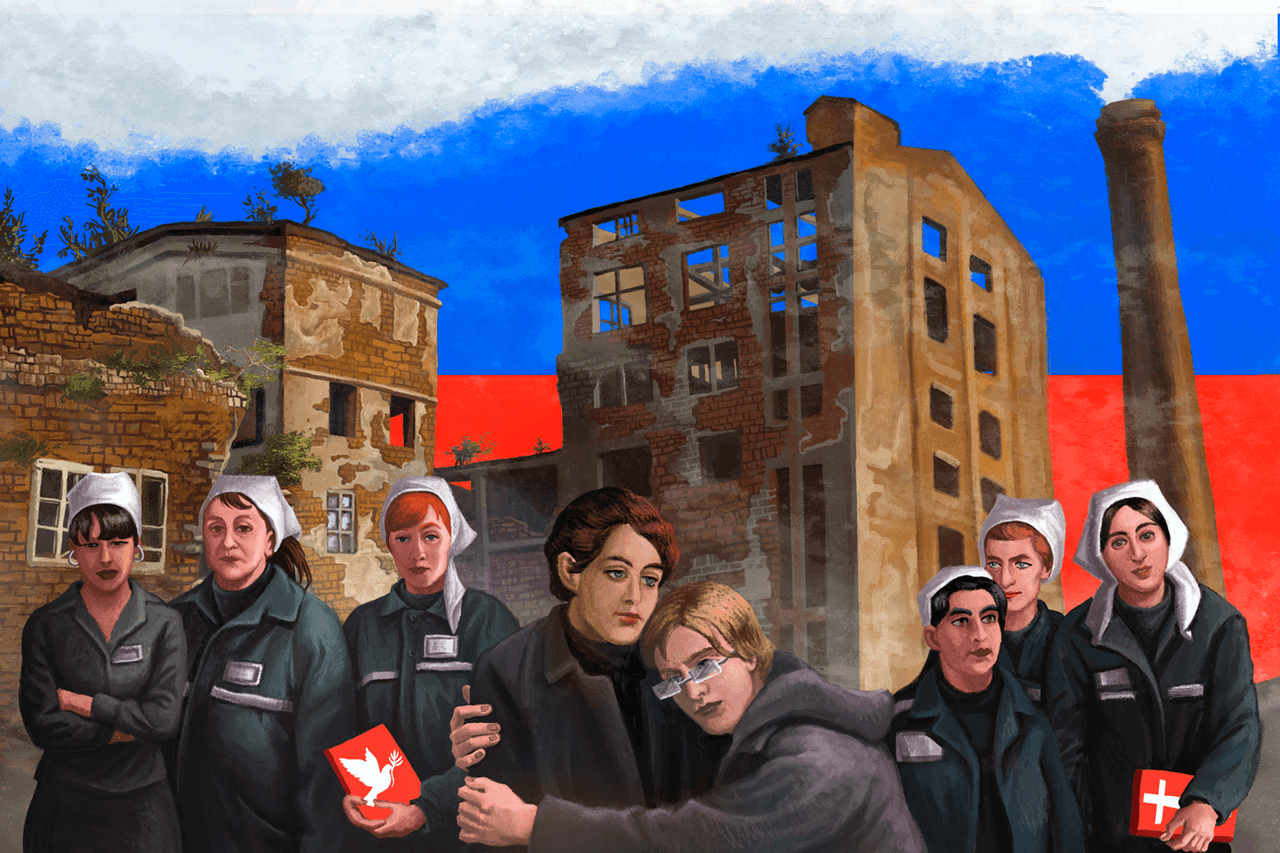
On one of them, the human rights activist Anna Kargapoltseva saw Agnia for the first time. “I know how I met her? I arrived in the women's colony. There was a holiday - Mother's Day. They crashed into two teams. One team of girls who was convicted for the first time, the other several times. Agnia was the captain of the team, which was called "Daddy's daughter". She sang on stage - just just, I don’t remember. And she had a bow on her head - more than her head. It was difficult not to notice. See Agnia? And Bant! This was impressed by the indelible impression, ”says Kargapoltseva laughing.
Agnia also noticed a human rights activist in the auditorium: one of the convicts whispered to her that Kargapoltseva could help with housing and documents. At that moment, Urakova had already spent seven and a half years out of ten-most of the term in a colony-settlement. According to the law, six months later, she received the right to ask for a mitigation of punishment. No one promised that the court would satisfy the petition, but Agnia decided to try. After the concert, she went to Kargapoltseva. Everything was decided in minutes. Urakova recalls their conversation as follows:
- Can I ask?
- Yes.
“Will you take me to you?”
- Yes.
“The dialogue, of course, was longer, but the general meaning is true,” Kargapoltseva laughs. Agnia began to collect documents. The human rights activist provided written confirmation that she was ready to provide her with housing. They regularly called up and met in a colony. Waited together.
It didn't work out.
First place in the KVN competition among all colonies
Once Agnia called Anna and said: "I'm not going." She received a violation - she smoked in a wrong place. Violators do not have the right to ask for mitigation of punishment. “So you are going later,” Kargapoltseva answered her. Violations are valid for a year, but after three months the authorities can remove them ahead of schedule. Agnia had to achieve condescension for a long time: her violation was canceled after eight months. Two days later, Agnia came to the boss and put documents on the table.
Agnia remembers the day of court well. In the morning she went to the meeting, then returned to the colony and began to wait for the results. By dinner, the head of the detachment came. "We took first place in the KVN competition among all colonies!" She said, smiling. Judging screams were heard. Агния, участница КВН, радовалась особенно сильно. Когда шум стих, начальница добавила: «Уракова, ходатайство удовлетворено». Все взревели снова.
«Там аж дежурные подпрыгнули. Говорят: „Что случилось? Уракова, ты что, суд прошла? Ничего себе, как за тебя отряд радуется!“ Это очень редко бывает», — говорит Агния с улыбкой.
Наказание заменили на ограничение свободы. В таком случае осуждённый может жить за пределами колонии, но обязуется соблюдать ряд условий. Ограничения бывают разными. Агнии запретили возвращаться домой после 23 часов и выезжать за пределы Перми. Кроме того, два раза в месяц она должна отмечаться в полиции. Суд решил, что Агния будет находиться под надзором в течение десяти лет.
Выход из колонии назначили на 16 марта. Агния позвонила Каргапольцевой, сообщила о решении суда и предупредила, что приедет к ней на день позже, 17-го.
«Ну посмотрим. Не все, кто сразу не едет, потом доезжают», — ответила правозащитница. Она уже не надеялась снова увидеть Агнию.
Во второй части — изучаем приговоры пермским женщинам, которые больше не смогли сносить побои, избиения, унижения и изнасилования от близких — и всадили в мужей ножи, а Баба Нюра после десятилетий избиений убивает мужа валенком.