
Translated material
Delibebration and democracy
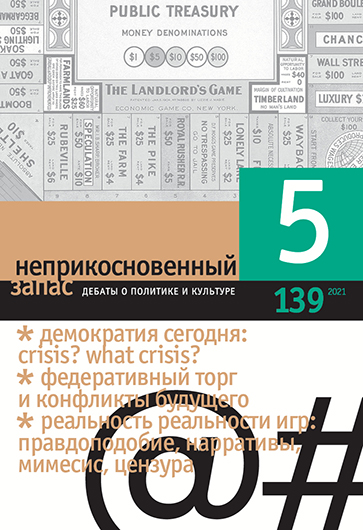
The new issue of the magazine "Un -Most Service" (5/139) is devoted to the topic that many are on the lips today: the fate of today's democracy, which - as it is obvious in the series of elections from American to recent German - is experiencing difficult times. As experts and observers almost unanimously claim, democracy in its already ordinary representative form ceased to work without fail. What should replace her?
One of the popular options is deliberate, that is, advisory, democracy. What is it and how it can act in the current political reality, the independent political scientist Alexander Kustarev thinks in this text, which Kolt publishes as a preprint from the new NZ number.
The text is published in the source.
 © "New Literary Review"
On the agenda - Delibebrate conciliation democracy. Interest in it is growing because party-representative competitive democracy, apparently, is declining.
Firstly, it becomes dysfunctional, since it is inadequate to the content and configuration of social conflict. One segment of society is depolitized, and the other becomes more and more fragmented and chaotic. Electoral preferences of the public are more and more subjective and more motivated by the need for iconic self-affirmation, than the interests of society and even material-consumer and social expectations of various agents, or already quite satisfied with their well-focus, or not realizing that their political choice threatens with their own losses.
As a result, the central procedure of democracy is sterilized - elections. They do not provide a sustainable regime of alternating reign of the convincing majority and have lost (already lost) their main, if not the only one, Raison d'Q : the ability to keep power under the threat of elimination (the so-called “retrospective vote”) and thus at least somehow control the work of the government or set the conditions for it.
Secondly, democracy loses moral authority. Eliminating the old dominant layer, she not only could not block the appearance of a new one, but also led to its occurrence. And since the new establishment continues to designate itself as the agents of democracy, the anti -control instinct of the masses turns them in paradoxically against democracy, with which the establishment is now associated in his eyes.
What can this mean or what will follow? Three options are purely speculatively imagined. Or the “Eurodemocracy”, in accordance with the long -known cyclic scheme of Aristotle - Polybia , degenerating, replaced by aristocracy (eliteocracy) or even monocracy - in order to return back when they, in turn, degrade. Or, in accordance with the idea of the progressive sociogenesis, democracy ends forever as unsuitable for the management of complex aggregates of individuals and their partacular clusters. Or, conversely, democracy has been established forever and will now be transformed from one of its temporary state to another - experimentally and to the touch, as John Dewey saw [1] . Now, in particular, party-representative democracy is transformed into Deliberate-albeit not immediately and not completely, but, in any case, directly.
It is easy to combine a cyclic and evolutionary model. To do this, it is enough to imagine that the sociogenesis is not in a straight line, but in a spiral, that is, through cycles, during which one of the options, although it is not known in advance which, discovers its superiority and ultimately displaces others. How many such cycles are still unknown, but some finale is inevitable.
You can compare the chances of these options indefinitely. We will avoid this casuistry and try to discuss what extent and how exactly Deliberation and democracy are compatible - that in itself is an unobvious state.
Now the term "Deliberation" is used exclusively in conjunction with the term "democracy". This leads to some aberration, creating the impression that Delibebration is combined only with democracy. In fact, it can be democratic and not democratic, depending on who participates in it and how. The circle of participants in Deliberation, similarly to the electorate, can expand and narrow.
The historical chronicle of Delibebration in the conditions of monocracy and elitocracy looks very impressive. There is nothing unexpected in this. If Delibebration is a calm and comprehensive discussion with the aim of finding consent, and not a confrontation with the aim of imposing their point of view to the other participants in the conversation, where everything comes down to the chipping of the majority by any means (trading, blackmail, bribery, charismatic hypnotization, etc. In the conditions of collegiality, ”as Max Weber notes, and“ collegiality of purely deliberative organs has always existed and will always exist ” [2] . In the practice of collegiality, the technique of Deliberation, the habit of rational discussion of other people's reasons, develops analytical skill and research instinct; The ability to evaluate the consequences of previously made decisions, to recognize failures and correct errors is strengthened.
The rational pondering of the problem as a mental operation appears already at the dawn of anthropogenesis and is further developed and institutionalized as collegiality. Any supreme ruler, even a complete owner of the situation, if he is not a psychopath or a sociopath (which, of course, happens), somehow considers his decisions, weighing “for” and “against” with the help of advisers. He is forced to allow Deliberation, and sometimes even encourages it.
And in the collective authorities, the regime of constant open circular counseling is simply inevitable - otherwise it is difficult to maintain their unity even with a stable unity of material interests. One might think that it is in collective tyranny, no matter how much they are touching their subjects, the consultations are closest to the scrupulous delibery, not corrupt by the vanity of participants and their sympathies and prejudices.
The texture of Deliberation in the deliberative authorities has been poorly studied. Until now, she has not paid attention to her as a special style of human relations, but, besides this, she is inadequately documented, since Deliberation until recently was oral and has not been protocolized. Of course, she left some trace in the memoirs and correspondence of relevant characters, even if they, participating in Delibebration, did not understand what they were doing (as Moliereovsky Jourdain did not know what he was saying prose), but only those who know what he was looking for.
The practice of collegiality has long become a common place in the instructions to rulers as the main genre of early normative political science. It goes to a new level at the turn of the XVII - XVIII centuries in the concept of an enlightened monarchy. “Enlightenment” is usually illustrated by modernizing reforms, but it is no less associated with the practice of meeting (deliberative). This practice is not clearly visible under the piles of chronicle garbage in the form of jokes about authoritarian antics of figures such as Louis XIV or Peter I and Catherine II, and is difficult to recognize that the rational discourses of the past may well seem not at all rational to modern observer and casuist. The practices of the meeting are better visible in the board of Maria Teresa and Joseph (Habsburgs), and especially under the chairmanship of Frederick II in Prussia and, of course, in the reign of Russian Emperor Alexander II. It is only that Delibebration under the traditional monarchy was not obligatory by the law from the “deliberative monarchy” is prevented by the rule, that is, it was not constitutionalized, and its body was not authorized to make decisions without the sanction of the sovereign.
However, the case went to this: the idea of the constitutional monarchy appeared, which developed adherents of the monarchy (especially in Prussia/Germany) in the hope of saving it from democratization in the same way as the draft Deliberate Democracy is now proposed by solid democrats in the hope of saving democracy (“from themselves”, as many add).
In the enlightened monarchy, the locus of collegiality-dedication is still the courtyard, as Norbert Elias [3] interpreted it and that we will now call the “neighbor” of the ruler or the nucleus of the establishment, although the monocrat happened, dispersed his nearby circle and recruited a new one. But the tendency towards constitutional sublimation at the court was intercepted by the estate parliament that arose at the site of the feudal, which at one time almost everywhere was actually forgotten. England was the leader here. John Stewart Mill, in essence, conceptualizes the parliament as an organ of delibery:
“[Parliament] is an arena where they speak out in the whole world and can be struggled not only in the general opinions of the nation, but even to every part of its <...> and even every wonderful person; Where everyone, whose opinion is rejected, has the consolation that it was at least listened and rejected not due to the whim, but due to the fact that the majority found more powerful arguments against him. <...> Opponents call meetings of representatives a place of idle talk and conversations. It was hardly a more inappropriate joke. I do not know what exactly, if not by conversations, the representative meeting can bring more benefits ” [4] .
But the collegiality of the reign, as Max Weber emphasized, has nothing to do with democracy in itself [5] . Especially if the advisory authorities (less or more formalized in the management system) are equipped with the ruler himself. Accordingly, Deliberation remains a monopoly (privilege) of a limited minority.
The contribution of democracy to the culture of Delibebration looks much more modest. Within the Eurocristian cultural circle, democracy itself was almost not practiced - except in ephemeral (most often confessional) foci of non -conform self -government. But in conditions of modern democracy, it was no longer necessary to invent Deliberation. She was already quite sublimated in the conditions of the “old regime” [6] , and she only had to master it. Now let's see how democracy coped with this task.
First of all: Delibebration was not the ideal (project) of the democratic movement of Art Nouveau. The Democrats not only did not know the word (no one then knew it then), but they did not think about anything that could now designate this word. Even those who, following Rousseau understood democracy, not as a political structure, but as a natural way of life and dreamed of returning to the original human community [7] , more relied on its spontaneous unanimity than to develop the most reasonable opinion. The masses, for their part, saw in democracy nothing more than a means to achieve material concessions from the gentlemen (“take their own”) and had no idea about the departure of power as a profession.
But, no matter how motivated by democracy agencies from the end of the 18th century, in the context of the aggravation of social conflict after the destruction of the traditional society of the historical mission of representative democracy, the cessation (prevention) of troubles and violence turned out to be. Democratization was not accompanied by the elimination of confrontation. She introduced confrontation into the civilian framework, when society was not capable of any delibery. As then praised, “Ballot, Not Bullets” [8] . Everything looks so that party-representative democracy, rather, turned out to be an alternative to Deliberation.
The first victim of this disposition was the parliament. After the confrontation from the street to the meeting room, he loses the ability to collegiality, still characteristic of the parliament of the times of Mill (also very idealized by them), and, therefore, the ability to support the practice of Deliberation. Delibebration in it degenerates into mutual obstruction of the parties - pure propaganda in the calculation of future elections or rhetorical orchestration of intra -parliamentary intrigue in order to achieve a vote of distrust of the government and early elections.
But a new locus appears - political parties claiming power, with their leadership as a shadow (alternative) government. This practice really needs parties, as once collegial tyranny. And - for the same reason of competition for power - each agents should be united if he wants to exist for a long time and succeed. This unity can be instinctive-identical (prototype-brotherhood) or derivatives based on a conscious community of interests (material, emotional and ideological), but these ties of solidarity are incapable of keeping massive sets together for a long time. And if the partisanship is voluntary, then the parties cannot become great political forces only by disciplining their ranks. The disagreements will simply leave them. Not to mention those who discover their partisanships only in the elections - they desert on the slightest reason. Minorities can be withheld in the orbit of the parties only by participating in a conscientious delibery. Large parties of the authorities always love to call themselves a “wide church”, and this was really so. This was the initial BCP (b). Her deliberative activity in the 1920s looks very impressive-probably more impressive than any other party in Europe.
The resolution of the CPSU (b) is generally a true pearl for political theory. She very clearly demonstrates the kinship of the parties in power with collegial tyranny. She certified herself as a dictatorship (proletariat). Western competitive democracy differed from it in that in the conditions of the multi -party science of such “tyranny” there were two (or even more) and they all the time threatened each other with a displacement.
But in both cases, the intra -party Deliberation, called (unsuccessfully) in the Russian one -party version of the “intra -party democracy”, turned out to be doomed to extinction - and ten years later ceased completely with the destruction of its agents. The magistral commentation, without hesitation, declared this to the end of democracy. Meanwhile, the click itself, which seized power, was sincerely convinced that it was she who ensures a “real” democracy. And if you take it seriously, it is difficult to abandon the suspicion that democracy in this case prevailed over Deliberation.
Multi -party democracies demonstrate the same trend, although it is more difficult to discern it in the fog by a much more intense and substantial discursive activity of the “Western” society in the conditions of liberal gabitus. With a new configuration of social conflict (see above), large parties of the authorities can no longer maintain their rating either by discipline or deliberia and rely more and more - like ordinary interest and self -predicatory parties and movements - on the natural (instinctive) corporate unity of “our/ours”, tied with a common cause. The fractions in them remain, but the confrontation replaces Deliberation in them - as in the CPSU (b) at one time.
But, dying in the authorities themselves, Delibebration as a necessary element of the practice of government does not atrophy and finds other loci - for example, the second (“upper”) chambers of the parliament. Weber conceptualizes them as a meeting-consulting non-partisan state council [9] . He characterizes them in much the same way as Mill - the English parliament. The British Chamber of the Lords, which is now closer to the parliamentary ideal of Mill, gives some idea of such an organ. The Public Chamber of the Russian Federation, until now, seems to be seriously perceived by anyone, unexpectedly, in this regard, can be a much more interesting initiative than Russian fake parliamentarism.
Another body of Deliberation is inter -party parliamentary commissions, where the justifications of political decisions are developed and bills are being prepared. All parties presented in parliament participate in the work of the commissions, and Deliberation is the only possible method of work for them.
Finally, another locus where Delibebration finds a refuge is a bureaucratic apparatus, although the paradigm and its structure to Delibebration (that is, its rationalite) look different than in other loci.
But all these loci are advisory bodies with a democratically elected, but monolithic and peremptory power. Functionally, they are similar to the locus of Delibebration under the Lord's power. They even use the same institutions (especially the Bureau). These, in essence, are the relicts of the Lord's rule due to their pure meeting and (this is probably even more important) due to the fact that they are increasingly monopolizing Deliberation, making it the privilege of a limited minority - a deliberative elite, if you like. Settlement of Deliberation in these loci in no case leads to deliberative democracy. Their functionality in conditions of democracy is precisely in the fact that they adjust and limit it to - to thin or good. Усиление их влияния и затем, возможно, полная эмансипация от политической власти означает, в сущности, поворот к экспертократии или элитократии любого иного рода. Как бы они ни культивировали практику делиберации и как бы ни были благорасположены к интересам масс, это господская власть... Как будто бы тупик? Not really.
В условиях демократии появляется — как совершенно неожиданное, хотя, глядя назад, абсолютно логичное ее порождение — еще один локус делиберации: многопартийная правительственная коалиция. Они у всех на виду, и в Европе практикуются уже давно, но до сих пор многопартийная коалиция не вызвала интереса в этом качестве. Остается незамеченным и необдуманным то, что именно коалиция — локус коллегиальности и, стало быть, делиберации par excellence . Вебер счел нужным упомянуть ее в своей разветвленной систематике форм коллегиальности [10] . Делиберация в них часто несовершенна и легко обрывается, а сами такие коалиции не сохраняются долго. Разные коалиции возникают и исчезают, но остается простое правило: нет делиберации — нет коалиции. Как только мы это заметили, коалиции выглядят уже не как патология демократии, а как указание на ее новое состояние в ходе ее непрерывной эволюции.
Дорога через этот эволюционный зигзаг тоже, конечно, может вести в сторону авторитарного правления. Долгая череда коалиций провоцирует антидемократические реформы и даже государственные перевороты, потому что неустойчивость коалиций ассоциируется с хаосом, что подрывает авторитет демократии и порождает антидемократическую реакцию при активной поддержке масс — правопопулистская реакция, уже имевшая однажды место между двумя эпизодами «тридцатилетней войны ХХ века» [11] . В лучшем случае это ведет напрямую в сторону экспертократии, как это регулярно случалось в Италии и только что случилось опять (нынешнее правительство технократа Марио Драги).
Но демократический вариант тоже вполне вообразим. Например, тематические и интересантские партии (движения) полностью вытеснят из политического пространства партии, ориентированные на весь электорат ( catch all parties ). И тогда избиратель будет сознательно участвовать в создании коалиций, особенно если его будет стимулировать к этому регламентация процедуры выборов. Такое впечатление, что в Германии это происходит уже сейчас, что особенно многозначительно, если вспомнить, во что выродилась такая же диспозиция в 1930-е годы . Или партии сами по себе ликвидируются совсем, а орган управления делами страны, как бы он ни комплектовался, выбирая тематику делиберации или даже принимая стратегические решения, будет по процедуре учитывать общественное мнение. Мнение это может выражаться в независимых или заказных опросах публики, равно как и официально учрежденных фокус-групп, инициативах интеллектуальных лобби («мозговые тресты») или петициях по образцу британской практики первой половины XIX века. Эта тенденция быстро нарастает уже сейчас.
В обоих вариантах делиберация окончательно вытесняет конфронтацию (конкуренцию), но не демократию, и на этом основании такой порядок может быть назван делиберативной демократией. При этом в первом варианте демократия остается представительной (косвенной); во втором случае — становится прямой.
Таким образом, если возможно и в самом деле желательно не вынужденное и неустойчивое совмещение делиберации и демократии, а их органическое и устойчивое единство, то путь к нему лежит через коалиционно-правительственную коллегиальность. Она появляется спонтанно, но, будучи творчески отрефлексирована, может сублимироваться и конституционализироваться. Сейчас или после временного возобладания авторитарной альтернативы. Навсегда ли — открытый вопрос.
Циклическая схема Аристотеля — Полибия (а точнее, ее цикло-поступательный вариант) позволяет думать, что не навсегда. И, если мы захотим воспользоваться этим представлением, мы сможем обнаружить иное содержание социогенеза вместо движения от господского правления к народному или в обратном направлении. Это содержание — экспансия делиберации. Словами Джона Дьюи: «Самое главное — поднять качество и улучшить условия обсуждения, дискуссии и аргументации общественного разговора. Это проблема “общества”» [12] . Сам Дьюи был убежден, что эта проблема может быть решена, только если в делиберации (общественном обсуждении — public debate , как он это называл) будут так или иначе участвовать массы, что будет означать становление демократии как образа жизни. Мы, пожалуй, можем сказать сегодня, что делиберация совершенствуется и ширится, возбуждая постоянные колебания архитектуры политического пространства — чистая демократия, элитократия или их смеси. До тех пор, пока этот маятник перестанет качаться и различение господского и народного правления потеряет смысл, поскольку на смену им обоим придет делиберация как образ жизни общества.
Александр Кустарев (р. 1938) — независимый исследователь, публицист. Сфера научных интересов — типология и эволюция политической сферы. Публиковался в журналах Pro et Contra (Фонд Карнеги, 1999–2014 годы ), «Космополис» (МГИМО, 2002–2008 годы ).
[1] J. Dewey . The Public and Its Problem . — New York , 1927.
[2] M. Weber . Wirtschaft und Gesellschaft. — Tuebingen , 1985. S . 161–164 . Вебер дает детальный обзор разных вариантов коллегиальности в третьем параграфе третьей главы первой части «Хозяйства и общества».
[3] N . Elias . Die höfische Gesellschaft. — Frankfurt am Main: Suhrkamp, 1969.
[4] Дж. Ст. Милль. Размышления о представительном правлении. — New York : Chalidze Publications , 1988. С. 74 (перепечатка с русского перевода 1863 года, изданного в Санкт-Петербурге ).
[5] M. Weber . Wirtschaft und Gesellschaft. S. 162.
[6] «Старый режим» (фр. l'ancien régime ) — политический и социальный уклад во Франции с начала XVII века до начала революции 1789 года.
[7] Последние отголоски этого умонастроения — Парижская коммуна и русский левый популизм под лозунгом «Вся власть Советам».
[8] Этот каламбур можно приблизительно перевести как «вместо пуль — [выборная] пулька». «Пулька» — графа, куда вписывают результаты игры в преферанс; в широком смысле — графа в любом списке.
[9] M. Weber . Wahlrecht und Demokratie in Deutschland // Idem. Gesammelte Politische Schriften . — Tuebingen , 1988. S . 259–260 .
[10] А именно как пример того, что он назвал «электоральной коллегиальностью» ( Abstimmungskollegialitaet — буквально: голосовательная), коль скоро она может заключаться, хотя и неформально, уже до выборов.
[11] Автор называет так Первую и Вторую мировые войны (примеч. ред.) .
[12] «The essential need, in other words, is the improvement of the methods and conditions of debate, discussions and persuasion . This is THE problem of the public» ( J. Dewey . Op . cit. P. 208).