
Translated material
Naked and lonely
Photos of Tatyana Lieberman: People and Vegetables
Tatyana Lieberman is a famous and bright figure of the Moscow conceptual art scene, the author of provocative works, which since the nineties changed the idea of modern photography and the female view of the image. Her exhibitions with great success were held in the Tretyakov Gallery, the Moscow Museum of Photography, in the exhibition halls of Europe. She was compared with the American rebel Cindy Sherman . The exhibition “EX -position” presents two episodes dedicated to the understanding of the female body; Black and white photos of men called “One Home”; Color series of works “Fruits”, “Flowers”, “Vegetables”, which from the world of flora convert the viewer into the optics of anthropology. As well as unexpected pictures dedicated to Moscow, and an installation of six three-meter black and white prints called “chiaroscuro”-about individuality and a person who is depersonalized by the theater of vanity.
These are completely different in the style of the last twentieth anniversary, which are united by the sharp critical mind and the clear gaze of their author. Tatyana Lieberman conducted a tour for us on her exhibition in the art center of the All-artist , in the building on Frunze Embankment.
Listen to the Vavilon Moscow Podkast and subscribe to other podcasts of Radio Liberty.
Photos of Tatyana Lieberman: People and Vegetables
- Here, one of the very first and significant projects for me is exhibited - “Projection”.
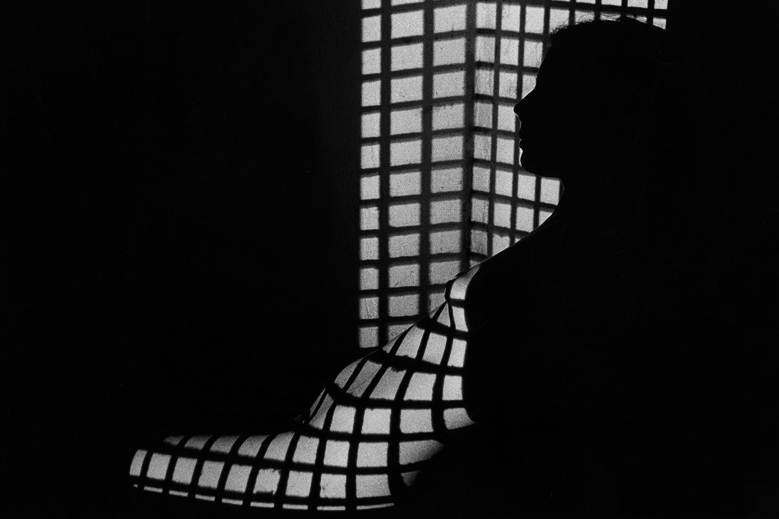
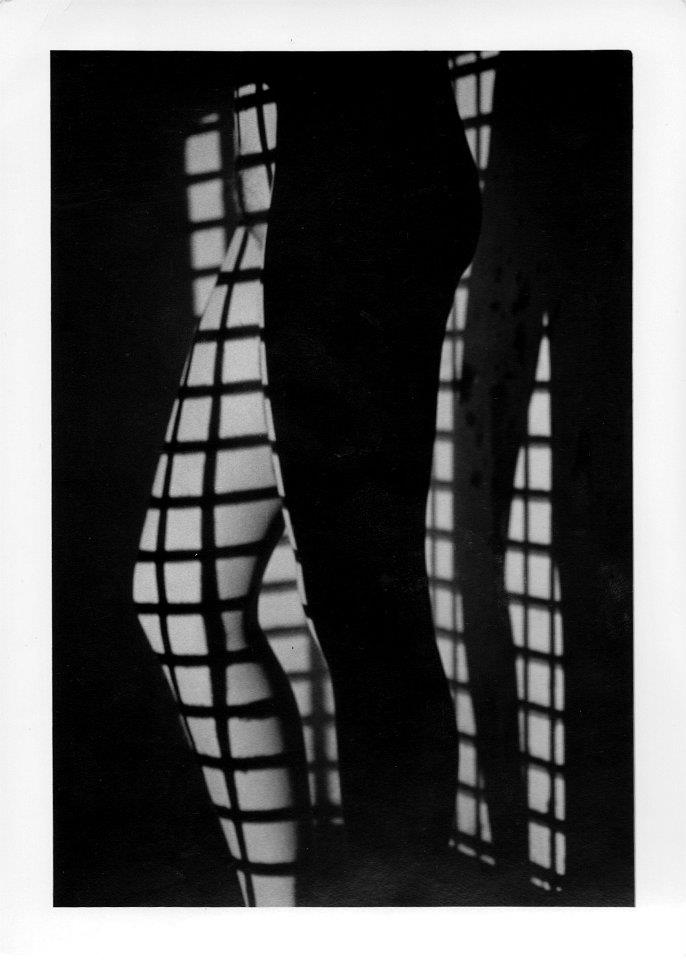
-Five black and white works, where the shadow of the grate is discarded to the human body.
- Formally, this is done as a projection. I always wanted to understand how artists, using a tonal linear perspective, convey a three -dimensional space on a two -dimensional sheet (and the photograph cannot do this because it works through the lens immediately with all these prospects). I figured out how to turn a three -dimensional body into a two -dimensional body, to make it flat, not voluminous, but the laws of physics are still here. In addition, since childhood, I remember the album of O-artist Vazali , where the volume crawled out of straight lines and cells. And so I made a series where the volumes, on the one hand, are lost, on the other, it seems to be manifested, and from the third, falling chiaroscuroers are applied, and this turns into a completely new drawing.
-This resembles experiments with the form of the 20s and 30s that European and American artists engaged in.
I invented how to turn a three -dimensional body into a two -dimensional one, but the laws of physics are still here
- By that time, it became clear: the photograph learned to perfectly portray reality, - and the painting began to leave. For many centuries, she trained the artist’s hand and eye so that he learned to realistically portray the world around him, and at the end of the XIX - early twentieth century impressionism appeared as the answer to the fact that this place took a photograph that could better convey reality. Artists began to share color and light, and impressionism - this is a form of what photography could not take.
But the photographers began to say: we are also artists, and came up with iconism, which in form resembled the impressionism of the artist’s brush. There was an endless technical and intellectual dialogue between painting and photography: art, not art. And my black and white project can remind.
- Who is your model here?
- Girl, the wife of the artist.
- It was fundamentally that it was a female body?
- No. True, before that I shot exclusively naked men (laughs), and it was important to try to remove not a male body.
-In the light of the latest feminist theories, I would say that this is a woman, imprisoned in some framework, squares, and a limited one. Or did you not put such a meaning at all?
- Not a single back thought. (laughs)
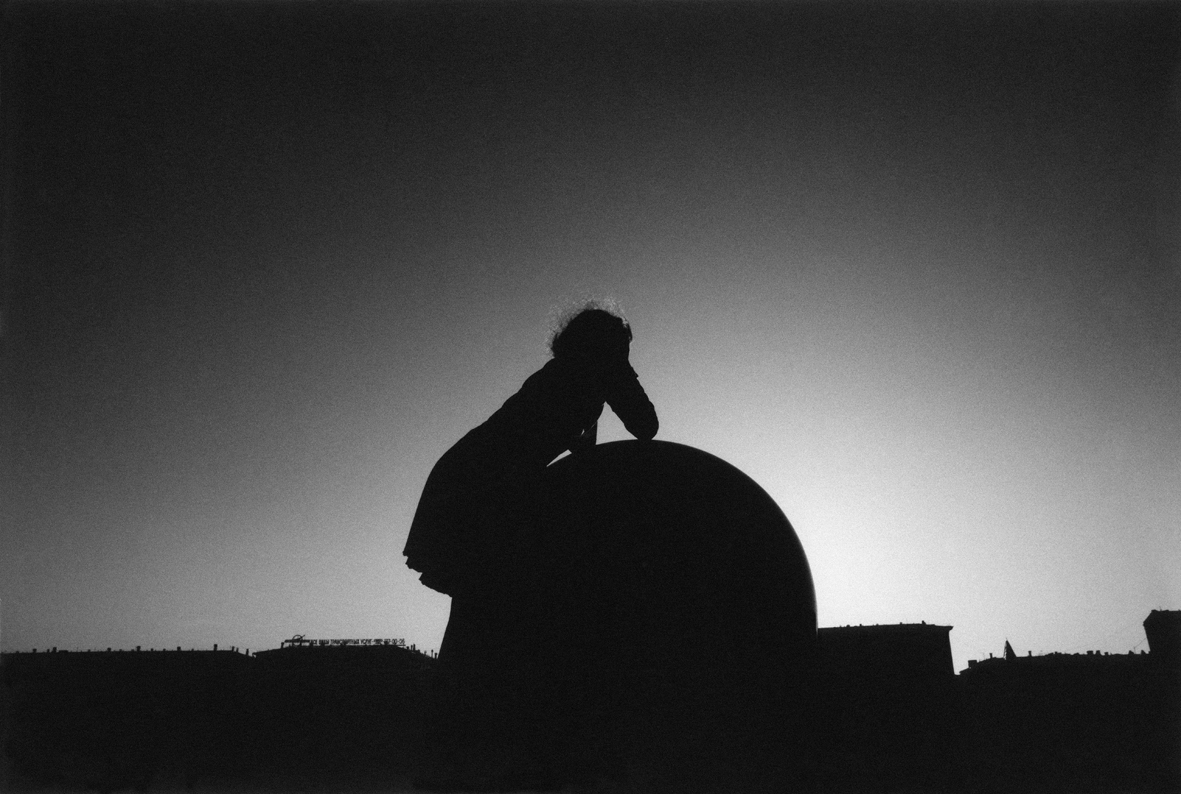
-Here is a black and white photo card called "Girl on the Ball." Where did you see this magical creature, this magical geometry?
- This is a park of culture - there there is such a ball on the embankment. And my niece, borrowed for half a day. I needed to take it off, and we walked along various balls that are in the city, looked, climbed on them, danced ...
- Under what circumstances did you shoot naked men?
-I, as a professional, entered the society of photographers-male, who like to shoot naked women (laughs). And I thought: since I am a woman-photographer, then I will shoot naked men. There are several such series, they were exhibited a lot, but here I do not show them.
- What was the context for these naked men?
The figure is in my hands, and you need to quickly come up with something-I went to the store and bought something
-Moscow: Naked man-on the streets, differently. This was my first business card in different galleries and museums, including abroad.
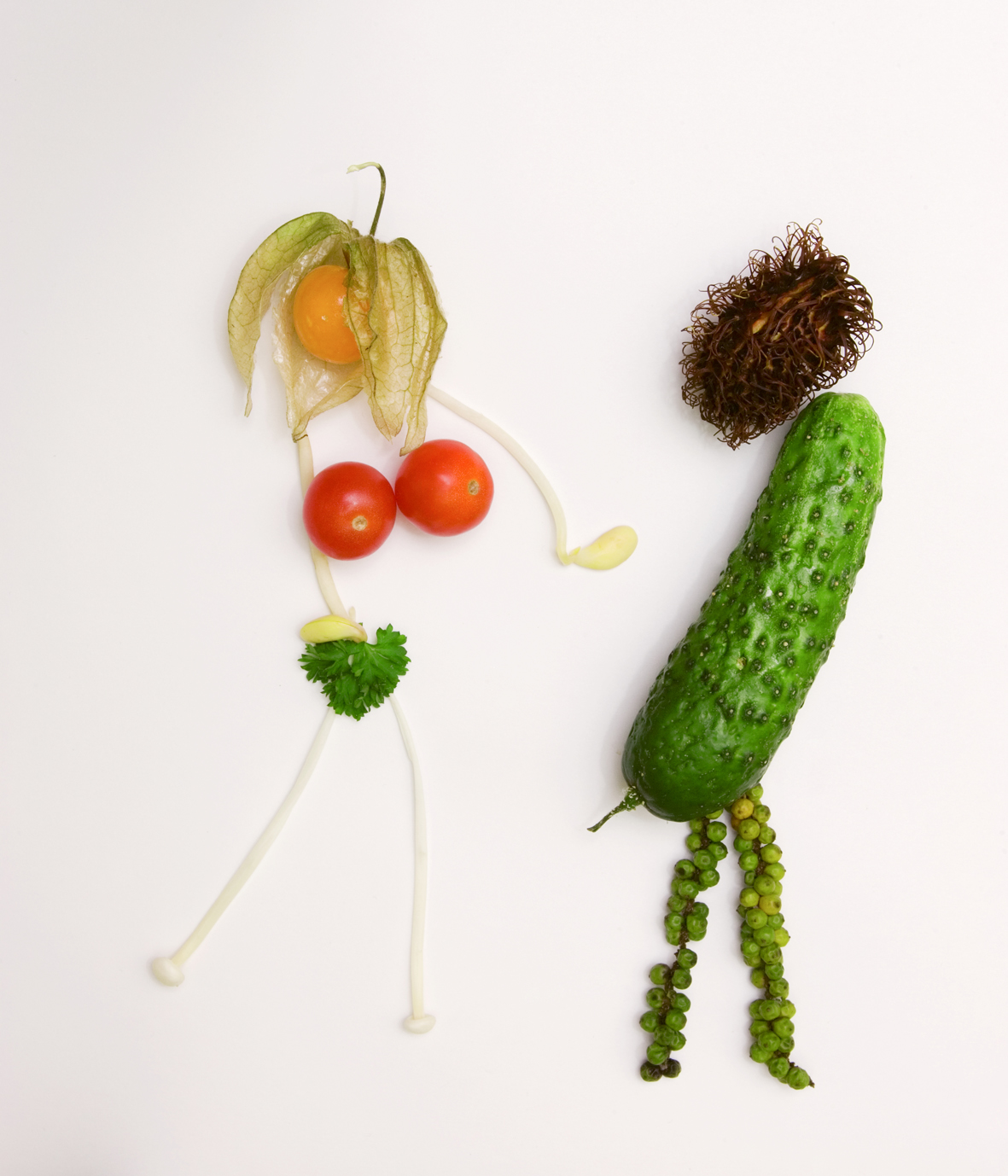
The next series is ridiculous - colored men from vegetables and fruits. For a long time I did not agree to take off to the figure. One of the first digital cameras in Moscow in the late 90s fell into my hands in the photobienal Oli Sviblova . We made a digital attraction there - we shot guests and after half an hour they printed photos. It was terrible in quality, and I did not immediately fall in love with the figure. But by the end of the tenths, I still picked up the figure and made this project with men. They have a story of a relationship. Here it is a little stopped, there are no two photographs, where the relationship begins between the boy and the girl, but there is only the first moment of their acquaintance, and there is already parting.
- The boy is naturally represented by a cucumber. And the girl - two tomatoes of Cherry, Phizalis (yellow berry) - this is her head, and leaves like a hairstyle. Where does this idea come from - vegetables like living characters?
- I have no idea. The figure is in my hands, and you need to quickly come up with something-I went to the store and bought something. I decided: since I do not know how to draw, I will come up with all this from what is.
-Handles-legs, cucumber-so the little man came out. It resembles some wonderful cartoon.
-We go to the black and white hall-there are three episodes. One of them, very important for me, is called "ONE Home". This is the end of the 90s. For the first time, the child was taken from me for the first time, my husband left somewhere, I was alone at home and caught. And I think: well, well, I know what a woman does alone at home, and what is a man doing when his family travels? It was summer, the sun. I phoned the nearest circle of familiar men: most were alone at home, and I came to them.
I trusted the camera, as the art critic Valentina Likhacheva says. I shot from the door: I went in, put the camera on a low point of the tripod, pressed the endurance and realized that in front of me is the space in which the man was returning to the affairs that he was engaged before he opened the door to me. So one frame was done.
Someone is sleeping, someone is erasing the dust, someone has breakfast. Men are busy with ordinary household chores
- How many heroes?
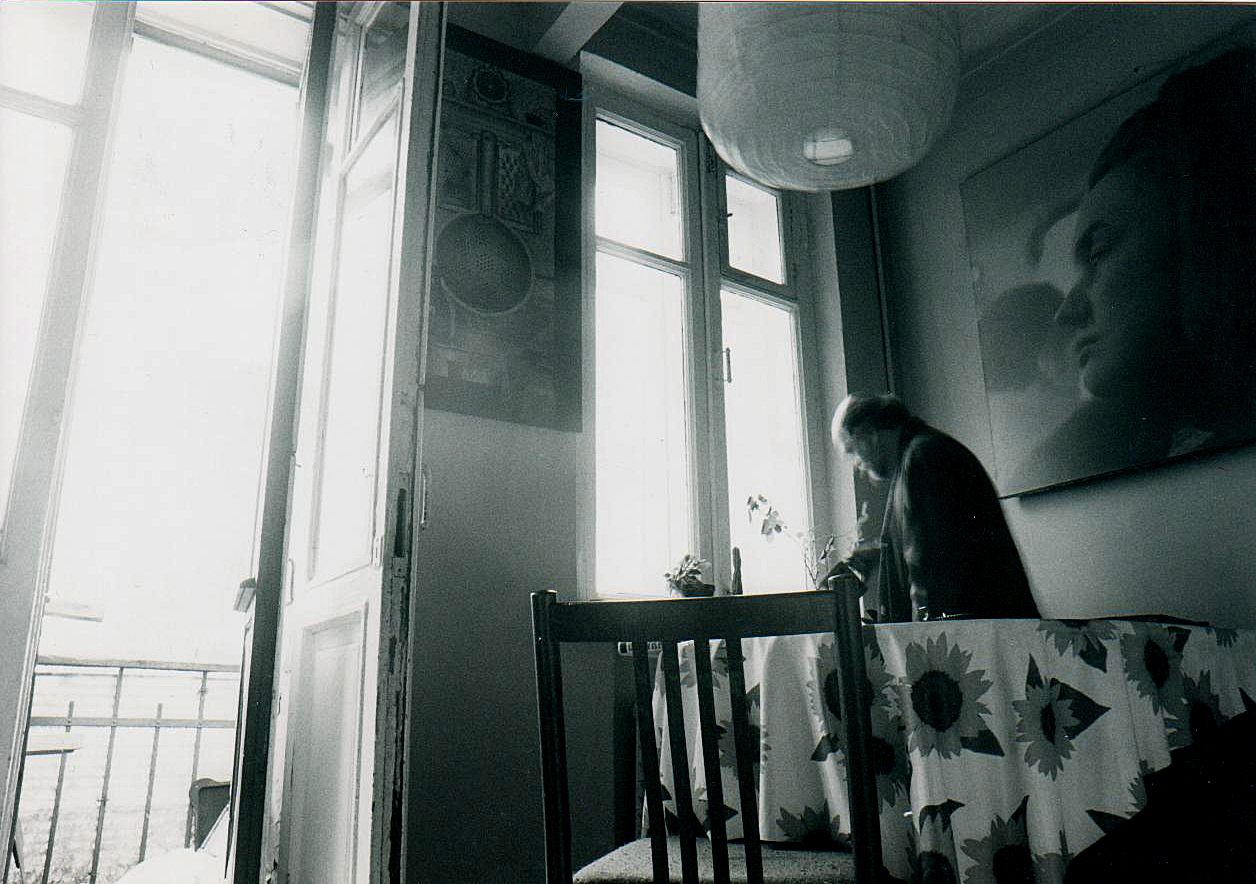
- 36, like shots of film. But only ten are presented here. This is not so much a portrait of a person when he is alone. Something atmospheric was important to me-what a man does, how this sensation is transmitted. Someone is sleeping, someone is erasing the dust, someone has breakfast. Men are busy with ordinary household chores.
- A few plots - in the kitchen. Or here a person looks thoughtfully through the window, into which the light is pouring incredible beauty, turning even modest interiors into palaces.
- Here these photos hang on the white wall far enough from each other. And when the exposition is all 36 frames and they hang closer, the first thing you see is divine light from the windows, illuminating the interiors. Many people ask: "Is this the same interior?" I answer: "Of course not."
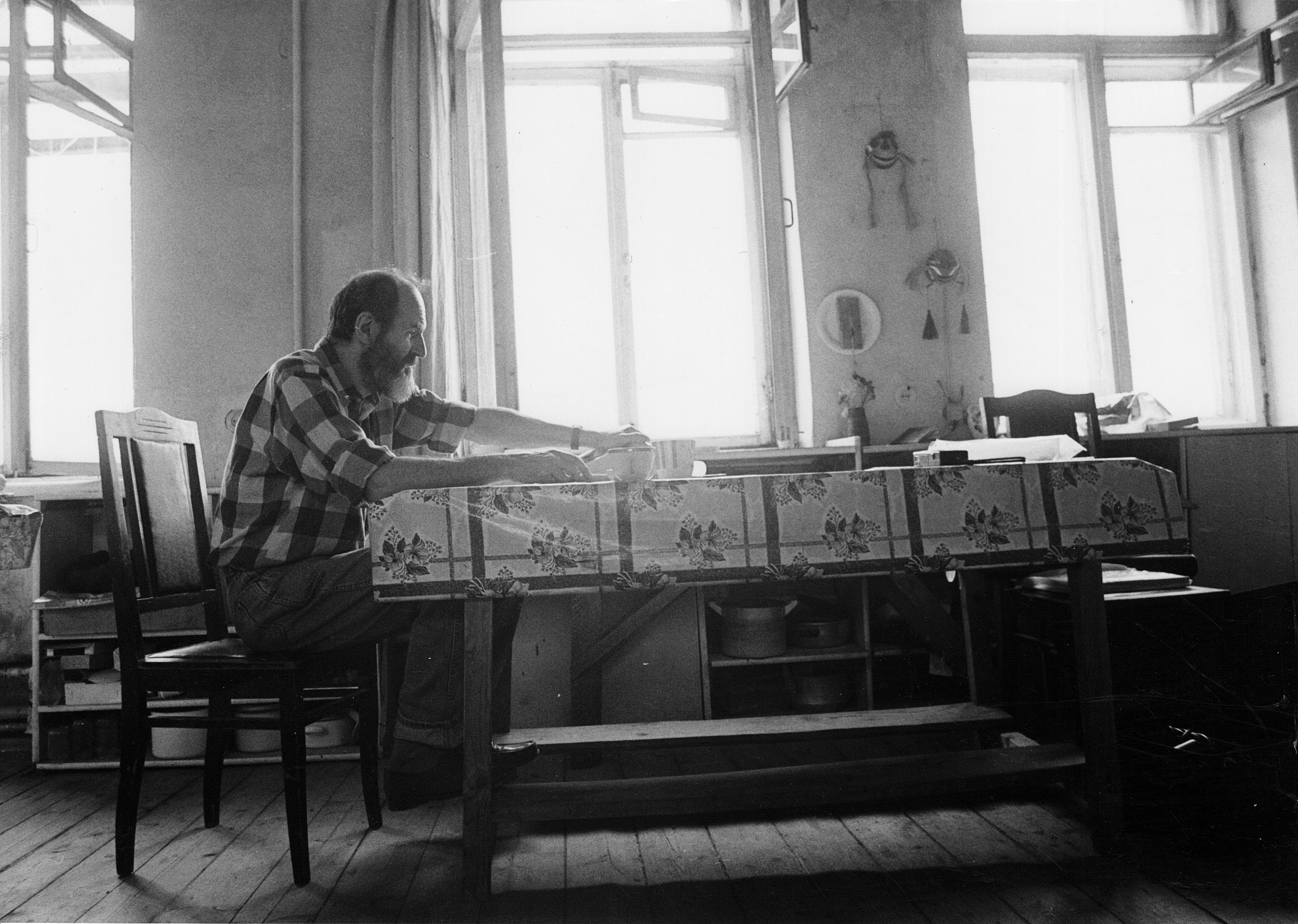
You can consider each character, his living conditions. Most are artists. I used to sign who is who, but I decided not to sign at this exhibition: just such men, such interiors. The Germans love this series, for them it is an encyclopedia of the Russian interior.
-The name "one home" in the era of the pandemic also causes such associations: a person may have been forcedly at home and somehow spends time with himself. And who, if not a friend-artist, will meet you and become your model.
“Yes, and I can call them.” Here is Sasha Petrelli (pocket), who walks at exhibitions in a coat, opening it.
- Here he lies in bed, lifting his legs on the sofa.
“His favorite situation, as he said.”
-This, apparently, is some kind of cottage: wooden walls and a wonderful rocking chair.
The Germans love this series, for them this is an encyclopedia of the Russian interior
- Yes, I went to the country. And this is the late Sasha Shatalov.
- He wipes dust on the windows. And on this card, a reflecting brilliant gender gives a completely cinematic sensation.
- And this is Volodya Dubosarsky in his workshop.
- And the dog. The artist was distracted, watches TV and cooks food, and the dog is enough. Also a very beautiful card with extraordinary light and architecture of windows: some respectable building.
- This is an old building on Kursk, where they had workshops. And this is the wonderful Zhora Litichevsky , an artist.
“He seems to be in his office at home.” One at home - in shorts, a white T -shirt and barefoot.
- Breakfast. And this is Volodya Govorkov, the husband of the deceased Asi Silaeva.
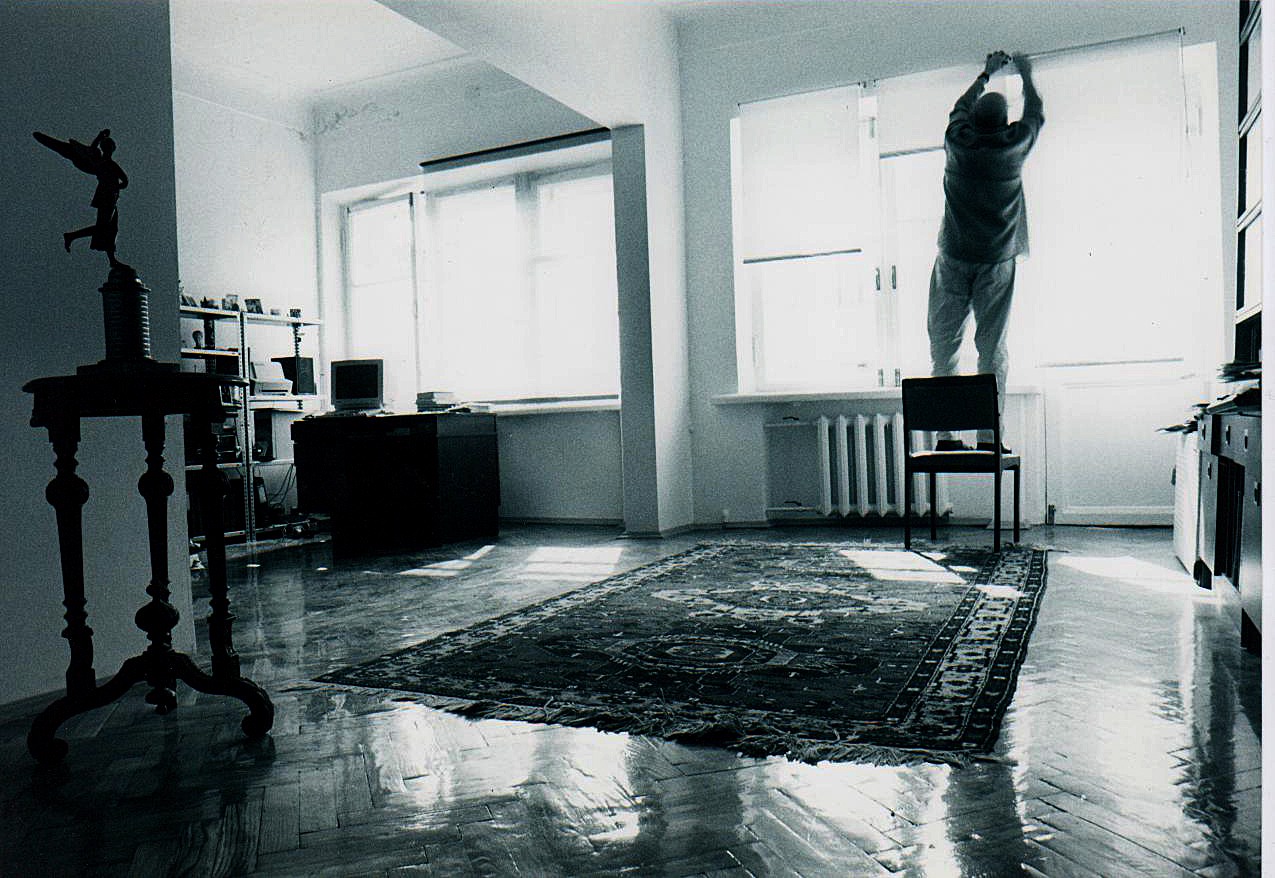
- Boy on the ball.
- This is their workshop. They lived on Taganka with a large friendly family. Asya left with the children then, and he jumped on a children's ball with happiness, said: "Otherwise, they just never let me jump."
“You took it off in motion, so the ball is visible well, and the person himself is like a shadow.”
“He can't see him at all.” And this is Semyon Faybisovich .
- Against the background of an open balcony - busy cooking.
Who, if not a friend-artist, will meet you and become your model
-Yes, there is something tasty there. Here, two frames were removed, because at the first moment when Semyon opened the lid, such a dense pillar of the couple went that a person was left without a head, only the contour of the figure was visible. And I made a second frame where the couples have already dissipated, and a person can be identified. It would be strange to show the seeds without a head.
But Sasha Sigutin . He rented a room, and this is in a communal kitchen.
-Now I understand why the Germans fell in love with this series: this is some kind of communal apartment in the style of the 50s: steam above the stove, and then linen is dried.
-Further Avdey Ter-Oganyan .
- He is also like a ghost.
-Yes, Avdey swayed, said something and shook his head, so there is this movement on a long endurance.
- The mirror appears on the card with Avdei for the first time in this whole story, although it begs here: the mystical light inherent in this series speaks of this.
- Here's another Litichevsky mirror, or the mirror door of the cabinet. Well, men have no mirrors in the rooms.
And this is the television producer Seryozha Savushkin. Here is such an apartment, such a kitchen, but he simply did not fit. I like this picture - one of the most interesting in this series.
He will enter, appear and become visible to us: will enter or not enter, will it become visible or not?
- The man turned out without a head. Apparently, he climbs somewhere in the closet, raised his head, and now the upper cut is at the level of wrists. Even the clock is crossed in half with the look of the photographer.
- No, I saw this lens so. This is a small -sized apartment with a very small kitchen, so a person crawls beyond the boundaries.
- Well, let's go further. Here in the center is quite tall, long pictures.
- This is a photo on a roll photo paper: three meters of meters. This is a series of several photographs in which the ray of the theater spotlight and haze created by the smoke-machine is shot: in fact, the appearance of the hero is expected in the ray of light. A little theatrical action. He will enter, appear and become visible to us: will enter or not enter, will it become visible or not? The story begins with the fact that it is not visible, then the contours of the head appear, and in the next photo we can already identify its physiognomy, facial features are visible.
-Is it shot in some theater?
- No, in the gallery on the hodgepodge. I hung the spotlight, took the smoke-machine and shot it all. And here a man still did not enter the circle of light, he went around it around and never appeared for us, left-and that’s it.
This is a story about gloss: zero, madness of our gloss, new life
-This story resembles both a stand-up show, and some Berlin cabaret with their clear, accurate light and a hero who wants to come to the fore and inform something. And at the same time, this is something from medieval engraving, the mysticism of William Blake with his puffs of smoke, when the human soul is invisible. We are talking here not only about the physical presence, but also about the substantial one?
- Maybe. But it has grown from me completely other roots. This is a story about gloss: zero, madness of our gloss, new life ... All this is not close to me: this is a desire to become a star and go out, become a hero of this or not to become.
My lantern hung in a gallery for some time, and the smoke-machine worked, so I managed to remove other stories there.
Once I showed this series in a gallery on a hodgepodge, and it was deployed inside. Here it was assembled in the center, and there it was the other way around-it was hung along the dark walls, on top we hung a lantern, put a small smoke-machine. The glossy photo paper licked from the rays of the lantern, gave amazing highlights of the rowan on the ceiling, on the dark matte walls, and it was a completely magical space.
But the people wildly surprised me. They are not that they looked and thought whether someone will enter or will not enter, will be a hero or not, and everyone rushed into this ray of light, self-wide and said: "Super!". I even took off how people behaved.
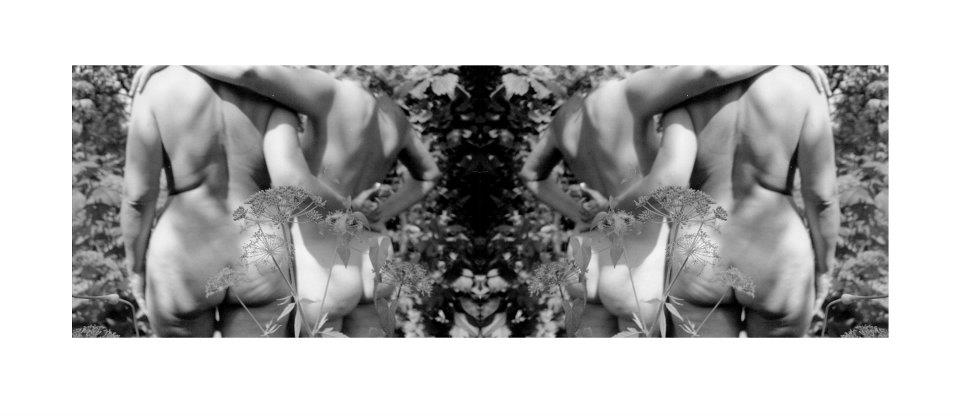
- We turn to a small, but very expressive series, which is called the "memory of the body."
- These are paradises - country thickets. And female bodies of the 40-50s. It was important for me to see how his history and life are reflected on the human body. Everything is reflected: joys, and illness, and pain, and even linen that a person wears. This series at one time participated in the exhibition of Katya Tig "Memory of the Body" about Soviet linen.
- And cellulite is present ... And again this technique with an absent head: you show only the body here.
It was important for me to see how his history and life are reflected on the human body
- At one time, when I showed her for the first time, she was called “anonyms”. In part, this was the condition of my heroines: they agreed to walk naked in the country, but asked not to shoot them with their heads.
-They are also some ancient sculptures at the same time. I recall several large exhibitions in Rome, where there were such matrons. The fact that this is precisely the part of the body, something cut, reminded me of a powerful Roman exhibition with figures once extracted from the ground: there is a mother earth. On two photographs-girls who stand with their backs and support each other by the shoulders and behind: this is about support, about female power, about the fact that age and body memory is not ugly, it is different.
-This, actually, is beautiful.
- I also think that it is beautiful, but these photographs are anti -gloss. With every centimeter, they protest against glossy consciousness.
“I don’t even remember whether we had gloss at that time or not.” In any case, this is that I do not like. And then, I like these gestures. It was easy shooting, endless hi-hee, ha ha ... Here I showed only two works, and there are only eight or even ten of them, and women there in different relationships: face to each other, backs, around the tree. All about paradise, where, perhaps, there was no Adam.
Now we go to the second hall, to the color hall. There are two episodes-"Fruit of imagination" and a series of color photographs "Moscow-River". Here is the "fruit of the imagination" - on one wall of melon, on the other pepper and banana ...
- And all these are erotic images.
These photos are anti -gloss. With every centimeter, they protest against glossy consciousness
- There is a story about why I took off the melon. It was a wonderful period of my life, I just flew. And now I’m going in the summer and suddenly I understand that the autumn will be sold, there will be watermelons, and these Caucasian men with huge daggers: here he cuts the watermelon, takes out a pink cone from it ... this must be removed - this notch, this cone! And then I think: Arbuzov to wait a month, and now they have already been sold melons. I know what the melon looks like if you cut it across or along, but what will happen if I cut it diagonally? I did this and, frankly, I myself was a little in shock.
- Because it is a real porn.
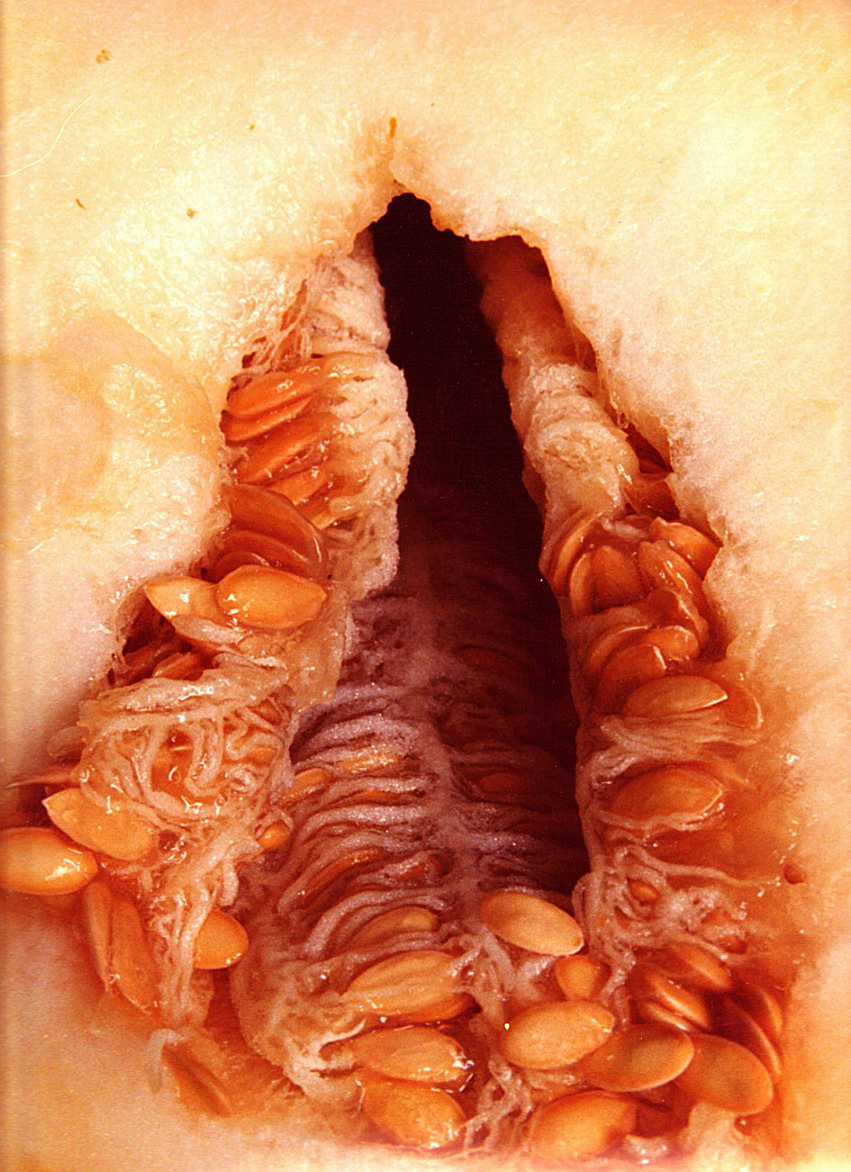
- Yes. Two extreme photos on the right are the same melon that I began to cut, cut and remove, as a knife is introduced into this flesh. There is also a stopped series, the bulk of the photographs about this aborting consists of vertical personnel, it is very tough. It was completely impossible to eat melon after that: after shooting, I just put it all in a bag. This is not to say that since then I generally abandoned the melons, no, I eat them with pleasure, but I cut it very carefully so that no other stories no longer pop up. (laughs)
- This is an amazing series: it is about pornography and about gynecology. Complex and beating a series. In what year did you do it?
-In 1996. And pepper is the story of the next preparation of a salad for the family. When the first petal opened, and there is suddenly such an amazing fifth element: well, how not to remove? Run after the camera and shoot.
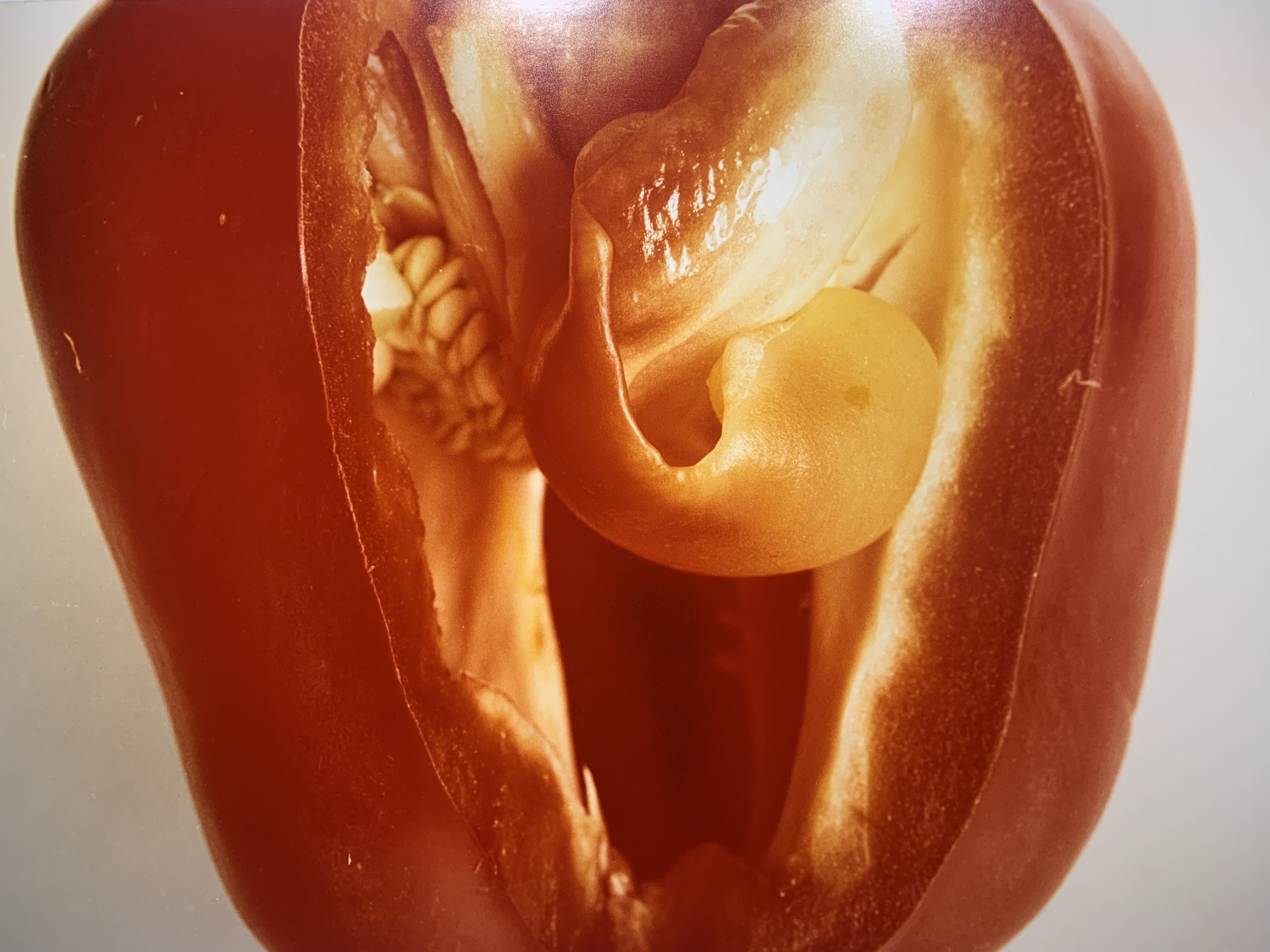
It was completely impossible to eat melon after that: after shooting, I just put it all in a bag
But the banana, I really love this series. For the sake of the experiment, the banana was cut in half, and white flesh was about nothing at all. Потом я отвлеклась, а когда вернулась, банан заветрился, появилась слизь, цвет, уже невозможно было не снять.
– Банан, несмотря на фрейдистскую подоплеку этого плода, здесь выглядит просто как цветовая абстракция.
– Ну, неправда. Давайте внимательно посмотрим. (смеется) Категорически фаллическая штука. Сохранившаяся, но препарированная.
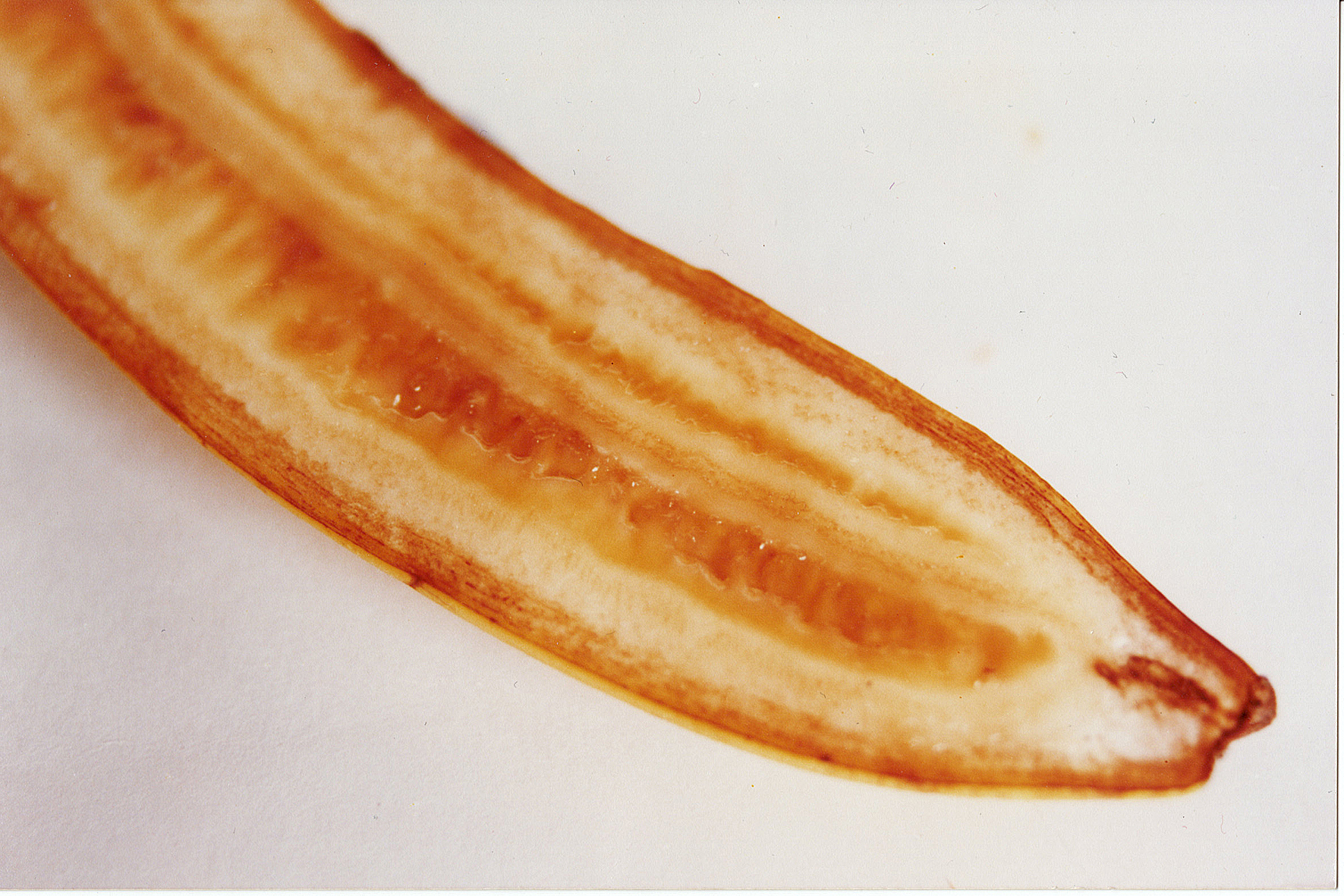
– В этой серии вы – и скульптор тоже, вы работаете ножом и отсекаете лишнее, как сказал бы Микеланджело, показываете другую, метафизическую суть овощей, плодов, природы.
– К этой серии есть другая – "Игра воображения", она тоже провокационная. Но в этот зал всё не вошло бы.
– Идем дальше.
– Я люблю эту серию – "Москва-река". Здесь видно, как идет искажение зданий на волне, когда мы проходите мимо.
– То есть все это – отражения в реке?
– Но только в другой – в автомобильной реке. Это капоты и стекла машин. Я специально оставила радиаторные, вентиляторные детали машин, значки, дворники, чтобы, разглядывая, можно было зацепиться за них и понять, что это не вода.
– Но первое ощущение – текучести.
Нет больше той Москвы-реки, в которой это могло бы отражаться
– Да, отражений в воде. Как будто бьет волна, и отражения зданий деформируются. Это тоже цифра: я привыкаю к ней. Я всегда думала, что в моих работах отсутствуют приметы времени. Но в этой серии они есть. Сейчас вдоль Садового кольца уже нет такого количества автомобилей и отражений в стеклах, которые я могла бы снять. Нет больше той Москвы-реки, в которой это могло бы отражаться.
Podcast "Babylon Moscow" can be listened to on any convenient platform here . Subscribe to the podcasts of Radio Liberty on the site and in the studio of our podcasts in Telegram .