
Translated material
How to deceive Putin
- Ask in the Ministry of Culture and Smolny, they can tell
The scale of disinformation invested in the report to the President on the execution of his assignment on the Okhtinsky cape, goes off scale. The agreements of the officials and the structures of Gazprom were issued as “the opinion of leading experts”, and the position of archaeologists, art historians and museum workers reinvented in their own way.
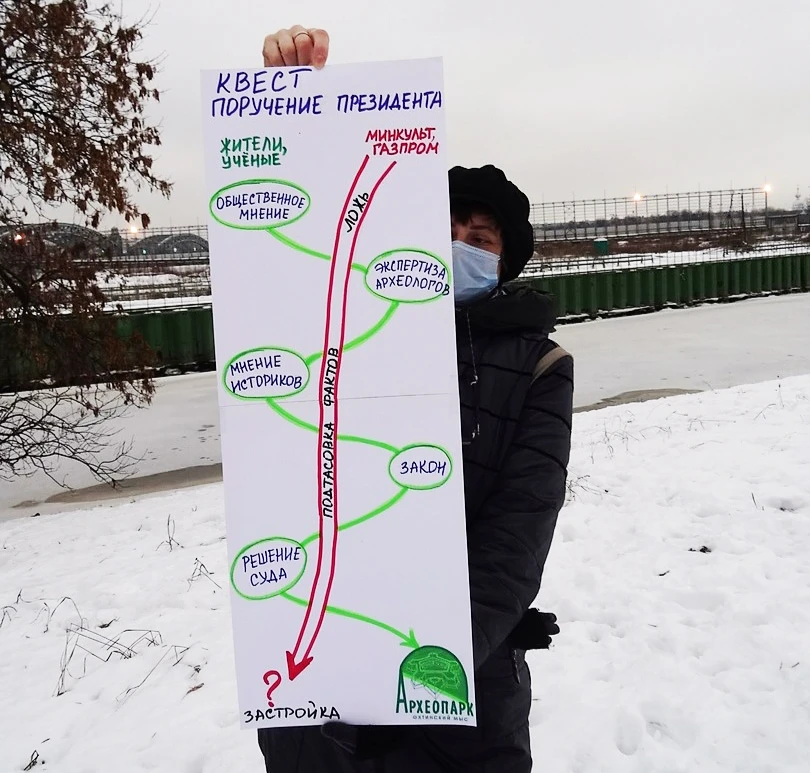
A year ago, Vladimir Putin supported the idea of creating an archaeological museum-reserve on the Okhtinsky cape as an alternative to its development by the Gazprom business center:
“One administrative building is larger, one less, and the archaeological reserve is an interesting idea,” the president said . And he instructed the Ministry of Culture, the government and PJSC Gazprom to work out this issue.
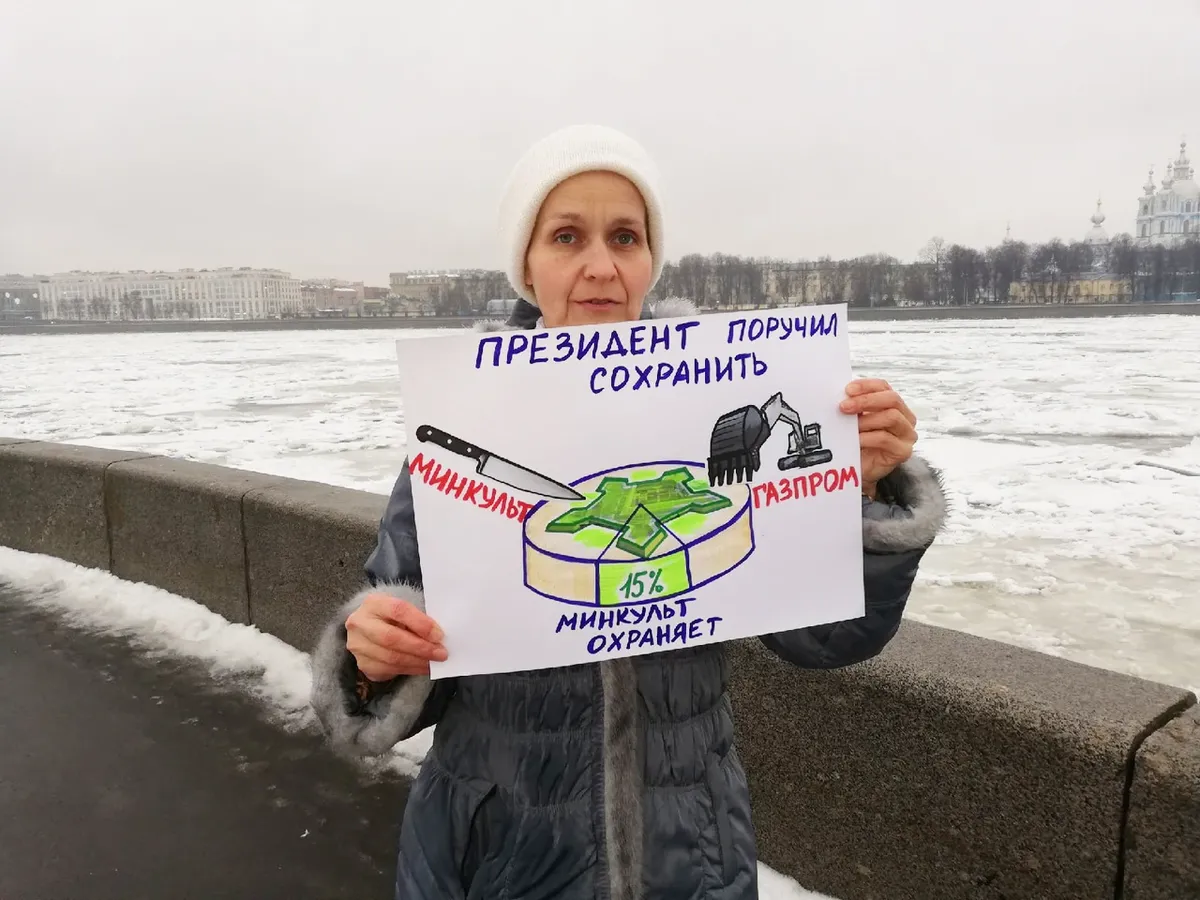
The year passed as an empty dream: judging by the report submitted by the head of state to the current meeting of the Council for the Development of Civil Society and Human Rights, Putin’s assignment was “reset”. The archaeological reserve was replaced by a “park under the construction of the public and business center of Gazprom Neft PJSC. The Gazprom concept, under this name, was allegedly supported by the working group under the leadership of the Deputy Minister of Culture of Alla Manilova, created to fulfill the presidential order. This construction, as the new "already said , implies the installation of a foundation pit up to 17.9 m deep. Which will destroy all unique medieval fortifications that fall into a spot of buildings (and it will take almost the entire territory of the cape, bypassing only the miserable 15%awarded state preservations). They will be celebrated with memorial signs, “a scoreboard with the image of a monument” and “a three -dimensional information card in the form of a layout of the Niennshants fortress” - “thus valuable archaeological artifacts will be preserved using modern technologies”, the report said.
This concept is approved in the document, the Gazprom Neft PJSC is processed "taking into account the proposals of the working group." Riddle - where the proposals came from if the concept was not considered at its meetings at all. Over the whole year they were held by only two (online). In the report, they were submitted as “full-format meetings, at which all aspects of the controversial issues of the museumification of the monuments of the Okhtinsky cape and the creation of the museum-reserve are comprehensively considered.
In fact, the first meeting (June 8) was more likely to be installed.
As the chairman of Alla Manilova announced , “we did not prepare anyone”, “we don’t have a special agenda” - and suggested “just an initiative to speak out”.
Most of the participants were not ready to speak out - because, according to their admission, they do not possess the topic at all.
Thus, the director of the Institute of Archeology of the Russian Academy of Sciences Nikolai Makarov expressed perplexity why he was turned on when "in St. Petersburg a wonderful archaeological shop qualified, which could well solve this topic without Muscovites."
The only representative of this workshop in the working group was Peter Sorokin, a senior researcher at the Institute for the History of Material Culture (IIMK) of the Russian Academy of Sciences, who had participated since 1997 in excavations at the Okhtinsky Cape and led them in 2006-2009. In the report, Sorokin is presented modestly - among the “representatives of the St. Petersburg archaeological community (hereinafter referred to as the initiative group) who advocate the ban on construction throughout the Okhtinsky cape”.
Sorokin prepared a presentation for the meeting, but it was not possible to show it. “We do not have such a technical opportunity,” said the state secretary of Manilova and then offered to send the presentation of Sorokin to the members of the group.
The chairman of the KGIOP Sergey Makarov admitted: "I am not an archaeologist and I mean little in this area." However, he gave an assessment of archaeological objects found on the cape: "There is nothing to show on the Okhtinsky cape."
Vice-Governor Boris Piotrovsky also showed complete ignorance, saying that 25% of the territory was taken under the cape (in fact-15). But, anticipating a professional discussion, he immediately gave a ready answer to the task posed by the president, saying: “When implementing the project [Gazprom], it is impossible to organize a museum-reserve for such a volume.”
Obviously, he does not draw to the “comprehensive consideration of all aspects” and the second, October meeting of the group: “took note” of the analytical certificate of the Hermitage and the prepared IIMK RAS track map to create a museum-reserve. And they instructed Peter Sorokin in four days to prepare a new document - what other archaeological objects on the Oktinsky cape are proposed to be taken under protection, "indicating the methods of their museumification and the degree of preservation." By deciding that then these proposals will be sent “to expert assessment” to members of the working group.
No final decision - what exactly to recommend to the president, with what justifications - was not accepted, there was no vote. It is known that some members of the working group, without waiting for the resolution, sent letters to Ms. Manilova, expressing concern about how the final decision will be formed, and with a request to send a draft report to the president to familiarize themselves and the possible introduction of their adjustments. But they did not receive answers.
The very fact of the “expert assessment” of the proposals of the candidate of sciences Sorokin (who devoted to the study of the Okhtin Cape for almost 20 years) by members of the working group (from which half falls on officials and representatives of Gazprom Neft), of course, is amazing.
Some of the understanding of the competence of their own and Sorokin unsubscribed very briefly, but honestly. As the director of the Research Institute of Natural and Cultural Heritage. Likhacheva Vladimir Aristarchkhov: “[Institute] reports the absence of proposals on the possibility of creating a historical and archaeological museum-reserve on Okhtinsky Cape.”
Others admitted that they have little information to develop a position, additional materials and research are needed.
The value of the heritage of the Okhtinsky cape did not cause any doubts. “The territory of the Okhtinsky Cape and the legacy associated with it is a unique complex requiring preservation”, “has an undoubted historical, cultural and recreational potential,” said Sergey Pilyak, director of the Smolensk Fortress Museum.
The Petersburgers, immersed in the problem, showed more thoroughly thoroughness in their argument.
“The Okhtinsky cape is the only territory within the borders of St. Petersburg, where you can clearly show the history of Pra-Petersburg, which would be of great importance for the patriotic education of younger generations. There is no other such opportunity in our city and will not be. Of course, neither the business center, in which part of the premises would be allotted to the museum, or even the landscape park without maintaining with the highest possible fullness of open monuments, will not be able to fulfill this task, ”the leading researcher NITAG, deputy chairman of the Cultural Heritage Council under the Government of St. Petersburg, Mikhail Milchik, insisted. “I consider it necessary that the working group supported the president’s proposal to create an archaeological museum-reserve on the Okhtinsky cape [...] should refuse a new business center here, but if it is still needed by Gazprom, you need to ask the government of St. Petersburg to find a suitable place outside the historical center of St. Petersburg and transfer this territory on preferential conditions.”
The creation of the Museum-Reserve on the basis of Sorokin's list of discovered archaeological objects was also supported by the director of the Institute of Archeology of the Russian Academy of Sciences Nikolai Makarov-as "the most acceptable way to preserve and popularize the historical heritage of the Okhtinsky cape, an integral part of the history and culture of the Nevsky Territory." Having recommended further evaluating the modern technical condition of objects on which "negative anthropogenic effects could affect, especially intensive in the XIX - XX centuries." And indicating (with the reservation - “as far as we know”) that during the excavations “it was not possible to identify the aboveground parts of the fortresses”.
And here is how they interpreted his review of the president’s report:
“... members of the working group noted the destruction of part of the objects in the process of archaeological excavations of the stratum of the Neolithic and early metal, as well as the complete loss of archaeological objects as a result of intense anthropogenic impact in the 19th - 20th centuries. In that part of the Okhtinsky cape, where active economic activity was conducted.
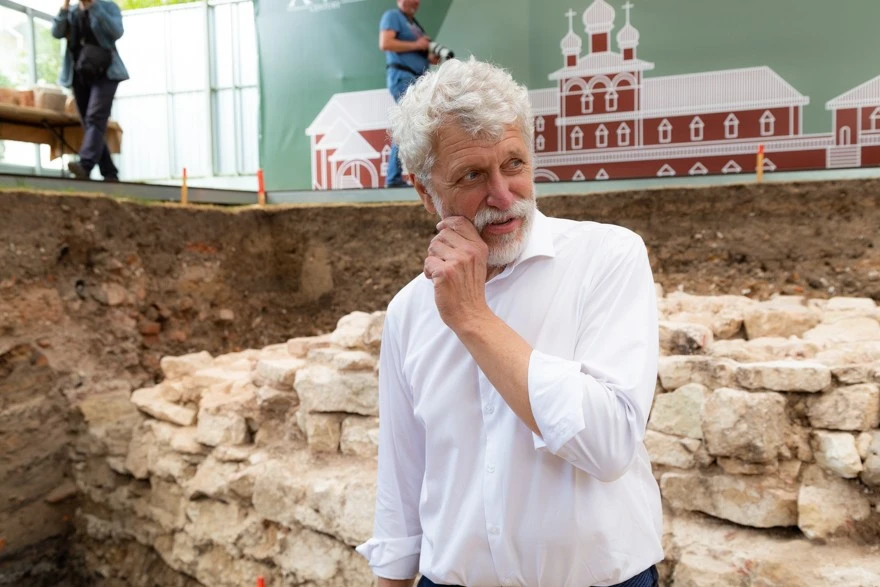
In fact, areas of cultural heritage in the Okhtinsky cape are small areas between excavations, as well as the remains of wood -earth fortress ditches. At the same time, museumification of part of the fortifications is possible.
Academician N. A. Makarov draws attention to the absence of the aboveground parts of the monuments and the inability to preserve the foundations of monuments in open form in a humid St. Petersburg climate. ”
Although Makarov does not have a word about such “impossibility” and climate. And neither he nor other experts never declared the "complete loss of archaeological objects."
The compilers of the report had to show special ingenuity, presenting the position of the state Hermitage. With the well-known diplomaticism of Mikhail Piotrovsky and the difficult situation for him (aggravated by the agreements of the museum with Gazprom, the museum sponsoring the projects, as well as the position of the vice-governor received by his son), the Hermitage was quite clearly outlined: the finds on the Okhtinsky Cape “represent value from the point of view of the history and military glory of the peoples of the Russian Federation”.
Moreover, it is not only about 15% of the put -impedial territory. The analytical certificate of the Hermitage also mention the Neolithic fishing zone V - III millennium BC. e., (“In such a high degree of preservation, such structures of the Neolithic era were never found in Europe”), and the soy settlement of the Novgorod time, and for the most (450 m) of the ditches of the Landskron of 1300, and its “completely unique object-the lower part of the log of the tower of the tower”, as well as the remnants of the ditches (13 thousand square meters) and m) and the m) and Bastions of the Fortress of Niennshants (XVII century), its stone and wooden structures and the Okhtinsky shipyard of the XIX century.
The degree of safety of the ditches and part of the Landskrona tower-Donjon “allows them to ensure their preservation in the existing form at the place of detection,” the Hermitage researchers are convinced. But "with any new construction in this territory, the threat to preserved monuments will become quite real."
The document concludes the document: the most important task should be a collegial decision on the possibility of creating a historical and archaeological reserve on the territory of Cape. The structures of which "are not affected by unique archaeological and cultural-historical objects."
The deputy director of the Hermitage archaeologist with 45 years of experience Svetlana Adaksina in his speech at a meeting of the working group said:
“ If we generally deprive the city for the only time in the life of the archaeological park, we will never have it, because there is no other territory on which such a multilayer monument has been preserved. And Gazprom can be a sponsor of this program and become famous for all centuries in all generations. Therefore, I propose to try to look for a middle ground. But this monument is not only in the form of an archaeological museum, but in nature, in kind, of course, you need to save. ”
Mikhail Piotrovsky himself, sending a Hermitage certificate to the Ministry of Culture, added in an accompanying letter: “... archaeological work should be continued, but not just for demolition, but to create a joint project, which should connect the public and business space with an archaeological park. [...] For a business reputation, both the city and the business, the creation of the original Gazprom-Varskrona would be a good project. ”
But what is good for culture, for the developer death: Landskron occupies 7000 square meters. m in the very center of the site. And Gazprom Neft, in the company with the Ministry of Culture and Smolny, is trying to prove that it is not, miraculously combining the defense of such a position in court with the execution of the presidential order. And on the other side of the barricades - 21 professional archaeologist, doctors and candidates of sciences, here is such an unprecedented collective lawsuit. The court of first instance recognized them right and obliged KGIOP to make a decision on the application for the identification of Landskron. But this is not mentioned in the report of the Manilova group.
“Not all identified objects are suitable for museumification,” Mikhail Piotrovsky admitted in the review of Sorokin's proposals. - This is due to the degree of their preservation, accessibility (partly objects of cultural heritage lean on each other, which creates inconvenience for their museumification, all of them are at various levels). [...] Most of the identified fortification objects should be mothballed (allocated by Piotrovsky). This requires a project for their conservation. This will save them. ”
And by a separate letter to Alla Manilova on November 23, the director of the Hermitage warned against haste "for the only purpose to be in time for the appointed time." Having explained that “the issue of creating a historical and archaeological museum-reserve on the Okhtin Cape is a serious comprehensive scientific, cultural, archaeological and business and business and requires significant intellectual efforts, examinations, public discussion, financial efforts. This is the only way to choose a solution for which it will be not ashamed to future generations. ”
Leaving the fed arguments and recommendations of the Hermitage, the president was put into a squeeze out of the context of a squeeze, knocking out a general conclusion to it: “According to the President of the Union of Museums of Russia, the general director of the State Hermitage M. B. Piotrovsky, not all identified objects are prepared for the museumification. This is due to the degree of their preservation, accessibility and the fact that objects actually layered at different levels and partially overlap each other. Thus, according to leading experts, there are no grounds for a full-fledged museum-reserve on Okhtinsky Cape. ”
But who are these "leading experts"? Of the 14 reviews received from the members of the working group, only 4-the review of Gazprom Neft, the chairman of the KGIOP Sergey Makarov, vice-governor Boris Piotrovsky and the head of the culture committee (now former) Eduard Sukhenko, against the archaeological museum-reserve.
All year, the Ministry of Culture received appeals of authoritative archaeologists, resolutions of scientific conferences (including international), the Department of Archeology of St. Petersburg State University, IIMK RAS, from Ikomos units (from St. Petersburg to international levels), Vodopiik, etc. - in support of the archaeological reserve with the preservation of all objects revealed on the Okhinsky cape and its complete prohibition Buildings. But all these opinions were ignored. The report is not mentioned in the report, as well as about the materials of the Hermitage and also prepared on behalf of the working group of the IIMK RAS Road Map with three options for creating a reserve.
In an effort to free the territory of Cape from the interfering development of archaeological burden, the lieutenant tried to switch attention to the creation of the Museum of Archeology of St. Petersburg, and in another place in the Peter and Paul Fortress (based on the State Museum of the History of St. Petersburg). Having reported to the President as a decision: “A constant exposition will be created in Menshikov’s bastion, demonstrating unique genuine archaeological artifacts that reveal the history of the Okhtinsky Cape.”
At the same time, having concealed the position of the leadership of the museum itself, which clearly outlined why the implementation of this venture is now impossible.
The main problem is that Menshikov Bastion is another problematic object of St. Petersburg archeology. Inside, under stone cladding, is the bastion of the original fortress of Peter's times (earthen ramparts and wooden log house). Under the former director of the museum, a voluntarist decision was made: to remove the contents of the bastion in order to obtain an additional room. The “excavation” of the soil that began almost turned into a disaster: the fortifications of Peter's times not only represent historical and cultural value, but also hold the bastion of a later time. The work led to damage to the stone cladding and were stopped. Petrovskaya wood-land fortress was recognized as an identified object of cultural heritage. But the problem of its preservation, as well as the restoration of Menshikov Bastion, is still unresolved.
“The design of the museum of archeology in Menshikov’s bastion is premature,” wrote Vladimir Kirillov, director of the Museum of the History of St. Petersburg, the director of the Museum of the History of St. Petersburg. -Currently, excavations in the bastion are completed, the artifacts found in the form of an earthen shaft and a wooden log house can be lost due to the lack of a methodology for their preservation. In the near future, with the participation of archaeologists and KGIOP, approval of the methodology of the museum of the excavation and objects found in it. [После чего] можно будет приступать к обсуждению вопроса об экспозиции в Меншиковом бастионе. На наш взгляд, она должна будет рассказывать прежде всего об истории этого исторического объекта и уже затем об истории приневских земель, включая Охтинский мыс как один из разделов экспозиции».
Кроме того, Кириллов объяснял, что создание Музея археологии требует глубокой научной проработки с привлечением «профессиональных археологов, специалистов по средневековой фортификации», а во вверенном ему музее таких нет.
На заседании СПЧ Константин Михайлов (поднявший вопрос об Охтинском мысе год назад) попросил Владимира Путина «не считать закрытым» исполнение его поручения, а «устроить полноценное экспертное обсуждение». По итогам деятельности рабочей группы ничего не было обнародовано. Но, добавил Михайлов, стали публиковаться экспертизы , из которых понятно, что проекты застройки мыса не меняются — «как будто бы не было Ваших поручений».
Из ответа Владимира Путина создалось впечатление, будто его уже пытались убедить, что концепция «Газпром нефти» (с «историческим парком» «в рамках благоустройства при застройке») обеспечит сохранность памятников.
«В целом, по-моему, компания согласна вложить определенные средства в то, чтобы создать музейный комплекс, — сказал президент. — Но я понимаю, что это вопрос дискуссионный: сколько должно быть там музейного пространства, сколько офисных помещений и так далее. Если это возможно, то это хороший путь — поиск компромиссов. Why? Потому что сразу у вас будет источник финансирования, и источник надежный и хороший. Если это возможно совместить, конечно», — еще раз добавил Путин.
Но совместить сохранение средневековых фортификаций со строительством проектируемого Газпромом офисного комплекса невозможно. Он «ложится» прямо на Ландскрону, наваливаясь и на неподохранные части Ниеншанца, новгородского городища, Охтинской верфи, где создавались суда, связанные с великими географическими открытиями, и могильник с останками русских воинов, проливавших кровь за эту землю.
Эти масштабные памятники, занимающие почти 20 тысяч квадратных метров, и есть главная ценность Охтинского мыса — в какую витрину их поместить?
Надежду на то, что еще не все предрешено, Владимир Путин все же оставил.
«Я сейчас не хочу предрешать окончательное решение вопроса, но тем не менее попросил бы вас с компанией [«Газпром нефтью»] поработать, — предложил Константину Михайлову президент, — а компанию я соответствующим образом мотивирую на эту совместную с вами работу и на обсуждение этого вопроса».
Скоро увидим, как будет сформулировано обновленное поручение президента — подключат ли к его исполнению Михайлова, как определят задачи. А к исследованию представленного главе государства доклада впору подключить Следственный комитет: пусть проверит, тянет ли такая работа на статью о подлоге.