
Translated material
Against the authorities, intelligentsia and all others
Gleb Pavlovsky - About the book of Simon Cordon "How Russia works"
Simon Cordonsky. How Russia is arranged. Articles and interviews of different years. M.: Common Place; The Hamovniki Social Research Fund, 2021 . Content
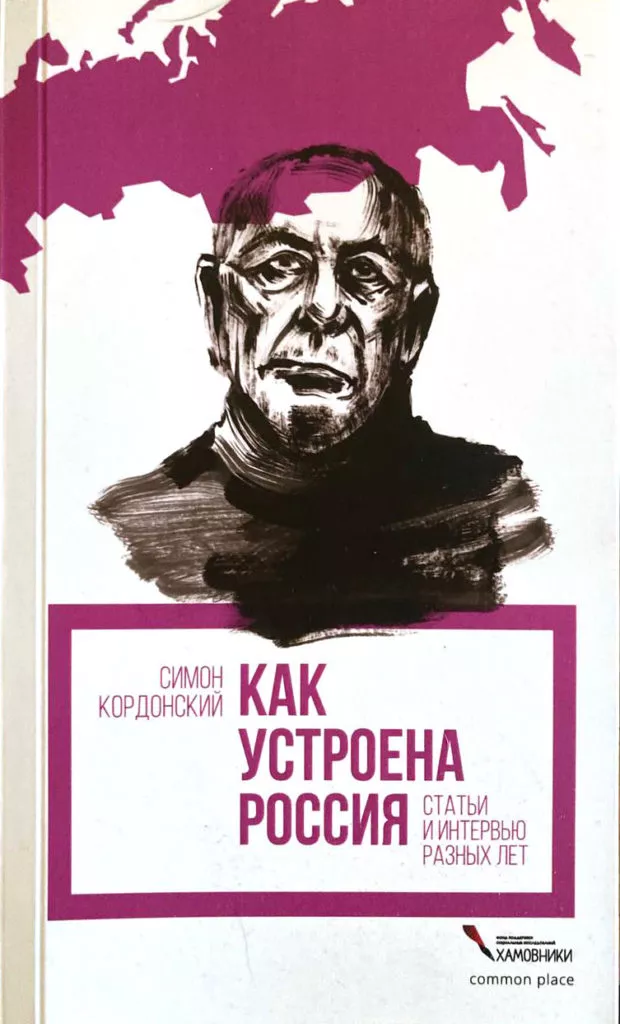 On the cover of this amazing book - someone like a big brother against the background of Russia. This is a book of attacks against all in the world, from power to the intelligentsia (among its anti -heroes there are me). And more recently, already under Putin, Simon Cordonsky led the AP Expert Department - the Office for Forest Affairs . He is known as the author of the running term “garage economy”, which has penetrated due to its apparent simplicity in presidential speech. However, the professor’s views have become more complicated.
“The life of most families of Russia is distributed between a city apartment, a cellar, a shed and a garage ... In general, the total housing is a relatively closed structure of materialized connections, non -economic in nature, the existing one in addition to the state ... This is a fishing life ... there is vodka, they make sour cream, cut, treated. I myself went so to treat my teeth ” (p. 305),” the Iron Cordonsky assures us. His Russia is a narrow strip of settled lands, which is crushed during the intrusions of the state, but then it is always straightened.
“The main activity of the state is the construction of threats and knocking out money for neutralization of constructed threats. For example, an external enemy ” (p. 308).
Cordonsky is one of the most angry in order not to say the evil people of Russia. Going into science from the overcoat of Paleobotanik Sergey Meyen , from power he went into the “tower” - the nest of observers of Russian life as it is. Just do not tell Kordon about the "real life"! The essay “In reality and actually” is a diamond of fierce journalism. The author shows the futility of any references to objective reality, in the case of Russia recognizing only a scientific description useful. However, in the social sciences he appreciates little.
“Realists are not inclined to pay attention to what is and is actually happening . They are sure that Russia, with some specifics, the same country as others. They are convinced that there is a state in it, there is society, there is an economy and people who strive for democracy ” (p. 52).
And what is there? In our first meeting, Cordonsky told me how he looked at the deaf taiga of a local fool who watched in turn the launches of the MBR from the training ground. The rocket with a roar rises above the taiga - and the fool loudly farts, each time celebrating a successful test. This image from the story of Simon was collected together by a poor, cheerful Soviet world, where I grew up.
“Benebility gives life a kind of adventure, from which some foreigners fall into a stupor” (p. 52).
Cordonsky is an personified challenge from the lands on which he wanders with a gun today. His knowledge of Russia is well armed. But this pepper , who has been working in the Office for Forest Affairs, has always disliked the state.
“The creation of a security illusion is spent on the main state resources. This is an economy of survival, not life. Life is developing, and survival stagnates ” (p. 214).
Didn't I have picked up the concept of survival for Russian policy ?
"Life according to concepts is life-survival, fishing life."
Cordonsky has been studying and describing the lands of the survivors for decades, and in the administration of business he studied not the forest, but the managers themselves.
“In reality, the state and citizens exist. But in fact, in Russia there is no state in the traditional sense of this term, as well as there are no citizens (not to mention civil society) ” (p. 50).
Then he returned to the forest to study - but who?
“Maybe the new Russia will arise from the interweaving of millions of simple lives and everyday affairs, and not from the heroic deeds of the aliens from nowhere?” (p. 97).
We went to the touch in the space of Cordon, in the N-dimensional continuum , in fact, and wandered out of the wrong place. Azimov has an instructive story " The Robot EL-76 gets in the wrong way ." In Russia, so many people were in the wrong way that they would need an immense transit hall, somewhere in the distance, which was moving into the hall for rumbles.
Professor Kordonsky introduced the term concept of concepts into our sociological discourse when the great ZEK Valery Abramkin was still developing it on the cases of the Soviet zone.
“If a person does not act according to concepts, then he is transferred to the law. This is not anarchy, this is a very stringent order - life according to concepts ” (p. 222). “The concept arises at the time of disassembly:“ You behave not according to concepts. ” With some of the arrested and planted governors, this situation was: he was told to share. And he, perhaps, even shared, but not enough, he did not take it according to the rank ” (p. 219).
Starting the partisan raid to the glory of relevance, Simon burns Napalm. He acts in this book as a thoughtful Hater. Anyone can become the target of Hayit - writers, innovators, God and economists.
“Innovators must take care of their future so that the regime is comfortable, soldering and that innovators die from senile dementia, and not from scurvy and dysentery in sharashki” (p. 199).
... our meeting began at the Bar of the Novosibirsk Academgorodok in 1988, and there the stranger whispered hotly in my ear: "There is nothing more to break in the country-enough!" In those years, the Soviet Union was a poor sick animal, and in Cordon I identified a veterinarian who is versed in the internal organs. I understood little in his reasoning, I called Simon to my analyst, because I believed in the progress of the USSR - and now I involuntarily found myself among the characters of the new book of Cordon. Simon included in it the spacing of my projects in the 1990s (he, however, does not compose anything about intellectuals). He hung me so cruelly that today, twenty -five years later, I am evading the polemic.
“Progressors consider the communities that they are designed by themselves realized by themselves - not vulgar, but a good past, reproduced directly in the future. In another, everyday life turns from trivial to heroic ... a new hero is being stuck into the bored pack of old characters ... ” (p. 95).
This old reproach today is even more fair. It seems that we overwhelmed with the glorification of the heroes and the distribution of a stabbing props.
Leafing through the book of Cordon “How Russia is arranged”, you feel like an Alice who failed in a rabbit hole. The flight is accelerated, the space is exposed, settled by people, which the language will not turn to be named. I would like to help them survive, but Cordonsky painfully hits hands - progressor, scumbag!
“I do not see corruption itself. It is possible only in the market, in relations between the market and the state. Since we fully have neither one nor the other, it is better to describe what is happening not as corruption, but as an estate rent ” (p. 220). I heard something close in time immemorial from the future President of the Russian Federation - in this they completely agree with Cordon.
And we fly past the racks caught by Russian classics - a regiment behind a shelf, an empire beyond the empire, a war behind the war. Plunging into the book, the reader falls into the institution of Russia so much appreciated by the author - into the Russian bathhouse with spiders, craftsmen and local authorities. All issues are resolved here. But did Dostoevsky warn us how his Russia ends?