
Translated material
Liberation Day
To the thirtieth anniversary of the collapse of the USSR
*“It should not regret it,
He was worth the fierce troubles of his misfortune ... "*
Karamzin, 1797
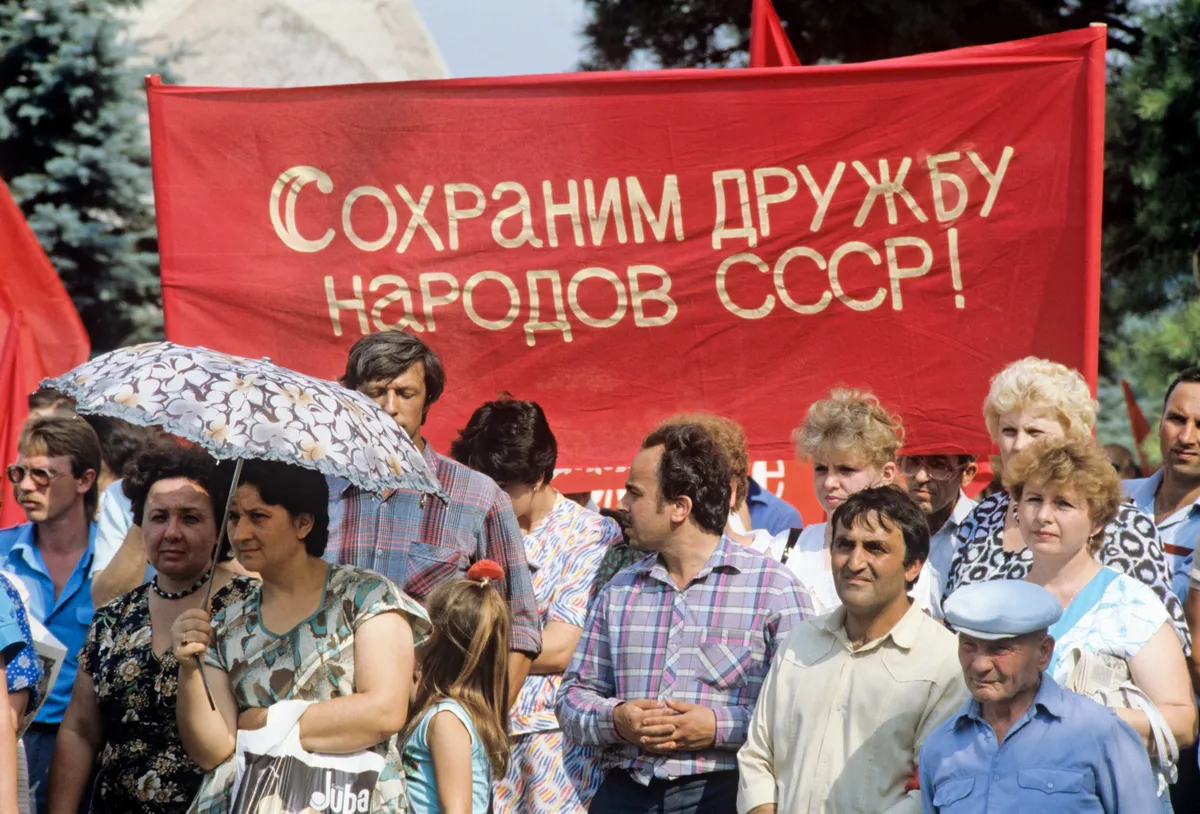
Blasphemy - I apologize for the word from the vocabulary of modern propaganda - the announcements of our chiefs precisely the bloodless collapse of the USSR (against the backdrop of the two world wars, civil war and communist terror) the largest geopolitical catastrophe of the twentieth century does not require evidence.
The USSR did not break up under external pressure, but for purely internal reasons - to whom it is interesting, read the “death of the empire” of Gaidar, everything is explained in detail there. And the Americans, who are now accusing of this so fashionable that some “activists” even projected on Christmas all sorts of nonsense to the building of the American embassy in Moscow, on the contrary, very much about this-the probability of Yugoslavia 2.0 stuffed with nuclear weapons did not please anyone.
Yugoslavia, thanks to the wisdom and restraint of Gorbachev, Yeltsin and Gaidar, and many of the then leaders of the Union republics, did not happen again. Yes, then there was anything, but, firstly, the aggregate number of victims of local conflicts in the territory of the former USSR by magnitude less than our country paid for the genuine tragedies of the past century, and secondly, for new wars, nevertheless, new authorities, and not the events of thirty years ago.
But are the USSR worthy of regrets?
Without comparing what was in the USSR and under the USSR bad and good, I want to pay attention to only two points.
Firstly, neither the Russian Empire, nor the Soviet Union inherited by it, managed to ensure that imperial identity blocked other identities so that people themselves wanted to be at the hand of the Russian king. Therefore, as soon as the fist was unclenched - more precisely, it was unclenched by the circumstances of the insurmountable strength - the country of the Warsaw Treaty and the National Republics began to scatter. They said a lot that in the Union republics everything, they say, occurred because of the egoism of local elites-they wanted to be not governors, but sovereign owners. Undoubtedly, but if the peoples had not wanted the same in a turbulent time, they would have been dared and remained in the Union. Or in the Warsaw Treaty. The empire, which had gone thirty years ago into oblivion, stood on force - sometimes on the strength of habit, from the sensation of the impossibility of changes, but often in direct military force. From time to time, the desire to free herself had to be suppressed by police repressions, and sometimes troops - Hungary, Czechoslovakia, Kazakhstan. The list is not full.
In 1991, neither no one protected neither the Soviet Union, which penetrated it from above to the bottom of the CPSU. And then, in addition to the opera version of the Supreme Soviet of the USSR, Sazhi Samalatova, there was not a single project for its restoration - even such journalism was not there. And so far, none of the countries that arose on the ruins of the USSR and in none of the states of the former Warsaw treaty have no one who would have advocated the restoration of previous orders. Even Lukashenko does not say this! Although no one denies that those tectonic changes for many people were quite difficult and that many problems that arose then were not completely resolved.
But the main thing is that the Soviet Empire was not needed by anyone.
Therefore, I “faded in three days”, as then, in 1917. By the way, the imperial nostalgia, which now parasitizes our propaganda, did not arise in the nineties, when the empire collapsed, but only in the zero, that is, very likely, was created artificially.
Secondly, those who talk about disaster are surprisingly self-centered. They are like strange people who want to declare the day of capture of Kazan in the All -Russian holiday, not thinking that for some citizens of Russia this is not necessarily a joyful date. The day of the collapse of the USSR is the day of the liberation of many peoples. For the sake of this day, Jan Paleh committed self -immolation, and twenty almost years after that a million Baltic citizens entered the Baltic Way. For the sake of this day, there were grandiose rallies in Yerevan and Berlin, in Bucharest and Tbilisi. To tell these people and their descendants that it was, they say, there was a tragedy, that it would be better for everything, as it was, it means to treat him with the arrogance of the XVII century colonialists, which means not to be considered them for people at all.
But this is the day of liberation for Russia. Galich said not in vain that the most terrible danger is not when other people's tanks come to us, but when "our tanks on a foreign land." The role of the oppressor of someone else's freedom destroys the country and destroys freedom in it - we all see it. Then, thirty years ago, Russia said that she did not want to be an occupier anymore, that she wanted to be not a metro, but a neighbor. Therefore, despite everything that is happening today, this is our holiday. The area of the land on which “our tanks”, although increased in recent years, still, is immeasurably smaller than the one on which they stood thirty years ago. So, our compatriots have less chance of being killed by fighters for the independence of their country somewhere far from our borders, and we hate us all fewer people than before.
No need to yearn about the empire. The symbol of the meaninglessness of this was our hockey team, dressed up this year in the form of the USSR and lost athletes from Finland.
Attempts to parasitize on the past greatness and turn the time do not lead to the time and cannot lead to anything other than shame.
The wise deputies of the State Duma proposed to make on December 26 something like a day of mourning-the day of memory of the USSR. If you strive for an increase in tension around the perimeter of our borders, then the idea is correct. But I have a different offer. Let's declare this day a holiday, day of liberation, offering our neighbors to establish the same holiday at home. It will be similar to May 8–9 in today's Europe, where it is an occasion to recall that even after such a terrible war as the one, you can live in peace with each other, that dictators are enemies not only of strangers, but also their peoples.
December 26 - the day of liberation from imperial burden is joyful both for us and for those who are no longer dependent on us.