
Translated material
"Ritual of the encouraging word." Why is it important to praise employees and how to do it right
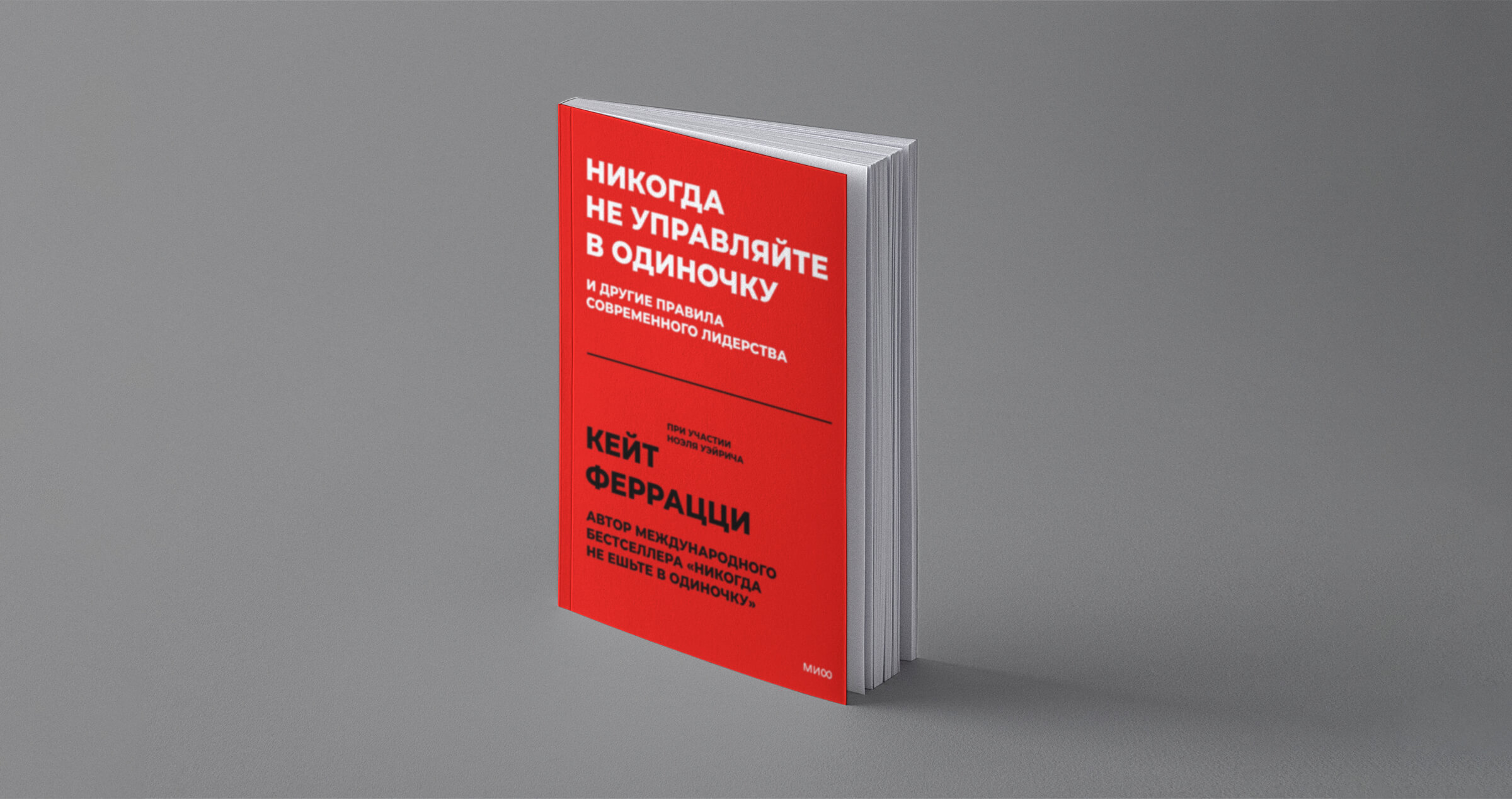
“If you don’t tell people what they succeed in, then how do they find out what needs to be continued in the same spirit?”, Asks a reasonable question that many leaders, coach and founder of the Greenlight consulting company Kate Ferrazzi forget about. Ferrazzi is called a deformer No. 1 in the world: his book “Never Eat alone” became a bestseller and brought him world fame. In the new book “Never manage other rules of modern leadership”, Ferrazzi argues how formal power and a tough hierarchy are increasingly capitulated before the ability to lead people. The book was published in the Publishing House in December, The Bell publishes its excerpt.
Psychological caresses
My friend Philip leads the global advertising agency, which includes even one of the largest companies from the Fortune 500 list. Every time we meet with him, he always speaks on the phone. Actually, I myself juggle with two phones at once and endlessly dial text messages on one, while the other is a conference-friend. However, compared with Philip, I am just a child. "How do you manage to do something if you hang forever on the phone?" - I asked him once, partly jokingly, partly out of sincere curiosity. Turning his eyes from the screen, he smiled. “Yes, this is the easiest and best tool from her colleagues ever invented for working with colleagues and customer satisfaction,” he answered. - And the most important part of my work. No matter how many meetings I have and no matter how long the list of mandatory matters is, I always sacredly observe the ritual of the encouraging word. ”
Philip's “ritual of the encouraging word” includes calls, text messages and emails, which he almost continuously sends almost a hundred of his customers and partners. This, in fact, is the incessant stream of praise and recognition of their merits.
According to Philip, this is his method to provide his team and customers with encouragement and support, so necessary in our complex, complete uncertainty world. “It is very important to constantly maintain a high level of energy and make the impulse of everyone who is important for you constantly gaining momentum,” said Philip. - My guys have taken so much on themselves that now I have one main task - to maintain their enthusiasm and energy at a high level and push them all to new and new heights. Today we ask customers to completely reconsider their entering the market. Everyone is as focused on the fact that it is not so that it still needs to be fixed, what needs to be done more, where to work faster and more efficiently, whether their constantly growing costs for advertising will pay off. In a word, people work hard for hours and days in a stressful environment, under severe pressure. ”
I must say, Philip has simply encyclopedic knowledge not only about the work of his customers, but also about their personal life. Sometimes he digs on social networks to find something special in their life that could be noted: an interesting trip from which the client had just returned, a recently celebrated birthday, positive news about the company. For him, this is really work, but he always carefully ensures that his encouraging words sound sincerely. “I really rejoice at the successes of people and with great pleasure I note their achievements,” he admitted to me. This guy calls and writes to customers and colleagues all day, and this gives him a real joy and allows him to maintain a good mood.
By the way, the daily rituals of Philip’s encouragement remind me of my personal coach tire. He can completely unexpectedly, on any day, call or write to me to praise for something or celebrate something. Shino calls it “caresses”. In a typical voice message for him, you can hear, for example: “Kate, my brother. So I wanted to send you a little love and tell you that the other day I listened with great interest to your TED lecture on the dating. You make a huge contribution to the improvement of this world. And I also noticed that you are wandering around the world as a crazy one. Brother, no matter how you feel, never forget that thanks to you this world is getting better. ” And you know, if I had a very difficult day or, say, I was completely stuck at the airport, such messages from Shino become for me something like a session at an emotional manual therapist who adjusts my mood. When we praise our teammates and celebrate their merits, we seem to be shone with a sunlight directly into their souls. I myself have felt this more than once, and this is unequivocally confirmed by psychologists who study the problems of motivation and organizational behavior. For example, psychologist Dan Aryeli, author of the bestseller Predictactably Irrational, found that people value praise above the money. His studies show that even from time to time a pronounced recognition of merits can be more effective than cash bonuses and bonuses, when it comes to increasing labor productivity and motivation for workers. Another study revealed that when practicing doctors felt something pleasant or simply in a good mood, their skills to solve problems and decision-making, as well as cognitive functions improved significantly. Doctors, originally positive (even thanks to a simple gift like a box of sweets), showed the most flexibility of thinking and faster made accurate diagnoses than those who were motivated in other ways or did not motivate at all. As a result, the researchers came to an unambiguous conclusion: positive affect contributes to the discovery of new ideas, flexibility of thinking and a creative solution to problems.
I was convinced of the importance of positive reinforcement many, many times and noted its advantages in my first book, "Never Eat alone." That is why, listening to Philip, who continued to talk about his “ritual of the encouraging word”, I felt a rather nasty feeling inside me. I suddenly realized that I was very behind the praise and approval of those who make up my circle of communication. For example, I forgot about the previous habit of calling and singing on Happy Birthday to You to those who had a birthday that day. Yes, I clearly needed to catch up.
Life -giving word
A few years ago, I ended up at a friendly dinner opposite Luke, relatively new friend, who recently sold his first company - a huge achievement for any entrepreneur. And I congratulated him on the fact that he managed to create a company and develop an excellent product that attracted the attention of a large software developer. “Respect and respect to you, old man,” I told him. “In eight years you have done what many dream of all your life.” A praising hatch for perseverance, determination and ingenuity, I saw a corner of my eye as my friend Tony, who was sitting next to him, moves closer to his neighbor with his chair. As a result, he turned out to be very close and almost moved to a chair to the hatch. I laughed and asked Tony what the hell he was creating. “Yes, I just wanted to experience at least once on myself what it feels like to hear praise from you,” he said. And we all laughed at Tony's joke over me. This was really funny and fun, but everyone knows that in every joke there is a share of truth.
Being my close friend, Tony has always received caring frankness and straightforward coaching from me with generous portions. I, like a coach, are very very speedy criticism: I really want everyone who surrounds me, as soon as possible to fully realize their enormous potential. I consider this a great opportunity for growth and development. But on the praise of Tony, I obviously skimped, and a friend found a humorous way to inform me of how much he would like to hear from me not only criticism. Thank you, Tony. I will not forget this moment soon.
In any relationship, professional and personal, you never know how seemingly fleeting praise or recognition of someone’s merits can lead to huge changes in the life of this person. Michael Lewis, the author of the popular science bestseller The Blind Side (“Invisible Party”) and Money Ball, told the interviewer in 2005 how his Basbola Fitz coach in high school once fundamentally changed the attitude of young Lewis to himself, simply publicly expressing his trust. On that day, introducing Lewis into the game with a pet with the Early States at a winning position, the Fitz coach told the guy: “I don’t know anyone who else can be put in this position.” And Lewis believed him. He intercepted the Runner at the third base, knocked out the next beating and finished Inning. But, as Lewis explained, the true genius of the coach of Fitz was more often manifested after the game. “He created dramatic moments on the field and made them perceived by us as something incredibly important,” says Lewis. - And when these moments worked well, he explained to them the most important features of your character. For example, after that game, he handed me the ball in front of the guys and told the whole team that I was very good at the reception - what was a clear exaggeration - and that in stressful situations he always counts on me. Pure water fiction! But after that day I really wanted to and tried my best to become like that. And since then my behavior has changed in everything. I even began to take my studies much more serious. ” And the coach of Fitz went to the director of the school, in which Lewis studied, and told him that the boy’s game that day was an achievement from which he could be repelled in the future. The director, calling Lewis to his office, said: “You know, we expect more from you. Coach Billy Fitzgerald speaks very well about you. ” Lewis explains: “No one would have thought that such trivial moments can become rotary in life, but I actually consider that moment such a point. And all this was organized by this wonderful person. " The Fitz coach chose, it would seem, the most ordinary, landed episode in the student’s life and turned him into something heroic and significant.
To create an experience that Michael Lewis will never forget, it took about ten minutes. And each of us can do something similar at any time convenient for ourselves in some ten minutes for members of our team, and for all other people in our lives. This is one of the greatest privileges of the leader. And a gift that, I must admit, we are too rarely given to people.
"Any praise is better than its absence"
If you want to strengthen relationships with teammates working with you hand in hand, and significantly increase their permeability, try to become the main cheerleider for them. Every day, allocate time to put aside your critical thinking, even for just a few minutes, admit how high you appreciate their friendship, their spirit, their stubborn work and significance in your life. Believe me, people crave such recognition. Praising people and noting their merits, be sure to pay attention to what feelings it causes you. You will see, this will greatly cheer you up.
Say, if depression seized you, perhaps the best way to get rid of it is to send people two or three messages with words of praise and gratitude. I, thinking about Philip and Shino, constantly ask the question: are it interesting, they recognize and note the merits of others because both are happy people, or, conversely, are they happy because they rejoice for others? Watch how praise and honor will help strengthen your bonds with team members. And believe me, when you begin to do this, pretty soon it will become your habit.
Next, I will give some tips, which, in my experience, are very helpful to develop it. Noticing that one of your team does something good and right-big or small,-mark it. Any praise is better than its absence. And if possible, try to link it with a specific action or behavior. If you see that a colleague does something as it should, recognize this right away and be sure to describe to him what pleasant feelings this caused you. Jalen, head of the personnel department of one of the largest startups in Silicon Valley, relies on such specific immediate positive reviews in almost everything that does. According to him, this leads to the consolidation of positive behavior. “People often do not understand what they do well,” he explains. “If we do not directly tell them where and what they succeed, then how do they find out what needs to be continued in the same spirit?”
Once, at the end of the informal meeting of his team, I saw how Jalen asked for attention to those present and, taking advantage of the moment, praised the manager who held the event (he held a post several levels below Jellen), for how he perceived the feedback, provided it and asked questions during a very energetic exchange of ideas.
Platinum rule
Then I would like to recall once again about the “platinum rule”, which we have already discussed: do with others the way they would like to do with them. Remember that public praise is great, but not everyone is comfortable to get it at all. Try to study your teammates as best as possible and praise and mark their merits as, according to your observations, they most like it. When a person, thanks to praise, feels that his efforts are noticed, and his merits recognize, this, as a rule, gives him strength and increases efficiency. But in almost every workplace there will be introverts, which are confused to pain when someone loudly announces their achievements at the general meeting. Be as attentive and delicate as possible; Perhaps such people will rather evaluate a laudatory manuscript note or a thank you electronic message.
If you praise a person in the most comfortable way for him, he understands that you really appreciate him as he is, with all his features. In some cases, it is more correct to praise privately. For example, sometimes I call the parents of employees and thank them for raising such a wonderful person. Once I called my employee’s father by the name of Frank and left a message on his voice mail, in which he told what excellent year Frank had and that he should be proud of his son. So, many years later Frank admitted to me that my father did not delete this message on an answering machine in the car until the end of his life.