
Translated material
The CSTO troops (mainly Russian) were included in Kazakhstan to suppress protests. What does this abbreviation mean? And how legal are these actions?
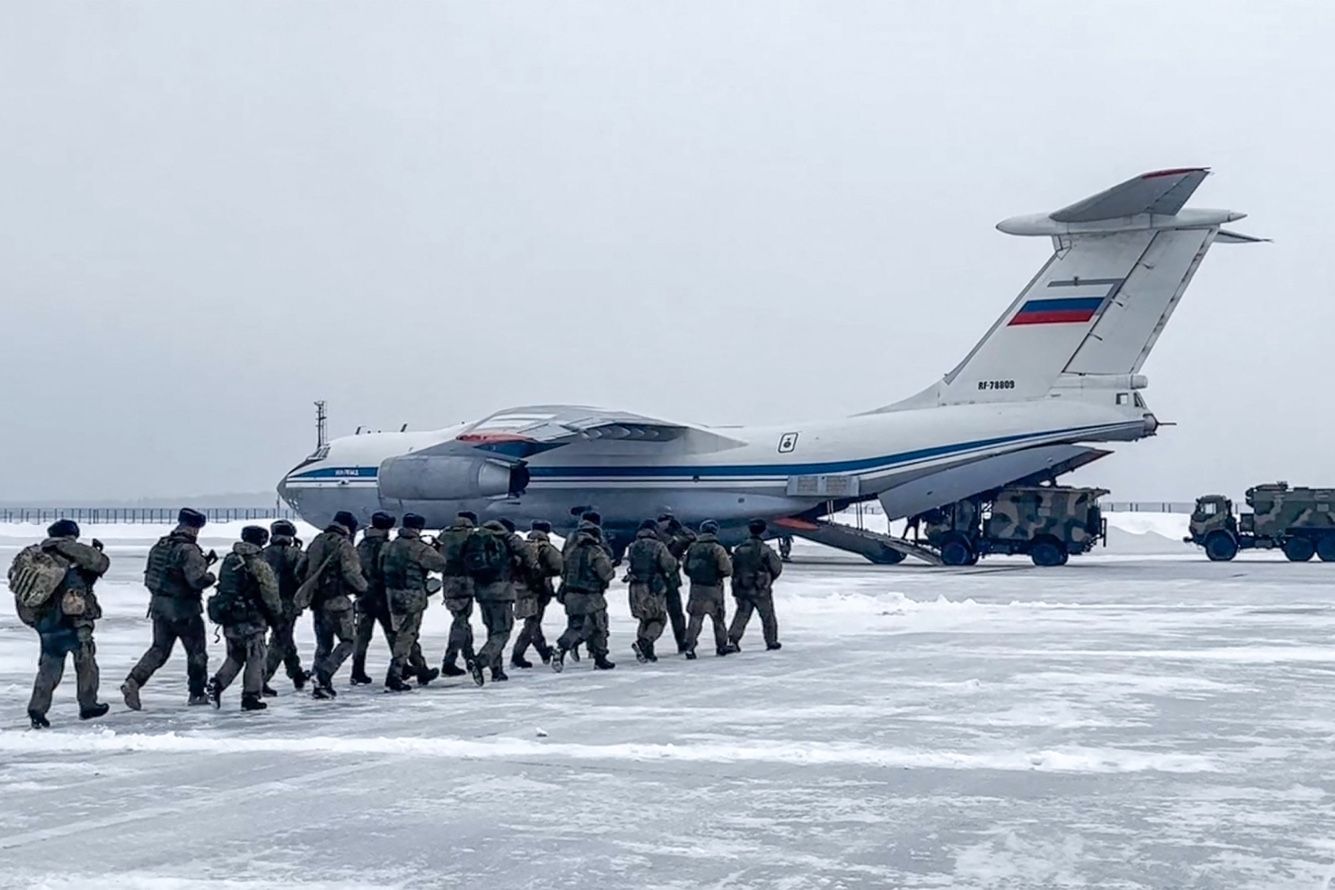
Russian paratroopers from the collective forces of the operational response (Queen) of the Organization of the Collective Security Treaty (CSTO) on January 6 arrived in Kazakhstan. Thus began the first combat operation of the collective forces of the six countries of the former USSR, which are included in an organization that has existed for almost 20 years. The legitimacy of such an operation is doubtful, since the use of collective force without external aggression against one of the participants in the organization is not spelled out in its documents (but is not prohibited directly). Earlier, countries included in the CSTO interpreted such conflicts unambiguously and opposite-they several times refused to help the troops precisely because of the lack of external aggression.
What is CSTO?
This is an organization with a complex fate, in the real strength of which even its participants doubted.
The organization was created in 2002 on the basis of the old agreement on the collective security of the CIS countries, adopted back in 1992, shortly after the collapse of the USSR.
A significant part of the signatories of this agreement (Georgia, Azerbaijan and Uzbekistan) left it back in 1999. In 2002, in Moscow, the remaining participants in the contract (Armenia, Belarus, Kazakhstan, Kyrgyzstan, Russia and Tajikistan) created a full-fledged collective security organization, which was supposed to resemble NATO-or the pro-Soviet organization of the Warsaw Treaty. In 2006, Uzbekistan joined the CSTO (so that in 2012 to get out of the contract again).
In 2009 alone, the organization acquired real mechanisms for ensuring collective security - the KPRA forces were created. At the same time, Alexander Lukashenko blocked the process of creating operational forces for a long time, but he still signed the contract a few months after other participants.
What was the CSTO earlier before?
All the time of the existence of the organization, its activity was limited to exercises and joint actions to combat drug trafficking. At the same time, during these 20 years, the CSTO participants fought wars, suppressed internal unrest, participated in international peacekeeping operations; Several times the governments of the countries were overthrown as a result of revolutions. The inaction of the organization under such conditions aroused criticism of its participants themselves.
CSTO participants asked for the help of allies three and a half times.
- The first request was not entirely official: during the next revolution in Kyrgyzstan in April 2010, the then president of the country Kurmanbek Bakiev, through Alexander Lukashenko, transferred a request to send the CSTO troops to combat the rebels. There was no official request for help, Bakiev left his post, but Lukashenko was still outraged that the CSTO was inactive. “What is this organization, if blood flows in one of our countries, a coup d'etat is taking place? Silence, zero. Why? It is easy to guess, ”said Lukashenko and concluded that“ the further activity of the organization is hopeless. ”
- A few months later, the CSTO received an official request from the new revolutionary authorities of Kyrgyzstan to send troops to the Jalal-Abad and Osh regions of the republic, where clashes between the Kyrgyz and Uzbek communities occurred. Russian President Dmitry Medvedev refused them, saying that the causes of the riots in Kyrgyzstan are internal, and therefore it is impossible to send the forces of the CSTO there. “The criteria for the use of CSTO forces are a violation of a state or non-state formation of the borders of the state, a member of the CSTO. In other words, an attempt to seize power from outside. In this case, we state the attack on all the CSTO, ”Medvedev explained.
- Armenia, even at the moment when the defeat of the Karabakh army became obvious in the war with Azerbaijan in 2020, did not ask for the help of the CSTO. The Kremlin answered in advance to a possible request negatively: the effect of the collective security agreement does not apply to Karabakh, and no one attacks Armenia itself. In 2021, the Prime Minister of Armenia Nikol Pashinyan still requested consultations in the CSTO, when the Azerbaijani army began an offensive on the controversial section of the border of the two countries. In response, Russia suggested Pashinyan to achieve a clear border demarcation.
- Finally, on January 5, 2022, the President of Kazakhstan Kasim-Zhomart Tokaev asked the CSTO assistance. He substantiated the request by the fact that the country was not just injured from the internal conflict, but "was attacked by terrorist gangs" prepared abroad. The heads of the CSTO participating countries quickly conducted online sowing the organization’s council, discarded the traditional interpretations of the term “external aggression” and satisfied Tokayev’s request. A few hours later, the first “peacekeeping” operation in the history of the CSTO began.
Is this operation legal?
The mandate of the Quele includes not only a reflection of external aggression, but also the fight against terrorism, as well as “other tasks defined by the Collective Security Council”. In fact, quick response forces can be used for any goals. Previously, it was assumed that the Quele will become the basis of the peacekeeping forces of the CSTO, which will be used, including outside the territories of the participating countries. However, the organization has never received the UN mandate to conduct such operations (although it submitted applications).
The collective security council consists of the heads of the participating state and makes decisions to send troops unanimously. At the same time, the Kyrgyz authorities could not immediately send troops to Kazakhstan: according to the laws of the country, this was supposed to make a parliament, but many deputies refused to participate in the meeting.
If the decisions should be made unanimously, and Kyrgyzstan did not send the troops, then the procedure is broken?
No, the requirement for a unanimous decision was observed: the president of Kyrgyzstan Sadyr Zhaparov voted to conduct the operation. However, the sending of troops, as recognized in the collective security agreement, should be carried out in accordance with national laws. In Kyrgyzstan, such a decision should approve the parliament.
And what is the procedure in Russia?
According to Article 102 of the Constitution of the Russian Federation , the President is made by the President with the consent of the Federation Council on the application of the armed forces outside Russia. But in 2009, an article on the “operational” use of Russian troops abroad was included in the law “On Defense”, in particular , “to repel or prevent an armed attack on another state, which turned to the Russian Federation with the corresponding request”. It may seem that for each such situation a separate resolution of the Federation Council is needed, but this is not so: in the same 2009, the upper house of the Russian parliament adopted a single resolution , which gives such a right to the president for all future cases. That is, it is no longer necessary to consult with senators before the abolition of this decree.
Will the CSTO troops suppress the riots?
It is not yet clear what tasks the troops will receive and what kind of forces the CSTO is involved. The total number of Queens is about 18 thousand military personnel, but (for now) they will not be fully involved. So, Belarus sent to Kazakhstan only one company (about 100 military personnel) from the 103rd separate guards airborne brigade included in the Kyrus. All other participants in the CSTO, except Russia and Kazakhstan, also use no more than a few hundred (or even dozens like Armenia) of the military.
Obviously, such forces will be not enough for a full participation in the suppression of unrest in such a large country. But, probably, such goals are not set: the priority of the CSTO forces will be the protection of the key infrastructure. For this, a small number of military men are enough.
It is clear that the basis of the forces will be Russian paratroopers from the 98th Guards Airborne Division (Ivanovo) and the 31st separate guards landing and screening brigade (Ulyanovsk). It is they who are part of the Queens from Russia. However, these forces are also not yet fully involved.
Dmitry Kuznets