
Translated material
A carol about the Internet
How we found and lost the dream of absolute digital freedom and what to do with it now
I remember well how my Internet began. In 1991, I bought a modem capable of connecting on a telephone line with a muddy, but, according to the seller, a steep speed of 2400 BOD, issued a subscription on the Relack network for “receiving information” (it is incomprehensible from which and where) and ... it rushed!
The modem drew an analog number (the one that is Trrr-Trrr-Trrr, and not “Pi-Pi”), for a long time struck (agreed!), Silently “loaded” something and turned off. At the same time, a heap of information was formed on the computer, downloaded, as he later found out, from the “News Conferences”. All conferences in a row that existed, because at first I did not know that in Usenet you can selectively subscribe to one and abandon the other.
Then, in my network life, many different things happened: the independent “Bulletin Board System) with a“ breeze ”and marginal-consoirological forbidden, and“ Echi ”FIDO, and an indescribable enthusiasm for the first acquaintance with the World Wide Web type“ Hello! My name is John and this is my passonal page! ” Everything changed and improved qualitatively - from the speed of connection to the formats of interaction with the world computer network. All but one: the essence of the interaction itself.
The essence of the Internet has always remained unchanged: absorption, absorption of new information and exchange of views.
For the sake of a free, not knowing boundaries of access to the information space, anywhere in the planet, for the right to speak out on any issue, the great digital revolution of mankind was conceived.
Rather, it was conceived, as usual with Homo sapiens, for another, to preserve communications between military facilities in the conditions of a global nuclear war, but this mosquito of the American military military personnel of the 60s over time, the glory of you, has dissolved in the right sense of the detachment (does the generation of z this term know?).
The original- Darpovsky -the Internet has gone 20 years into oblivion with public radars in order to be reborn in double power and modified teleology: as a materialization of humanity dreams about boundless information and free access to it.
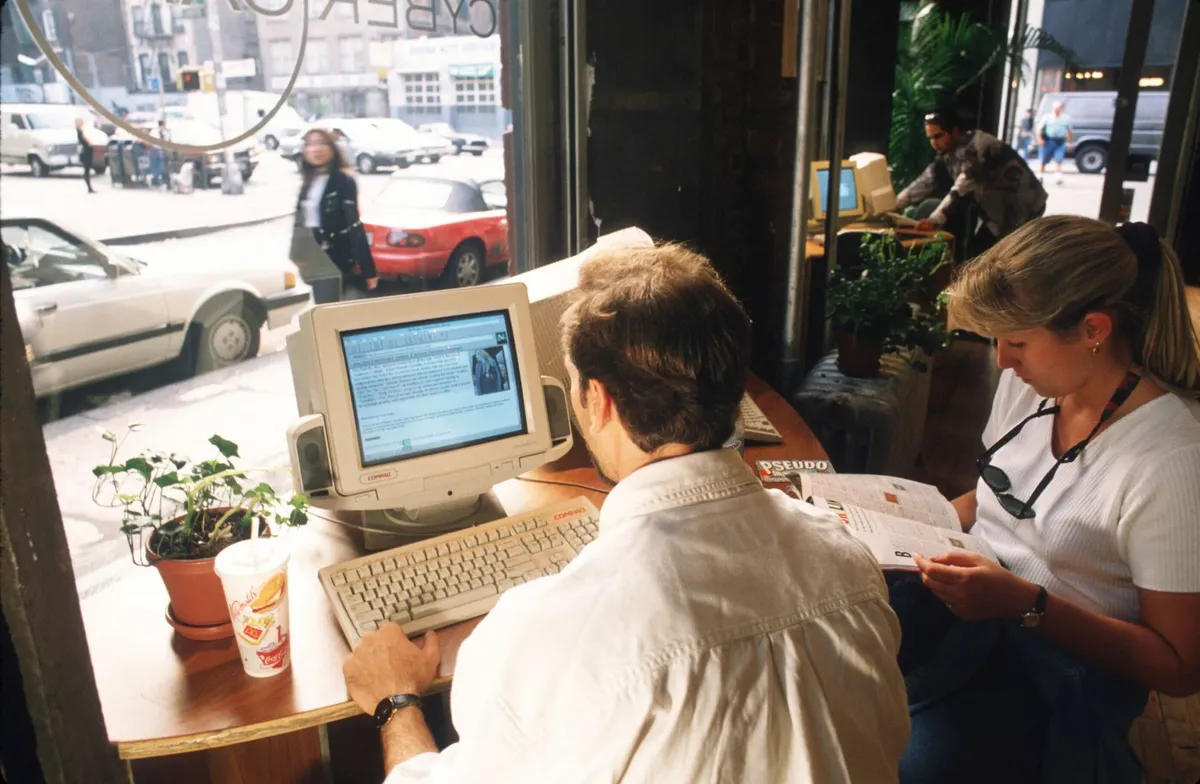
The first impulse for the movement to the dream was set by the uprising of the masses : the Internet of the 2nd half of the 90s was characterized by timid attempts by nameless, not known and not interesting objects of history to digitize the theory of reflection : the sacramental “Petya was here” began to scratch on the bark of the tree, but on “individual web pages”.
The next stage: the unification of nameless enthusiasts at democratic sites for communication-news conferences and web forums. The people stalled in interests and discussed the nights long with the uno -hobby questions, which either understood or wanted to figure it out.
This stage in the development of the Internet did not last long, before the beginning of the zero, and gave two results - positive and negative.
Positive: in the mass consciousness, the idea of the Internet was finally fixed as a place where you can realize the dream of an information paralle , find answers to all the necessary and exciting questions.
Negative: the horizontal structure of democratic forums rapidly destroyed the hierarchy of knowledge and information . The format provided anyone with the opportunity to freely express their own opinion, even if incompetent and amateurish. As a result, there was an inevitable erosion of clear ideas about the basic axioms and the authority of the statement , which at first culminated in the form of total relativism of ideas and ethical norms , and then cast in the formula that is still not so unambiguous! ”
It is the phrase “Everything is not so clear!”, Approved and backed up by the right of anyone who wants to broadcast on the Internet, created the prerequisites for the formation of information dystopia at the next stage of the development of the Internet - Web 2.0 .
At first, when the power in the world computer network was seized by transnational corporations, it seemed that the case would be limited to low blood. “We give you the opportunity to consume content for free and communicate with each other to the last like on global social networks, and you do not interfere with us to trade your metadan” - this was the initial Web 2.0 agreement, which was quite happy with Netizanov, tired of protracted forum counterattacks and finding out.
Very quickly, however, it became clear that one trade in metadata was not limited.
Smoothly and imperceptibly centralized social networks began to turn into giant factories of information manipulation , the effect of which is comparable to nuclear weapons. Hello, as they say, Darpa ( Defense Advanced Research Projects Agency-the US Research Institute of the US Ministry of Defense ): with which they started, and returned to that!
Technically informational manipulation on social networks (supplemented with exactly the same manipulation from centralized search engines) has become possible thanks to three factors:
Web 1.0 heritage and its installation on the right of total self -expression , which led to absolute relativization of truths;
The unique phenomenon of the “filter bubble” , which closed people in information ghetto, formed according to taste preferences: vatnikov -sewls -consoytniks - Liberal -Liberaltarians - BLM - LGBT - Anti -Marsian aqualangists, YUU NAME IT. Inside each information ghetto, only information circulated that its inhabitants liked it, and all unpleasant and contrary to taste plants mercilessly expelled outside to a state of complete nothingness;
The law of the psychology of the masses , which read: as soon as the uprising of the masses becomes the key principle of the organization of society, the ball begins not to rule the abstract mass, but the professional manipulators trained in the non -wary rules of introduction into the crowd, its excitement to the state of mass hysteria and the hallmings of the destructive energy of the crowd in the right direction of the direction.
Literally in one decade of the Web 2.0 structure, representing the interests of private business circles, which, in turn, are subject to the interests of national and supranational power elites (it doesn’t matter where the egg and chicken are capital or power, because they have not merged into an indivisible coagulas for the first century), completely emerged from the illusions of the construction of the information paradise and turned the world's computer The network in the history of myths and falsifications of reality unique in the history of mankind.
The degradation of the great dreams of mankind, first before the illusion, and then to the pitch kingdom of information manipulation, is a consistent, agree, a cruise happened to us in some three decades.
***
The editors asked me to write a column with the "Christmas spirit." And so more optimism. I promised. And then he wrote ... N-yes. I'll try to somehow rectify the situation in the remaining lines.
He struck the alarm, the case for small - to find a way out of the information inferno, into which we voluntarily drove ourselves. The key word here is “voluntarily”, and soon I will explain why.
My first thought was - salvation will bring Web 3.0! It is no accident that the majority of articles in 2021 devoted to this particular miracle - a decentralized Internet that creates an unprecedented alternative not only to social networks (Web 2.0), but also by the collapse of traditional financial relations, which banking people regularly imposed the last 300 years of history.
Forced, however, to state after a two -year -old full, almost round -the -clock immersion in Web 3.0:
A decentralized miracle can save us from anything, but not from information manipulation.
Do not just think that I am disappointed! Decentralized Internet and decentralized finances are definitely the future of mankind. The advantage of decentralized finances over traditional forms of monetary and investment relations is so great that there can be no doubts about the triumph of Defi.
The problem is different. Decentralized Internet brings the idea of horizontal democratic communication to an extreme point, at which it is even easier to manipulate information than in systems with centralized control, which in the very least creates obstacles on the path of frantic falsification of reality.
In a decentralized social network, where, by definition, nothing can be prohibited, manipulating opinions and creating trends that are profitable for the manipulator is much easier than, say, on Facebook or Twitter, where internal regulation rules are filtered at the entrance, at least, frankly antisocial insinuations.
In a decentralized social network, everyone is anonymous and free to pour out the most unthinkable nonsense outside. A similar Petri cup quickly leads to the mythologization of the processes taking place in the heads of the participants in the information exchange, and the accumulation of anonyms turns into a flock of monkeys, which are not only easy to give in manipulation, but also willingly degrade to the most primitive forms of hard hierarchy. The flock allocates a leader (or rather, the leader becomes the main manipulator), who literally receives the attributes of God in front of his eyes and begins, already without the slightest embarrassment, authoritarianly canalize public opinion in the direction he needs.
This is a terrible, in truth, the spectacle is observed in cryptoeconomics every minute and everywhere: most of the system participants voluntarily refuse to choose an independent choice, preferring to blindly follow the deified influensers, who are ordered in order, the recommendations that crypto acts must be bought and when.
In short, the decentralized Web 3.0 will definitely not save us from total information manipulation. And then what will save?
My "Christmas positive" echoes the code of my favorite plate of university youth-Pink-Floydovskaya The Wall. After the lyrical hero Roger Waters destroys the wall of self -alignment, he is surprised to discover those who were on the other side of the artificially divided world:

Getting rid of total information manipulation will not be given to us neither new communication formats, nor new technological constructions. No matter how much the Internet will be rebuilt, the same Nomo sapiens will populate it, so sooner or later they will build a world that fits into their ideas about what is good and bad, how correct and wrong.
Getting rid of total information manipulation may not come from outside, but only from the inside. Until our internal attitude has changed, not a single structure outside will change.
The problem, however, is that we ourselves cannot change anything in our heads. Our consciousness has already been formed by the education system and the society in which we live. This system has already imposed on us about good and evil and has prioritized.
The whole twentieth century passed under the sign of the struggle of two extremes: maximum individualism and maximum collectivism. Historically, individualism proved itself as less evil, so he won and today everywhere dictates its rules of the game. Despite the fact that the squalor of individualism was obvious before collectivism cast in labor concentration camps and mass terror.
In the mid-70s, the American writer, composer, poet and philosopher Dane Radyr tried to reconcile the extremely individualism and collectivism in a new quality, putting forward the concept of transpersonalism .
A person who has escaped from the shackles of communal slavery and already enjoyed the freedom of individuality, at some point realizes the limitations of his new selfish life and faces the dilemma: either to surrender and voluntarily die, or achieve a synthesis of his self with the outside world. Thus, it is poetic described by Pink Floyd musicians as “The Bleeding Hearts and the Artists”.
Transpersonalism as a life installation is not a repeated dissolution of its individuality in a pack, but the realization that there are many other opinions above your opinion, more importantly, your comfort is more important than your personal goals, there are more important goals.
Unfortunately, we are already formed as individuals (representatives of the active generation Z are not an exception), therefore, something radically changed in the situation with the Internet is unlikely to be possible.
If, however, we want future generations to live in another, truly humane and fair world, we all must make maximum efforts for a radical change, primarily the education system. It is not about changing the selection of academic disciplines, but about the radical destruction of both distilled ideologies - both individualism and collectivism.
A person of the future must live according to the ideology of the future. In my view, such an ideology is transpersonalism. Only - for God's sake! - cleared of mysticism Dane Radyr (excusable, however, for the poet).
Do you think this task is utopia? Maybe. But for the genre of Christmas story - it is!