Date
Author
Олег Зурман, Александр Бородихин, Давид Френкель
Source

Preserved copy
Translated material
Or a complete cessation of the work of cryptocurrencies in Russia. Why did the Central Bank decide to ban bitcoins
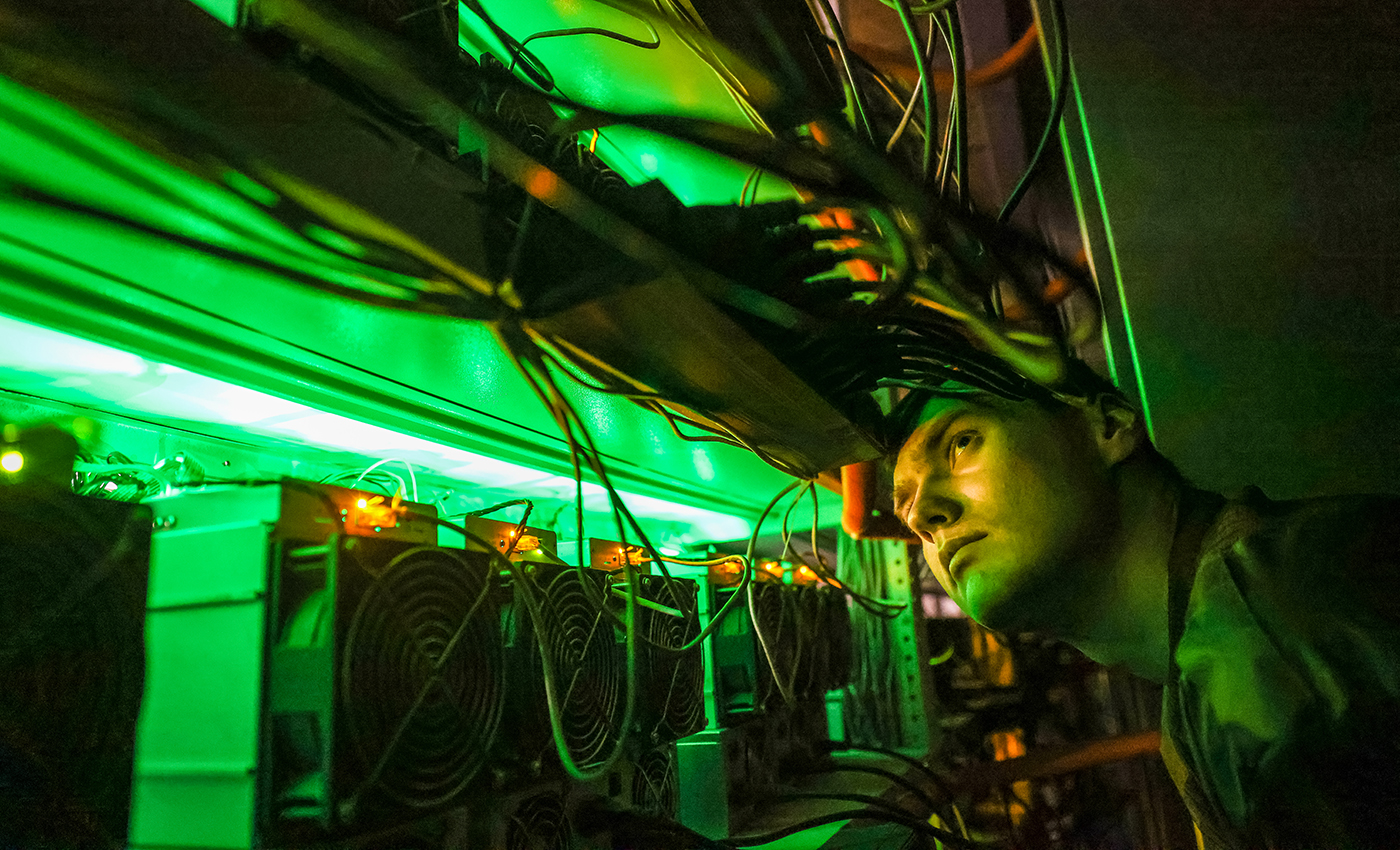
An engineer in the machine room of the Data Center of Mining Farm in Bratsk. Photo: Alexander Ryumin / TASS
On January 20, the Central Bank made an unexpectedly sharp statement on cryptocurrencies, proposing to completely ban operations with them for Russian citizens and organizations. The 36-page report on the threats of cryptocurrencies was preceded by Bloomberg’s message that the initiative to proceed allegedly from the FSB, which thus tries to cut off the opposition and organizations declared by “foreign agents” from the donates. Why the Central Bank decided to put an end to the gaining popularity of technology and what does Elon Musk are in the Mediazone material.
Report of the Central Bank of System threats
“The wide distribution of cryptocurrencies creates significant risks for the Russian financial market,” the document called “Cryptocurrencies: Trends, Risks, Measures” says. “In the absence of restrictions and further growth in the volume of investment in cryptocurrency by Russian citizens, large -scale involvement of banks and other financial organizations in the market, the risks inherent in this activity, can intensify and carry systemic threats.”
The dangers of cryptocurrencies are listed below: this is a threat to the well -being of citizens, the financial stability of the country as a whole and the growing popularity for financing criminal activities.
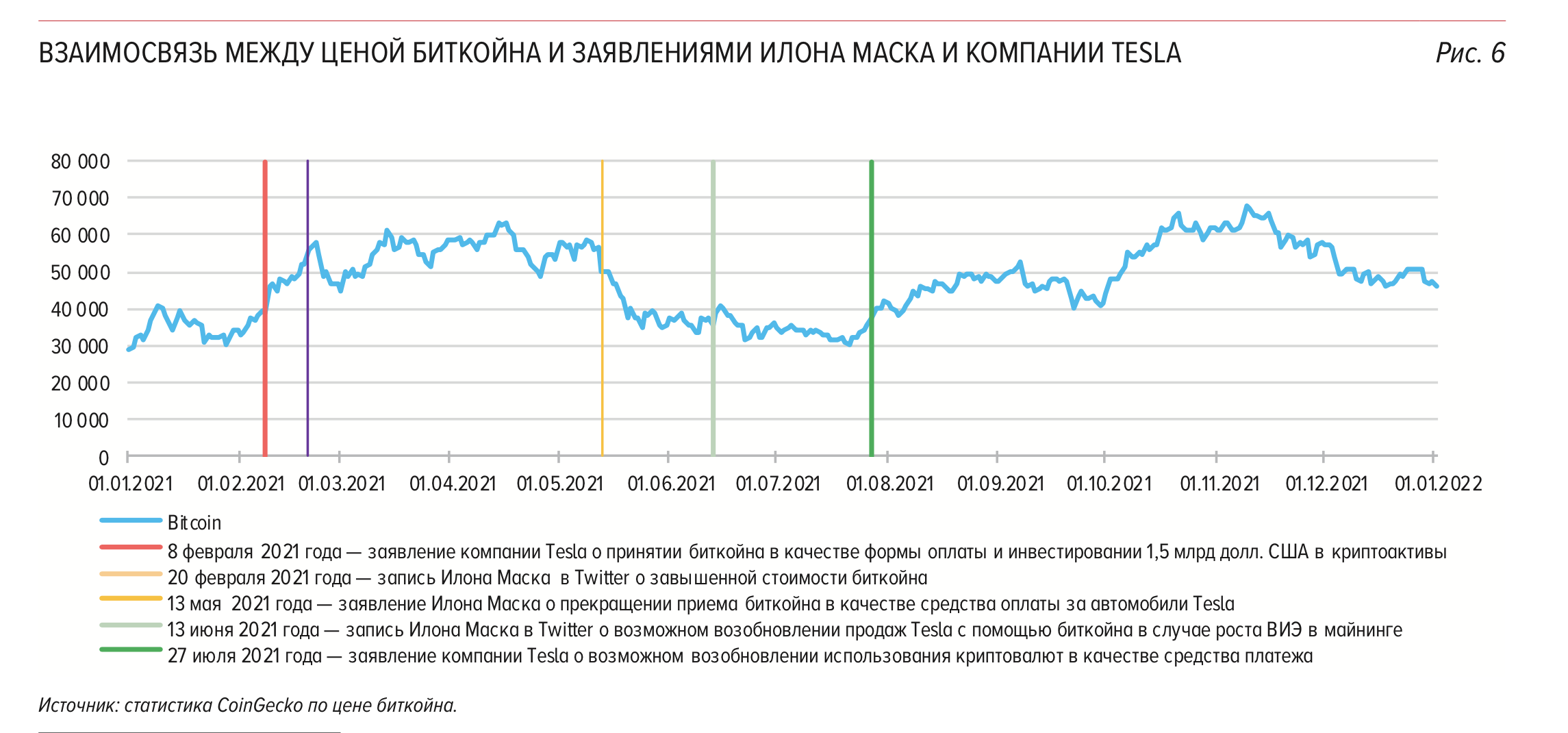
The financial well -being of Russians the Central Bank puts in the first place and writes about the “possibility of a complete loss of investment in cryptocurrencies” compared to the usual ones: their courses are too unstable and depend on the information background, the concentration in the hands of a small number of wealthy people allows them to manipulate the market, and also increases the risk of creating financial pyramids. To illustrate this thesis, the Central Bank refers to a study that compares the price of bitcoin with the statements of Ilon Mask and its Tesla electric vehicles.
An equally dangerous consequence of the popularization of cryptocurrencies in the Central Bank is considered “undermining the money circulation and loss of the sovereignty of the national currency”, which will lead to the fall of the ruble, the outflow of capital, the risk of reducing investments in the real sector of the economy and a decrease in the financial stability of banks.
The Central Bank pays less attention, but emphasizes that “at the moment there are no approaches to deanonymize all participants in cryptocurrency operations” - this allows, in particular, to use bitcoins as a drug payment for a darknet.
Finally, the Central Bank is also concerned about the negative impact of mining, "contributing to an increase in carbon trace," to the environment. The reason for the increase in emissions is an increase in energy consumption in regions with cheap electricity tariffs, the Central Bank notes: “Such trends increase the risk of significant loads on the mains and emergency situations.”
Unhappy with the Central Bank and soared due to mining prices for computer video cards-the demand for graphic processors for the production of cryptocurrencies "has become one of the factors of semiconductor deficiency" and "exerts additional inflationary pressure in the world economy."
In this regard, the Central Bank offers to act harshly: “The status of a Russian ruble, which is not a reserve currency, does not allow the use of a soft approach in Russia and ignore risk increasing.”
The Central Bank wants to introduce responsibility for cryptocurrency operations for Russian tax residents, a ban on its appeal and exchange in Russia, as well as develop mechanisms for deanonymization of specific operations and currency owners, which the ban will violate. Finally, financial organizations are invited to ban investments in cryptocurrencies and any operations with it in Russia.
Punishment for mining
The head of the financial stability department of the regulator Elizaveta Danilov, speaking after the publication of the report, emphasized that the criminal liability for mining and other violations has not yet been discussed: "We still see responsibility in the form of fines."
“It can be assumed that this will be a confiscation plus a fine in the amount of an illegal operation,” says Stanislav Seleznev, lawyer of “network freedoms”. “No criminal is needed with such sanctions.”
According to Danilova, the Central Bank does not propose to punish for owning cryptocurrencies, but wants to ban the use of Russian financial infrastructure to acquire it in order to reduce its popularity. The ban NFT , which was spreading the method of encrypting uniqueness of digital objects last year, is not yet discussed by the regulator.
“The Central Bank’s proposal is a step back,” says Sarkis Darbinyan, lawyer in the field of cyberprave. - The Central Bank shows that he is among state bodies the main opponent [cryptocurrencies] - why so far white rules for the crypto business have not been created. I think this story will continue. Not a single Russian bank and the financial institution will risk dealing with the crypt, but the market itself will resolve, it will continue to exist in the gray zone-until some political decision is made: either to give normal rules for regulating and the life of cryptocurrency projects, or this is all sent to digital underground. ”
Stanislav Seleznev suggests that the authorities will monitor and analyze payments between individuals and entrepreneurs using neural networks.
“Firstly, the cybercriminalist methods of tracking payments using the most popular tokens are already existing and are actively improving,” he says. -Secondly, the over the past few years, the Central Bank has actively identified the largest exchangers, promising their legalization, that is, there are already starting points for research. Thirdly, part of the transactions with tokens already introduced into circulation is really difficult to track, but it is quite possible to identify new tokens in the Russian Federation. ”
Seleznev adds that in the proposals of the regulator we are talking about “residents of the Russian Federation”, that is, “even having gone abroad, less than 183 days (at that time, the status of a tax resident of the Russian Federation remains), and having performed an operation with cryptocurrencies, a citizen will formally violate the ban offered by the Central Bank”.
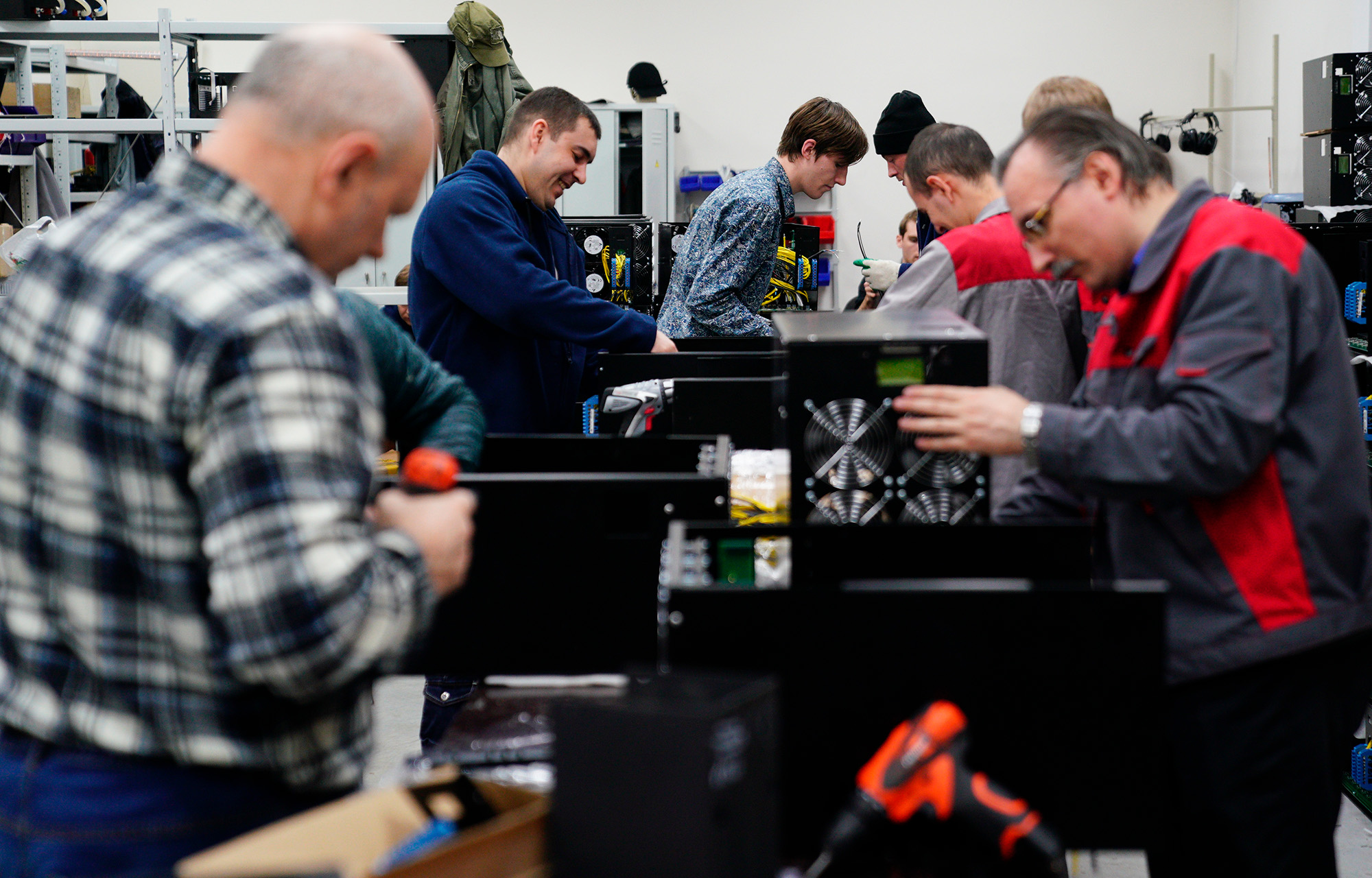
Employees in the assembly workshop workshop for mining cryptocurrencies on the territory of the Moscow technopolis. Photo: Vladimir Astapkovich / RIA Novosti
How is the Central Bank connected with the crypt?
It is believed that cryptocurrencies are completely anonymous. For example, Bitcoin and Ethereum do not identify account owners in any way, but these systems are arranged so that the current condition of all wallets and all operations between them are published. Knowing the address of someone’s wallet, you can find out its current balance, as well as from what accounts, when and how much money was transferred, as well as where it was withdrawn.
To maintain anonymity, users are officially recommended , with different payments, use new accounts or conduct operations through special wallets that collect transfers from a large number of people, and then send other amounts back, but already to new ones. Naturally, in this case there is a risk that the owner of an intermediate mixer wallet will deceive his customers.
The Central Bank considers such methods of anonymization potentially criminal - they "give the opportunity to both fraudsters and merchants forbidden goods and services to significantly complicate the work of law enforcement agencies."
Although the wallets themselves are anonymous, any interaction with the real world poses a threat to calculate the owner, and at the same time all his operations. On the way from receiving cryptocurrency to payment of services there are many nuances.
The most reliable way to get cryptocurrency, without telling anyone your name, is to directly roll it, having received a generated amount for an anonymous wallet on your computer from the system itself. Today, for the vast majority of users, this option does not make sense-a hashrate, that is, the computing power required to create "new money" has seriously increased due to the emergence of new powerful devices and connect new miners. Now mining requires powerful video cards, which, due to the popularity of cryptocurrencies, have already become a deficit around the world.
In addition to mining, cryptocurrency can be bought (for ordinary money for any of the numerous exchanges) or exchange through special exchanger sites. However, at the time of such a purchase, the Russian bank - and therefore the Central Bank, becomes known that the transfer was made to the address of the exchange or exchanger. Exchange can cooperate with the authorities and report the buyer’s wallet number, or the wallet number can be calculated by the transfer time and sum. Binance's largest exchange has already stated that she was ready for dialogue with the authorities.
Services like Localbitcoins offer an alternative to purchase: users themselves agree with each other about the transaction, and for the bank the transfer of real money will look like a regular transfer between random people. Localbitcoins has been blocked in Russia since 2016 by the decision of the St. Petersburg Court for posting information about currency, which "is not provided with a real value, does not contain information about its holders."
The same problems arise and if necessary to sell cryptocurrency, that is, cash it out. In some countries, there are ATMs that allow you to exchange cryptocurrencies for cash at once, but in Russia few existing "cryptomats" were removed by the police at the request of the Central Bank.
Problems remain when trying to buy something in the real world with the help of cryptocurrency-the fact of the purchase, becoming publicly known, makes it possible to connect the date and amount with operations in the blockchain and calculate the transaction participants in the chain.
Community reaction
“What will happen now? Those boys who have serious capacities will just go to Kazakhstan, as they did, ”said Kaliningrad, who has been engaged in mining for several years.
He is sure that the authorities will not control the small mining farms, but does not exclude that now they will be engaged in large players: “Boys are mining in the garage - and will be mined. Those who steal electricity will continue to steal it. Perhaps they will squeeze those who mines on an industrial scale, but this, again, under the security forces. You are either a banker, such as a "Sberbank", or a security forces - you simply do not have another option. I think that a simple mortal miner, with not very large capacities, will not affect it in any way. ”
Frolov recalls that in 2017 in Russia they offered to ban “apartment mining”, referring to fire safety rules, but the law did not adopt: “This was all the same then, and everything was stalled. As I understand it, they sounded, maybe the ground. "
An employee of the mining farm, a networker, believes that in Russia it is impossible to block or destroy the cryptocurrency market. “In China, this turned out because they are limited by the great Chinese firewall. Closing large miners there is very simple. In Russia, with large miners, it is clear that they can be regulated, but I do not think that Russia will go to such radical measures relative to large mining companies. ”
At the same time, Ignatov notes, even the Chinese authorities could not cope with the "home miners." “And if they couldn’t in China, then I don’t think that in Russia it will be tightly engaged in this,” he said.
The amateur miner from the Moscow Region echoes him: “The initiative, of course, is shitty. But what do they want to ban completely mining and cryptocurrencies? Yes, they will not work. ”
Degtyarev is convinced that the state simply does not have a mechanism that could somehow influence the cryptocurrency and mining market, but if the authorities still begin to pursue miners, then they will simply go into Darknet.
The expert in the field of blockchain and cryptocurrencies Egor Vinogradov considers the statement of the Central Bank “some kind of rhetoric”, which will not lead to real changes in the market. In the professional community over the statements of the regulator, they only “finished off”, and among the miners, according to Vinogradov, there is no panic.
“Nabiullina is always against it, and she often makes such statements. It is clear that they now used a red rag in the face of financing some opposition there, in short, the nonsense nonsense, ”explains Vinogradov.
He says that he does not imagine how, in principle, transactions and transactions between the participants in the cryptocurrency market can be limited.
“If only some exchangers are closed. Well, others will appear. I do not quite understand how this can be limited. In my opinion, this is some kind of rhetoric, someone is gaining political points. Everything is as usual in our country, to close everything, ban, do not develop anything. ”
Editor: Maria Klimova