
Translated material
In anticipation of the main answer
In the pause safety negotiations. That after her, no one knows
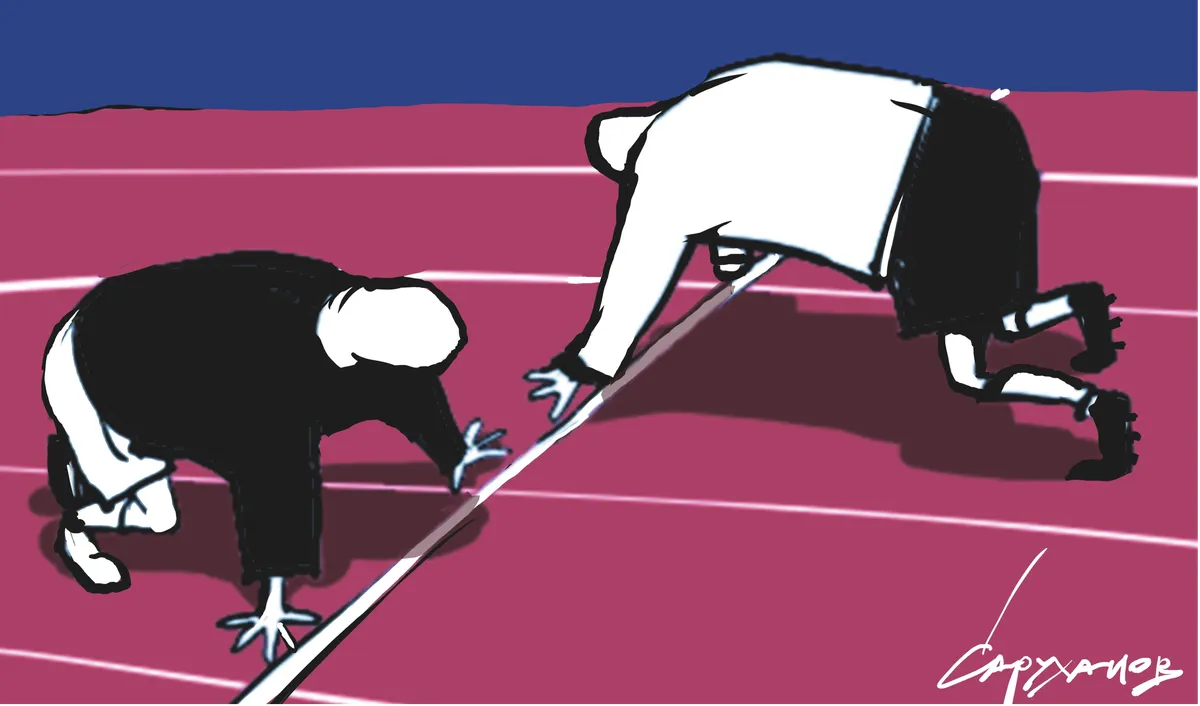
The geopolitical series, which began in mid -December and walking in real time, continues. The blood of the audience will excrete. Mobilizes the sophistication of the scriptwriters. Anxious expectation. Saspens. Big bets are the preservation of the world.
The chain is simple: our sentence is their answer - our answer to the answer. However, with the latter everything is more or less clear. Since everything was mainly clear with their “their answer” - already when they made an offer. But we must wait for the main answer. In Russian political language, this is the decision of President Putin after consultations with the military and politicians. Its details will be more important than the main meaning already declared by Minister Lavrov (they say, the “partners” refused our main concern, and this does not suit us).
True, the “partners” in their unpublished response seemed to meet “secondary issues”, which until recently seemed to Moscow quite important (non -replacement of the RSMD in Europe, restriction of exercises near the borders, the measure of “deconflicing”, in particular, in the Baltic and the Black Sea, restoration of contacts between the military, etc.).
True, the Paris meeting in the Norman format in Ukraine was held at the level of “political advisers”, they discussed the implementation of the Minsk agreement for more than eight hours and intend to continue to clarify inconsistencies in its interpretation in two weeks. That is, while the pause is anxious, but with the glimpses of the hope of continuing negotiations, and not on their breakdown and unfolding an ominous “military-technical response”.
And all this is against the background of a warlike scream, and on all sides. In Russia, there are a militaristic demoniac of propagandists and the irresponsible “proposals” of different in the party affiliation of the Duma public (to recognize the unrecognized Donbass “republics”, to pump them with weapons and, of course, which is inevitable, Russian instructors for its maintenance).
Interesting,
What is more here - the amateur activity of the party of war, which felt that the Kremlin fluctuates and we must push the swing in its direction,
The desire to grab the “boss” with its stiffness (it is always “patriotic” and less punishable than the manifestation of softness) or the Kremlin playing a banal staging about an evil and kind policeman: they say, look, “partners”, we have such a public opinion, we generally for diplomacy, but do not miss a chance, so far, until it’s too late. I suspect that a little bit that we are dealing with hybrids here - if party functionaries and their media colleagues in the Kremlin’s service (even if they are convinced members of the war party) were afraid that their actions would be perceived there as absolutely harmful, they would hardly have so violent.
In the West, its own is an endless discussion of Russia's invasion of Ukraine, which does not subside with doubts of many Western politicians and experts in its reality, or from endless refutations of the Russian side.
And this is not just a discussion, but a massive intimidation by various “hellish” sanctions against Russia and its top leadership in case of aggression. As well as demonstrative supplies to Ukraine of weapons and instructors.
And on this side there are also their hawks, and also of different party and media affiliation. And also different motives, including pressure on the negotiation process.
Of course, this method of rear support of diplomacy does not necessarily contribute to it, there is a suspicion that the opposite is quite the contrary. But the diplomacy itself in the current negotiations and answers to the answers sinning manipulations and legal underdated. About this - a little more.
One of the main theses of the head of the Russian Foreign Ministry, Sergei Lavrov, branding the legal dishonesty of the nasty party, is to ignore its representatives of the completeness of the formulations of the 2010 OBCE Summite of the 2010 Summite of the 2010 Summit. There, according to Lavrov’s remark, made on Friday in an interview with radio journalists, “the interconnected principles of ensuring indivisibility and security were contained. The West is tearing out of this package only one syllable: each country has the right to choose allies. Choose military allies. But there this right is agreed by the condition. And the obligation of each country under which the Westerners signed is not to strengthen their security through the safety of others. ”
Indeed, these documents signed by the leaders of all countries - members of the OSCE, contain the corresponding passages. Istanbul:
1999 OSCE summit
“We again confirm the right to freely choose or change ways to ensure its security, including union agreements, as they evolution, inherent in each state. <...> Each state parties will respect the rights of all others in this regard. They will not strengthen their security through the safety of other states. ”
The same principle is recorded in the Astana declaration.
It is true that Western representatives are based on the thesis about the right of members of the OSCE to enter into unions and “forget” about the principle of non -damage to the safety of others. But that is what the trick of all is difficult to consistent based on compromises of multilateral documents, that they create a lot of opportunities for various interpretations or, according to Lavrov, “tearing”. The Russian minister, for his part, for some reason does not recall other provisions of these documents. For example, a fragment about the inadmissibility of the spheres of influence. Istanbul:
1999 OSCE summit
“Within the framework of the OSCE, not a single state, a group of states or organization can be endowed with a predominant responsibility for maintaining peace and stability in the OSCE region or considering any part of the OSCE region as a sphere of its influence.”
The same, word for word, is contained in the Astana document.
Here, in one sentence, the grounds for reproaching NATO (for the fact that the safety of others ignores its “Euro -Atlantic” security system), and rejection of the spheres of influence, of which Western politicians and political scientists constantly accuse Russia of addiction. Remembering both the nineteenth century with his Russian-British struggle for Central Asia, and the “Yalta conspiracy”, and Russia's claims about special relations in the post-Soviet space. But,
Apparently, the topic of “predominant responsibility” and the spheres of influence we decided not to touch as too “acidic” - more expensive.
Our Minister does not recall that all the OSCE documents are based on the principles of European security from the Helsinki final act of 1975, which are not canceled by anyone, which is not canceled by the basic and fundamental “decalge”, which contains the principles of “respect for the rights inherent in sovereignty”, “non -use of power or threat of power”, “territorial integrity of states” and “irresponsibility of borders”, which Repeatedly violated, including Russia. By the way, the last principle was at one time with great difficulty was sold by the delegation of the USSR, which then feared the German revengeism, that is, the unification of the Federal Republic of Germany and the GDR into the Unified Germany, belonging to the opposing military-political blocs-NATO and the Warsaw Treaty. It would be worth reminding this principle:
From the Helsinki Final Act of 1975
“The participating states consider both the indestructible borders of each other and the boundaries of all states in Europe, and therefore they will abstain now and in the future from any encroachments on these borders. They will, accordingly, will also refrain from any requirements or actions aimed at capturing and usurpation of the part or the entire territory of any member state. ”
Not without sin and the other side. And we are talking not only about the replacement of the general indivisible Security of Europe “Euro -Atlantic”, which contradicts the principle by which no states and organizers “can be endowed with a predominant responsibility for maintaining peace and stability in the OSCE region”. Not only about the laurel accusation of ignoring the West of the thesis about non -damage to other countries, in particular, not NATO members. Arbitrary interpretations of the Minsk agreements and the implementation of their points by various parties to the conflict are ongoing. In particular, the other day in an interview with Radio Liberty (“Inoagent”, according to the Ministry of Justice), the American impact Lavrov, the head of the State Department, Anthony Blinken publicly stated that not one of the parties impleed these agreements. Moreover
The main sabotage man is, they say, Russia, which "did not implement at all that the Minsk agreement requires." As if Ukraine had done something significant.
In fairness, we note that in these dances and “tearing” around compromise, and therefore often differently interpreted formulations of the Minsk protocol itself, the competencies of its signing parties (even the one who is considered by the parties to the contact group), as well as the guilt of signatures for non-fulfillment of obligations is actively involved in the Russian side. Apparently, this seeming an almost hopeless complex of problems and mutual claims will have to be discussed separately. At least after the promised second, Berlin, round of the “Norman format” at the level of political advisers (Dmitry Kozak, Andrei Ermak, Emmanuel Bonn and Jens Petner).
In the meantime, everyone is waiting for the result of "studying documents." Both compatriots, and Ukrainian neighbors, and Western “partners” who have learned, who really make fateful decisions in our country, are accustomed to unity of unity of unity. The main question that excites those who do not want a military-political escalation is formulated as follows: the rejection of the West refusal of NATO non-division is the failure of the negotiation series, or will there be some continuation of it? At least on “secondary issues”, such as weakening military tension?