
Translated material
Final "Wanderer/Nose" - 2021/2022
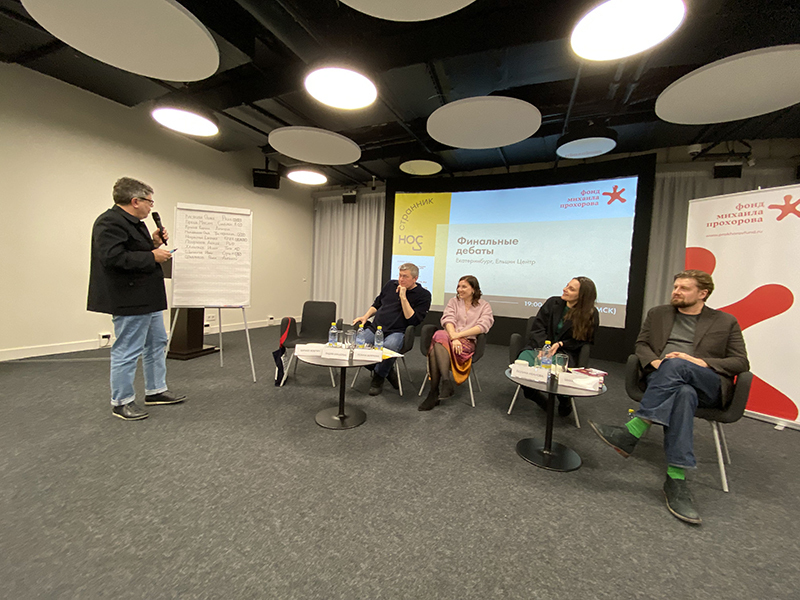
Actors
On chairs in front of the public:
Kirill Kobrin is the curator of the Wanderer/Nose, the owner of the literary salon.
To the right of his jury:
Chairman: Vadim Mikhailin - cultural anthropologist, cultural historian, translator (Saratov).
Polina Boyarkina is a literary critic, editor-in-chief of the journal of modern literature “Reading”, editor-in-chief Bookmate Originals (St. Petersburg) .
Polina Ivanova is a city researcher, local historian, author of the first modern guide to Yekaterinburg (Yekaterinburg).
Mikhail Maltsev -since 2009-owner and director of the Piotrovsky bookstore in Perm, from 2015 -director of the Piotrovsky bookstore in Yeltsin Center (Perm-Yekaterinburg).
Invisible because of Covid:
Denis Korneevsky is the co -founder of the Piotrovsky bookstore in Perm and Yekaterinburg, since 2015 - the program director of the presidential center Boris Yeltsin (Yekaterinburg).
In the hall:
Alexander Kuritsyn - head of the department of creative projects in the Nizhny Novgorod State Center for Contemporary Art (Arsenal).
Place of action
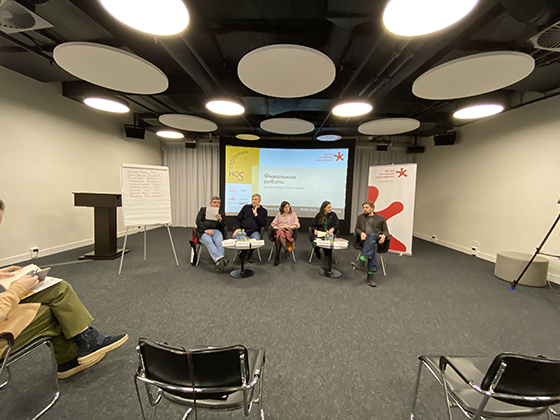
Two cozy halls with glass walls of the educational center on the third floor of the Yeltsin Center in Yekaterinburg.
Short list of "Wanderer/Nose":
1. Vasyakina Oksana. Wound. - M.: New Literary Review, 2021.
2. Gureev Maxim. Caprah syndrome. - M.: Friendship of peoples, 2020.
3. Kutalov Kirill. Antibodies. B.M.: Publishing decisions, 2021.
4. Medvedkova Olga. Three characters in search of love and immortality. - M.: New Literary Review, 2021.
5. Nekrasova Evgenia. Leather. - M.: Bookmate Originals , 2021.
6. Polyarinov Alexey. Reef. - M.: Eksmo, Inspiria , 2020.
7. Hanipaev Islam. Like me. B.M.: Publishing decisions, 2021.
8. Shipnigs Ivan. Stream. - M.: Livebook , 2021.
9. Shmarakov Roman. Alkina. - M.: The United Humanitarian Publishing House, 2021.
Short
The Wanderer/Nos still remains a very strange branch of the federal “nose”. He has not yet become a cultural event significant for Yekaterinburg, rather significant for part of the cultural elite. The conceptual vacuum is filled with the theses and charisma of Kirill Kobrin - he continues to move the “wanderer/nose” towards the parallel project. The discussion (it is difficult to call it debate - more like an exchange of views) came out very meaningful and this year the federal “nose” is ahead of the content. Many members of the wanderer/nose jury are surprised by the absence of non-fiction in the long list. Kobrin claims that this award is an attempt to find a relevant language about books is not the language of philologists and observers. Members of the jury, including two philologists and a bookseller, while considering their background more than a dignity than a disadvantage. Polina Boyarkina summarized the list of this year, rejected the accusations of the “skin” of cultural appropriation, put forward an interesting hypothesis about the ethical functionality of Nekrasova’s language, admired Shipnigova’s language, said that for her the “wound” is the main book in this list. Polina Ivanova said that she was really looking for a new language, that she was very pleased with the list, voted for the “stream”, thanks to which she now always tries to write correctly, and for the “skin” of Evgenia Nekrasova, thanks to the language of which we can look at Russian and American history in a new way . Maltsev cannot suppress a book trader in himself and tells which books from the list and those present are sold in Piotrovsky. He votes for the “Capra” syndrome, complaining that people do not pay due attention to cool literary magazines, and the “wound”, which became an important experience for him, simultaneously telling a personal story about his father. Mikhailin explains the deficiencies of “wounds” and “Stream” and votes for those in whom there are enough literature - for the European book “Three characters in search of love and immortality” and - two votes at once - for the “skin”. The Council of Elders through Kuritsyn passes the voice behind Medvedkov, the hall votes for the "skin". The “wound” and “leather” go to the super final, Boyarkina takes self -confront, as she worked on “skin”, Kobrin and Mikhailin count the voice of the hall in the superfinal. As a result of a short vote, the “leather” of Evgenia Nekrasova three voices against one wins.
Result
Despite all conceptual difficulties, we can say that it was an almost exemplary final-with real content and intrigue. The victory of the "skin" falls into two goals at once. Firstly , Evgenia Nekrasov, who had previously nominated for the country's main literary prizes, finally received a well-deserved premium recognition-the so-called “curse”, which so much was talked about, finally removed. On the other hand, the fact that the “wound” did not receive a “wanderer/nose” opens her direct road to victory in the federal “nose” - as a favorite of this year’s prize.
 © Mikhail Prokhorova Foundation
* * *
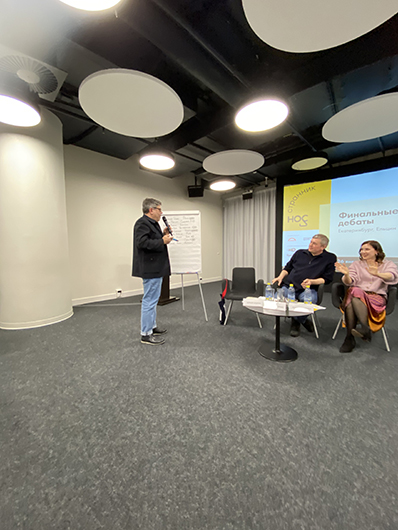
The gathering of guests was declared an hour before the debate, half an hour in place - two small bright halls opposite each other, separated from the corridor with glass partitions. In one, chairs, a screen with the “Wanderer/nose” award, chairs for the jury, flipchart with an already drawn a short list of a bonus are placed in one. In another - several tables with snacks and welcoming sparkling. So far, only after 10 minutes the first guests will arrive, and after another five - an organized jury with Cyril Kobrin by an organized composition of the jury.
The space of the educational center is located on the third floor of the Yeltsin Center. It must be said that this is not a small museum of the deceased president with the hall to pronounce speeches, but a huge memorial-musical-artistic-articular-office-trade center. This community is located on the shore of the city pond, nearby is the skyscraper of the Ural Mining and Metallurgical Company and a mothballed wooden mansion, where Arkady Gaidar did not live long and not to notice, if not set the goal of bypassing the center around.
Soon the hall with sparkling is filled with representatives of local publishers and the local literary community, bloggers and librarians, enthusiastic readers. Around 19:05 the debate begin.
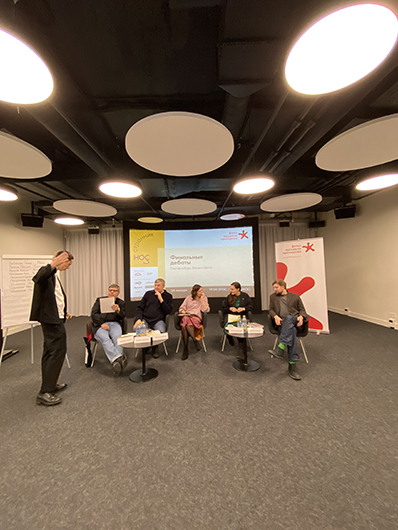
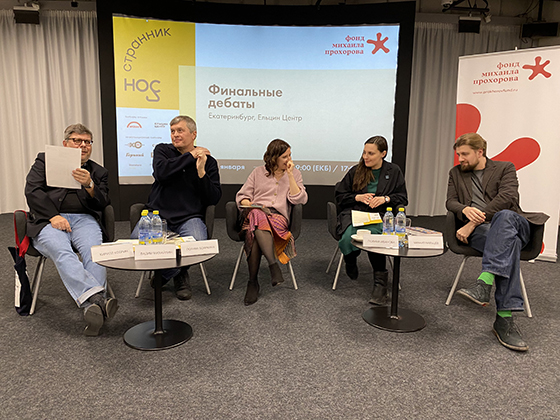
Kirill Kobrin, who has to moderate the ceremony, sits closest to the flipchart. Nearby is Vadim Mikhailin, the chairman of the jury. Then - Polina Boyarkina, Polina Ivanova and Mikhail Maltsev.
Before the flipchart, Alexander Bakin, the head of the department of educational programs Yeltsin Center, faces. He talks about the Wanderer/Nose and that Yeltsin is glad to accept the prize. It emphasizes that one of the key topics since the day of the base is decentralization, so the debate fit perfectly into the center of the center. Conveys the word K.K ..
K.K. With a smile, he takes a microphone. Talks about the hospitable walls of the Yeltsin Center. Submissions in the history of the prize. He says that this is the most interesting literary prize in Russia. However, she, like much in our country, continues to be hierarchical - and is built around the capital. Therefore, the "Wanderer/nose" was invented. Kobrin emphasizes that against the words “daughter of a prize”, he claims that this is a parallel project.
Cyril Kobrin has an amazing property. He envelops those present by friendly intonations, the room at once becomes more comfortable and warmer (imagine something between the interior of Anna Pavlovna Sherer and the studio of the historian of fashion Alexander Vasiliev), but what Bakin called the “wanderer/nose” to the daughter of “nose” is no coincidence. Such an understanding is not without reason.
 © Mikhail Prokhorova Foundation
In 2018, the Volga-Zno appears, lives in Nizhny Novgorod for several years, and then moves to Yekaterinburg and changes the name. The principle of determining the winner of the bonus does not change - first the jury of the federal “Nose” determines the long list of the bonus, and then begins to determine the short list, and in parallel with it comes into the “regional jury”, which independently forms a short list and winner.
The section of the Prokhorov Foundation website “Prize Projects in the Regions” says:
“On the eve of its decade, the Nose Prize expands the framework of its cultural and educational activities: now open discussions about the best modern Russian book will be held not only in Moscow and Krasnoyarsk, but also in other cities of the country.”
There is a conceptual vacuum - we do not find a clear understanding of what the goals of the “wanderer/nose” are. Since it is Kirill Kobrin who oversees it, it is his statements that fill the vacuum. For example, after the debate, where the short list was determined, he said :
“This is, of course, a new stage in the history of the regional“ nose ”. <...> Each of the regions has its own cultural situation and its own cultural language. Our task is to include the voice and intonation of Yekaterinburg - one of the most important centers of modern Russian literature and book publishing - into a public discussion about a new literature and new sociality. ”
- How and what is this voice of Yekaterinburg manifested? Theoretically, this can be identified on a comparison of the nature of the debates of the federal jury with the regional. But there are many additional conditions: how much does its curator affect the bonus? Is the consciousness of the cultural elite in the regions and in the federal center? On the Prize website next to the name of each jury member, the city is signed, and this is not only Yekaterinburg-it is also St. Petersburg , Saratov, Perm. There are also votes from Novosibirsk and St. Petersburg in the federal jury. A difficult task.
- It can be assumed that the “wanderer/nose” in the regions will revive the literary situation in the city. But in Yekaterinburg there is already a developed cultural and book life, this cannot be done with the help of two debat events. Some supportive program is needed here-like a large book fair with meetings, where you can at least look at the authors, or a series of presentations.
-The formation of a long list of bonus is still raising the question. We know that about two hundred applications were submitted to the award from all over the country. So why doesn't the jury “wanderer/nose” selects a long list of itself from the total number of applications? Roughly speaking, we have chosen here in our federal center to your liking, and you-the regional jury-now live with what we have chosen for ourselves, somehow overdo it. And, if you recall the discussion of long lists of previous years, the regional jury is not always quite a choice of colleagues.
The structure, the order and some other signs tell us that in the Prokhorov fund there is no clear understanding of why a “wanderer/nose” is needed, except for a tribute to the Russian regions and the idea (!) Of decentralization. Rather, it is important that one book can be paid to another book, besides those that they will honor the federal jury, reader voting and the critical academy.
When K.K. He speaks of a “parallel project”, you need to understand that it defends this parallelism as a concept and as his point of view as a curator of this award.
Kobrin continues. He emphasizes that this is not a literature championship. He repeats the traditional that “nose” is not only a new literature, but also sociality and sexuality. He says that the way society forms a request to literature, how literature gives words to society is a “dialectical draft of mutual transformation”. The prize is first of all about the language. Therefore, the winner is determined on the debate, the purpose of which is to make a conversation about books understandable and intelligible - which will not go in the language of critics, philologists, observers.
Then K.K. Reminds of the procedure. Today there is a short list (indicates flipchart), there is a jury, each will call two favorites. The jury chairman, just in case, has a third voice. At the same time, the hall votes: "You can influence the final result." One vote will be from the Council of Elders, consisting of former members of the jury. Then the voices are summarized. If there is the same number of votes or a small difference, there will be a superfinal.
Then he says that he will introduce the jury and will be able to “start finally ” (in the hall of revival). Represents this:
Mikhail Maltsev is one of the main ascetics of a book business in the country, a legend man.
Polina Ivanova-author of the only readable guide to Yekaterinburg, is also a legend man.
Polina Boyarkina - editor -in -chief of Reading and Bookmate Originals .
Vadim Mikhailin - a super -legendary man, translated several classic books in the eighties.
(It is worth submitting a petition for the provision of Pauline Boyarkina the status of a man-legend in an accelerated procedure.)
On this, Kobrin conveys the word to the chairman of the jury Vadim Mikhailin.
(This is another magical property of K.K. - By this moment you are already so immersed in details and contexts that you can read the lecture on the "Nosa".)
Mikhailin replies that he took the microphone only to pass it on to Polina. He says that the jury members met secretly yesterday to "agree in what order we will speak."
K.K. reacts: about the order of performance, but not about the winner, he will be determined now!
(Talking behind closed doors never remain a mystery.)
 © Mikhail Prokhorova Foundation
Boyarkina picks up a microphone. It complains that it is not easy for her to start, although she volunteered herself. Coors K.K. - She is a historian of literature and tries to adhere to an analytical approach to the text, to think that the text tells us about the world around. Lists of bonuses are always subjective, but in any case they are modern and talk about the present. I would like to identify trends, find rollbacks. However, this process was performed even at the stage of determining the short list - "such equilibrics is more impossible." During the last discussion, there was a remark from the audience that the jury was not sufficiently subjective, so I would like to balance between the analysis and my sensations from reading.
Further, Boyarkina says that a short list is divided into two categories of texts: some work more with the plot, others - more with the language. The first can be attributed to “antibodies”, “reef”, “type I”, too, but it is a little at the junction. “Antibodel” is an anti -utopian about the near future, in which the epidemic is more terrible than now. As in most anti -utopias, the problems of totalitarianism are raised, which are relevant in our circumstances. “RIF” - about sects - several characters who say ...
K.K. - On the shoulder is quietly: "Time has passed."
Boyarkin - to him: "I will curl up."
Continues. With Gureyev - also polyphonic: smoothly flowing consciousness from one character to another. A story from a common person is a claim to objectivity, from which many modern writers want to leave, they do not want to be demiurges. Language is one of the heroes of Medvedkova, Shmarakov. In "Alkin" is an important plot about oratory. It is important that this is a magical, magical power of the word. Another novel about the language - for which the voice will be given - this is the "stream" of Shipnigov, which is built on imitation of modern speech.
Boyarkina - K.K.: "Already possible?"
K.K. celebrates the "stream" on the flipchart.
It is important that the author interacts with reality and how he does it. This is one of the funniest texts, Boyarkin admits.
K.K. - Boyarkina: "And the second?"
Boyarkina says he will say about the “skin” and move on to the second. He says that Nekrasova knows about the phenomenon of cultural appropriation and she solves the problem at the level of the language: her replacing names (“working”, for example) is an attempt to level the appropriation.
(It is important to remember that Boyarkin now is the editor -in -chief of the project, which has released the “skin”, moreover, she edited the book herself. Here, Boyarkin answers all the cupa accusations of Nekrasova. They often heard from those who did not read “skin”, although Nekrasova herself says why she dared to write about a dark -skinned girl. Boyarkina gives an alternative - or rather, an additional additional - explanation.)
Boyarkina continues. He says that the second voice gives Oksana Vasyakina to the “wound”. For her, this is the main book of the year, five years, perhaps the main one. She works surprisingly with reality. Boyarkina draws in touch with Pushkin, indicates the reflection of the genre in Vasyakina. Pushkin, also inside the text, reflects over the text inside the text, also acts Vasyakina.
K.K. Takes a microphone. He says that they asked Polina to start, since she could give an outline of all the books that entered the short list ( did not Polina herself said a few minutes ago that she herself volunteered?). This is useful for the hall, since we, the audience, probably did not read many books.
(Gorky Realism K.K. on appeal to the hall and with the address of the hall - rare frankness.)
K.K. He says that the time has come to open the envelope from Korneevsky. There are two names in the envelope - Oksana Vasyakina and Islam Hanipaev.
Boyarkina: "I will literally throw the phrase." He says that for her, in terms of choosing preferences, nothing has been changed from the moment of determining the short list, and asks his colleagues, the jury, as they have with this.
(Here in order to talk and convince each other, to bring arguments, and debates are needed. True, while what is happening before us is more like not to debate, but to pronounce speeches in a strict order, which were agreed on the eve of it.)
The word passes Polina Ivanova.
Ivanova says that she is generally about the city, architecture is now really looking for a new language. She is in the jury for the second year and is surprised that neither in Long nor in the shorts there is no non-fiction , since non-fiction herself reads more and it is easier for her to evaluate it.
Ivanova talks about the "wound" Vasyakina. Представьте: если вы из Екатеринбурга долго-долго едете в Березовск на маршрутке и какая-то женщина берет и начинает рассказывать всю свою жизнь. Язык естественный, чтение затягивает. Пришлось унимать зеркальные нейроны — чтобы совсем уж не принимать близко к сердцу душераздирающие вещи.
Иванова продолжает. «Алкиной» вызвал воспоминания о книгах мифов и книгах про дервишей, где одна история цепляется за другую, где короткие серии постоянно длятся. Там очень стилизованный язык, несовременный — думала, что будет тяжело читать. Но потом практически гекзаметр, поэтический текст с ехидными метафорами — быстро начинаешь втягиваться.
Иванова продолжает. «Риф» Поляринова. Главный злодей в книге — ловец человеческих душ. Хороший роман, но есть вопросик к автору — главной героиней каждой истории является женщина, но каждый раз — женщина в беде.
К.К.: «Такую книгу мог бы Джеймс Бонд написать».
Иванова отдает первый голос «Стриму». Говорит, что книга научила писать в мессенджерах. Иванова сама пишет так — поэтому читать сначала смешно, потом невозможно. После книги она старается правильно ставить все знаки препинания.
(Такой вау-эффект достоин включения в хотя бы дополнительный список литературы для школьников.)
Иванова говорит, что «Стрим» — документ эпохи (сравните с «имитацией» Бояркиной). Еще один и, собственно, главный герой Шипнигова — Т9: «Невидимая рука нейросеть приложилась к этому произведению».
(Звучит как охранное заклинание! Один из главных споров вокруг Шипнигова — насколько язык его персонажей является реальным человеческим языком, и здесь две точки зрения — Бояркиной и Ивановой — нашли свое отражение.)
Второй голос Иванова отдает «Коже». Это интересный, важный душераздирающий роман. История сильных женщин. Некрасова не говорит прямые слова — слова замаскированы под определения «работающий человек», например. Это позволяет по-новому взглянуть на картину как российской истории, так и зарубежной.
К.К. добавляет, что важно, что члены жюри работают в разных областях, оттого они по-разному прочитывают книги. После соглашается с печалью Ивановой насчет нон-фикшена .
Слово переходит к Мальцеву. Говорит, что Полина пыталась преодолеть внутреннего филолога, но он не сможет преодолеть внутреннего книготорговца и перечисляет, какие книги из списка продаются в «Пиотровском». Говорит, что он — эмоциональный читатель русской литературы, всегда в нее верил, но отвлекся от нее, зато ближайший год будет неплохо в ней разбираться.
Мальцев продолжает. Говорит, что благодаря ему в короткий список попал «Синдром Капгра», и надеется, что премия подарит тексту жизнь за пределами гетто литературных журналов, которые круто читать, так как можно наткнуться на неожиданное. Это книга о внутренних двойниках. Как будто один и тот же голос переходит от одного персонажа к другому. Рассказчица считает себя темным двойником идеального ребенка. Это странная притча, где человек считает себя не собой, а двойником в балабановских декорациях. Книга заставляет о себе думать даже в очереди в «Пятерочке».
Мальцев продолжает. Думал о критериях литературы, о том, как литература создает народ и нацию, но потом плюнул. Обращается к Оксане Васякиной и «Ране». Говорит, что это книга на пересечении разных жанров — автофикшен, травелог, путешествие вглубь памяти. Вспоминает о Прилепине и «Саньке», отмечает, что отделение от корней у Оксаны не так мучительно. Говорит, что разговор о Сексуальности у Васякиной — не навязывание повестки. Его отец-моряк, который транслировал гомофобную повестку, однажды порекомендовал ему «Это я — Эдичка» Лимонова: « Какие-то моменты тебя смутят, но это голос человека, истерзанного любовью». Так, книга Оксаны может быть нужна, чтобы преодолеть навязанную обществом гомофобию и предрассудки через человеческое сопереживание. Книга Васякиной — максимально близкий опыт для него. Упоминает книгу «Антитела» как работу остроумную, драйвовую и бойкую, с убедительным миром.
К.К. берет микрофон. В последние годы принято презрительно относиться к журналам, но они изменились с советского времени, это живое место. This is the first. Second. Смущают ограниченность и провинциальность разговора. Как будто русская литература существует в безвоздушным пространстве. Как будто рефлексию жанра придумал Пушкин, а не Стерн. Как будто приключения с мертвым телом не были у Фолкнера. Мы все это читали. Говорит, что мы самоизолируемся от собственного бэкграунда.
Иванова — К.К.: «Не все читали. Я существую в безвоздушном пространстве».
К.К.: «Но все-таки хорошо бы добавлять контексты согласно своему бэкграунду».
Михайлин берет микрофон. Список беллетристический, тоже не хватало нон-фикшена . Он ровный, проблема выбора серьезная. Эти книги прорабатывают немые зоны опыта современного российского человека, пытаются сформировать язык разговора о нем. Это как о сексе — где либо медицина, либо мат, а другого языка нет сейчас. В этой прозе такой разговор есть. В каких-то вещах, построенных как эго-высказывание , не хватило литературы. Именно потому, что «Рана» — это текст поэта, текст не сложился. Шипнигов, например, нашел классный ход, но заигрался в игру, которую придумал. Нет внутреннего редактора.
Михайлин продолжает. Хочет отметить две вещи, которые, несомненно, литературны. Книга Медведковой — европейская проза. Работает на суггестии. Большая часть того, что рассказывает текст, остается за кадром. Изысканная книга, которая работает на разных уровнях. Говорит, что отдал бы и второй голос за этот текст.
Иванова: «За эту же книгу? Может, все-таки за разные?»
Михайлин: «А можно я буду все-таки решать сам?» Continues. Смотрит на флипчарт. Говорит, что, учитывая, как развивается ситуация, хочет отдать еще два голоса Евгении Некрасовой, чтобы уравновесить шансы. Она заслуживает попасть в суперфинал.
(Складывается три на три в этот момент — у «Кожи» и «Раны». Это интересная процедурная история — казалось, что у председателя третий голос не априори, а в случае, например, равного количество голосов. Михайлин посчитал, что это сумма голосов и он может использовать их по своему усмотрению. К.К. его не остановил, как и другие члены жюри, дебаты продолжились.)
В зале аплодисменты.
К.К.: «Вот это настоящий поворот винта». Говорит, что пора начать читательское голосование. Передает слово Александру Курицыну.
Курицын встает. Подчеркивает, что он самый молодой старейшина. Говорит, что старейшины обратили внимание на три книги. За них равное количество голосов, и он отдаст свой голос еще одной — он будет решающим. Первая — это книга Медведковой. Изысканнейшие описания Италии. Если интересуют фактура эпох и контекст искусства — это то, что нужно. Вторая — «Риф». Это хорошая современная русская проза, если вы ищете отвлечения — она для вас. Третья — «Рана». Во-первых , автобиографическая тема. Во-вторых , это тема русской смерти, которая сейчас наконец-то поднимается, очень важная и перспективная. Говорит, что отдает голос Ольге Медведковой, чтобы у нее был шанс.
Вопрос из зала Михайлину — почему отдали голоса за «Кожу»?
Михайлин отвечает, что, во-первых , по уровню это похоже на раннюю Гертруду Стайн. Опыт человека, которому темно в словах и которому нужно найти способ высказаться. Во-вторых , это проблема сопоставления опыта рабства и крепостного состояния. «Кожа», несмотря на то что является беллетристикой, — актуальное высказывание, которое может быть крайне продуктивным для дискуссии в обществе.
Вопрос из зала про нон-фикшен — почему его правда нет?
К.К. отвечает, что уверен, что нон-фикшен присылали, но состав федерального жюри литературоцентричный. Ему самому странно. В мировом масштабе странным образом мода на беллетристику вернулась благодаря Салли Руни.
Бояркина парирует. Говорит, что между фикшеном и нон-фикшеном всегда выберет фикшен.
К.К. отвечает, что это потому, что она — профессиональный читатель.
Бояркина парирует, что у нее так и по работе, и не по работе. Затем переходит к размышлению о распространенности усложненного высказывания и запросу на прямое высказывание, которому отвечает «Рана».
К.К. отвечает, что культура — штука сложная и его пугает то, как культурная элита испытывает презрение к сложным вещам. Хотя видит запрос на новую искренность.
Мальцев добавляет, что еще недавно хорошим тоном считался сложный нон-фикшен и вообще была мода на сложные вещи, прежде всего — на сложную музыку. А затем появился грубый панк-рок . Обращение к себе самому — это выход из сложной ситуации в сторону жизни.
К.К. отвечает, что панк-рок был разрушителен, а те, кто пишет автофикшен, — гуманисты.
 © Mikhail Prokhorova Foundation
Подведены итоги читательского голосования. К.К. зачитывает результаты. С большим отрывом зал проголосовал за «Кожу».
Совокупный голос читателей получает Некрасова. Расклад — четыре Некрасова, три Васякина.
К.К. обращается к жюри. Говорит, что можно сразу объявить Некрасову победительницей, а можно устроить суперфинал между «Кожей» и «Раной».
Михайлин говорит, что количество членов жюри четное и будет трудно.
Бояркина говорит, что берет самоотвод. Она не может голосовать, так как работала над «Кожей» как редактор. Говорит, что может отмечать на флипчарте голоса, но К.К. не реагирует на ее предложение.
Следует небольшое обсуждение К.К. и Михайлина. Договариваются о том, что если есть зал как коллективный член жюри, то следует в суперфинале зачесть сразу один голос Некрасовой. К.К. говорит, что это первый случай, когда в суперфинале учитывают голос зала.
Объявляют голосование жюри в суперфинале.
Мальцев голосует за «Рану».
Иванова голосует за «Кожу».
Михайлин голосует за «Кожу».
К.К. берет микрофон:
«Торжественно объявляем, что победителем “Странника/НОСа” сезона-2021/2022 становится книга Евгении Некрасовой “Кожа”».
В зале аплодисменты и смех.
К.К. благодарит всех, что пришли. Затем приглашает людей продолжить небольшим угощением.
Счастливая публика потихоньку перемещается из одного стеклянного зала в другой через маленький коридорчик — к вину и закускам.
END