Translated material
One of the oldest Kursk streets

Sonina Street can be called the oldest of the Kursk streets. In general, this street appeared millennium ago, then it went around the fortress wall of the Kursk Detinz. Today, Sonina Street is located between Alexander Nevsky Street and Red Square.
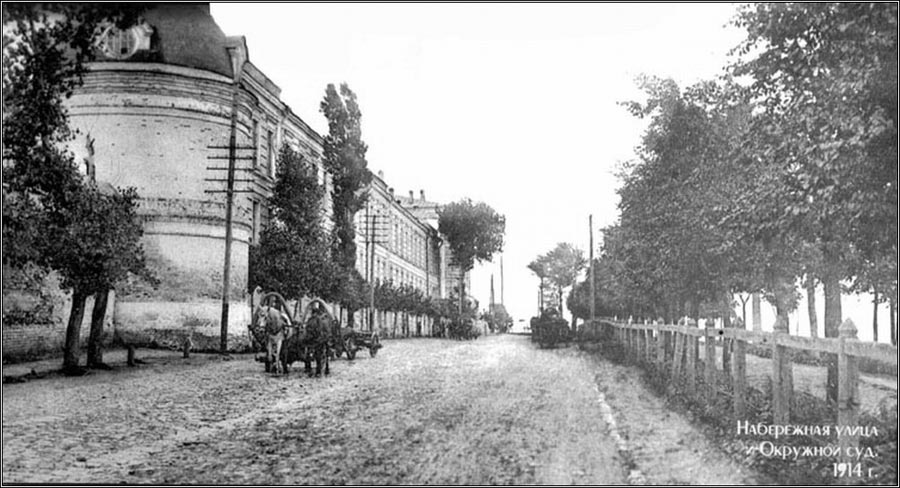
Until 1905, Sonina Street was called Muranovskaya and included the territory of modern Lunacharsky Street. In 1905, the street received a new name - Upper Naberezhnaya. The street received its modern name in 1977 in honor of the Hero of the Soviet Union, Lieutenant Ivan Egorovich Sonin. A native of the Dmitrievsky district died heroically during the Great Patriotic War. The title of Hero of the Soviet Union was assigned to him posthumously.
At the address: Sonina Street, 1 is the building of the spiritual consistory archive, built in the spirit of the Italian Renaissance.
Next to the archive was the building of the spiritual consistory, which was demolished in the 1920s. The consistory was the organs of the diocesan administration. It included from three to seven members who were archpriests or priests, they were approved in office and dismissed on the proposal of the diocesan administration of the Synod. The spiritual consistory within the borders of the Kursk diocese was engaged in judicial, economic and administrative issues.
The building of the spiritual consistory that was not preserved today was built in the XIX century according to the project of the architect of the Kursk Tales Chamber Pavel Stepanovich Grozny. The building was built for money that was received from fees from the indigenous fair. These funds went to the city treasury.
As for the preserved building of the archive of the spiritual consistory, it contains decrees of the Holy Synod and Consistory, documents on the construction and repair of temples, collecting donations, metric books, journals of the clergy, etc. Today, all these documents were transferred to the State Archive of the Kursk Region.
If the main building of the spiritual consistory was demolished in the 1920s during the reconstruction of the entrance routes to the railway station, which was located on the site of the circus, then the archive building was not injured during the Great Patriotic War and was not demolished later. After the war in the former building of the archive, kindergarten No. 33 was opened, and in the 1980s a branch of the Semashko city infectious diseases hospital began to function here.
But the most noticeable building of Sonina Street, known to the Kuryans as the House of Officers, is today the official name “Philharmonic 2”. Of course, this building is one of the main symbols of the city of Kursk and one of the best examples of secular architecture of the XIX century.
Before the revolution, the building was located in the building a noble assembly and a shelter. The name of the project architect, unfortunately, is unknown today. It is only known that the future house of officers was built in 1877. The structure in the eclectic style was erected without plaster with facial and curly bricks with embossing. The first two floors of the building were given to the noble assembly. The real pride of local nobles was the assembly hall, designed for 2 thousand people. The third floor of the building was given to the noble boarding house, where students of the gymnasium and real school lived in housing.
On October 17, 1892, a fire occurred in the building of the noble assembly, which completely destroyed everything that was inside the building, all the floors collapsed and only the walls remained from the house. But the house of the noble assembly was quickly restored. The assembly hall also earned again, which more often served for concerts or theatrical productions than for the meetings of representatives of the noble estate.
After the October Revolution, the building of the noble assembly was renamed the working palace. In the hall of the meeting, which now wore the names of Marx and Engels, many famous revolutionaries, including Trotsky, Kalinin and Bukharin, as well as famous poets, in particular Aseev and Mayakovsky, performed. On September 12, 1920, the Museum of Arts was opened in the building, and in 1922, institutions such as labor, province -owned and proletarian club appeared in the working palace.
During the Great Patriotic War, when the Nazis retreated from Kursk, their leadership decided to inflict maximum damage to the city, so the building survived a large -scale fire for the second time in its history. The reconstruction of the building was completed only in the early 60s, after which the house of officers was located in it, which for decades became one of the significant cultural centers of Kursk.
The oldest building of Sonina Street is a guard tower, built at the end of the 17th century on the donations of Prince Peter Romodanovsky. The tower was a defensive structure of the Znamensky Monastery and the Kursk fortress. The tower with part of the wall is the last preserved element of the once strong massive monastery fence, in which there were several towers.
Opposite the guard tower is a modern attraction-a commemorative sign in honor of the 700th anniversary of the Icon of the Kursk Rown Icon “Sign”, opened in 1995. Its author is Vyacheslav Klykov.