
Translated material
Sex, lies and video

 Illustration: "Agency"
Sex, lies and video
The Kremlin wanted to build its own YouTube, but it turned out as always. Investigation of "Important Stories" and "Agency"
Russian authorities are using fines and threats of shutdown to force Google, which owns YouTube, into submission. In case this doesn't work out, Kremlin-linked companies are creating domestic substitutes for popular video services. “Important Stories” and “Agency” tell what Russians risk being left with if the authorities ban YouTube.
Look Russian
“The war with the Russian World puts compradors, embezzlers, the Kyiv junta and curators from the United States on the same line of barricades. The defense of the Russian World, on the contrary, unites all of us - those who are ready to resist,” this is a policy quote from the news site ANNA-News, which, in the spirit of pro-Kremlin propaganda, covers military conflicts in Syria and the Donbass. In 2020, YouTube blocked ANNA channels. This began the latest attempt by the Russian authorities to create a replacement for popular foreign video services.
Roskomnadzor demanded that Google lift the block on ANNA-News, and at the same time called on Russian media to run channels on “domestic video hosting sites.” Over the past year, Russia has experienced a real boom in domestic “alternatives” to popular video services.
A month after Roskomnadzor’s statement, one of the largest Russian media holdings, Gazprom Media, became the sole owner of the Rutube video platform, the so-called Russian YouTube. The Rutube project is being handled by the new general director of Gazprom Media, Alexander Zharov, the former head of that same Roskomnadzor.
What is Gazprom-Media?Gazprom-Media (GPM), one of the four main television holdings in Russia, is three-quarters owned by Gazprombank.
GPM received its main assets as a result of the destruction in 2001 of the independent holding Media-Most, which was owned by Vladimir Gusinsky (the main asset is the NTV channel). The authorities did not like the independent policy of the holding: satire on the new President Vladimir Putin, investigative journalism in general and the way Media-Most covered the second Chechen war in particular. They liked the political ambitions of Gusinsky even less, who in the 1999–2000 elections supported not Vladimir Putin, but the opposition.
The destruction was accompanied by searches and the opening of a criminal case against Gusinsky. The Kremlin presented the conflict in an economic sense—it was then that the meme “dispute between economic entities” appeared. Media-Most had a large debt to Gazprom; this debt was eventually paid off with the assets of the holding. An agreement on this - on the principle of “freedom in exchange for property” - was reached in the Butyrka prison, the corresponding protocol was signed by the arrested Gusinsky and the then Minister of Press (and in the future - the head of the GPM) Mikhail Lesin.
So Gazprom-Media became the owner of Gusinsky’s assets, which still form the basis of his portfolio: NTV, TNT, Ekho Moskvy and others.
GPM is a holding company that was the first to show Russian stand-up on TV, launched the longest-running reality show “Dom-2”, the sports channel “Match TV” and Premier streaming.
GPM's revenue in 2020 is 99 billion rubles, the share of television audience in 2020 is 26.6% (cities with a population of more than 100 thousand, viewers 14–44 years old). GPM itself writes about itself on its website: “Gazprom-Media is a whole universe of media brands, which is created by creative super-heroes, passionate and bright people.”
At the same time as Rutube, Gazprom Media also bought the “I’m Well Done” mobile application, developed with the support of the Innopraktika Foundation, which is headed by Putin’s daughter Katerina Tikhonova. Zharov announced the creation of a “Russian TikTok” based on the application, where users will be able to post short vertical videos. The service, aimed at users 14–34 years old interested in “personal recognition and material success,” launched under the name Yappy in November 2021.
Support “Important Stories” This way we can tell more often how the authorities are building a “sovereign RuNet”Support “Important Stories”Yappy was soon introduced to Putin. At the president’s press conference in December last year, the star of the TNT TV channel (owned by Gazprom Media), actress Anna Khilkevich, asked the president a question: “I represent the Russian social network Yappy. The development of digital services brings great opportunities, including in the field of education... In Yappy you can not only view, but also create videos. How do you approach interacting with young people in these environments?” “The opportunities you mentioned should certainly be used,” the president responded. Three days later, Gazprom Media announced that the application had already been downloaded a million times.
Finally, in the fall of 2021, the VK holding, which owns the social networks VKontakte and Odnoklassniki, also announced the launch of a video platform - VK Video, which will unite the 40 million audience of the company’s video services. Soon, VK shares were transferred to the same Gazprom-Media and Sogaz - companies that are associated with Yuri Kovalchuk, the president’s confidant, responsible, in particular, for control over the media. Vladimir, the son of the first deputy head of the presidential administration Sergei Kiriyenko, then became the general director of VK.
However, the Russian authorities first became interested in video on the Internet many years ago.
Putin and women's breasts
At the end of the 2000s, student Yuri Degtyarev went to the Titan gym in Lyubertsy. “Such a man’s rocking chair,” he recalls. There Degtyarev met Vasily Yakemenko, the head of Rosmolodezh, a creature of the deputy head of the presidential administration Vladislav Surkov: “Once a girl in a short skirt was leaving the hall, and some jock took a photograph of her from behind, as if under her skirt. Yakemenko approached the jock and asked to be removed, I also threatened him. That's how we met."
Soon, 22-year-old Degtyarev was invited to work at Rutube, which was purchased by Gazprom Media in 2008. In his words, “look for talent.” “I was promoting various characters: [the still popular video blogger] Ilya Maddison was found on Rutube, [video blogger] Kamikaze Di I dragged to Rutube from YouTube, [video blogger] Ruslan Usachev appeared,” says Degtyarev. — The market was empty. They attracted almost anyone who filmed anything and offered exclusive conditions.”
In 2010, meeting Yakemenko yielded results. While working for Rutube, Degtyarev came up with the semi-religious project “Thank you, Eva!” As a result, the Russian Orthodox Church did not approve of the show, and Gazprom Media was not eager to implement this project, says Degtyarev. Then Degtyarev quit Rutube and found allies in the Kremlin. This is how the affiliate network for young bloggers “Thank you, Eva!” was launched, without religion and not on Rutube, but on YouTube. The work was supervised by the then press secretary of Rosmolodezh Kristina Potupchik, who began her career in the pro-Kremlin youth movement “Nashi”, whose leader was Yakemenko and whose ideologist was Surkov. Potupchik is still considered one of the Kremlin’s main contractors on the Internet. As Potupchik later admitted in a conversation with Meduza, in Degtyarev’s projects the Kremlin “sometimes used halftones to indicate some kind of political discourse through banter.”
The most famous video of this kind was called “Putin gropes voters”: a video blogger touches a thousand girls’ breasts, and then shakes Putin’s hand on the Seliger forum. In this way, he “transmits tactile information to Putin,” since Putin himself is “busy with government affairs and cannot afford to touch voters on the street.”


Many now popular bloggers started in the Kremlin show: Ruslan Usachev, Ilya Maddison, Danila Poperechny, frontman of the Little Big group Ilya Prusikin. In 2012, hackers hacked the emails of Potupchik and Yakemenko. The published letters indicated fees paid by the Kremlin to bloggers, including participants in “Thank you, Eva!” After this, the show was canceled - the bloggers left the project, saying that they did not know about the Kremlin financing. Now Degtyarev says that half of those who said so knew - “it was just convenient for them to say so.”
Then the authorities missed the chance to grow something worthwhile from Rutube; later “the product was doomed,” says an interlocutor close to the Kremlin. Indeed, then the gap in the audience between Rutube and YouTube was not as huge as it is now: in the spring of 2007, 1–2 million people visited Rutube monthly, and the monthly audience of YouTube worldwide was about 40 million, Business Journal cited statistics in the summer of 2007.
YouTube without handle
After the first attempt, the authorities seem to have forgotten about Rutube for a long time. Over the past ten years, this service has been a “suitcase without a handle” for Gazprom Media; they have tried to develop it somehow, but the result has always been controversial. As a result, Rutube fell catastrophically behind YouTube.
In 2007, YouTube launched a Russified version and “it quickly became clear that it would not be possible to catch up with it,” says a former employee of Gazprom Media. “The weakest thing was the assembled technical part, almost on the knee,” recalls Vladimir Barabanov, director of service development in 2008–2010. “Rutube has gained fame as a video hosting site where it is very difficult to watch videos.”
In 2010, Barabanov quit his job, and Gazprom Media began a series of experiments. Former employees of Rutube recall how they tried to turn the service into an aggregator of videos from social networks, launched paid live broadcasts of the Russian Premier League on it, and even wanted to turn it into an online cinema.
But attendance was falling. For example, according to TNS, in July 2011, Rutube's audience was almost 15 million, and in May 2015 - 5.5 million. “By 2015, no one was betting on him,” sums up the ex-Rutube employee. “But they couldn’t close it completely, otherwise why would they spend so much money and resources?”
In 2016, Gazprom Media made a joint venture with Pladform, where it transferred Rutube. The merger was supposed to lead to the creation of “the leading video platform in Russia.” But it didn’t. In December 2020, when Russia desperately needed domestic substitutes for foreign services and Gazprom Media decided to buy Rutube back, its audience was 1.82 million per month.

Roskomytube
Conversations that “it would be good if an alternative video hosting appeared in Russia” intensified at the turn of 2020–2021, recalls a presidential administration official. Around the same time, the former editor of the Vedomosti media department, Ksenia Boletskaya, citing her sources, reported that the largest media holdings, on behalf of the presidential administration, were “with all their might” working to create a Russian alternative to YouTube. This work began even before Alexei Navalny published on YouTube an investigation into his poisoning and the confession of one of the poisoners (the two videos have now received a total of more than 56 million views). And in February 2021, after protests caused by Navalny’s arrest, Putin publicly formulated a policy regarding foreign services: “We will not curtail anything until we have our own... When our respected colleagues see that there is an alternative, that they do not occupy a monopoly position in this market, they will behave differently.”
Soon, new figures ideologically close to the Kremlin appeared in the Gazprom-Media team: first, Sergei Minaev, editor-in-chief of Esquire magazine, became Zharov’s advisor, and later Tina Kandelaki was appointed Zharov’s deputy.
Russia has the technical ability to slow down or block YouTube, Artem Kozlyuk, head of Roskomsvoboda and member of the expert council of the State Duma Committee on Information Policy, is confident. This threatens IT companies that refuse to open their representative office in Russia under the “landing law.” Other experts interviewed earlier by The Bell also agree with Kozlyuk. Slowing down Twitter was not carried out in words, but slowing down YouTube is even easier, Kozlyuk believes. Firstly, video is the heaviest traffic; it is easier to isolate it using equipment installed on provider networks and block it. Secondly, Google installs its servers at Russian providers, in particular, to make YouTube work faster. Authorities can simply ban telecom operators from using these servers.
“In 2021, people from Rutube came,” says one of the top Russian video bloggers, “they offered to move the show to Rutube. The financial conditions were as follows: fix the monthly profit of my channel from advertising and affiliate projects, add another third to this and stupidly turn this figure into my salary, which will be paid by Gazprom Media or an agency associated with them. Additionally, they offered to pay for each episode of our show, just as television buys content from third-party production studios. In a word, this is a tempting offer.”
“The conditions [of switching to Rutube] were as follows: fix the channel’s profit from advertising and affiliate projects, add another third to this and stupidly turn this figure into my salary.”
The interlocutor eventually refused: “Why sacrifice advertising revenue for the sake of incomprehensible prospects on a social network where there is not a single famous name?!”
“They are ready to overpay,” says a Gazprom Media employee on condition of anonymity. — They don’t have any options: who will agree to switch from YouTube to Rutube? Therefore, they are willing to pay more, compensate for monetization, and help attract advertisers.”
In 2021, Gazprom Media indeed waged a broad campaign to lure bloggers to its platforms - Rutube and Yappy, this was confirmed to the editors by eight more bloggers and two managers working with stars. “Important Stories” and “Agency” have copies of contracts for content creation for Rutube and Yappy, which are concluded with novice tiktokers. They are willing to pay them from 5 to 125 thousand rubles a month, depending on the number of subscribers in other social networks. A special condition is the absence of “jokes and questions on religious and political topics” in the videos.
Contracts with bloggers are concluded by the Insight People agency. Apparently, it is the main supplier of content for new Gazprom Media projects. At least, this agency was mentioned by four editorial interlocutors as a representative of Gazprom Media. A year ago, such a company did not exist, but now Insight People studios are open in 43 cities, the company says in press releases. The agency's general producer is 28-year-old Ilya Ivlev. He claims that he worked with rapper Yegor Creed and stylist and artist Sergei Zverev, and there are numerous photographs with these stars on his social networks. Now Ivlev, in his words , is “implementing patriotic projects.”
However, so far, attempts to lure major figures from YouTube to Gazprom Media have not yielded significant results: bloggers interviewed by the editors claim that they refused the offer. Some of those whose videos can be found on Rutube learned about this from correspondents of “Important Stories” and “Agency”. Video hosting allegedly, bypassing the authors, agreed to duplicate content with affiliate networks that act as intermediaries between bloggers and advertisers.
Subscribe to the “Important Stories” newsletter So you will be the first to know about new “financial projects” of former officials“This is state propaganda, they won’t let us into Ukraine,” says the indignant author of the channel, whose videos ended up in Rutube without his knowledge. “I don’t have such idiots,” answers the producer of large YouTube channels when asked if any of his clients went to Gazprom Media. - They can promise that everything will be fine with monetization, and then it turns out that there is no money. This is a government agency, they are trying to turn the Internet into a TV, where you can neither comment nor see views.” On Rutube, users actually do not see the video view counter and cannot leave comments.
Most of the interlocutors of “Important Stories” and “The Agency” say that Rutube’s funding has increased significantly since the beginning of the state’s war against YouTube - money is allocated to lure bloggers and to update the technical part of the service. Moreover, it is not only Gazprom Media that is investing in this project. The state also helps Rutube indirectly - for example, through the Internet Development Institute (IRI). This institution was created as an autonomous non-profit organization, but is actually managed by the state. It is headed by a former employee of the presidential administration, Alexei Goreslavsky, and on the supervisory board is the first deputy head of the administration, Kiriyenko, and Alexander Zharov himself.
In the summer of 2021, Iran received 7 billion rubles from the state to create “youth and patriotic content on the Internet,” and in January 2020, Rosmolodezh issued a subsidy of 9 billion rubles for three years to the institute. In 2022–2024, Iran should receive more than 41 billion rubles from the budget for the same purposes, according to budget annexes published on the State Duma website. Since 2021, IRI has obliged grant recipients to post their videos on Rutube, if this “does not violate the agreement on exclusive publication on other platforms.” Among such videos on Rutube you can now find, for example, the series “Sanya, gas!” — there you can watch it without advertising.
Gift to Zharov
Who definitely benefited from the struggle of the Russian authorities with foreign Internet giants was the long-term censor of the Runet, the former head of Roskomnadzor Alexander Zharov. As can be seen from his declarations , over ten years (2009–2018), as Deputy Minister of Communications and then head of Roskomnadzor, he officially earned about 42 million rubles. At Gazprom-Media, his income increased by two orders of magnitude, as follows from financial documents at the disposal of the editors. For just over nine months of 2020, Zharov received at least 299 million rubles, or more than 1 million rubles per day, including weekends and holidays.
“This is his personal financial project,” an official familiar with him says about Zharov’s transition to Gazprom-Media.
About a year after Zharov moved to Gazprom Media, his family became the owner of luxury real estate. Last summer, a plot of land of 45 acres and an 846-meter house with a 278-meter garage in the Pavlovo cottage village near the village of Velednikovo, Istrinsky district, Moscow region, were registered in his wife’s name. This is a gated community with very expensive houses, its own “premium fitness center,” golf club and concert venue. The cost of comparable cottages in this village starts from 300 million rubles. Both buildings and the land plot were purchased with a mortgage obtained from Gazprombank, which is the main owner of Gazprom Media.
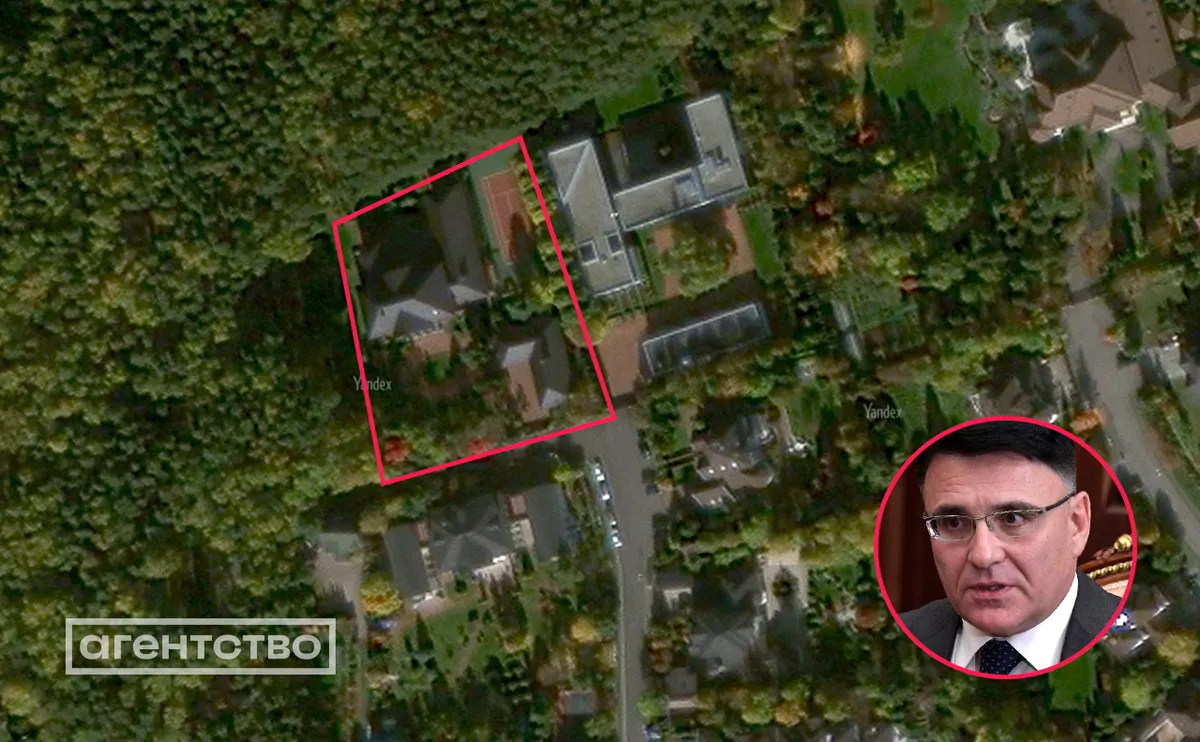 Photo: "Agency"
Before Zharov headed Gazprom Media, judging by the same declarations , the main breadwinner in the family was his wife Evgenia. In 2012–2017, she showed income of 183 million rubles, “including from the sale of real estate.” According to Rosreestr, she almost simultaneously bought and then gradually sold twenty apartments in Khimki and a plot of land near St. Petersburg for the construction of a large residential complex.
Gazprom Media refused to answer questions from Important Stories and the Agency. It was not possible to contact Zharov.
* * *
“No one [in the Russian leadership] believes that anything will come of these products [domestic substitutes for popular services],” admits a high-ranking Russian official who knows the IT industry. Current and former employees of the presidential administration said the same thing. The authorities have much greater hopes that Western sites will succumb to pressure and meet the Russian regulatory authorities halfway. “The Economist party is winning so far,” says one of the interlocutors. “It was decided that economic measures will be applied to YouTube first, including a ban on advertising for Russian companies, slowdown, and only then shutdown.”
With the participation of Mikhail Rubin (“Agency”), Galina Sakharevich and Roman Badanin (“Agency”)
Editors: Roman Badanin, Maxim Solyus
Support thosewho is telling the truth! You can become our donor by making a one-time or monthly donation. We want to depend only on you - those who want to know the truth, those who are not afraid to be free. Help us tell you the Stories That Matter.Support Important Stories