
Translated material
About the "Code of Frikov"
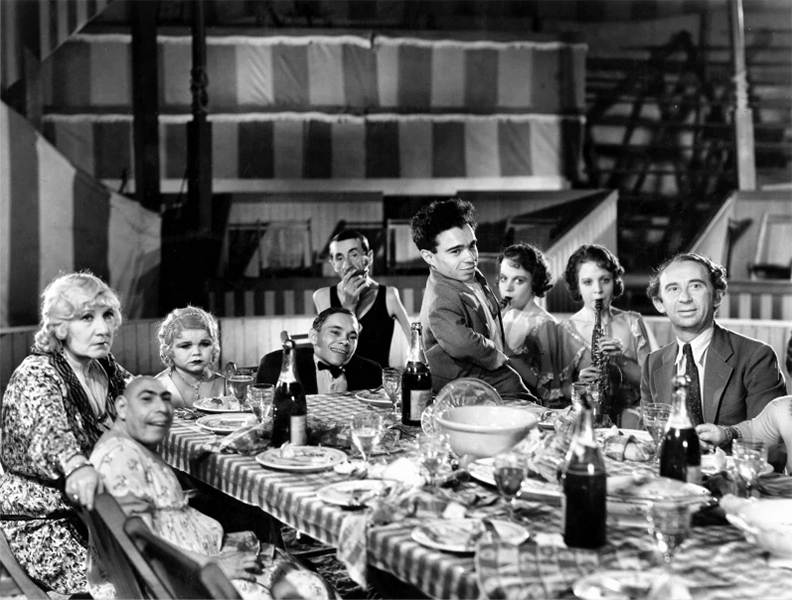
On February 12 and20, the Garage Museum of Contemporary Art will show the Codex Friciks - the Salome CHELOME CHANOMS, in which she turns to the history of the disability in the Hollywood cinema, taking the legendary picture of Tod Browning “Frequent” as a starting point. This show is part of the program of the annual conference “The Museum of Sensations. After inclusion: utopia and new scenarios. ”
The film-Estseum Salome Chasnoff is embedded in a great tradition: a few decades before its appearance, Marlon Riggs (Ethnic concepts, 1986), Barbara Hammer (Nitrate Kisses, 1992), Rob Epstein (Celluloid Cabinet, 1995) by the same method studied the tradition of invalid communities. People with disabilities had to wait much longer than others: the problems of this group with imaginary political neutrality were not so soon to separate from the general imperfections of the social environment. The radical voice of Michel Foucault in the 1960s managed to politicize the field of mental disorders, but people with physical and mental disability still need to defend specific political subjectivity.
Its existence is not so obvious due to the lack of a clear antagonist, and to unite “against” it is always easier than “for”. Supporters of feminism, LGBTK+ and movements for the rights of dark -skinned have long found a way to cooperate into resistance groups - partly because their opponents were never embarrassed to massively declare themselves in a word and deed. But with the exception of rare statements of especially odious politicians, in recent history, people with disabilities did not encounter explicitly derogatory discourse, which would not be sporadically in everyday life, but a program-exhield in nature. And this only harmonized consolidation - after all, for the instance of the authorities of real people with disabilities, as it were, does not exist. In their place is an nameless and invisible addressee of the strokes of verbal formulas (“give in place”, “click on the button - and we will help to rise”). It is more difficult to resist the polite indifference than open aggression, especially since its character is so total that it would require not only competent political statements, but immediate nuanced reforms in all social infrastructure - the enterprise is costly conceivable under capitalism. In other words, the “healthy” is still not realized as a privilege - and in the actual discourse much further from this awareness than “male”, “heterosexual”, “white”.
But the film Chasnoff, like this essay commenting on it, is not about politics as a whole, but about its specific manifestations in the field of representation. Unlike predecessors (Riggza and Hammer), the director narrows the area of designing images to the very mass segment - Hollywood cinema, which in the last century was really responsible for which character schemes will become a model for real human interactions. It is fundamentally important that there is nothing to oppose to such a canon so far: no subversive, small cinematography-comparable to feminist, black and Quir-Kino -did not have created the trunk discourse in parallel, people with disabilities had the opportunity to speak on their own behalf only in a rare radical dock, like “uncontrollable for anyone” Boris Yukhananov or “faces of our faces Fear ”by Stephen Dvoskin, well, and, in fact, the“ Code of Frikov ”. Each hero, talking with Chassnoff, conducts an audit of Hollywood films and expectedly does not find anything in them, at least some kind of correlating with his daily experience. Still, because films are attributed to people with disabilities that victimic sexuality (if we are talking about women), then possessing magical strength, then the ability to motivate the “healthy” to realize their advantage and live a full life. The last cliche is no less naive than the Contactly copy -paste of the zero with the biography of the artist Nikuychich, whose repost was reduced to one idea - if he did it, then I can .
Criticism becomes especially acute when the collective storyteller of the “Code of Frikov” discovers the terrible typicality of happy ends: in Hollywood ribbons, heroes with disabilities either die (prefer to leave beautifully than to live “such a life”), or return to special institutions (it is better to be safe than in the brutal world), or they give up magically. The specific pathological of such finals is that the filmmakers refuse to consider the disability of heroes by the option. It is impossible to get used to this state, to accept it - then it remains to die or recover, or permissible only in specially designated places, really and symbolically delimited from the "normal life". It is easy to understand why the last scenario is supported by a wide range of power institutions. Since in real life, patients do not die so often and almost never recover, isolation under the guise of caring is the best way to keep this group under control.
The main question of the film Chassnoff is not formulated directly, but it is clearly read: by what means can such a film replacement of characters with disabilities can be achieved, which would be adequate to their daily experience? Choosing an essyist format, the creators - consciously or not - leave the need to answer it. But several sentences still sounds. One thing is quite common for inclusive discourses - to allow people themselves with disabilities to the production of films. The fulfillment of this requirement is the truth is the only way to place in the place of the usual character abstraction of the living hero who can translate the personal experience of its creators. The second sentence, persistently sounding in the film, is to return to the motive of the Browning "freaks" and show people with disabilities as a community, and not as outlandish loners. If everything is quite obvious with the first, then the second move generates new questions.
The Fricice Code has a particularly curious cutting of personnel: rich, famous and - of course - completely healthy Hollywood actors climb onto the stage from year to year to get an Oscar for playing a person’s role with disabilities. It is clear where the short installation is marking: Chasnoff indicates the obvious political blindness of this repeating ritual. Let's see what roles are rewarded with a movie academy: a blind man (Al Pachino in the “Women's Smell”), a man with cerebral palsy (Daniel Day-Lyuis in “My left foot”), a man with an autistic disorder (Dustin Hoffman in the “Rain Man”), HIV-positive (Matthew of Maconac and Jared Summer in the “Dallasian club Buyers ”), a woman with Alzheimer's disease (Julianna Moore still Ellis). Of course, none of these heroes can be considered conventionally healthy. But it is hardly possible to unite them into a homogeneous community, including on the basis of those problems that were previously outlined in the film itself. It is extremely difficult to equalize the depolitized status of people with disabilities with the increased politics of HIV-positive (not only in the cinema, but, of course, beyond it). Heroes with Alzheimer can hardly become the target of criticism, demanding to show the daily experience of people with disabilities without an accent on pain of their condition. And there are differences between blindness, cerebral palsy and auto disorder - not only in the clinical sense, but also in how each of these disabilities structures relations with the world.
Therefore, when watching the film, the question arises: what kind of community are we talking about, how does it realize its own boundaries? According to the film, Chasnoff seems that so far - only apophatically, through the denial of belonging to the group of normative “healthy” subjects. But should, in this case, confriving him to be one? Or to agree on the general rules for the representation of those who are non-health -only the district path to strengthen the same norm of "health"? These issues, of course, are not questioned by the value of Chasnoff's work - in the end, only one of its episode is problematic. And the main force should remain polyphony, which comes to the film, contrary to the name - the multiplicity of the votes is not needed by the code, but a variety of individual experiments. By the way, heroes are also said about him: the use of the general category “person with disabilities” leads to the silence of internal differences.
Once Hollywood cinema refused the right to individuality even white heterosexual men-the stars system obliged to fit into a limited set of role, especially if we are talking about characters-prostagonists. Today, for many groups, the situation has either changed or changed, but, as Chasnoff rightly concludes, people with any disabilities are still out of this process. This rule is not without exceptions, and over the past years I recall characters whose subjectivity was not determined exclusively by disability. As a rule, these are second-plan serial heroes, which are not at all similar to each other, and therefore exactly put here in one row: Walter Jr. from the “Great” , Rebecca from “I never” , Lenny from “Do not try to repeat it”. In these cases, the characters do not manifest anything (they are not political activists, and disability does not give them superpowers), but they do not hide it. And the viewer, who is not used to considering people with disabilities, the norm of their everyday life, gets used to the natural sound of stuttering speech and the rhythm of the movement of a wheelchair. For those who share the peculiarity of their position with the heroes, they become an excellent example of how, without any insurmountable problems, you can fit into a diverse and complex character world without becoming an object of exoting.
But the listed examples do not solve another problem that the heroes of the film pay attention to - in these TV shows there is only one character with disabilities. It is known that the clever way to get away from accusations of hegemony is to indicate that there is always a place for a limited circle of others in the privileged community, the existence of which it allowed . The problem of single characters is that they are obliged to fit into the proposed world, not allowing it to transform it. And this is a big catch of even the most pleasant representations.
However, do not believe in the effectiveness of simple solutions. The directive increase in the number of heroes with disabilities in the everyday environment accessible to everyone will not be a breakthrough, but a sugary lie, since today's world (and not just cinema!) Remains a person’s measure without disability. And no matter how important the questions posed by Chasnoff are, no matter how her heroes believe in the power of cinema, to change the situation means to modernize the porch, bus, underground transition, and not just calibrate the character structures in the hope that the pre -gradual space will change over time. In the case of people with disabilities, demonstrating their mass and trouble -free integration into everyday life means to make a gesture similar to the interaction of the Stalinist musicals and Hollywood fantasies Ryan Murphy. Do not open the state of things, but to film a dream about what life could be.
In the "Code of Fricigs" there is another repeated motive condemned by all respondents respondents. The point that in Hollywood cinema there was always a strange aberration: people with disabilities were closely associated with the semi -fantastic world of inhuman. With a slight interpretative effort, they are easy to recognize in magicians, mediums, monsters, superheroes. It is clear why such a context may seem repressive - even more than alienating people with disabilities from normativeness. Nevertheless, for this observation, another scan is possible, which, before oddity, echoing the ideas of post -humanism - in the parallel to Afrofuturism and cyberpheminism. Yes, the monstrous of disability is not-human . But, perhaps, according to the results of a long history of violence, which is inseparable from the category of “human”, this category itself is irretrievably discredited and must lose the privileged status? Then the task is no longer in order to finally feel “your” in the community of centuries-old oppressors, but, on the contrary, in defending differentness. So it is not necessary to reject the magical fantastic discourse-it can be assigned by opening the hidden potencies of freedom.