
Translated material
Day of the day: Ivan Borgman
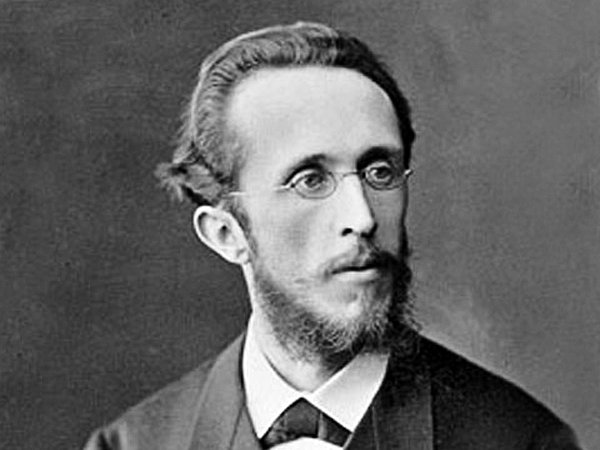
On February 12 (24), 1849, Ivan Borgman, physicist, first rector of St. Petersburg University, was born.
Personal business
Ivan Ivanovich Borgman (1849-1914) was born in St. Petersburg in the family of a Russified immigrant from Finland. The boy was given to the 2nd St. Petersburg gymnasium, after which he entered the Physics and Mathematics Department of the St. Petersburg Imperial University in 1866.
After graduating in 1870 the course with the degree of candidate, he remained at the university, where he continued to work to obtain the degree of a master's physics. In 1873, Borgman went abroad. He listened to lectures at the University of Heidelberg, was engaged in the Kirchhof laboratory. After returning to his homeland in 1875, he was appointed a laboratory assistant at St. Petersburg University.
In 1877, Borgman defended his thesis on the topic “On the galvanic resistance of coal at various temperatures”, based on his own experiments. After that, he received the position of Privat-Tocent and began to give a course of lectures. He began to first state the doctrine of electricity and magnetism at his lectures, showing how, along with experience, a mathematical analysis should be used.
Next year, protecting the dissertation “On the influence of the environment on electrodynamic phenomena and on determining the function of magnetization of liquids”, Borgman received a master's degree, and in 1882 after defending the dissertation “On heating of iron with interpretable magnetization” - a doctoral degree.
Having taken the position of professor at the university, Borgman read courses in almost all sections of physics - mechanics, optics, electricity, thermodynamics. In addition to lecture work, he devoted a lot of time and effort to improve the teaching system and conduct practical classes.
In addition to the university, Borgman lectures at higher female and pedagogical female courses (1876-1883) and at the Electrotechnical Institute. The Technological Institute in St. Petersburg also considered Borgman to be its teacher on the mechanical theory of heat and electrical engineering.
More than a quarter of a century-from 1875 to 1901-Borgman was the editor of the physical department of the "Journal of the Russian Physics and Chemical Society" (since 1931, the successor to the physical department of this magazine became the "Journal of Experimental and Theoretical Physics").
Under the leadership of Borgman and according to his plans in 1901, a physical institute was created at the St. Petersburg Imperial University. The building of this institute was the first in Russia, designed specifically for physics.
“What was the usual atmosphere of the electric department of the physical office of any higher institution about forty years ago? - Academician A.N. Krylov recalled. - In the middle of the room, occupying almost half of the area of its floor, there was a certain monster with a glass circle on the glass axis on glass legs, there are several many -versed Leyide cans under it, in the corner on the shelf, and more often on the windowsill (shakes less), a simple galvanometer, then called a “multiplier with an Astatic Rifle”, an agometer, an agometer, agometer, an agometer. Daniel battery, a spoiled telegraph apparatus of Morse, an electromagnet and an electric call, not to call a watchman, but as a physical device; That's all. "
Thanks to the efforts of Borgman and the incredible perseverance, with which he defended the release of funds for equipment and improving teaching at the university, the physical institute created by him became the most advanced educational institution of that time in equipment. Borgman headed the institute created on his initiative, becoming its first director. His personal book assembly gave rise to the faculty library.
In 1905, under the influence of revolutionary events, the authorities went to expand the autonomy of universities, returning the right to elect rector and deances to the professorship councils. After the resumption of the rectification elections, Ivan Borgman became the first elected rector of St. Petersburg University. True, for a short while - five years later he left this position in protest against the violation of the rights of students.
In 1906, Borgman was a member of the State Council from universities.
In 1911, he was awarded the honorary degree of the Doctor of Laws (LLD) University of St. Andrews in Scotland.
In 1913 he was elected a member of the St. Petersburg City Duma.
Ivan Borgman died on May 17, 1914 in St. Petersburg.
 Ivan Ivanovich Borgman Eduspb.com
What is famous
Ivan Borgman is known as the first elected rector of the St. Petersburg Imperial University.
As a physicist, he made a significant contribution to the development of the doctrine of electricity and magnetism. When Borgman began his scientific and teaching activities, in the doctrine of electricity “there was a full coup”. “The teaching of high -quality“ electricity ”Pulie and de la Riva with their proportions and proportions was replaced by“ electricity ”of Green, Thomson and Maxwell with potential, triple and six integrates and differential equations. Maxwell’s ideas began to penetrate the continent, but only Germany was prepared by Gauss, Weber and Riemann for their critical perception, and at that time in Germany physics was read and developed by names such as Clausius, Father Neumann, Kirchof (Gelmholtz's genius was addressed to physiology), who knew how to combine the artistan and the artist’s art and the experimental artist The power of mathematical analysis. Ivan Ivanovich, a student of Lenz and Petrushevsky, became a skillful and insightful experimenter, who at the same time could bypass the most meager means, creating, like a pharadey, from beams, traffic jams, wires and pieces of paraffin, on which he was able to notice the thinnest phenomena, ”wrote academician A.N. Krylov.
Borgman developed the theory of heating of iron during interpretable magnetization (1882), which was of great importance for the development of electromashine building. For the first time, he established accurate quantitative data on a decrease in the resistance of coal with increasing temperature, which was important for engineering work in the field of search engine construction. He studied the nature of electrical fluctuations and discharges in gases. He created the condenser of the original design, marked by the award at the World Electrotechnical Exhibition in Paris (1881).
Borgman is the author of the first fundamental textbook on electromagnetism in Russia “The foundations of the doctrine of electric and magnetic phenomena” (2 volumes, 1893).
Almost all the numerous works of Ivan Borgman were devoted to electricity and magnetism and printed mainly in the "Journal of the Russian Physical and Chemical Society".
His main works include the works “On the conduction of galvanic current with liquid plates” (1881), “On heating the glass of capacitors with interpretable electrification” (1885) and “Experiments over the spread of electric current through air” (1886-1887). He also left the monograph "magnetic stream and its actions."
His last works were devoted to the electrical glow of sparse gases (1899-1904) and the radioactivity of Russian healing mud (1904-1905).
The contribution of Borgman is invaluable to the creation of a physical institute, the equipment of which met the most advanced requirements of that time.
What you need to know about
Borgman taught physics to members of the imperial family.
From January 1883 to 1886 - to the heir to the throne, young Tsarevich Nikolai Alexandrovich - the future emperor Nicholas II.
Then he began to teach Grand Duke Georgy Alexandrovich, graduated from teaching in 1890. After that, he also taught the Grand Dukes of Ksenia Alexandrovna and Olga Alexandrovna and Grand Duke Mikhail Alexandrovich.
Direct speech
Academician A.N. Krylov about the Borgman's contribution to the activities of the Russian Physical and Chemical Society: “It is very easy to express in the few words what Ivan Ivanovich did for our physical society, because this is exhausted in one word:“ Everything ”.
4 facts about Ivan Borgman
- In 1899, the St. Petersburg Electrotechnical Institute Borgman was among the first to be awarded the title of honorary electrical engineer. Only 17 people received this title.
- Borgman presented to the physical institute the busts of Newton and Faradei, and to this day decorating the 308th audience.
- Since 1905, Ivan Borgman has been a member of the cadet party.
- From 1910, until the end of days, he edited the collections "New Ideas in Physics."
Materials about Ivan Borgman:
Memory of Ivan Ivanovich Borgman. A.N. Krylov
Borgman, Ivan Ivanovich . Article in the Encyclopedic Dictionary of Brockhaus and Efron.
"Cradle of electrical engineering." Ivan Ivanovich Borgman
Article about Ivan Borgman on Wikipedia