
Translated material
The dark side of the screen

Andrei Miroshnichenko leads the monthly column “The Medium and The Message” on Colt.
Many people habitually use a light background in their devices and consider it the norm. They do not suspect that Twitter and other applications allow you to install a black background. For a person with a light background, the freests are completely incomprehensible why the dark is needed. You can, of course, guess that the dark is less annoying the eyes at night. But for the majority, familiar to the consumption of ink from the white sheet, the dark background seems to be a perversion.
This applies mainly to white -screen. Black Ecrandniki most often know that there is also a white background. In general, the choice between Dark Mode and Light Mode carries a lot of information from the point of view of digital anthropology.
 © provided by A. Miroshnichenko
The basic hypothesis is this: the watershed between the black -screens and the white -screen passes between generations. Digital migrants, that is, the last printed generations that migrated into the digital world, most often use a white screen with black letters. The reason is obvious - this format simulates the book page. Digital Aborigines, that is, generations that have already grown with digital devices may well be inclined to a black background. There are two main reasons. Firstly , a book with its white pages and black letters no longer holds them. Secondly -and most importantly-the black screen is really incomparably more convenient at night: another name Dark Mode - Night Mode . Many applications introduced this configuration precisely for the convenience of night use, but it has become for the default shaking adherents.
This obvious distinction, however, does not exhaust all the features behind a black or white screen. The most amazing thing is that the screen itself, technologically, should be dark, not light. The transformation of the background of the screen from the dark into the bright became the result of the global conspiracy of digital media against humanity.
Light in the darkness of the screen
So that we perceive the information, it must be distinguishable. Someone must make an effort, violence over the background, leave a mark on it, whether it be an ink sign on a sheet or scratch on a stone. A sign is a strong -willed effort on a "limp" field. From the point of view, energy consumption is a “unit” sign, while the surface under it is “zero”.
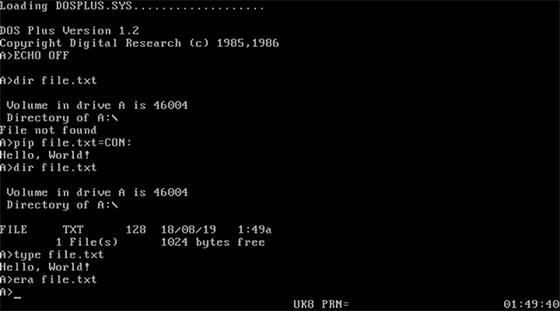
It is for this reason that the initial screens of computers and other devices were dark. If the background is “nothing”, and the sign is “something” , the sign should glow on the screen, not the background. In the same way as for written and printed media it was “natural” to have a light background and “disturbing” the dark marks of signs, for electronic media “naturally” to have a black background and “violating” it, that is, glowing, symbols.
Indeed: excavations of digital archeology show the total dominance of dark screens with light symbols in the early periods of development of digital space.
 © Wikimedia Commons
Dark signs on a light background come across among the early screens very rarely. This is an obvious concession to computer energy conservation of human ergonomics, more precisely, a book habit. Simply put, this is a concession to the computer to the user.
And here there is another watershed between black -screens and white -screen. Programmers, that is, manufacturers of the digital world, most often use the black background. Consumers most often use light. By introducing a light background, the computer was adjusted precisely under unprofessional users.
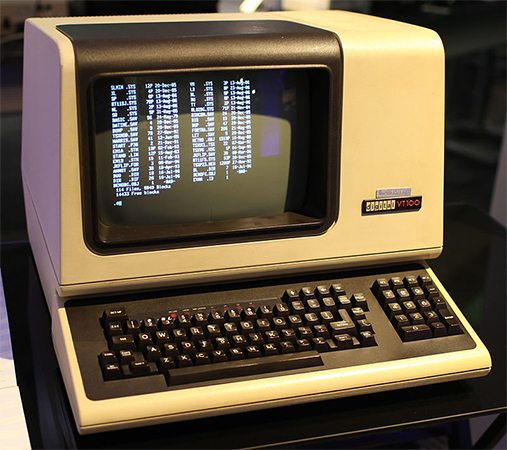 © Jason Scott Computer terminal VT100 DeC. 1978
You can even say exactly when the programmers stopped dominating the digital media population and an ordinary user population grew so much that they became a new target for computer design and a light screen appeared. This "demographic" transition occurred in 1984 . On January 24, 1984, Steve Jobs introduced Macintosh to the public - the first computer, originally focused on the consumer and not carrying the “programmership” inheritance in his design.
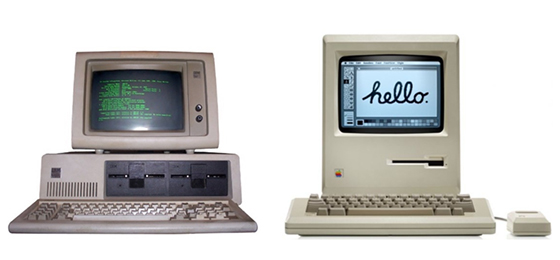 © Wikimedia Commons IBM and Apple Macintosh early 1980s
Two days before, Apple launched the Macintosha advertising during the Super Bowl broadcast. Advertising was shot by Ridley Scott based on Roman George Orwell, 1984. In the final credits it was written that Apple was producing Macintosh so that 1984 does not become like “1984”. The video has become an icon of television advertising. The idea of liberation encoded in it, including the release of users from the previous IBM monopoly, which in personal computers continued the "programmership" tradition of text interfaces of the MS -DOS type.
Apple made a “computer for us - all the rest” ( “The Computer for the Rest of Us” ) . Instead of a text interface, Macintosh proposed a graphic one. The screen points displayed the picture, not the text.
In previous interfaces, the text, as expected, conveyed mental abstractions, primarily computer programs. The picture was a kind of “iconic” sign in the classification of the pier - it was similar to what she portrayed. This meant, in particular, that the printer would print exactly what is shown on the screen. So the new screen design principle arose - “What You See is What You Get” .
The introduction of a graphic interface was accompanied by another innovation - a mouse. Unlike the linear text, according to which it was necessary to move the arrows, the picture demanded - and allowed - “poke” into any element of the image by a cursor moving freely (and not according to the lines).
Pixel pictures of the screen allowed to simulate the usual images of print media, albeit with specific computer navigation. The very idea of “pictures” made the black screen turn into a bright one, on which significant elements are marked with dark “ink”. The idea of the new interface was anti -comprehensive and anti -programmer, but - pro -security.
Digital mythology indicates that the leaders of Apple , led by Jobs, spied this idea during a visit to Xerox . Xerox is known, of course, primarily with copying technology, which he launched for commercial use in the 1950s . But, worrying about competition from Japanese corporations, as well as fearing that in the future the business will become balm, the company created a computer unit. It has developed the world's first desktop computer with a graphic interface and mouse. This is how this computer looked in the 1972 advertisement.
Perhaps it was precisely the attachment of Xerox to paper, to office office work, which led to the white background of their first graphic interface. One way or another, the participation of the Xerox in the transition from natural for computers of the dark background to the white paper, white can be considered a sort of Easter Evolution. The role of the intermediate link went precisely the Xerox .
May there be light
But Xerox 's computer was very expensive. And they did not have this famous commercial vein of Steve Jobs, who was thinking not about functions, but about the user. So Xerox gave humanity an important innovation, but not a computer. The breakthrough was made by Apple businessmen and businessmen.
The graphic semblance of the screen to the world displayed in the “window” of the computer led to the inevitable consequences of an evolutionary scale. IBM also switched from MS - DOS to Microsoft Windows as a basic user interface . Somewhere in the backyards of these epoch-making changes, this fact lurked: the black background remained the subject of the workshop pride of programmers (or a workshop boring-like a handwriting among doctors), while the light background became an attribute of the marketing focus of the computer for ordinary users.
Connoisseurs and still living eyewitnesses of computer paleozoic can lead many different details, including “rebounds” from the main development line for screen interfaces. The use of black or white substrates of the screen was determined by technological and marketing needs and tasks, as well as random events. But from the point of view of mediacology, this was what: digital media, born with a dark screen and luminous symbols, learned to simulate paper in order to lure billions of people from the paper era into the digital world.
For nothing else, computers do not need it. To communicate with programmers, they had enough dark MS screen - DOS with luminous symbols. But several hundred thousand programmers cannot ensure the development of the digital industry and, therefore, the further progressive movement of the media evolution. This requires billions of users. Then there will be investments and innovations that move the media evolution forward. Therefore, digital media rebuilt on a light screen. They pretended to be an advanced book to seduce billions of former readers accustomed to the white background for four thousand years of writing.
Our relations with the mediavolution can be described by the metaphor of Marshall Makluen, who called people with a sex organ of the world of machines, like bees in the world of plants. Both we and the bees serve the reproduction of our symbiots - computers and colors, respectively. And in exchange, they give us nectar of their life, so necessary for our existence.
However, the next question arises. Yes, light screens seduced the printed man and increased the human resource of digital media from hundreds of thousands of programmers to four billion users. Thus, light screens were one of the tools for enslaving a person with computers. Why is the black background now become popular among younger users? Because they go further from the book? Because they use social networks more and more at night, in the dark? These factors are probably playing a role. But there are more hidden circumstances.
Glows VS Lighting
The Fordemian experiment , which was conducted in 1968 by the son of Marshall Makluen Eric at the University of Fordem, can help shed light on a dark background. When reading the “Television Effect” course, Eric Mlyuen and his colleague found that students could not understand what “The Medium is the Message” means.
These were the times of the "sociological" approach to the media. Researchers considered media a means of transmitting messages. Lasswell's formula “who said that, to whom, through which channel, with what effect” dominated.. " In fact, the communicative theories of that time studied the intentions of users and the conditions of communication, but not the medium itself. The most “advanced” views admitted that the media not only transmit information, but also carry a hidden message. Marshall Mlyuen called all these theories “transportation”, while he considered his concept of media “transformation”. Therefore, students could not understand what they want from them when they say that the medium itself is a message.
Eric McLuen divided the group into two parts. In the same room, the same film was projected onto the translucent screen. But one part of the group sat on the side of the screen on which the light fell from the projector, and the other part sat on the opposite side - the image of the “luminary” on them from the screen. This distinction is known in mediaecology as Light on vs Light Through . In the first case, information is covered, in the second - the glow of the information itself. These conditions reproduce key characteristics, respectively, traditional media, including books and cinema (light falls on the perceived information and is reflected from it in the eyes), and the screen media starting with TV (light falls to the eyes, passing through the screen with information).
The Fordem experiment showed significant differences in the perception of the audience despite the fact that the content was the same. The main difference was the level of involvement.
Those who watched on the film “Kino” ( Light on ) were treated as an alienated object. They offered a more abstract analysis of the content, allocated some fragments of the plot. Those who watched the same film through the screen with a glow aimed at them ( Light Through ) were more involved in what was happening on the screen. They described their emotions more, commented on individual scenes less, it was more difficult for them to evaluate the duration of the film, that is, the volume of time spent on it.
Of course, in the conditions of the experiment, there are many details that require additional and complex interpretations, including the left-and-right mirroring of the picture, the cultural habit of cinema or television, etc. But the main goal was achieved - the experiment showed the difference associated precisely with the medium, and not with its content.
With one of the repetitions of the experiment, the difference was completely screaming. During the viewing of the comedy of Buster Keaton “ The Railroader ” (1965), the participant of the TV group went even to the other half of the room to see what the “film group” laughs at and whether they show them the same film because it was not funny on its side. Kiton, a very specific “comedian without a smile”, belonged to the era of early cinema, and his ridiculous techniques acted on the viewer observing the situation, and did not affect the viewer involved in it. On the side of Light Through , the involvement placed the viewer in the picture and killed a comedic effect.
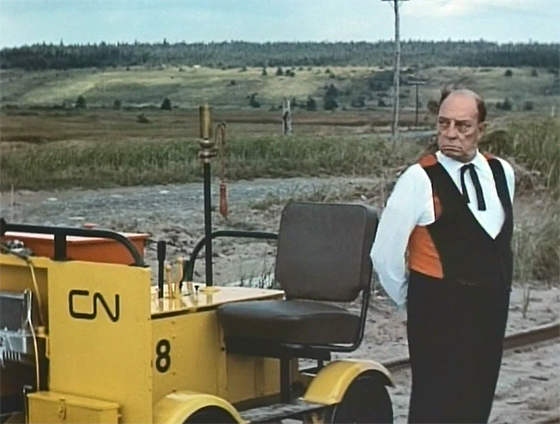 © Canadian Film Board Frame from the short comedy of Buster Keaton “The RailRoder” (1965)
What does the Fordemian experiment have to do with the dilemma of the black and white background? The experiment showed that the light aimed at the screen/object involves less and allows you to see the details and analyze, and the light directed from the screen/object not only involves more, but also reduces the ability to control time. Accordingly, the white background simulates the traditional Docifre lighting format - Light on . And the dark background with luminous symbols is Light Through . It contributes to a better involvement of users.
The screen instead of the sun
Summing up all these speculations, we can draw the following conclusion. As soon as the digital media went beyond the limits of programmership demography, they began to simulate not electronic, but physical “coverage” of information. The mediavolution “committed” this somersault to seduce billions of users who are familiar to Light ON lighting format.
Now, the growing popularity of Dark Mode means, apparently, that humanity is approaching the final resettlement from the physical world to the number. The perception of information from the screen to the lumen becomes no less familiar than the driving perception of information illuminated by the light falling on it. For young generations, the screen reality is compared in importance and temporary costs with physical. Digital media no longer needs to be so diligently imitating “illuminated” information, and they can move on to their “natural” format of glow of information itself.
The very principle of falling light belonged to the physical world - this is the world in which the sun shines. In the digital world, a screen shines instead of the sun. The sun illuminates the information, the screen shines with information. When the information shines itself, the sun does not need.
In Dark Mode, the information shines exactly as much as necessary to achieve the pupils. If electricity began to wash the difference between day and night, then digital media completes this transition to round -the -clock, which is absolutely logical in the conditions of a global network that expands a person into all time zones. The screen with luminous information relocates a person from a physical place illuminated by the sun, and from physical time, measured by the sun. The development of screen design first from the dark background to light and now back to the dark accompanies the transition of a person to the best - digital - world.
The screen glow, not distorted by simulation of solar lighting, not only allows you to consume media at night, in the dark, but also involves the user more, better, stronger. Information, illuminated “on” the user, reduces its ability to perceive objects alienated and control the time of media consumption. The investment of our time and effort, our complete immersion in digital media is just what is needed for further media evolution.