
Translated material
Divide the pain
The stream of publications about “P” in the theater and near -theater became viral. Everyone writes about the last Butusov work - no matter what text, nervous intonation and a new concept. And after me, my thoughts go a day after the performance itself, I think they are in different directions. Such a unique fan effect. Judge for yourself.
In his variation of the “Examiner”, Mikhail Durnenkov built a dialogue between different Russian eras: the nineteenth century before last here sardonically echoes the twentieth, and the echo of their votes disfigured by time is refracted right in “here and now”. She caught herself during the performance at the hero’s syndrome from “Galosh of Happiness”, when she thought: Lord, how much easier, clearer, more definite, more reliable and did not try to so insoluble contradictions! And she grinned at herself, recalling the final of the underwear fairy tale.
This Butusovsky performance is echoing with Krymovsky Kostik and with Boris not only in terms of free staging of a superclassical drama. Like Krymov , “P” is a direct directing statement about today, where, albeit radically converted, the most textbook of the entire set of Russian comedies (as the most-most-most great historical tragedy “Boris Godunov” or as the very first revolutionary Chekhov drama at Krymov) still plays the same in Brezhnev’s times (and and and and and and and and and more Be sure to Russian!) Classic. If you remember, Anatoly Smelyansky called his collection of reviews on the performances of those years “Our interlocutors”. We will interview again. And not without allusions, not without some esopovisen - with all the current obvious directness.
 © Satyricon Theater
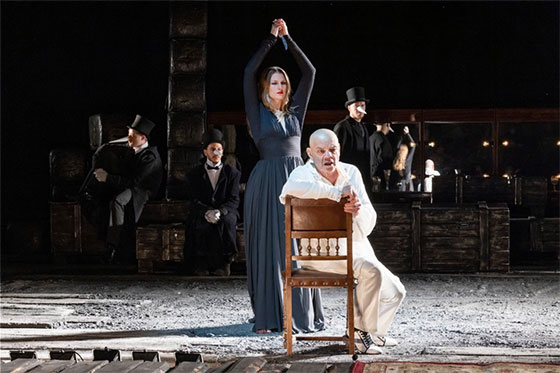
Khlestakov Konstantin Raikin was growing old, traveling from Gogol times to the present, which would kill him. It’s no longer the Osip to him, but he says to Osipu that it is necessary to fall out of the town, because it smells fried. He understands everything, lazily, not without dreary boredom in the hundredth thousandth times, plays a role without any even elementary fantasies (and here the obvious Ommage of “Tararabia” - the Raikinsky Khlestakov would be quite appropriate on the Krymovsky stage conveyor) and no longer dragged himself for pretty women. And the non -nonal laws know very well, the danger immediately smells, the nerves are naughty, cowardly, not to live - he wants to survive. It is ridiculous to attribute to such a devilishly multi -year Khlestakov to attribute the authorship of a stupid letter, opened by the postmaster. The postmaster himself wrote him, remembering the play. Nikolay Vasilich has a plugagagic.
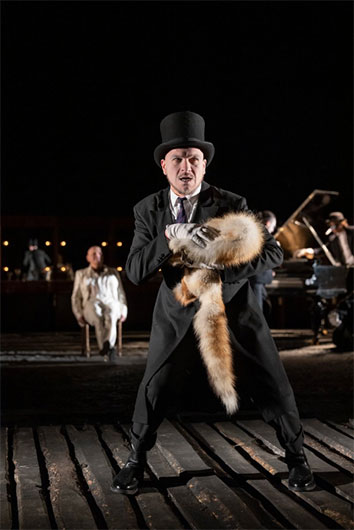
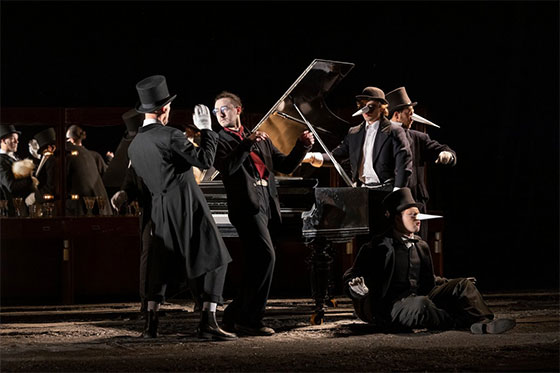
But Timothy of the Tribunets constructs his tunnel from the past to now differently. He juggles in this performance by faces of many of his roles, instantly replacing the character from the bad with the good, as Garrick who once looked from behind the door mowed feelings on his own face. Moreover, at some point, the Tribyans even grabbed a completely alien-is the Raikinsko-Butusian Richard with a torso shed from a hump and dragging legs. But the great villain is fragmented here, but the Krymovsky Boris and Butusovsky yago from the grandiose scene with the ovary in the kitchen here demonstrate themselves in more detail, fixing the main, in my opinion , the theme of the performance-about the banality of evil. And about the little people triumphant his media, which is literally manifested by Butusov by the strongest angry final scene "P" .
 © Satyricon Theater
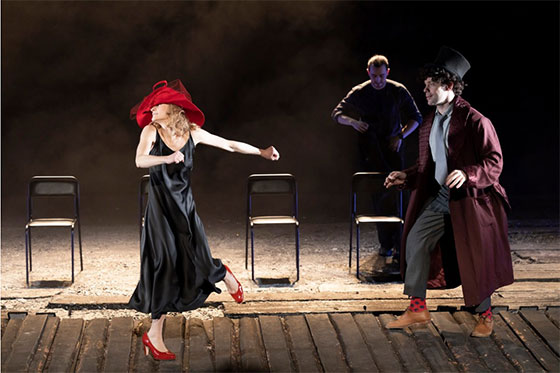
It is also important to think about the shaky, clicked floor on the stage, where actress heels fail, under which, it seems, some kind of black pool, a black hole-like in the tiny pond “Kostya”. Back in 1978 , in a different reality, the Mayakovsky Theater released a very strange, for several decades ahead of time, the play “Seagull” with a beautiful lascivious Arkadina-Doronina, with the lovely half-Simonova and Treplev-Kostolevsky, whose youth was brutally smeared in the finale. Then Nina, shabby, with her last monologue, fell into the gap almost to the first row of a podium put forward into the hall with uncleaned boards, tearing her away about them, pulled herself out of there and collapsed again. The performance of Alexander Wilkin was completely forgotten, and he stood before my eyes throughout the “P” .
Secrets, intrigues, investigations, scraps of history, crumbling classic, collage modernity, philosophical flaps, funny moments and many, many of today's pain.
And one more thing: in the recent premiere of the Oberiut “feast” Denis Azarov, the artists balancing on the floor covered with a thick layer of giant chips under the feet, as if something of a small-human one and then grabbing the ankles.
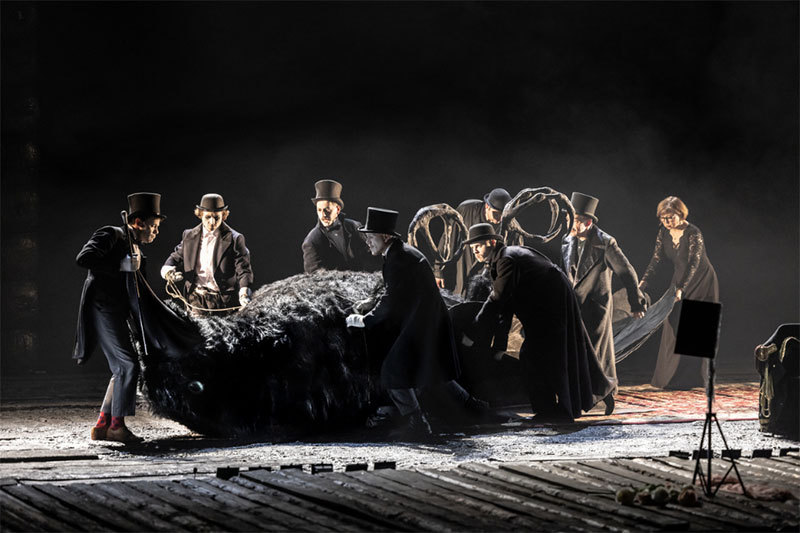
So the bottomless bottom reveals itself. You can not knock on it either from above or below. It breathes and wants to eat. It feeds on a warm human woman. And the giant dead black brown, in the middle of the action of “P” suddenly founded with its beak and paws up in the middle of the stage, the bottom buried, disgraced. And the little men, small in comparison with her, the inhabitants of the “P” space , flooded the crow's carcass from all sides, as if wanting to adopt the experience of intolerance with the bottom-and somehow stagnated, get to death.
 © Satyricon Theater
There are plenty of deaths, unlike the Gogol's “Examiner,” in “P”. Osip Artem Osipova will tell how the ice with classmates scored a little puppy for a long time on the school porch for a long time, and the death of Mu-Mu at Turgenev (and in the theatrical hold of the theater of nations in the same performance of Krymov) will appear in comparison with this simple-minded self-justification of an immature, light. And then the same Osip will tell how the old Khlestakov shied into the forest, peering into the eyes of a huge dying moose shot down on the road. In Durnenkov and Butusov, this terrible motive in the play is finally deployed in a careless, between the Citynichy Khlestakov’s message about the death of the Ledo Ledo, with his whole family-with a pregnant woman who was never born by Pavlik his wife and with two more idiotic offspring. Yaroslav Medvedev was terribly played in this frustration execution in advance, even in the scene of a bribe, when his Dobchinsko-Bobchinsky, sobbing his hands from impotence, crawls on his knees and kisses Khlestakov’s shoes, refused to sign the paper that he took a colossal collective bribe collected by the city. I could not tie the right man in circulation - die, loser!
 © Satyricon Theater
“P” is a rare, specific performance. In it, secrets, intrigues, investigations, scraps of history, crumbling classic, collage modernity, philosophical flaps, funny moments and many, many of today's pain. But it’s strange: when after the performance you think about “P”, this very pain slightly releases. Because you know - she is not only yours.