
Translated material
Eternal Merzlota is a great novel about the last years of the Stalin era. Republic talked with his author about the Gulag, mistakes of the leader and Bolshevik propaganda, which still affects us
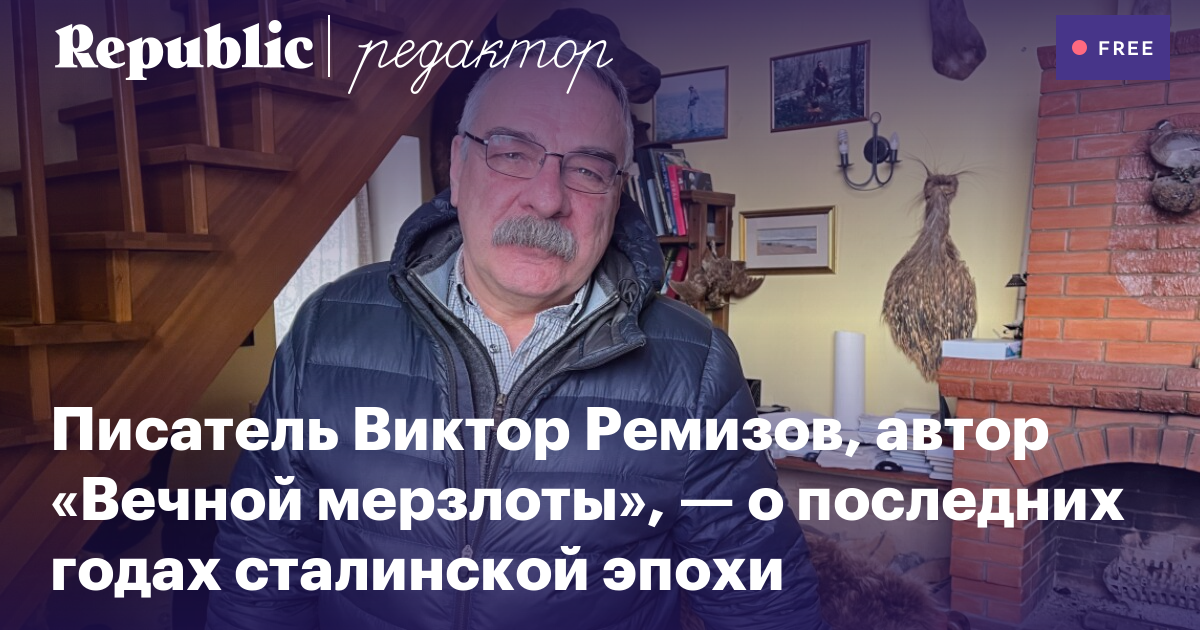
“Eternal permafrost” is a great novel by Russian writer Viktor Remizov about the life of the USSR in recent years of the Stalin era. In 2021, he managed to receive three literary awards, was published in several circulations, but it seems that he was just starting his way to the wide mass of readers: his sales in stores are growing, “Sarafan Radio” carries the news of this rich, diverse, very detailed novel. Its action takes place in correctional camps and on the Yenisei ships, in Moscow and Norilsk, at the Kremlin meetings and in Siberian forests. Republic talked with Viktor Remizov about the work on the book, the features of the life of the Gulag and the Stalinist methods of farming.
"Life in the camp was much more diverse than in our mental cliches ."
- When in 2013 you planned this book, you probably asked yourself - why in the 21st century you need another novel about the Stalin era, about the gulag? After all, there were already Solzhenitsyn, Sha Lamov and what was not written on this topic ...
“It is strange that no one recalls Mandelstam:“ A wolfhode century throws me on my shoulders, but I’m not a wolf by my blood ”or“ We live under us without sensing a country ... ”, this is much closer to the“ permafrost ”. I don’t know how differently people relate to books, but as a reader it is important for the life of the heroes that the author offers. In “War and the World”, not the ideas of Tolstoy are important to me, but his experiences, they are always more than ideas, so I just live the life of Natasha, Andrei, Pierre ... Therefore, I reread it, otherwise there would be no sense. Accommodation, unlike understanding, gives reality in all its complex volume.
The Gulag Archipelago, Shalamov’s stories, Ginzburg memoirs are very different books. Everything is valuable in its own way. Of course, I remembered them, thinking about my venture. At this time, I studied a lot of time and space, and at some point I understood, but rather felt that I could have my own gaze, I felt that I was already starting to live the life of my heroes. I tried to do this and I propose to do it to the reader. The experience of that life is not easy, in places tragic, but valuable, life is not only sweet. And then, it is better to live it in a novel than in life. There is one more difference - I look at that reality from the standpoint of a modern person. The same reader - today we have our experience that the classics of this topic did not have. Thus, the theme of the “eternal permafrost” and the books you have named are different, I did not try to convey the horror of the camp life, it is already given exhaustively, but the structure of the life of ordinary people with totalitarianism, their living reactions, the opportunity to maintain a person and freedom - apparently this interest me.
It was the ordinary life of people, some extreme cases of violence, I deliberately avoided.
- It turns out that you have filtered some terrible things, decided not to place them in a novel? Why?
-There are real events that may be interesting, and even say something about the psyche of people of that time, but I did not touch them. For example, monstrous cases of sexual violence. There was a case when they brought a small stage of women to a place where there were almost no women. And men-zeki barricaded in some large room, almost in the house of culture, dragged these women there ... For several days they could not open this house of culture. And some of the women simply died. Or the return occasion, it was just in the “my” edges, when women-confined women worked on the hayfield, a barge came for hay with men and guards. And these women raped both peasants and guards. These are real stories, a lot of this is described.
Why didn't I use them? These are special cases, frequent, but still atypical, my heroes, like most people of that time, were not witnesses of this. “Eternal permafrost”, I repeat, is not about the horrors of the camp. And to specially play on the reader’s nerves was not my task. Former camp, Alexander Snovsky, at the beginning of my work, once told me: “Victor, do not invent anything, write how it was, it will be enough.” I tried to show everyday life, there was enough tragic in it.
The remains of one of the construction camps 503
Photo of 2004, Vitaly Ivanov/Russian Look/Global Look Press
- When I started reading the book, I did not really understand how historical it is. But then it became clear that it was probably impossible to come up with so many details and history. And, having read to the afterword, I found out that you really wrote a novel partly as a documentary. Especially as for the production aspects - they are literally written according to documents. It can be seen that you have done a lot of work on the collection of material. What discoveries did you make for yourself while working on the book?
-Still, this is a novel. Everything was invented in it, and it is not worth calling it documentary. When you through memoirs, documents, conversations with living witnesses are immersed in that era, it is not very difficult to come up with close to reality.
Yes, I very carefully studied the history of construction 503, in some places I quote documents, but not for the accuracy of documentary, but in order to convey the style of then relationships, these quotes themselves give the most accurate image of that era. The very reality in the novel is literary, this is my idea of that time. “Eternal permafrost” is a historical novel, and the historical novel should be precise, what else? Therefore, I was looking for important, characteristic and exact details. It is they who translate our superficial view of the events of that time to another level, into the plane of real life, we begin to live it with the heroes, and thus somehow approach the essence of what is happening, we feel it from our own experience.
I don’t know what to give as an example ... Well, it is known that in the first two years of construction, security, prisoners and free builders lived in tents. This information itself gives little. Well, a tent and a tent, everyone knows what it is. But in the novel, we have the opportunity to “live” in the tarpaulin infusion of Gorchakov, where a hundred prisoners lies on the bunks, infectious along with injured, minus forty on the street. Or large, for sixteen families, free tents, dug a meter into the ground. The tarpaulin walls share “rooms”, seven meters into the family, two stoves in the corridor, crying of children, a cheerful party with a drunken obscenity or sex, the sounds of which everyone listen to. But here we are with Shura Belozertsev in a tent for the camp authorities - there are already plywood walls, double insulation, instead of a bunk of a bed with sheets, wear tea ... This was a device of life. A small piece of its details.
Or a detailed attentive description of the work of San Sanych in a sandy career, in the cold, when Kylo bounces from the ground. (Involuntarily, a comparison arises with his work in tow, when he was free, when he risked for the sake of a complex and important matter.) In his career, his labor and all these torment are meaningless. It is used as a useless creature. A very terrible thought for a person.
When you just read about it, this is one thing. It’s completely different when you get used to the hero and literally clog the crowbar into frozen soil with him, while you are hungry like a dog, and you were just beaten by the head of the camp ...
Actually, living of that life, not necessarily camp, in its details and was new to me. Just like for the reader, I hope.
The novel "Eternal Merzlota"
Alpine Publishing House
- Have you talked with people who sat in these camps?
- One of my consultants was Alexander Albertovich Snovsky, now already deceased. He sat in Ermakovo, in Norilsk, at a shipment in Igarka. He helped me, could call and say: “I remembered one case from my paramedic practice ...” I could ask him any questions, not all, of course, entered the text, he was not embarrassed by the rudeness of camp life.
- For example?
-Some ... not too much ... they brought them to the hospital a pregnant prisoner, a large stomach, everything is as it should. Does not give birth. They made a cesarean, and this is not a child, but a ball of worms, forgive for naturalism. Or he told in detail how inventive camps did their own “masters” - they disfigured themselves to get exemptions from work.
- It is interesting that with all its horrors and restrictions, the camp life in the novel looks surprisingly diverse. It seems to be prisoners, there is security. But, apparently, there are too many concludes, and there are too few security, so the mass of camps live its own life, they have their own services market, and some prisoners of the “bosses” are sometimes more influential than the formal leadership of the camps.
- People are everywhere, so life in the camp was very diverse. And this was one of the difficult moments when writing a book, because it is always important to understand the character’s algorithm: how he can behave and how he cannot. In the case of the camp, this is quite difficult to do. On the one hand, each sneeze of prisoner and security was described by instructions. For example, there were dozens of different diets for different regions of the country and different works. It was accurately spelled out how a person should be dressed and how fastened in what weather. Or, say, a concluded according to the 58th article could be divorced only after imprisoning two-thirds. But these instructions were once respected, but once not. Therefore, I seemed to be free in choosing the behavior or fate of my hero, but in reality not at all. There was some hard algorithm, very variable: an experienced, old camp-this is one, young-another, the camp “moron”-the third. It is a little like army service. There, too, it seems like nothing, but under some conditions - much can.
-In general, our life is so arranged.
- Apparently, so. Ordinary people sat in the camp and guarded them the same. You can’t cancel life, it was much more diverse than in our mental cliches. The relationship of the prisoner and his camp boss is still the relationship of two people. To one prisoner, it is one, to another another. Some prisoners, for example, were cherished. And no matter how he violated the rules of the camp, it went away because he was valuable or humanly cute (there are many such characters in the book-the surgeon Bogdanov, Colonel Koshkin, Sanitar Belozertsev). Or the main dispatcher in the water transport management of the construction site 503 Kladko. This is a real character, an indispensable professional, he, being a prisoner, lived in the village, did not go in the state, that is, everything was violated, he was almost free.
"Building hacks, everything was bullshit"
- But in general the prisoners were cherished? As I understand it, 1949-1952, when the action of the novel unfolds, this is still not 1937. The attitude towards prisoners changed-not because of humanism, but because labor resources had to be protected. After all, the post -war years, adults of healthy men were not enough.
- I think it was, in 1937-1938 they destroyed the “enemies”, and the camp authorities and security proceeded from this. In the post-war period, in the late 1940s-early 1950s, the main task of the Gulag was to supply free labor, which can be used in any, even the most severe and inaccessible places. And then, after 1945, there were many military in the camps. And if the head of the camp did not fight against a man who had seen a lot of things for this war, then their relationship was already worn by a slightly different shade.
As for the specific construction of 503, due to the features of geography, labor was brought there only in the summer, during navigation. This is from mid -June to October. Therefore, the attitude to labor resources was more lean. There was even a small shortage of labor.
- You traveled to the places described in the novel?
- I used to be there, and when I was about to write, I went on purpose again. Look at everything with the eyes of their heroes.
The railroad track and the preserved security tower at the site of construction 503
Photo of 2004, Vitaly Ivanov/Russian Look/Global Look Press
- A significant part of the novel occurs in the village of Ermakovo. This is a whole city that appeared on the shore of the Yenisei in 1949, and after the death of Stalin and the closure of his construction, he , in fact , was abandoned. What do objects of string to and 503 look like today ? As I understand it, there is no road there, only the river. What is left of him?
- We have the roads further than Yeniseisk and now, that is, the road closest to the Ermakovo ends at about 1200 kilometers. The village is overgrown with alkhovnik, nettles, birch, from the shore it is not even visible. Alexander Mikhailovich Kazantsev lives there-he rents hunting and fishingets, and his efforts there is something preserved there. Recently, he fixed the roofs over the camp huts, cleared the path for tourists. The outlines of the streets can no longer be guessed. In those houses and barracks that have retained roofs, you can go and see. But most of the housing has already fallen.
The camp is better preserved, six kilometers from Ermakovo. Even the towers and in some places the thorn, partially fell the roof over the large dining room-club, but a separate punishment and power station, huts, were well preserved. It can be seen that each brigade built a hut for itself, so they differ from each other. Elements of decoration, for example, paintings of walls. People lived there.
All this was stopped two weeks after the death of Stalin. Like another 26 large -scale projects - a tunnel for Sakhalin, the main Turkmen Canal and others. This construction was the largest. A lot of money was spent on it, but it was the appearance of work, built hacks.
- Why?
- Everything was bullshit there. And the camp bosses, they are also the leaders of the construction (which in itself is already absurdity), they understood this perfectly. The conditions were extraordinary, but there was not even a project. They built mainly in winter, when swamps froze and temporary winter roads could be laid on them. For each kilometer of the future railway, only rails had to be brought 80 tons, and another thousand tons of gravel, sand, sleepers .... Plus materials for the construction of housing for protection and camps, they cost there every 5-10 kilometers.
There should have been many bridges, that is, durable and complex structures, they were built temporary wooden, they required constant repair, the speed of movement on them even for light steam locomotives with one or two wagons was 5 kilometers per hour. These bridges then quickly washed off. There is little left at the construction site.
I think no one, including Beria, especially believed that this road would once be completed and work. No one understood what the meaning was in it.
- It turns out that even if Stalin had not died, would they still not have completed the construction?
- A lot of goals would flew. After all, they reported to Stalin that everything was in order, but in reality, everything was held there on the back of the lies. How much could they deceive him like that? According to the government in 1955, the road was supposed to be put into operation, but this was impossible. Only for operational repairs were required a huge amount of money and additional human resources, that is, prisoners, since the places there are completely deserted. And prisoners - this means security, special housing, life, meals and so on, and all this had to be imported and imported there. But the main question is why? This huge highway was absolutely not needed by anyone! Neither there nor from there there was nothing to carry. Even now there is nothing!
A steam locomotive thrown at a construction site 503
Photo of 1995, Vitaly Ivanov/Russian Look/Global Look Press
- In the novel, this word "bullshit" often flashes. The prisoners drive bullshit, the foremen drive bullshit, the camp authorities are chasing, ultimately they drive bullshit to the very top - to the Kremlin.
- Of course, they also demanded a plan, a kilometer. Some kilometers must be laid. Well, here they were "paved." They attributed, fulfilled and overfulfilled the plan ... Everyone was interested in this lie. This is easy to see even from official reports, when one unit accepted work with another and saw discrepancies. But then there was nothing surprising in this, it was one of the principles of building public life and production. I'm not talking about the work of prisoners, which, in principle, cannot be effective.
- How do you explain the reason for the appearance of this project for yourself? Why did Stalin need him if, from the point of view, the economic road was useless?
- There are almost no considerations on this subject. I carefully studied this, spent a lot of time. There are no intelligible statements anywhere. In the decision of the Council of Ministers, construction motivation is not given. I suppose that after the war, Stalin felt omnipotent. I decided to set myself another monument - to build a road that would connect Russia in the north. In the south, the Tsar-Batyushka built a Trans-Siberian Railway. Why not build in the north if you are omnipotent?
- I read that at the beginning of the 20th century there were plans to build such a northern road.
- On this subject, people thought, thought that it would be nice to master the Arctic of Russia in this way, to develop life there. Such proposals were also submitted to the king. But they have never been accepted as inappropriate. Actually, the Minister of the Naval Fleet of the USSR Afanasyev said about this at the first meeting with Stalin. There was a brave man among the "rudeness of the leaders." And he immediately sat like an English spy, and they began to build the road. It was in 1947. The highway was supposed to bring at the mouth of the Ob, a year later it became clear (I think it was clear to specialists right away) that Afanasyev was right. Но Сталин от дороги не отказался, а увеличил на тысчонку километров. Ее повели к Енисею, где тоже ничего не было, что можно было бы возить.
При царе, кстати, там людей жило больше, чем при Сталине, если не считать ссылку и лагеря. Думаю, что с помощью ссылки он и пытался «развить» советское Заполярье. Уже после войны вышло постановление, что ссыльные остаются там навечно. Кстати, бериевская амнистия освободила большую часть заключенных, а по ссыльным никакого решения не было.
Брошенные на Стройке 503 речные катера
Фото 2004 года, Vitaly Ivanov/Russian Look/Global Look Press
— В вашей книг е герои вспоминают царскую жизнь как более разумную, что ли, по сравнению со сталинской.
— Мне кажется, так и есть, люди были свободными, поэтому и жизнь была лучше организована и в культурном смысле (там сохранялись очень старые традиционные культуры), и в материальном. Насилие способно только разрушать. В царские времена многие проблемы решались гораздо умнее, чем во времена советские.
В книге описано, как в дореволюционные время на Енисее добывали рыбу. Ценные породы — осетр, стерлядь, нельма, омуль, чир, муксун в больших количествах добывались в низовьях Енисея. В те времена красноярские купцы ставили два парохода, которые цепляли за собой множество барж с рыбаками и тянули вниз по Енисею примерно две тысячи километров. Рыбаки там рыбачили, солили рыбу. Причем, чтобы рыбу правильно солить, по государственной программе туда для обучения специально привозили астраханских засольщиков. Осенью все это тянули обратно, привозили рыбу, продавали ее в Красноярске и по всему краю, где и жило основное население.
Цена на рыбу была высокая, потому что за услуги этих пароходов купцы брали с рыбаков дорого. Так вот, государство озаботилось тем, чтобы снизить цену для населения на красноярском рынке (это есть в губернаторских отчетах). Царское правительство поставило на Енисей два своих парохода, что сразу снизило цену на завоз и вывоз барж с рыбаками, и, соответственно, упали цены на рыбу в Красноярске.
«Мы до сих пор жертвы сталинской пропаганды»
— Герои книги — НКВДшники. В основно м они малосимпатичные, но есть, например, персонаж Вано Габуния — офицер НКВД, но при этом хороший человек, который и НКВДшником-то быть не слишком хочет. И старается как минимум не умножать зла вокруг себя. Наверное, одна из главных тем книги — это вопрос личной ответственности. Как вы считаете, был ли в реальности у винтиков тоталитарной машины выбор: делать или не делать зла?
— Чтобы это понять, достаточно внимательно прочитать того же Шаламова или Гинзбург. Собственно, Шаламов остался жить благодаря людям. Ведь врачи, которые не один раз спасали его в лагере, могли этого и не делать. Выбор у нас есть всегда, но мы чаще всего не хотим за него платить.
Что касается Габунии, то он персонаж вымышленный, как и все остальные. Но подобные люди в жизни встречались. Енисейский капитан Казаченко, работавший в тех местах и в то время, прочитал фрагмент с Габунией и говорит мне: «Я его знал. Только у него фамилия была другая».
Хотя большинство людей, работавших в органах, вели себя иначе. Устами того же Габунии в книге описываются ситуации, которые имели место в реальной жизни. Ну, представьте, вы — комендант заполярного поселка, где живут ссыльные. В вашей власти не только их свобода, но часто и сама жизнь. Бывали случаи, когда женщины за кусок хлеба приходили сами и приводили коменданту своих дочерей.
— Так голодали?
— Во время войны, если ты работал, ты получал пайку, которая позволяла выжить, а если не работал — не получал ничего. Я описываю несколько таких случаев. Рабочих мест в рыбацком поселке 50, а привозят 300 ссыльных. Люди погибали от голода, и этим пользовались разные начальники. Не обязательно, кстати, НКВДшники.
— Один из ваших персонажей удивляется, что граждане одной страны ведут себя по отношению друг к другу хуже, чем враги на недавней войне. Как вы для себя объясняете этот феномен? Что-то случилось людьми в сталинскую эпоху? Или это вообще свойственно человеческой природе? Свойственно ли это именно русским людям или людям вообще?..
— Я не на все вопросы знаю ответы. В какой-то степени мы животные, а в какой-то — творения Божьи, созданные для другого. Сталин идеологически обосновал и дал людям страшную вещь — власть человека над человеком. Человек сильный такой власти не возьмет, а слабому только дай. «Вечная мерзлота» во многом как раз об этом.
— При этом многие ваши герои, включая одного из главных , Сан Саныча Белова, до определенного момента Сталина искренне любят. Они жертвы пропаганды? Или просто дети своего времени?
— Пропаганда была отвратительной, но работала прекрасно. С одной стороны, творилось чудовищное, людей натравливали друг на друга, с другой — рисовался красивый образ жизни в будущем. Посмотрите плакаты сталинского времени: счастливые люди, хорошо одетые, сытые, с радостными детьми. Моя теща, ровесница Сан Саныча, очень умная женщина, прочитав, сказала, что таких, как Сан Саныч, было абсолютное большинство.
И кино, и литература — все было заточено на это. Все дули в одну дуду. А уж газеты! Если сейчас открыть «Правду», выпущенную к 70-летию Сталина, невозможно поверить, что столько людей отвратительнейшим образом лижут ему задницу. Знаменитые ученые, писатели, рабочие, колхозники… Тексты чудовищно подхалимские и примитивные! Я это в книгу тоже не стал включать, потому что выглядит просто неправдоподобно.
Мы, кстати, до сих пор жертвы той пропаганды. Многие вещи, которые тогда были заложены, до сих пор прочно живут в нашем сознании.
- For example?
— Да взять хоть само деление людей на «правильных» и «неправильных». Или трусливая «любовь» к власти, какой бы она ни была. Или то, что мы самые лучшие во всем белом свете, а остальные все — в лучшем случае дураки, а то и враги. Вот «лесных братьев», к примеру, если провести опрос, многие назовут врагами и негодяями. При этом люди бесстрашно, без всякой надежды на успех восстали против насилия над своей страной. Наши партизаны — герои, и это правда, но почему такие же прибалтийские партизаны — враги? Такое бездумное развешивание ярлыков — тоже наследие большевиков.
С Сан Санычем Беловым, кстати, было непросто. Я долго не мог влезть в шкуру человека, который искренне боготворит Сталина. Прямо мучился по этому поводу. А потом внимательно вспомнил себя в молодости. Я был обычный молодой человек своего времени. Верил, что мы идем по правильному пути, что страна наша строится, жизнь становится лучше. У меня не было сомнений, разве что по мелочам. Вспомнив себя самого, я довольно легко перевоплотился в сталиниста Сан Саныча.
Один из капитальных мостов, сохранившихся от Стройки 503
Фото 1995 года, Vitaly Ivanov/Russian Look/Global Look Press
«Большевики положили насилие в основу общественного устройства»
— Ваша книга в целом, думаю, жизнеутверждающая. Она про то, что любовь побеждает смерть и зло. Она оптимистична. Но в то же время я закрыл ее с тяжелым чувством, потому что она, как мне показалась, про «вечную мерзлоту» в нашем обществе, в нашей природе. Некоторые вещи очень рифмовались с нынешним временем. Те же пытки во время допросов. Как вы считаете, возвращение сталинизма, тоталитаризма сегодня возможно? И в нашей стране, и в других странах?
— Сталинизма — нет. Просто потому, что коммунистическая, или правильнее сказать, сталинская идеология себя полностью исчерпала со всех точек зрения. Тоталитаризм как полный контроль государства над жизнью… думаю, это для современного мира мертвая идея, долго это не продержится.
Знаете, у меня есть такой поэтический образ. Очень оптимистический. Я считаю, что Создатель разлил в нашем мире такое безмерное количество любви, что сколько бы гадостей мы ни делали, любовь эта не кончается. И она помогает нам оставаться людьми. Никогда нам не совладать с прекрасным замыслом Творца.
— Есть такой шаблон про возвращение 1937 года, и каждый раз, когда случаются новые репрессии, многие его вспоминают. По-вашему, м ожет 1937 год вернуться? Или уже вернулся?
— Нет, конечно, никакой 1937 год не вернулся. В стране стало меньше свободы, это очевидно. Но если бы в 1937 году вышла такая книжка, вряд ли мы бы с вами сейчас разговаривали.
У нас принято ругать начальство. Начальство плохое, поэтому все плохо. Но нам бы не забывать про личную ответственность. Сейчас у нас есть огромные возможности делать какие-то правильные вещи. Ведь то, что тогда происходило — это делал не Сталин, это делали люди. Нам неплохо бы это осознать и не делать, не повторять ничего такого. Ну, например, если ты считаешь, что наша власть чем-то неправильная — не служи ей!
Мы отвечаем перед Создателем за то, чтобы быть такими, какими он нас задумал. Немаленькая задача, я думаю.
— Когда вы готовили книгу, вы работали с красноярским «Мемориалом» (внесен в реестр НКО-иноагентов). Как вы отнеслись к известию о ликвидации «Мемориала»?
— Я в это поначалу не поверил. Думаю, что со временем все вернется на свои места. Это все равно, что отменить правду. С ней, кстати, это постоянно происходит, а она все есть. Я дружу с руководителем красноярского «Мемориала» Алексеем Бабием. Прекрасный человек, честный, умный, очень знающий и абсолютный бессребреник. Думаю, у власти нет задачи выдрать эту страницу из истории России, скорее, досаждала правозащитная деятельность «Мемориала». Но то, что «Мемориал» уже сделал — этого уже никуда не денешь, это часть нашего информационного мира.
Я спросил у Алексея, как они будут работать. Он сказал, как работали, так и продолжат. У них собрано столько материалов, что их еще лет пять обрабатывать надо. Деньги им особо не нужны, они там все пенсионеры. Так что будут работать с этими материалами дальше.
Виктор Ремизов за рабочим столом
Фото: Дмитрий Колезев
— Разве нет ощущения, что власть пытается как-то залакировать прошлое, дает обществу сигнал: «не лезьте в старые раны»?
— Думаю, власти это абсолютно все равно. Она достаточно инертна, ее не интересуют телепередачи о репрессиях. Сегодня нет запретов ни на фильмы, ни даже на телепередачи о репрессиях. Никто не запрещает книги или спектакли. Есть какие-то отдельные деятели, которые пытаются бежать впереди паровоза, но что с ними сделаешь? Такие всегда были и будут. Возможность работать, изучать, писать сегодня есть. Вопрос в другом — многие ли готовы этим заниматься? Написать роман о репрессиях, о ГУЛАГе за год или за два, я считаю, нельзя. А таких книг сейчас выходит немало.
— Что бы вы рекомендовали прочитать про ту эпоху и документального, и художественного? Ну, кроме хрестоматийных Солженицына и Шаламова?
— Я специфический читатель. Я, например, не мог читать Гроссмана, чисто стилистически он мне не идет. Несколько раз пытался и не смог. Книги советских авторов мне вообще сложно читать, это очень несвободная литература и это сильно чувствуется.
Я бы посоветовал начать именно с «Крутого маршрута» Гинзбург. Честная, умная, талантливая книга. Или с двухтомного сборника «Доднесь тяготеет», который собрал Семен Виленский. Это мемуары и художественная проза о репрессиях и лагере.
Ефросинья Керсновская «Сколько стоит человек» — замечательно точная и объемная книга. Вообще же такой литературы гигантское количество.
— Керсновская в вашем романе выведена в качестве одного из персонажей.
— Да, я дважды прочитал ее книгу и не мог не восхититься этой женщиной. И понял, что просто обязан вывести ее на страницах книги, хотя в планах у меня этого не было.
— Какое у вас отношение к советской эпохе в целом, если говорить не только о сталинском времени?
— Я родился через пять лет после смерти Сталина и жил в Советском Союзе вполне счастливой жизнью. Да, у нас в Саратове за колбасой надо было очередь занимать в четыре утра, и мама занимала — на руках маленькая сестренка, рядом я — сопливый и невыспавшийся, но мы собираемся к бабушке в деревню и надо купить колбасы на гостинец. Но жизнь состояла не только из этих вещей. Были живы мать, отец, бабушка с дедом, мы любили друг друга. Вообще, принципы устройства тогдашней жизни вполне соотносились с евангельскими заповедями, никто плохому не учил. Так что жизнь моя была вполне нормальной. Я читал хорошие книжки, смотрел хорошее кино, получил образование, какое хотел.
Но если смотреть на советский период, как на эксперимент над людьми, то это чудовищное преступление. В книге мои герои не раз вспоминают тот страстный порыв России к свободе, равенству и братству, но большевики его просто задушили. В основу общественного устройства жизни они положили насилие. О чем тут еще говорить?
Мне больше нравится христианский подход, то есть любовь.