
Translated material
Black swans flock
Packages of sanctions imposed by the USA, EU, Japan, and which have not yet been compensated by China, have become real "black swans" for Russia
The key difference between the current packages of sanctions and previous ones lies in the degree of their impact on the consumer market of Russia and on international business as a whole. In previous years, sanctions packages were “soft and fluffy” compared to the current ones. And the effect of the current ones we still have to feel. Spoiler - you will not like it.
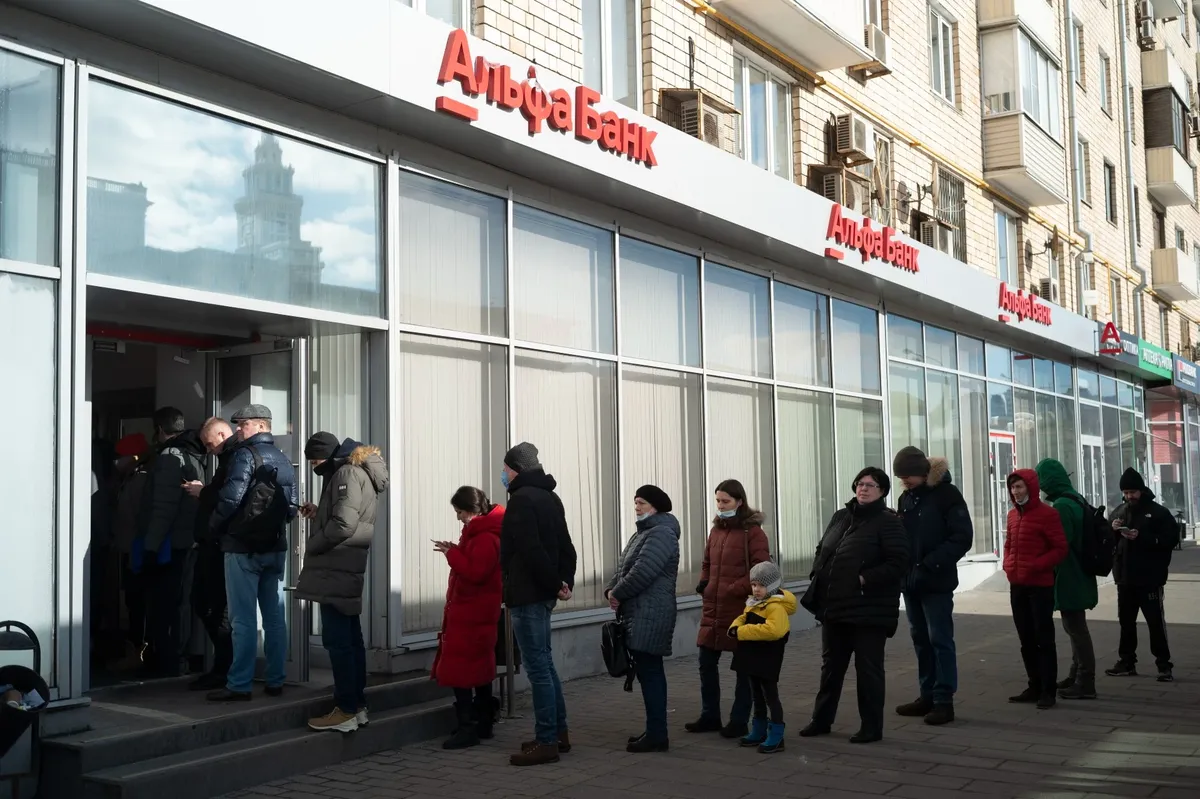
The basis of past optimism
Until now, sanctions, of course, influenced the standard of living in general, have practically not touched on the level of household comfort, achieved over the past 30 years.
Yes, the inhabitants of Russia, with a few exceptions, are “not rich” in the traditional sense of the word, but life in Russian megacities - with 24/7 supermarkets, developed by the general feeding, the best fintech in the world, accessible to the Internet, is really comfortable.
And this comfort may come to an end (along with the standard of living). Rather, comfort will remain - but for a very narrow group of the population, the standard of living of which will even grow.
The economic optimism of the Russian authorities was based on four cornerstones
Huge gold and foreign exchange reserves of the Central Bank ($ 630 billion).
Huge revenue from exports (almost $ 500 billion last year).
National Welfare Fund (more than $ 110 billion).
High (more than $ 100 per barrel) oil prices.
That is, according to people who make decisions, money should have been enough for everything about everything and in any case.
And this should be added to the full loyalty of the population, whose income, according to the authorities, increased significantly in the last year. In addition, the loyalty of people was supported by mortgage programs, the ability to easily invest in the shares of Russian companies, the cost of which grew faster than inflation, the availability of consumer goods (albeit at high prices).
Plus, a powerful information and entertainment machine worked excellently-Russian television shows really attracted the attention of tens of millions, and really formed a picture of the world around people-the one that the authorities wanted to see.
But now about comfort, you may have to forget - and for a long time.
Without comfort, money and apartments
Sanctions against banks and disconnecting from international payment systems are primarily sanctions against the ability of the Russian Federation to conduct international trade. At the same time, judging by the official information at the time of writing this text, the restriction scheme is built in such a way as not to hurt the export of raw materials - the only chance of the Russian Federation to ensure currency revenue.
For buyers, this may mean reducing the assortment in supermarkets and increasing prices for consumer goods - even regardless of the dollar in relation to the ruble.
The ruble exchange rate to the dollar is a special story. Reducing the flow of currency in the country means a decrease in the supply of this currency in the market. Less offer is higher than the price. Yes, the central bank holds back the growth of the dollar, selling funds from its reserves. But, "reserves" are not "property of the Central Bank." These are precisely “reserves” - the amount that provides the opportunity to all participants in international trade at any time to access their funds - regardless of what happens to the banks in which your currency accounts are open.
According to the data on February 1, 2022, the Central Bank of the Russian Federation had reserves for $ 630.2 billion, including $ 113.5 billion from the liquid part of the National Welfare Fund.
Almost half of the SVR ($ 311.2 billion) is located in foreign securities, a quarter ($ 151.9 billion) on deposits in foreign commercial and central banks. $ 132.2 billion from ZVR (21%) falls on gold, which is mainly in the repository of the Central Bank within Russia.
In countries that directly impose sanctions, 39% of reserves are placed. If Japan and the IMF join the frost, then 56% of the ZVR will be under the “blockade”.
In China, at the last reporting date (June 30, 2021), the Central Bank of the Russian Federation stored 14.2% of reserves. However, it is mainly about the yuan, which are suitable except for bilateral trade.
The gold that is stored in the Russian Federation and this is “protected” from physical confiscation can also be useless: sanctions will hardly be allowed to implement it on the world market for solid currency. This can bring a share of blocked reserves to 77%.
Let me remind you that most of the gold and foreign exchange reserves that refers to the currencies directly are an electronic record in the accounts of specialized organizations, which are not difficult to block.
The central bank - in a difficult situation, selling reserves to hold the dollar - it means to take risks that in a few days or weeks the remainder of reserves is not enough to ensure import
There are no reserves - there are no access to foreign exchange accounts, Bankster will say. Wait when there will be free money. It used to be in the exchange of currency - there are no dollars at the checkout - wait and wait in line until someone brings their amount for sale. But there are no accounts - there is no import.
First of all, consumer, since cars and equipment will continue to be imported-the owners of the country need to sell “resources” in order to continue to receive at least some funds.
But, and here everything is not easy - there should be a desire of partners to buy and sell goods to Russia, the export of which is not yet prohibited. At the same time, both transport and cargo should be insured - and how will insurers behave in such an indefinite situation? So far, transportation to Russia, if they have not stopped, have slowed significantly . And the fewer goods in the market - the higher the prices of them, this is the basis of economic theory.
The simplest example with banking sanctions and reserves is to imagine that you are standing at the cash desk of a supermarket with a cart filled with goods. And when paying it turns out that your bank card does not work. And there are not enough cash. There is a ring on the finger that can be laid in a pawnshop opposite - but how much will they give for it? You can ask a neighbor in line in a debt - but does he have cash, because a bank transfer also does not work? And does he want to help you? In this situation, you will have to unload your cart, leaving in it only the most necessary. Now imagine that the same story happened to all buyers in the supermarket - and here you have the simplest model of what can happen on the Russian market.
But let's say we don’t get used to inflation. But the Russian consumer market has one more feature, which was reminded of the authors of the telegram channel “Gosakups Time”. In short, the problem is as follows. The expenses of the Russian “mortgage” are a monthly contribution on the loan and “life expenses”.
And if the costs of life increase sharply - unlike income, some of the Russian borrowers who bought their “odnushki” within the framework of the National Project will lose the opportunity to serve a mortgage loan,
on which they have not even paid the entire amount of interest. The emergence of a large number of such “bankrupt apartments” on the market may have the most negative consequences for the construction industry as a whole.
Black swan in Lake Oil
But, in addition to the proper sanctions, there is another scenario, the possibility of which is admitted by financial analyst Nikita Demidov.
In addition to direct sanctions, there are also indirect economic shocks caused by a sharp change in market prices.
Now the high price of oil is seen by the last line of defense for the economy of the Russian Federation. Nevertheless, it is the price of oil that can now become the economic weapon that will change everything. In spite of all declarations of recent years, nothing could be done with the dependence of the budget of Russia on hydrocarbons.
Is it possible to believe in the return of the near -alloy oil prices as an element of economic pressure? Economic commentators in 2014 already carefully suggested that the reduction of oil is a controlled movement and a form of pressure on oil exporters.
Now there is even a more convenient situation for price manipulation. Oil is located at the upper boundaries of the medium -term price corridor. Changing the volume of production and proposal of oil of Saudi Arabia - an ally of the United States - indeed, affects price indicators.
If you add restrictions on the proposal of Russian oil in a particular format, the appearance of oil from Iran in the oil market as a result of the long -awaited signing of a nuclear transaction, then the puzzle is fully formed, explains Nikita Demidov.
In addition, an important moment in the financial markets is still an insufficiently studied phenomenon when the “cart runs a horse”, that is, the oil price is determined by the derivatives of financial instruments - futures contracts, as well as hedging by the participants in the market of the largest exchange fund United States Oil Fund (USO). This is an exchange fund that monitors West Texas Intermediate (WTI) oil prices. ETF USO invests mainly in short -term NyMEX futures for WTI brand oil.
The leading operators of the market of derivatives of commodity tools are the largest American investment banks, which can separately or jointly influence the price of oil. As a result of their actions, a derivative instrument, especially in the moments of the expiration of contracts, began in some cases to determine the price of an asset, that is, oil
A pleasant bonus from cheap oil for the United States will be a decrease in inflationary pressure, in which energy prices play an important role.
An unpleasant consequence of a decrease in oil prices will be a price shock for shale oil manufacturers, but they are already relatively adapted to price fluctuations through a rapid change in production volumes and price hedging mechanisms.
But for the financial and economic bloc of the Russian government, a decrease in oil prices will turn into the need to absorb this shock-through the already developed mechanism for reducing the ruble, in relation to the dollar.
This will once again lower the income level of the population, amid a price increase and high credit load.
If you look at the oil price schedule, it was precisely the sharp cost of black gold in 2008 and 2014 that the national currency devaluation mechanisms launched.
Thus, if a decrease in oil prices becomes the following plan after imposing sanctions, then economic problems will be at a fundamentally higher level. Indirectly, in favor of such a scenario, the emergence of shareholders from the capital of Russian oil concerns also speaks. For example, British Petroleum announced plans to get rid of her share in the Russian oil business.
But what about the oil embargo, which Russia can use. Can the world do without Russian raw materials? Will this not mean paralysis of the world economy. The fact is that the world already has an experience of life in an almost paralyzed economy - two years ago, during quarantins. And nothing, managed. The economy of the Russian Federation is one and a half percent of the world. And this is a fact that explains a lot whether we like it or not.