
Translated material
War - prohibited word
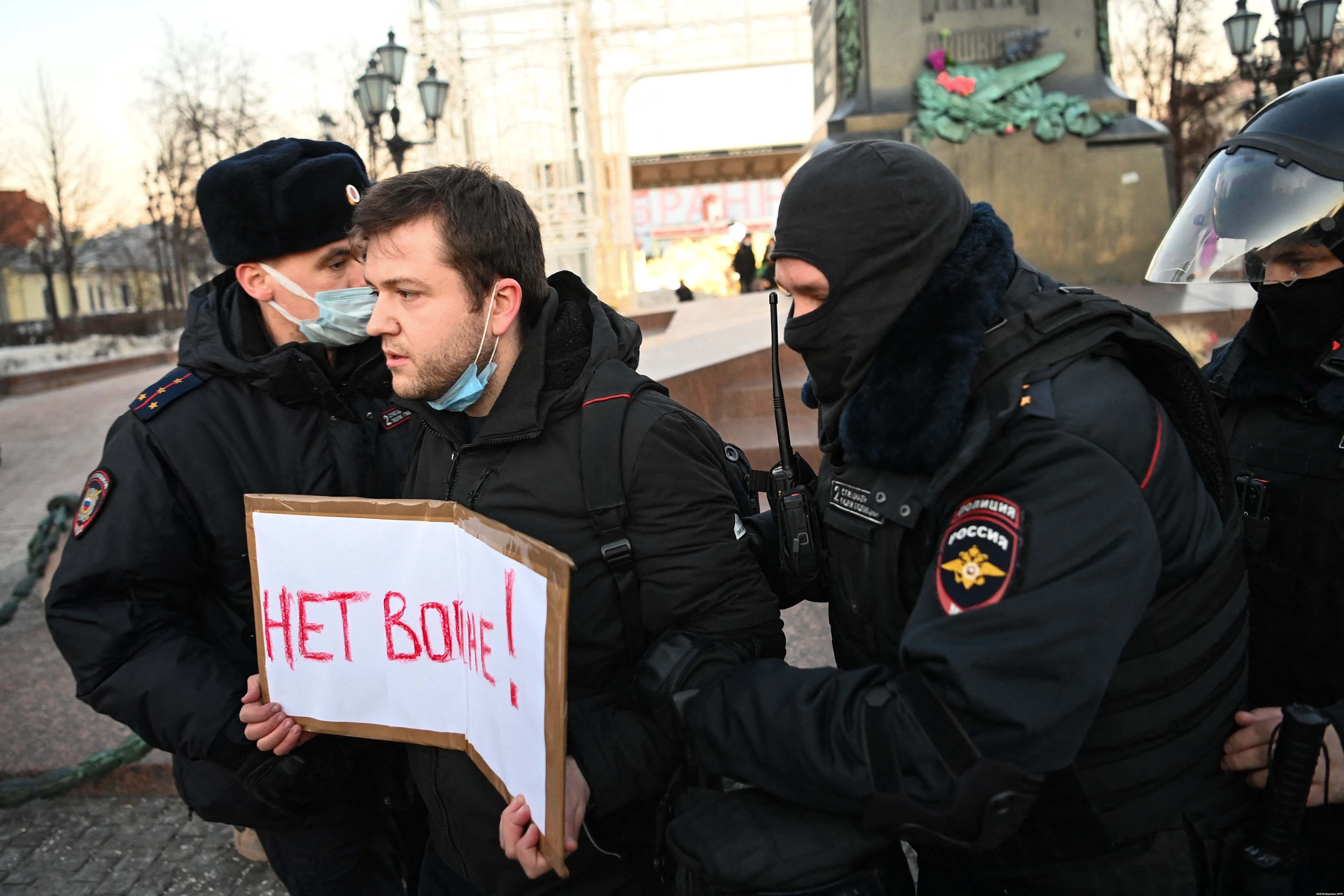
- In Russia, a law on discrediting the actions of military personnel began to apply .
- Every day in the cities of the country they detain participants in the shares opposing the war with Ukraine.
- The detainees in anti -war actions in Moscow talked about violence in the police department .
- Participants in the Ingush protests of 2018-2019 in anticipation of the appeal .

Width PX Height PX
The url has been copied to your clipboard
No Media Source Currently Available
0:00 0:53:10 Download the media file 15 years for "there is no war!"
Recently, telling the truth and expressing your own opinion about the actions of Russia in connection with the invasion of Ukraine has become dangerous. On March 5, the country began to operate new provisions of the Criminal Code and the Code of Administrative Offenses, which can affect not only authors of posts in social networks, commentators and participants in shares, but also citizens who openly express their opinion about the war if it does not coincide with the official position of the authorities. Punishments are real and very impressive - from many thousands of fines to 15 years in prison.
How to put it in practice, and is it true that now for a peaceful post in social networks with the words "no war" or "peace - peace" in Russia can you get a deadline? We asked this question to lawyer Ivan Pavlov (entered in the register of foreign agents).
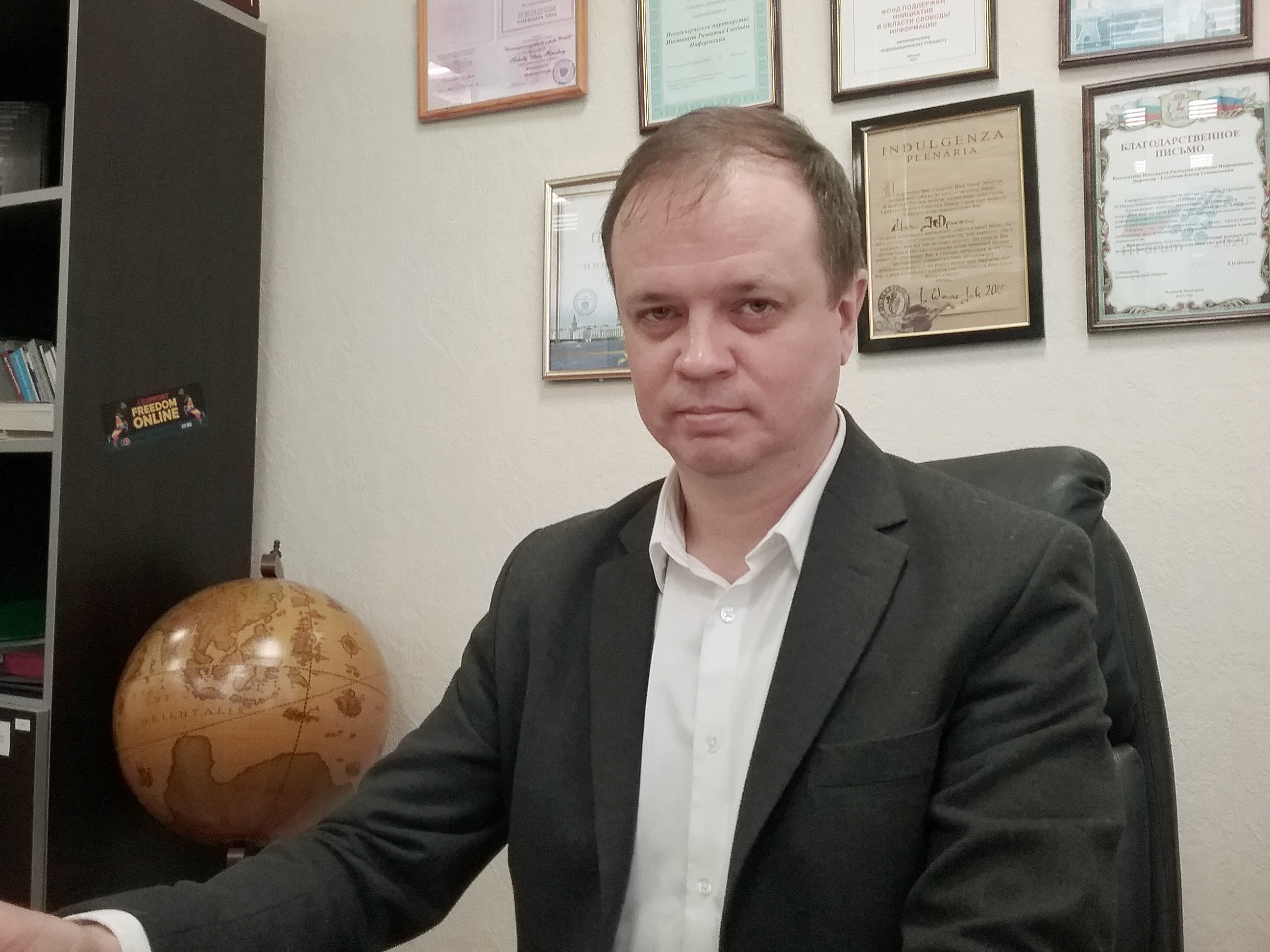
Ivan Pavlov: In wartime conditions, the right does not work. Our "frantic printer" - the State Duma - issues a military product aimed at intimidating the population. But the words of the authorities that they conduct a "special military operation" should not interfere with us to call a spade a spade. This is a war. It’s just that now the authorities considered that if you call white - white, and black is black, then this is crime. But from this the white will not become black, and black - white.
In wartime conditions, the right does not work
Maryana Torocheshnikova: But a person can be in prison because of this. For the phrase "world - peace" in Russia can now be sent to bars?
Ivan Pavlov: They can first be punished in administrative order, and if he performs the same act within a year after bringing to administrative responsibility, he may receive a term. Such laws are now adopted. This has nothing to do with the right.
Many journalists choose the only possible option - just not to work, but to sit and be silent, because in such conditions it is simply impossible to engage in normal journalism.
Maryana Torocheshnikova: Do all these provisions of the Criminal Code and the Code of Administrative Offenses concern, comments, reposts in social networks?
Ivan Pavlov: Reposts - of course - this is the dissemination of information. "Like" is something else, a reaction to a message. “Likes”, by the way, were not previously criminalized by extremist legislation.
Maryana Torocheshnikova: Will they prove which war was talking about? Maybe a person thus speaks about the war as a whole, as a phenomenon.
Ivan Pavlov: No one will delve into the details. They will look: if a person was against the war, against the actions of the authorities in Ukraine, then he must be punished. There would be a man, but there would be an article. Today, these articles have become much larger.
Maryana Torocheshnikova: Why do the Russian authorities put on all this in some laws, create the appearance of the existence of law, if there is actually no right, martial law?
There would be a man, but there would be an article. Today these articles have become much larger
Ivan Pavlov: Vladimir Vladimirovich is a very interesting person. Despite the fact that recently he has “flew off the coils” a little, he is still trying to remain a lawyer. It is obsessed not only in the war, but also in some legal procedures. The main thing is that there is some kind of procedure and a suitable statue. And now from these articles a powerful repressive apparatus is being created to completely drive the population into their homes, so that no one violates the regime of silence, which is so important for the "special military operation", which I call the war.
13 thousand is not the limit
From the beginning of Russia's invasion of Ukraine, people in various cities of the country go out into the streets to say “no” to the war. They are dispersed and beaten. About 13 thousand participants in anti -war shares were detained throughout the country. Most of them draw up protocols on violation of the rules of public events. But some are already judged by the new article - about discrediting the army, and students are threatened with deductions.
We have in touch-the head of the legal department of the OVD-Info Alexander Baeva .
Who most often entered these promotions?
Alexandra Baeva: We are counting only those people who are delayed. We understand that these are mainly young people, about 20-30 years old. But the portrait of the detainee can be very different-these are young girls, and middle-aged men, grandparents, very different people by age, status, level of education, involvement in some professions.
Starting February 24, protests occur almost every day. These are processions, and marches, and pickets, and all this happens at the same time. Every day, from several hundred to several thousand people, is delayed. The most massive detention was March 6: we counted 5.5 thousand people.
The portrait of the detainee is very different - these are young girls, and middle -aged men, and grandparents
Of course, leaders are Moscow and St. Petersburg, but in other cities we also record detention. These are regional actions, they begin with Khabarovsk, Vladivostok, and then how the time zone moves, so by evening people begin to detain in a wide variety of cities. Most of the detentions were in Novosibirsk, Krasnodar, Krasnoyarsk, Kazan, Nizhny Novgorod, Perm, Veliky Novgorod. For all these days, we counted about 147 cities in which there was at least one detention on anti -war protests.
In St. Petersburg, a special aggression is always observed by police officers, they delay it tougher, often with the use of special equipment, people have bruises, abrasions, cuts, bruises, when they are dragged to police buses. In Moscow, the most common article is 20.2, and in the regions others are used, for example, the “coronavirus” article. They love 19.3 - disobedience to the police officer. Or 20.1 - petty hooliganism.
Maryana Torocheshnikova: And now the new one has appeared on 20.3.3, which provides for administrative liability for the discrediting of the Russian army and military personnel. How wide did this spread?
Alexandra Baeva: There are already more than a hundred protocols, and the courts of the first instance have already examined a number of these protocols, people receive the first fines. In addition, some part of Article 20.2 can also be added to people, although double attracting for the same act is prohibited by Russian law.
Torture in Bratevo
During anti -war protests on March 6 in Moscow, the police detained more than two and a half thousand people. 29 of them, mainly the girls, ended up in the Bratevo police department, where some of them were beaten and tortured . According to the stories of the detainees, this was mainly done by one employee whose name has not yet been established. He was of particular aggression by his attempt by the detainees to take advantage of the 51st article of the Constitution, that is, not to testify against himself.
A human rights activist, a member of the Presidential Council of Human Rights Andrei Babushkin joins us.
What happened in Bratevo is a very disturbing signal
Andrey Babushkin: In different ATSs, the detainees turned differently. Somewhere people-minors and people with disabilities-the employees even mined to the house somewhere for their money bought food. But somewhere, unfortunately, there were excesses that demanded our intervention. For example, one of the departments was delivered without any reason Svetlana Gannushkin , who celebrated her 80th anniversary that day. It is clear that she did not participate in anything, however, before our arrival she was held there for two hours (then, however, everything was issued quite quickly).
Maryana Torocheshnikova: Svetlana Alekseevna is a well -known human rights activist, she heads the Civil Assistance Committee , which helps refugees and migrants. She was lucky - a lawyer was allowed to go to her.
Andrei Babushkin: We identified eight cases when lawyers were not allowed or allowed at the wrong time. In six cases, these violations were eliminated, in two cases, lawyers could not wait until they were allowed. Of course, what happened in Bratevo is a very disturbing signal. I thought such excesses were a thing of the past. Today I went to Bratevo. A person who was a checking made an impression of a very conscientious officer. But what I did not like is the organization of the work of the district police officers. We tried to get through today to the district police officers under the guise of visitors, and not a single district police officer picked up the phone and did not call us back.
Maryana Torocheshnikova: And who is checking?
Andrey Babushkin: Parallel passes several different checks. The audit is carried out by the Investigative Committee, the prosecutor's office, the own security of the district and the city, as well as the department itself.
Maryana Torocheshnikova: Now almost every department of internal affairs (in Moscow for sure) is equipped with video surveillance cameras. Did the notes from these cameras be requested from the Brotherian branch?
Andrey Babushkin: Yes, all cameras have been studied, requests were sent to all medical institutions where the victims could contact. The list of an enhanced analysis group, the personnel exit, the passage of the passage to the checkpoint, is requested. All measures are taken in order to collect the information as widely as possible. But this is not enough, it is necessary that a person who will give this assessment show sufficient will and independence.
Everyone agrees that the police should not apply violence where it is not provided for by law
More than two thousand detainees are a fairly large figure. It is clear that here the police become a hostage to the situation. Those who make a political decision put the police with their opponents, which works in forced circumstances. Here the police must be remembered that today they detained a person, tomorrow was told by journalists or just social networks, and the day after tomorrow hundreds of thousands of people who are ready to help the police will not come to her aid at the right time.
Maryana Torocheshnikova: Is there already some consolidated position of the Presidential Council of Human Rights in relation to repressions against people who want to express their opinion on this special operation, come out with the posters of the World-Peace, “No War!” And in the end they find themselves in police branches and in court?
Andrei Babushkin: There is no consolidated position, because the council includes people of very different political views, starting with those who believe that Putin acts too soft, it is even tougher, and ending with those who believe that these things are generally unacceptable and from the first second of February 24, everything was done incorrectly. But everyone agrees that the police should not apply violence where it is not provided for by law, that measures bearing the nature of coercion should be minimized, that these actions should not lead to the destruction of civil society, or to discredit the police to citizens.
Maryana Torocheshnikova: Alexandra, which people who were detained in these days more complained about the OVD-Info?
Alexandra Baeva: The most difficult thing is the very fact of detention. As a rule, the law is often violated here, when the police officer does not appear, does not explain the reasons for the detention. Often, detention occur quite aggressively: they ran up, grabbed, dragged into a car zak. And in the police departments, violations are mainly associated with forced fingerprint and photography. This is a new practice: we have massively recorded it only last year. There is something completely new, and so far not everyone understands why this is done: DNA collection, when people take smears from their mouths, from the nose. Often they do not allow a lawyer, and this suggests that the rights of the detainees will be violated in the police department.
Maryana Torocheshnikova: A year ago, when in Russia there were protests related to the arrest and sending to the colony of Alexei Navalny, a huge number of people (unexpectedly for Moscow) ended up in special receivers and received real punishments. Is it now known, as often, the courts make decisions to send them, for example, to serve a few days of punishment against people who have gone to an anti -war action? Can this be compared with what happened a year ago?
Alexandra Baeva: I think you can. Previously, famous activists, politicians or deputies received a day as a day, and all the rest - most likely, fines. Last year, this practice has changed dramatically. A person could reach the protest for the first time or to be accidentally detained and get an arrest of up to 15 days. Then we saw crowded specialists. We observe this now, but to a lesser extent.
The most difficult thing is the fact of detention: as a rule, the law is often violated here
Maryana Torocheshnikova: As of the evening of March 9, what number of detained participants in protest anti -war shares throughout Russia are we talking about?
Alexandra Baeva: From February 24 to date, we have recorded more than 13 thousand detainees. But the fact that the OVD-Info brings to its statistics is only the lower border. People may not call us because they do not know about us or they are not given the opportunity to call. Real numbers, of course, are more.
Ingush business
Against the background of events in Ukraine and their consequences, other human rights topics are fading for people, which we continue to follow: for example, the appeal in the so -called "Ingush case". The leaders of the Ingush protest against changing the administrative border with Chechnya at the end of last year were appointed from seven and a half to nine years of colony. Such terms were requested by the prosecutor's office. Everyone was found guilty of organizing violence against representatives of the authorities and the creation of an extremist community. According to the results of the protest in 2018-2019, dozens of activists from Ingushetia were in the dock, many of whom have already served the punishment. But it was precisely by the time of consideration of the cases of opinion leaders in Ingushetia that the prosecution position was noticeably tightened.