
Translated material
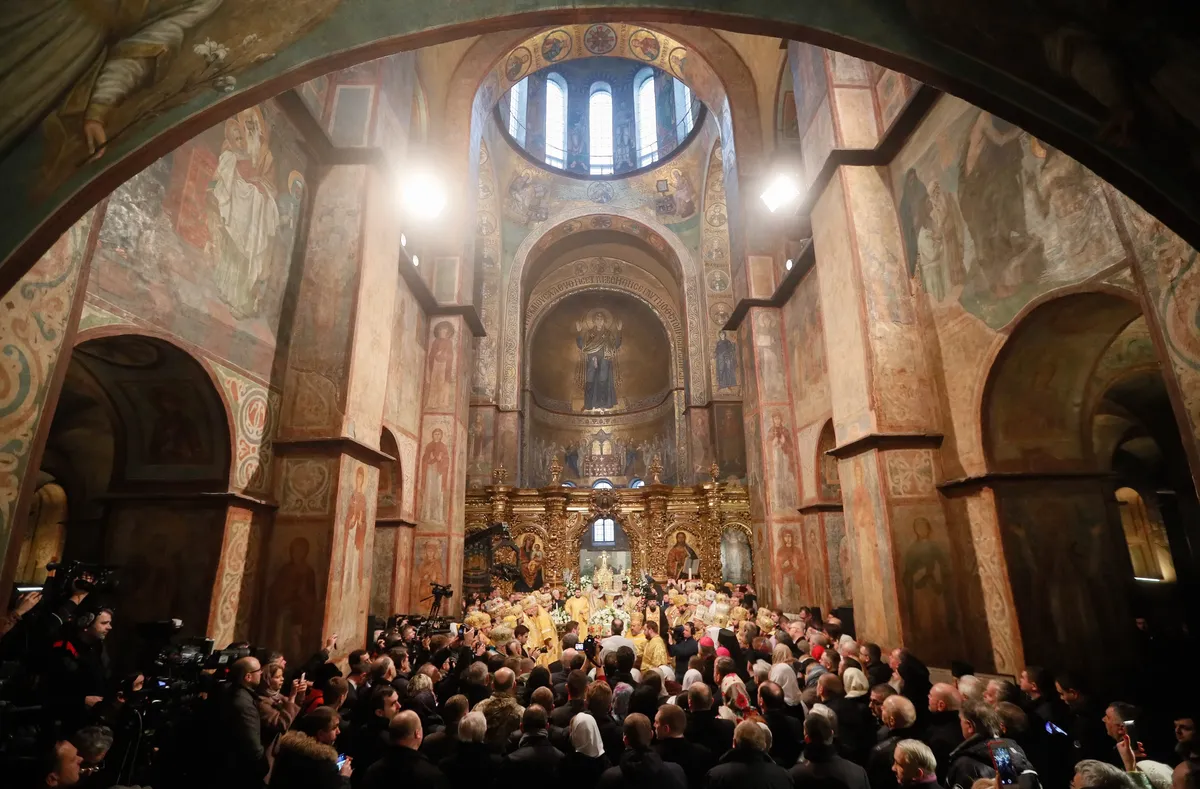
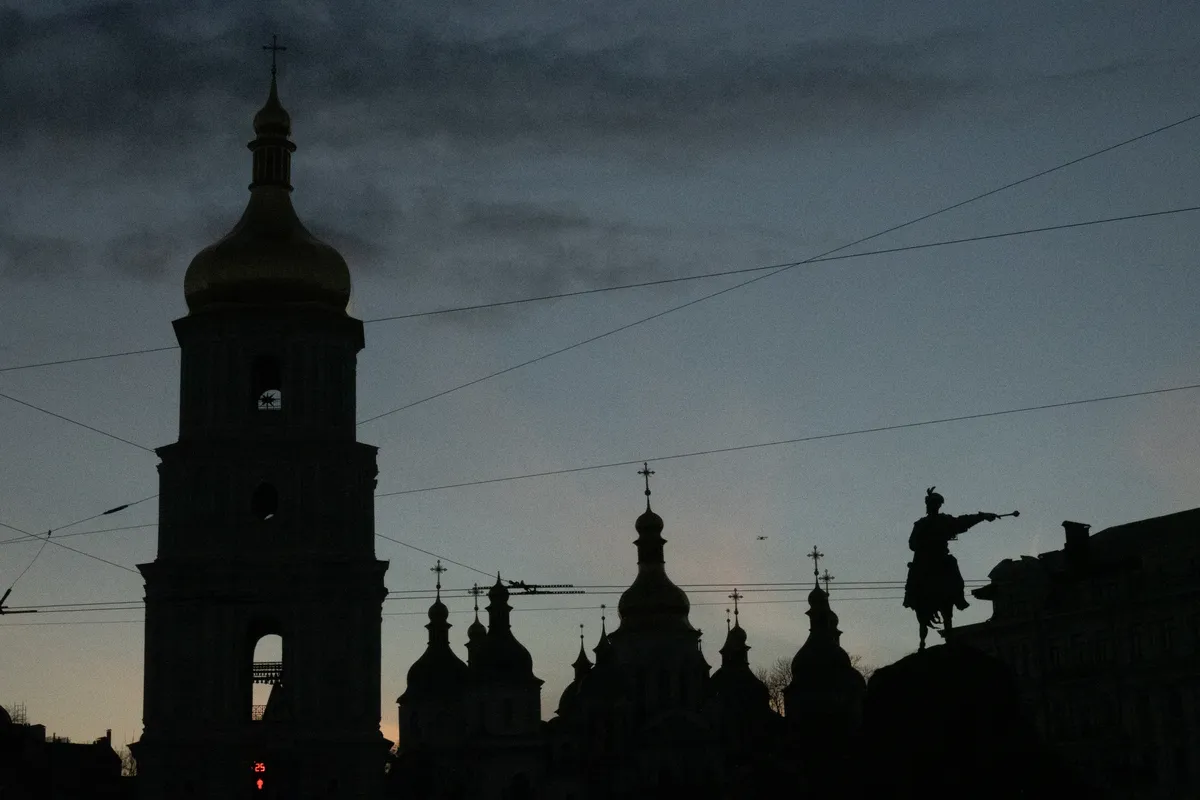
Under the dome of St. Sophia
“Do not be afraid, just believe” - words for any moment, especially for this. About Kyiv in the heart
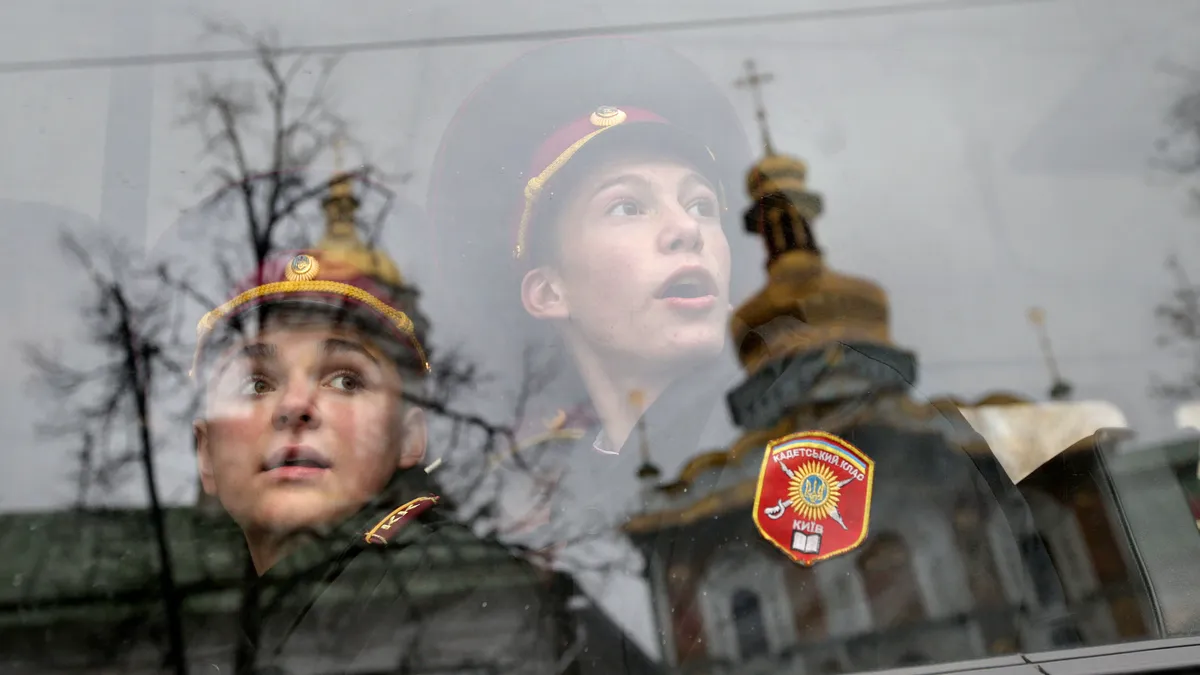
The libraries of the Kyivans lie with brick masonry in the windows: Tom with a “binding towards themselves” - a home -made barrier from fragments. But the sand clock has not yet broken: they turned upside down.
For everyone - and the living in the Asian part of Russia, far from all European borders - with Kiev their direct relations. They are long -standing. Bypassing Moscow. Long before it - not only in the sense of more antiquity of the “mother of the cities of Russians”, but also in the sense that for every reading Russian person Kyiv is the first “Stol city” known to him or to it.
This is from epics. Of the books with pictures. This is from the recent. From the era when they read - to us.
The topography of Kyiv-Pochaina-river, text, as historians say, in the place of the current Khreshchatyk, and the Dnieper-River itself (as in the children's book "Bogatyr")-are recognized simultaneously with the topography of the native city.
“The hero arrived to the Dnieper River ... And the water in the river is muddy, mixed with sand.
“Why are you muddy, Dnieper River?” - asked Sukhman.
The river answered him:
- How not to be stitched? The third day Busurman Most is bridge. They want to cross to Kyiv. And I'm the shores of the swarm, I ruble the bridge. Yes, I don't have more strength ... "
This is a free arrangement (the author is Anatoly Vasilievich Mityaev, the front-line soldier and the chief of the Murzilka and Soyuzmultfilm in the 1970s) are not a news report, but the epic about Sukhman-Bogatyr. Apparently, the Turk in the service of the Kyiv prince.
And although at the end Sukhman dies-not so much from wounds as from “resentment” that the prince did not believe in his feat-the rescued golden-haired city on the hill (this is how he appears in the illustrations of the artist-blocker Nikolai Mikhailovich Kochergin) shines and lives.
This world recognized in childhood rotates around Kyiv, the archetypal goal of all roads. The winner of the Nightingale-robber Ilya Muromets paves a direct path from Murom to him. Over his city walls and a guard tower, he flies on a magic-father and grandfather-a horse of Burke Dobrynya Nikitich, on a battle with a snake of a mountain, a kidnapping of people holding them in the "burrows"-Zindans in the "mountains of the Saracensky".
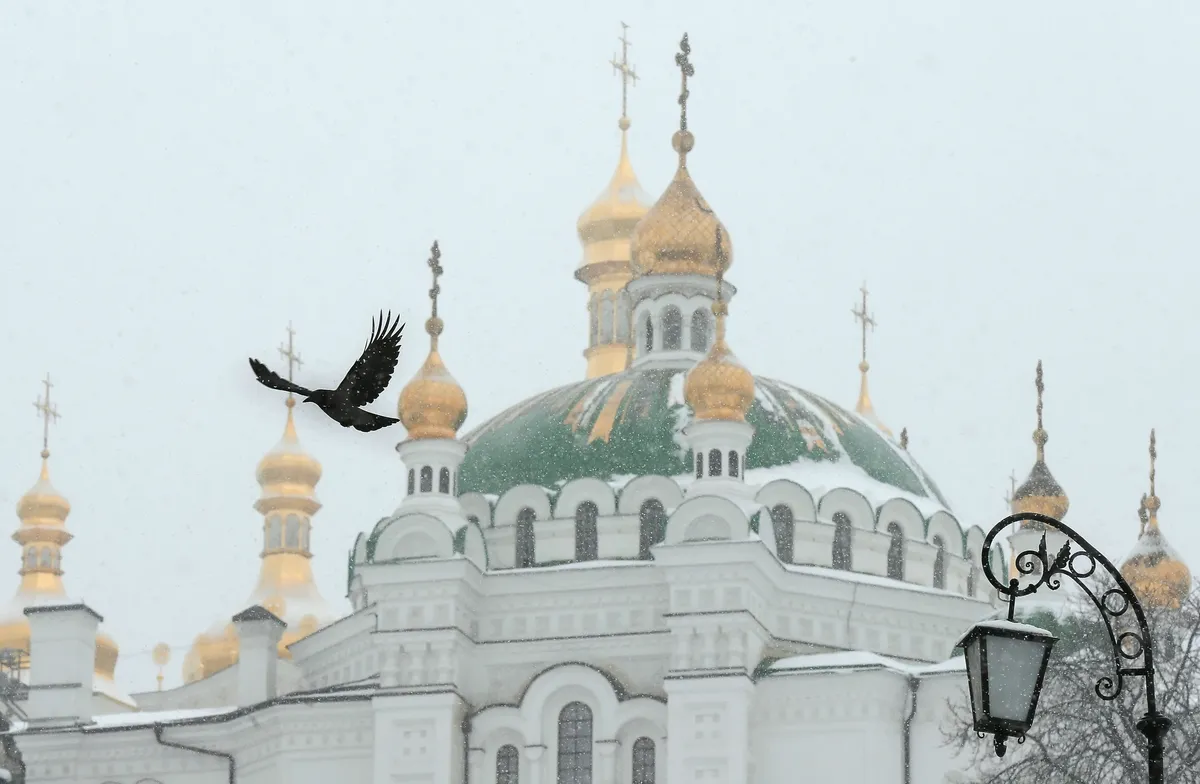
The heroic couple, Dobrynya with the bride Nastasya, found by him in an unknown Vityaz, on whom he "swung down, but could not hit Kiev, but could not hit." Under a fairy -tale silver helmet - "The braid is blue, the eyes are blue."
The background of the meeting of Nikita and Dobryni is given in the style of icons: these “Sinai” mountains in the representation of Russian monks; This oak tree from the tree above the Old Testament Trinity. It was impossible to find out, to solve the origin of things in a frantically and harmoniously colorful world of heroes; But one thing is clear-this is something sacred. A fragment of the ideal world.
Kyiv is his touch, the inlets of the ideal - a distant, penetrating ray, the light is either scattered, then indicating: look, the main thing here is.
So - here, in the very middle - flickering, improper, undeniable “contours” begin, Kyiv is in the heart, such a schematic and exquisite, blatantly multi -colored, emphasized festive; Especially durable that
This is an illusion of art, created for preschool children with a scribe and a miniaturist who passed a war that no one forbade to call war.
In this ideal world, the Greek idea was embodied (the expression of the philosopher George Fedotov from the 1926 article “Three Capitals”), there the dome of St. Sophia soars, even if it is invisible, even if its name is not named.
This "Byzantine and princely Kyiv" comes to life for me in the voice of my godmother.
The poet Elena Fanailova and Ironia noted on Facebook that recently everyone in Russia found his “Ukrainian grandmother”, filled southern sentiments.
My godmother was my grandmother, and - Russian in spirit, reprimand and passport, she was in the face and girlish name - there was a Turkish woman. Female form from the definition of "Turk". And in my case, the southern sentiments were given to the Turkic world, which she outlined by the arc of her biography. From birth and childhood among the Siberian Tatars of Tobolsk to youth in the border Azerbaijani Lenkorani and Baku, to maturity and old age on the border with Kazakhstan in Kurgan. This is my personal "crescent of pilgrimage", turning to the point of the house, the homeland.
But it is necessary in all ways from those minutes over the book for the non-readers (“Sit down closer to me, cling to it stronger. I will tell you about the epic heroes”) I know, I will find out the sophia light. The shine, the reflections of the Greek-the brave Perseus (we also read about it), and some scattered cloud. It covers - and thereby keeps, protects and points - holy. “Language will bring to Kyiv” - but also speech, this is freely Russian speech that begins in the same place.
They say that the Greek word “logos” has 40 meanings, and it is not clear that the main thing is “word”, “thought”, “reason”, “number”, “structure”, Heraclite “necessity”, or all this together. But it is the glow-long-range and peaceful, invincible and gracious-this total essence, this fire (again Hercitel) visits me then, pressed, as ordered by the book, to his native person stronger.
A native person constantly stretches to Kyiv, returns there, and therefore reading it, radio recitative is so convincing.
She brings from Kyiv - his part, which can. With a wicker basket of fruit, it bursts into the house at five in the morning, from the train, so that, barely crossing the threshold, to proclaim, instead of “hello”:
- Eat the pears!
Things, its will, come themselves: every month the postman throws the literary and artistic magazine Barvinok into the box, published in Kyiv (the Central Committee of the Komsomol of Ukraine): some boy looks from the colorlage, a petal instead of bangs. This is the barvino. Mysterious children, Lesik Spasokukotsky and Stasik Kukuevitsky share their double being, a translation from Ukrainian.
The Slavic Sea, the contrast to the dashing-crossing Turkic river, splashes around me: from the capital of Bulgaria Sofia, the post is brought by the monthly magazine for the youth “Art Gallery”, and to the centenary of the battles and the sword, the seller of the book, similar to the pre-revolutionary Mason, reserves the book “Two Ivan” for us. Russian Ivan helps Bulgarian and (“this is as usual,” in the language of the hero Pelevin) dies.
Our own Ivan - the one who studied in Kharkov, fought in the Don region within the borders of Ukraine, in Snezhnoye and Dibrovka, where Russia is already visible with the naked eye - also died. It was there, on the so-called Mius-Front, as part of the 18th Army, which connected their unprepared offensive in December 1941, those German units that historians suggest that would find themselves near Moscow. The practical purpose of the offensive was to recapture at least part of the three million tons of coal left by the enemy. It is this understanding that follows from the diary of Kondrat Zamenkov, the organizer of the evacuation of the coal industry of the East Donbass.
Anna - that’s the name of my grandmother - cannot but go closer to her Ivan: she is fused along the Dnieper from North Kanev (here she is in the photo near the Tarasova grave) to the seaside Kakhovka, then he goes to bow to Kyiv Sofia.
But she does not go to the exhausted plasma of generations, the exhausted land of Donbass. “Masses have no tearful widows,” Veda is right.
This is a magical, conspiracy place.
And he doesn’t go to Kharkov, where he was happy in his youth, along with the cadet of the Kharkov military school of border and internal troops. For much longer they lived on the border with Iran, in Lenkorani, but our home is the main, everyday things - with brands and brands of Kharkov: a cross -out calendar, razor and a manicure set. My first plate with a gold and green strip - Budyan porcelain: in the village of Buda since 1887 there was a Kharkov branch of the Kuznetsov porcelain “business”.
And Kharkov, too, is an inaccessible place, gilded by a legend.
But they are available and simply open to us: Kyiv, Lavra, Sofia.
Lavra, Sofia, Kyiv ... those that are now ...
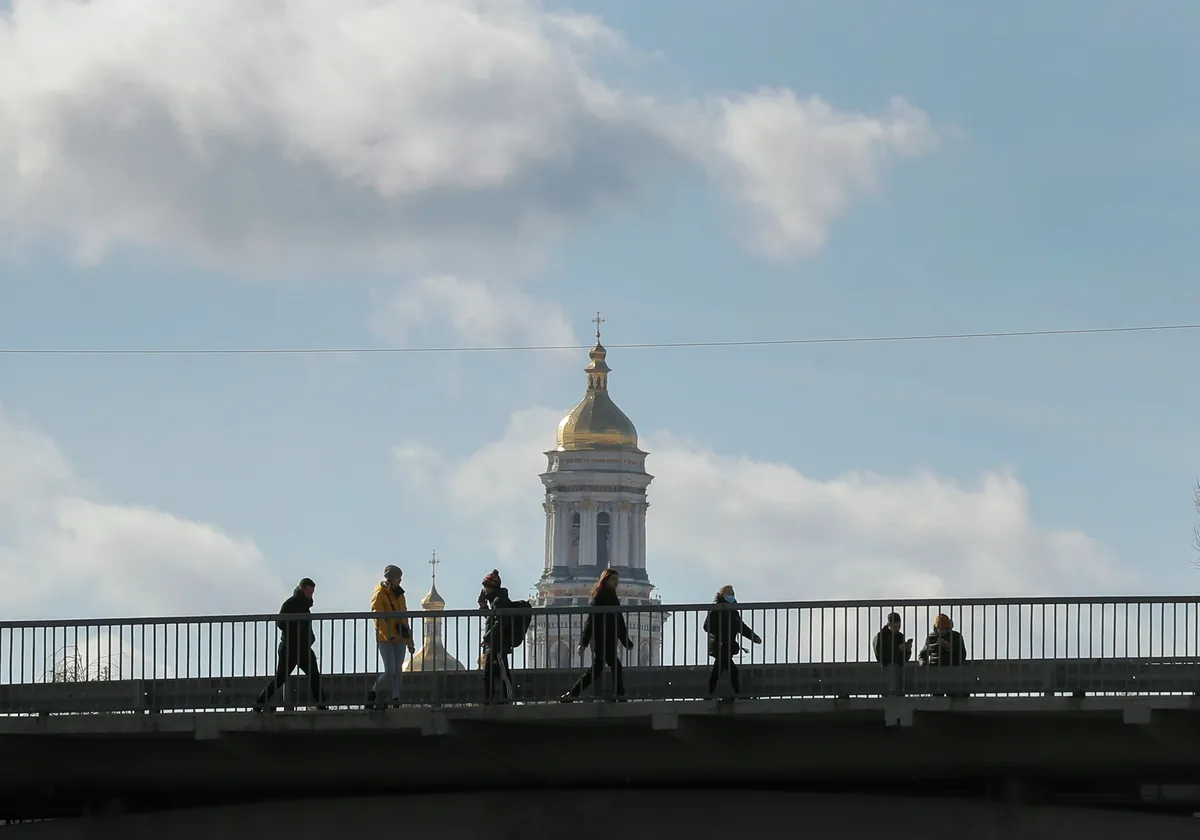
The muffled, “whispering”, as they put in Siberia, Anna says in a reverent voice, Bays, like Bayan, again and again: Lavra, Kyiv, Sofia - and in our narrow, penal room, gold and green (this is a shadow from the branch of Jerusalem), pilgrimage, the pilgrimage light, the almost material fragrance blows.
The philosopher Georgy Fedotov wrote in 1926, being in exile and looking for new ways, new capitals for the coming Russia that educated Russia did not think about Kyiv. “In the recent past, we easily renounced Kyiv glory and powerlessness, leading our family from the Oka and the Volga. We ourselves gave Ukraine to Grushevsky and prepared the independents. Did Kyiv ever stand in the center of our thought, our love? A striking fact: the new Russian literature passed completely past Kyiv ... And the Russian people in all centuries of its existence did not get tired of sticking to him and in epics, they say, very late, praised a wonderful city and his bright prince. ”
So-as about the shrine-my domestic Turk, who attributed himself, like Sukhman-Bogatyr, to the Russian people speaks of him.
He pulls me if not under the “golden sky of St. Sophia” (once again George Fedotov), then at least closer to him.
I really need to go there, closer to the sea. Otherwise, I will worship on my 55th degree of northern latitude-from otitis media, bronchitis and improper Mantoux reaction, in the surroundings of home quarantines.
And we go to the sea, at about halfway between the Constantinople Sofia - and the Kyiv Sofia. And in the house of the then-closed Evpatoria mosque, Juma-Jami, built with the thought of Sofia of Constantinople already as a Muslim Ayia-Sophia, I am recovering. I’m just falling, plunging with my head into the water of the salty estuary and, having risen, spit out, erupting all the muddy, which on my native north-east, which Maximilian Voloshin called the “polar underworld”, has stolen my unfortunate sinuses, bronchi, the very soul.
I walk past the fence of Juma-Jami, look at the night rustling garden, some ghost of the minaret ... I go with my Genghisid to the Nikolsky cathedral, where it has a slightly dusty golden light. Beautiful, clean - close to me, it looks from the height of the dome by a divine eye, and through the open bribery windows flies into the temple of the rumble, monotonous harmony of waves, polyphonic support for infinitely high soprano in the choirs.
We all loved it. We were alive, lively.
The choir of the things of Ukraine was buzzing around us and when we returned: so dense that sometimes it seemed-even a moment, and in the evening air of Siberia, in our actual hot (Central Asia nearby) and a dry Zyuid-west you hear the sounds of Bandura.
I really wanted to write words to the elusive, but not an illusory motive. But the melody was inaudible, only the chords hung over the giant acacias, and the feeling, indefinable, hot and infinitely important, died out on the verge of a word.
In the afternoon it was no time to catch the meaning: I just opened the “Library for Children” at home, numbering my favorite books and inviting yard friends to come and “take”.
“Well, well,” said Anna, but did not add anything anymore.
For that, she was an “excellent student of the popular education of the RSFSR” in order to know how sometimes she burns the desire to catch up and enlighten. Share your beloved.
I was even ready to lease Gogol with pictures. In addition to the inventory library cipher No. 5, there was: “brilliant creation” on the form. More readly after a couple of years, only a book for Irina Wilde teenage “adult children” became a book for adult teenage; Authorized translation from Ukrainian.
The timid-modestist “Grave Diti”-about how in the 1920s the Bukovinsky intelligentsia is turning and rebeling under the Romanian yoke, looking at the vein, then at the Soviet Ukraine, and most of all, in the person of the heroine of the Darka, at the countryman in the village of Vernichan, the curly violinist Danko Danilyuk. He, infinitely elegant, faithful and incorrect, I drew in the imagination amazingly subtly worked out - helped manuals and artistic albums of my father - appearance. I completed a runaway image to the finished phenomenon. Is it wonder that I met these features in my life?
Yes, probably marvelous.
If we begin the exrasis of the seizure, isolation from ourselves and our inner world of the Ukrainian features, a literal special operation to clean up this hum of phenomena, I can say in advance what will be the result.
Some kind of mess.
Dante's line: "And I fell, as the dead man falls."
A revived atlas of anatomy. There is not enough one or the other - a partial, busy person.
The desire to keep something in reality can lead to the fact that not only the held, but all that is enormous that is attached to him will leave us.
We are threatened with scorched land in our own heart.
And even for yourself - for the fact that you will save the shrine in your heart: Sofia, Kyiv, Lavra - you can’t vouch.
But we can hope, and hope is already the basis for action.
And you also believe that with a sophia trick - and Sofia, after all, is another Greek word with dozens of meanings, and “cunning” as a form of wisdom is also among them - what is happening will turn out completely different from the high -precision, mathematically doomed to predictability of artillery.
“Do not be afraid, just believe” - words for any moment, especially for this.
To be Russians now is sorrowful and painful, but this pain gives to see the grain of the future, because one of the concepts of what it means “to be Russian” - like this, taking the holy in the ring: Lavra, Sofia, Kyiv, crumbles literally before our eyes.
It is not alone: historical fire is firing, like inflation - money, pyramids of untruth. Bankruptcy of false entities unfolds live as a sanctions list.
Now it is important for us not only to survive-professionally, personally, somehow else.
It is important to stay on the side of the truth.
In one of the books, the truth is called "first love."
Kyiv, Lavra, Sofia.
Lavra, Sofia, Kyiv.
Sofia, Kyiv, Lavra.
Any word order.