
Translated material
"Anti -East" terror
In Russia, pressure on eco -activists is increasing. How the protection of nature turns into criminal cases and the death of people - says the ecologist Vitaly server

The Russian Socio-Ecological Union (RSOES) presented a report in the Public Chamber on the persecution of eco-activists in 2021. The organization recorded 135 episodes of pressure against 181 people in 44 regions of the country.
“28 activists were attacked and/or their property was damaged. 12 criminal cases were instituted and more than 70 administrative protocols were drawn up. The total amount of individual fines reached 866,000 rubles. One person died, ”the report says. Why is the protection of nature, the need for which President Vladimir Putin has repeatedly spoke, is actually turning out for the people who are involved in her persecution, persecution, and sometimes at all - death? We are talking about this with the co -chair of the RSOES Vitaly server.
- When I read the release of the discussed in the Public Chamber, I literally tripped on the phrase: "One person died." Explain: are they killing eco -activism in Russia?
- For eco -active is killed in principle. And the number of those killed is growing every year. There is such a Global Witness organization. They record the killings of ecologists around the world. This is not only a Russian problem, although it must be recognized that in the first place it concerns the states of conditionally authoritarian, not democratic, not capable of ensuring the interests of their citizens. First of all, the countries of the Global South: Latin America, Southeast Asia and Africa. Some of them take place about a hundred murders per year. In Russia, the numbers are others, here
It’s not so far that they hunt ecologists, but, let’s say, incidents take place here, which from time to time spill in death.
It is difficult to say that these deaths are directly related to environmental activities. The problem is that in such cases an article on an encroachment on the life of a public figure (Article 277 of the Criminal Code) should be used. But it is not used. And, accordingly, there is no proper investigation, including investigation of motives.
For example, with the death of Sergei Pakholkov from Vologda in August 2020 ( Sergey defended the square from cutting down on Yaroslavskaya Street. - I. Zh. ) The situation is most obvious. Because the person was detained for protests, the man fell during the detention and then was in the police station. This means that the state is responsible for him on international human rights principles. We cannot say that we wanted to specifically kill him there. But the fact that a person was not provided or at least was not properly provided - must be investigated. However, so far Sergey himself is trying to discredit. They say that he was drunk and so on. This is all an echo that the state is not able to protect people who defend their environmental rights.
If we are talking about the death of the Associate Professor of the Timiryazevo Academy of Zahid Urazbakhtin , which fought against the transfer of agricultural lands of the Academy for development, then the situation is more complicated: it is not clear whether a person was fought or he made a suicide ( Zahid Urazbakhtin was found dead in his apartment. - I. Zh. ). There is a suspicion that here it was necessary to apply the article “Bringing to suicide”. Because there was also persecution against him: there was a whole media campaign, during which he was accused of using these lands of his interests ( officially no accusations against Urazbakhtin were put forward. - I. J. ). It was all necessary to investigate.
Other well -known cases of the death of eco -activists (since 2012)
Mikhail Beketov - died of the consequences of cruel beating in 2013. Ecologist journalist. The killers are convicted.
Igor Sapatov was shot dead in the forest of Kazan. Also 2013. He fought with the development of specially protected natural territories along the banks of the Volga and Kama. The killer was not found.
Nikolai Podolsky and Sergey Malashenko were shot dead in the Tersky district (Murmansk region). 2013. Public environmental inspectors. The killer shot himself.
Irina Zelenina with her daughter brutally was stabbed in the city of Vidnoye (Moscow Region). 2014. She defended city forests.
Zemfira Gallamova was strangled by a dog collar in Ufa. 2014. The head of the public shelter for animals "Kindness". The killers were not found.
Vadim Volodin . Killed on March 2, 2018. Activist Utrish.
Most likely, this is not a complete list.
- Last year, according to your report, 12 criminal cases were instituted against eco -activists and 70 administrative protocols were drawn up. Are they all connected directly with the ecology?
-There are no household chores in statistics, but again: it is often difficult to understand whether the persecution or with some other civil or political activity is associated with environmental activity. We have certain mechanisms with which we are trying to determine this. We plant like this: we record cases that are associated or can be associated with environmental activities. For example, when the Communist Party activist comes out with a poster against the plant and is delayed. She is probably not a purely environmental activist, but here it is obvious that she is detained for protest against the plant. When there is a direct connection or an obvious suspicion that detention is associated with environmental activities, we fix and reflect such cases.
As for criminal cases, these are classic articles for activists: extremism, “Dadinskaya” article, like Vyacheslav Egorov from Kolomna ( he fought with the construction of the Volovichi garbage training ground. - I. Zh. ). There are economic criminal cases, such as the lawyer Vladimir Kazantsev from Chelyabinsk, who represents the interests of activists fighting against the construction of the Tominsky mining and processing plant of the Russian Copper Company. He is credited with fraud ( the New Gazeta wrote about the case of Kazantsev in No. 111 of October 9, 2020. The lawyer who filed a lawsuit against the plant was accused of collecting money from entrepreneurs to “resolve” their issues in court. We are talking about arbitration disputes that are not concerning the GOK. He categorically rejects the charges. - I. Zh. ).
- What is the trend? Over the years, the pressure on activists is increasing?
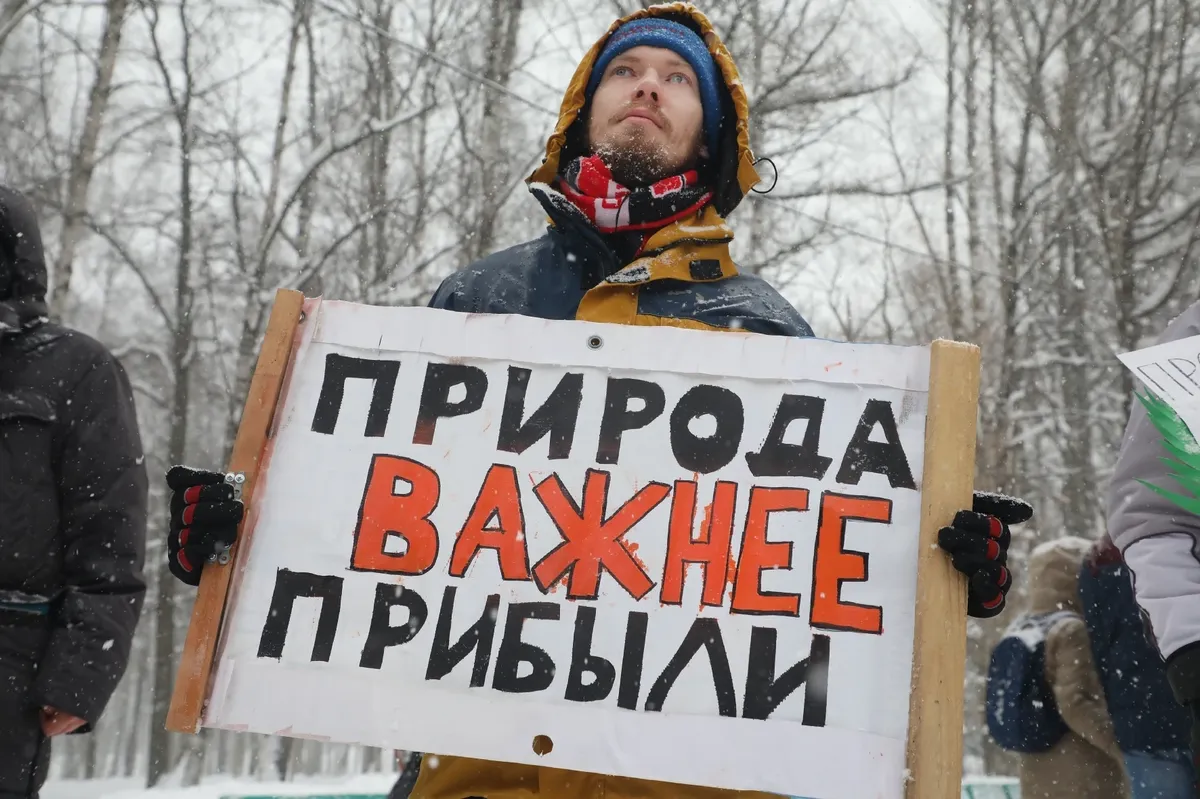
- Rather, yes. But here you need to outline the historical perspective. Until 2017-2018, there was much less masses of mass lower outlets in Russia than now. Mostly public organizations worked.
Since 2012, when the law “On Ino -Agents” appeared, pressure began on environmental NGOs. Many organizations were forced to close. The state damaged the institutionalized fabric of the ecological community. And when by 2017-2018, the Crimean consensus has exhausted itself, people began to “wake up” and take the initiative into their own hands. And they already had other methods of solving problems. So, we saw protests on Shies, in the square in Yekaterinburg, on Kustau.
The politicization of the environmental agenda has increased. Accordingly, the reaction of the authorities has also changed.
There are more administrations and detentions. Mass detentions appeared - directly on stocks. In this case, it will be wrong to measure the pressure only by the number of detainees. Because the situation goes to a new level when criminal cases appear and when attacks begin. In 2020, 14 criminal cases were instituted against eco-activists, in 2021-12. The number of attacks for the year increased almost doubles-from 15 to 28. The total fines increased from half a million rubles in 2020 to 866 thousand in 2021.
- How all what you said correlates with these words of Vladimir Putin: “Environmental problems, ecology have always been and remain among the most sensitive ones that are important for society <...> many live on the principle of“ after us - even a flood ”. This is regrettable. This logic is deadly and extremely dangerous. Nature itself gives us a signal: sustainable development is possible only if the harmonious, rational balance of interests is observed - economic growth, the well -being of society and, on the other hand, environmental safety ”?
- Here you need to draw two lines. Firstly, there are different local officials and representatives of local elites who have their own commercial interests. Unlike political activists and human rights activists, ecologists almost always confront not so much power as money. And the pressure that the state exerts on eco -activists is almost always the cover of “commercial ears”.
However, at the same time, of course, I do not believe in history that "the king is good and the boyars are bad." Academician Alexei Yablokov invented such a term - “deepologization”. And in Russia since the 2000s we have been observing just such a trend: weakening of environmental legislation is underway. The same Vladimir Putin was one of his first decrees as the president was abolished by the State Ecology - an organ that was directly responsible for environmental protection.
The weakening of environmental legislation leads to all these conflicts, to the emergence of dangerous environmental projects, which now falls on the street.
- In general, there are departments in Russia or at least individual representatives of the authorities who are consistent and, importantly, actively protect the ecology?
- If the question sounds precisely as “actively and consistently protect”, then, I am afraid, they cannot be called. Here it is necessary to understand: a negative selection works in the country, and there are no “active and consistent” ones in the structures of the authorities, and those who appear do not delay for a long time. If someone is like this right now, then no one will publicly call these people, because In the current anti -ecological and anti -legal system, it will be a “black mark”.
If we reduce the bar of the requirements from “active and consistent” to those who at least decently fulfill their functions - without unsubscribing and closing their eyes on disgrace - then it all depends on how much the question is on their teeth.
The bodies can still respond to violations of local pollutants, but touching projects affiliated with large federal officials can get out more expensive.
And once again, in regions where a working dialogue is more or less established, environmentalists are not ready to declare this openly, fearing the “punishment of decent people”.
- Which projects are more dangerous to withstand: state or private?
- This is a difficult question. You can’t answer it definitely. Private companies can resort to illegal struggle methods: during the confrontation around the Tominsky mining and processing plant, neologism appeared-“Altushki”: the so-called fighters who attacked eco-activists ( they were called so because of the owner of the owner of the Russian Copper Company, Igor Altushkina. - I. Zh. ). Attacks on nature defenders were also on Kuzhtau, where a private Bashkir Soda Company was also going to develop the development.
On the other hand, we have Rosata - a state corporation, which systematically exerts pressure on activists. Almost all anti -core NPOs in Russia were one of the first to be recognized by foreign agents. This is “eco -protection” from Kaliningrad, this is the Chelyabinsk movement “For Nature”, this is the Green World organization in the Leningrad Region, the Kola Ecological Center in the Murmansk Region, “Bellona”. In addition to “eco -protection”, which remains in the register, they were all closed. Plus, we have stories when people were forced to emigrate due to pressure: for example, the Chelyabinsk activist Nadezhda Kutepova, who told about the problems of the Mayak plant, where they allegedly process nuclear waste. Her organization "Planet of Hopes" was recognized as a foreign agent, and she was accused of espionage. She was forced to leave. Alexandra Korolev, director of Eco-Protection,-due to the failure to fulfill the law "On Ino-Agents", criminal cases were instituted on it. And now for a year it has not been in Russia.
Rosatom has a lot of “hot spots”, and this is a state structure.
-What measures do environmental organizations take to somehow protect activists?
-Firstly, I must say that we are monitoring so that the pressure does not pass without a trace. We have presented its results in the Public Chamber for the second year in order to at least indicate the systematic presence of this problem and propose a system solution. There was a series of recommendations aimed at investigating attacks with attacks, we proposed investigating those cases, those situations, environmental problems due to which the attack occurred. For ecologists this is an important story because
We are attacked for a reason - environmentalists are attacked by the fact that they affect certain problems, specific interests.
Of course, it will be important here to improve the legislation on public participation, access to information. So we regularly talk about this that working mechanisms of public participation and the real influence of society on decision -making are needed. We are trying to convey these things.
Plus, in 2021, an ecological-critician group was created in conjunction with the movement “We live here”, where we, relying on our monitoring, are trying to look at different situations and understand and suggest to the eco activists how and what can be done. If the situation with the upcoming pressure, we are trying to understand which human rights activists to attract, which authorities to contact, what to do with that environmental problem that leads to pressure. Such a brain center where we are trying to either help or prevent. We give some general advice or recommendations on how activists behave, because now it is already clear that the one who begins to engage in activism puts himself theoretically at the risk zone. And we have this ecological and crisis group as a certain institution to support activists.