
Translated material
Without Bigmak?
When something went wrong, or what is behind the ideas about "nationalization"
The story of the idea of the nationalization of companies that suspended, or ceased their activities in the Russian Federation, is of particular importance primarily for the consumer market, which is coming difficult times.
Error in the calculations
The fact is that the strategy of the Russian authorities to overcome the possible economic crisis was based on the assumption that accumulated foreign exchange reserves, an important place in the European energy market, and the developed consumer market would allow people not to “notice” crisis events. “In which case,” the currency revenue had to allow you to compensate for possible economic losses, foreign exchange reserves could insure the decline in foreign exchange earnings, and if “something went wrong”, then a foreign business working in Russia would somehow cope with the situation, the bosses reasoned. Yes, perhaps prices would have risen somewhere, the assortment would decrease somewhere, but, by and large, nothing would have changed for the ordinary resident of the Big City in the “domestic plan”. And the full shelves of supermarkets and shining windows of boutiques in shopping centers would convince him that “everything is in order”, and would do it no worse than television screens. The “refrigerator” was supposed to supplement the “TV”, and not contradict it.
But something went wrong. At first it turned out that the accumulated reserves could not be used, and foreign exchange revenue can be sharply reduced.
And if in this situation the authorities made two obvious moves - they increased the rate on loans and limited the sale of currency to people, then a sharp reduction in the activities of foreign companies in Russia, apparently, turned out to be completely unexpected for the authorities.
Fears and consequences
Contrary to optimistic rhetoric, the Russian authorities are seriously afraid of two things - a sharp shortage of goods and services in combination with uncontrolled prices. Perhaps they read the research of a professor of economics and finance of the University of California in Berkeley Ulrika Malmendir, who proved that the experience of an experienced economic crisis and accompanied his behavior is preserved with a person for life. And the inhabitants of Russia, especially the older generation, excellently remember empty shelves in the late 1980s and prices in the early 1990s. And, most importantly, they remember their reactions to what is happening. It is no coincidence that the Russians have called prices among the main economic problems over the past twenty years - even in a situation where inflation was relatively low. I must say that the authorities constantly reminded him of this, telling that no matter how difficult it is, compared to “terrible nineties”, people live much better.
In addition, experts in the behavioral economy are aware of the existence of the “observed inflation” phenomenon. The government can insist on reducing prices in the "production sector", but people evaluate price tag inflation on the usual goods in the food store. The reasoning “On reducing steel prices” for citizens is less important than the figure on the check in the supermarket.
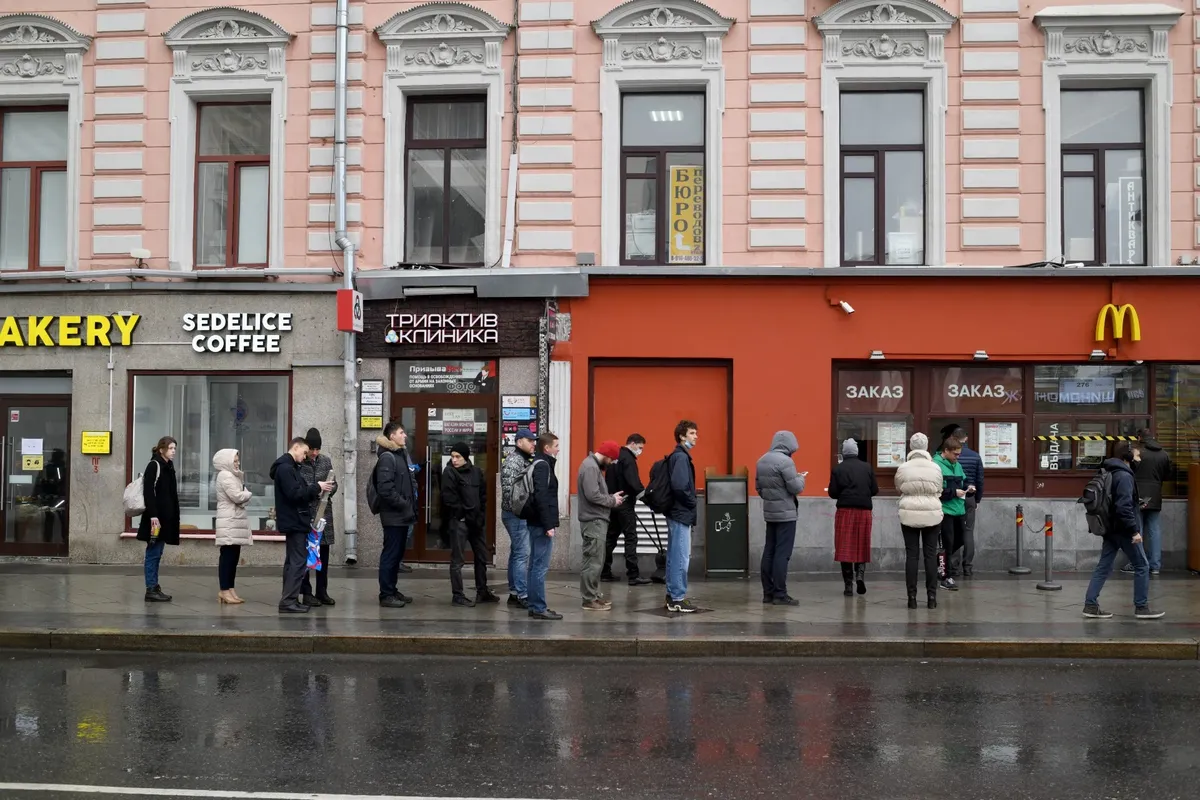
At the same time, no one knows how people will behave when they see empty windows and shelves. You can say as much as you like that citizens are ready to abandon "hostile products", but in the economy of affairs are more important. If these stores are closed today, where the guarantee that my company will not close tomorrow, a person might think.
Yes, it can be argued that new businesses from “friendly countries” will appear on the “liberated” squares, but no one will undertake this. The consumer market is a derivative of people's income, these income has been stagnated for 10 years, and there are no signs that they will grow in the near future. Note that the authorities, discussing nationalization, speak of “preserving jobs”, there are no words about “growth of real income” in official rhetoric.
Risks and benefits
Therefore, the current idea of nationalization is certainly not to turn the Fastfood into any state “metropolitan cutlet”, and the stores of “Do it Yourself” format-in license plates “Stage Buildings”. According to the model "But in the USSR." On the contrary, the authorities really want to “remain for people, everything was as it was”, so as not to reduce the level of household comfort in cities.
Isolation and Autarchy with a “support on its own forces” as a national economic idea, if it was realized somewhere in the twentieth century, then only in countries where the “transition from the village to the city” took place,
And for yesterday's peasants, the achievement of civilization was hot water from the tap. The current Russia is the “country of cities”, its capital in terms of domestic comfort and the level of consumption of household goods is not inferior to global megalopolis, and no one can answer - how 20 million residents of “Big Moscow” will react to the loss of familiar services for them. Maybe they will be happy to stand in line for the "Moscow cutlet in a bun." But who knows for sure?
In addition, from the point of view of potential partners from “friendly countries” who theoretically plan to enter the “liberated” Russian market, the adoption of the nationalization law turns into additional risks. Yes, in the words of officials everything turns out well, but the business believes not to words, but to actions, but “nationalization actions” is an increase in business risks. Suddenly, the situation will change, and the “friendly country” will become unfriendly? Suddenly, the entrance to the Russian market will turn into problems for entering the market of other countries? And such risks business always and everywhere insure - lays them into prices for the end consumer.
In the case of leaving the Russian market, “replacing” them in theory will be possible, subject to the preservation and growth of people's income - but for each step, the consumer will pay for such a replacement - the change of the managing team, and the rupture, and the restoration of suppliers, and even the change of sign will affect the prices. Yes, “separately” these will be small amounts, but, “folded together”, they can be quite noticeable for the buyer.
Real desires
There is one more circumstance - the authorities really do not want a loss of taxes from the activities of “outgoing” enterprises, and the loss of jobs in cities. Perhaps the chiefs do not like the degree of effectiveness and level of competencies of “Western management”, but they have reasonable doubts in the quality and competence of “Russian” effective managers. Perhaps foreigners are also unhappy, and it would be better to leave for them, but whether loyal compatriots can replace them - this is so far an answer.
In addition, the conditional “salary level in McDonald's” is an important element of Russian economic policy in terms of forming a labor market for young people in large cities. Paying a young employee with a diploma “less than in McDonald's” looks absurd. The salary in McDonald's until recently was the same “real”, and not the “fiscal” level of the minimum wage, which supported the price of labor in Russia, at least for a certain social and demographic stratum.
Therefore, the conclusion here can be like that - the current bill on “nationalization” is, first of all, a tool of pressure on business owners who are offered to find some form of their presence in Russia - and, at the same time, “share” the shares of revenue and shares from property.
The authorities did not pay attention to the internal, “consumer” contour of the economy for quite some time, receiving everything that is needed due to the operation of the external “raw materials” contour. Now the “internal” economy, according to the plan of the authorities, should compensate for the problems of the “external”.