
Translated material
David Hayes: Invisible prisoners of Iran
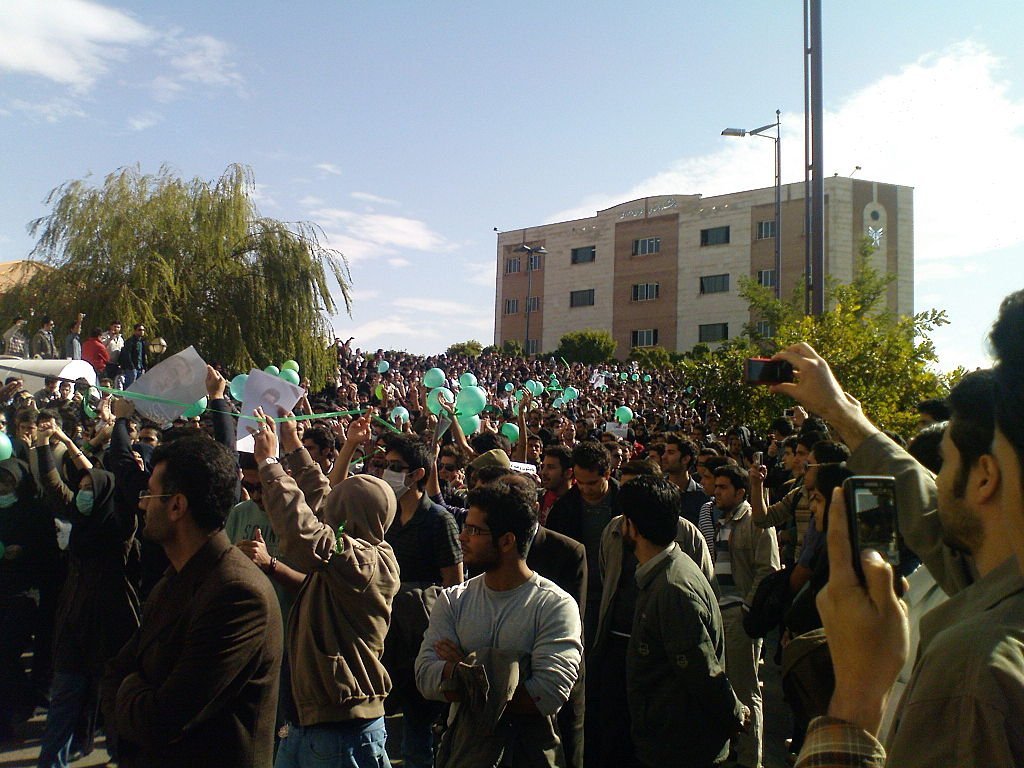
David Hayes  Protests in Iran in 2009 Asalehi84 / Wikimedia
 Protests in Iran in 2009 Asalehi84 / Wikimedia
In 2009, in Iran, President Mahmoud Akhmadinejad was elected for a second term - it was an unprecedented in the history of this country according to the intensity of the campaign. For the first time, the candidates made the live broadcast of the debate on the air of the national television, and the turnout, according to official figures, amounted to an unprecedented earlier 85%.
The opposition did not recognize the results of the vote. In Tehran and other major cities of the country, demonstrations and clashes with the police were held. The riots were suppressed, and many activists were imprisoned.
This text of the British journalist David Hais about the intellectual-pronounced regime Ayatall first entered Polit.ru in November 2009, when the result of opposition performances became finally understandable.
The presidential election in Iran on June 12, 2009 was followed by a wave of arrests. This means that now more and more Iranians are subjected to cruelty, which have already been subjected to thousands of their fellow citizens. The repressions became a reaction to a civil protest in response to a shocking announcement about the full victory of Mahmud Ahmadi-Needzhad-such a situation has repeatedly occurred over thirty years of the Islamic Republic of Iran (precedents were also during the Hocher regime preceding it).
The Iranian regime knows how to make its victims be silent and be invisible - this is his main weapon. And the dissemination of reliable information about particular cases is a valuable source for those who remained aside: for family members, employees and friends of prisoners, as well as for human rights activists who are trying to turn Iran into a rule of law. Iran citizens who have ties in the West often turn out to be the most vulnerable category of the population: they can be detained at any time, especially during the domestic political crisis and/or conflict between Iran and the West (especially with the United States). So, Iranians with dual citizenship or those who work in foreign media or brain centers have always been a favorite target for attacks. At the same time, thanks to such connections, it becomes possible to inform the public about their fate and fight for their liberation.
That was, say, the experience of the scientist Halekh Esfandari, journalist Parnaz Azima, journalist Roxanne Saberi, businessman and fighter for the world of Ali Shakeri, diplomat Hossein Rassama, Newsweek journalist Mazara Bakhary. Now among the arrested is the scientist Kian Tajbakhsh. Its case is an instructive example of the psychology that determines the essence of a tough course in Iranian politics.
The same regrettable scheme acted in the case of a blogger-first Hossein Drairahn, who was arrested on November 2, 2008 in Tehran. However, as in the above situations, in his case there are a number of individual characteristics.
Unusual trip
Hossein Drarahshan (better known as “Hoder”) became a noticeable figure on the Internet, as well as in Iranian history, when in September 2001 in Canada he created the first blog on Farsi; In order for the letters of the Persian alphabet to be displayed, he combined the capabilities of the Unicode and Blogger.com. He moved from Iran to Canada in 2000; Before that, he wrote articles about the Internet and technology and published them in two newspapers: ASR - E Azadegan and Hatay - E No (in the last he led the column “ Panjere - I Roo Be Hayaat ” - “Window to the Yard”).
His first blog soon appeared many readers; At the peak of popularity, he totaled about 35,000 visits per day, while in 2004 the Iranian cyber police failed to block it. Sardabir: Khodam [“Editor: I myself”] before that the English -language version appeared, thanks to which the author was able to contact an audience who wanted to understand what is happening with Iran - with the help of this new media with amazing opportunities.
Hooder also wrote for other media; Including (from 2004 to 2006), he wrote five articles for Opendemocracy. He took part in the project “Stop Censoring us”, which has tracked the cases of Internet censorship in Iran. In 2006-2007 He visited Israel twice, and in 2007 he entered the magistracy of the London School of Eastern and African research (School of Oriental and African Studies, Soas).
Hooder returned to Iran in October 2008, and they say that at first he spoke positively about his experience in the country. The message about his arrest on November 2 for several weeks was not confirmed; But on December 30, 2008, a week before the 34th birthday of the head, Alitraz Jamshidi, a representative of the revolutionary court, who is in charge of which are the cases related to national security, announced during a press conference in Tehran that he accused of “insulting religious figures”.
This is a typical example of template accusations “retroactively”, which are so common in the authoritarian tradition: it was not confirmed by any evidence. And now a year has passed, but there is no hint of any achievements in the investigation of this case; It was also not considered in court. Instead, the motors are kept in the Tehran prison Evin - this name is always accompanied by the word “sadly known” - where only fragmentary information comes from what is happening to him.
On October 17, 2009, an authoritative organization called Human Rights Activists in Iran (Association of Human Rights Procedures of Iran, HRA) published a brief report on the conclusion of the head. It says:
“According to HRA, Blogger Hossain Drarahshan, arrested on November 2, 2008, after returning to Iran, spent the first eight months of his imprisonment in single cameras of the Evin prison. During this time, he was subjected to various kinds of physical and psychological pressure, as well as more than once transferred from the camera to the camera. He was regularly beaten and forced to do squats, dousing him with cold water. In interrogations, they threatened to arrest his father and sister if he does not recognize the justice of the accusations of espionage.
When mass arrests began after the presidential election, Evin was not enough in the Evin prison, and IrgC (Iranian Revolutionary Guards Corps, the Islamic Revolutionary Corps), where he shared the premises with new prisoners, was transferred to the 2a Revolutions Corps. Many times Deprahshan promised to release him to freedom: during the Fajra and the Navruz holiday. Contrary to all promises, he is still kept in the manner of temporary conclusion. The term of conclusion was repeatedly extended, the latter expired on October 10, 2009. There is information that Drarahshan was going to start a hunger strike if his position did not change after this date. HRA has no data on whether he began a hunger strike.
In conclusion, investigators pressed on Drarahshan so that he agreed to cooperate with them and recognize the charges assigned to him. In September 2009, he was brought to the court to sign documents approved by his lawyer the right to act as his representative. He told the judge that all his confessions were made under pressure. According to HRA, Drairahn agreed under pressure that his recognition was broadcast on television, but after the first record, this case was stopped. ”
Family
Due to the fact that there is no reliable information about the events in the life of Hossein Drairahn after his return to Iran, his case attracted less attention than other similar situations. In addition, there was an unusual intellectual and political trajectory, when he gradually expressed more and more support to the government of Mahmoud Ahmadi-Nedzhad-a sharp disapproval of this Iranian critics in the West, perhaps, also caused such a relatively restrained reaction.
But when information about his arrest spread, calls began to appear to release the - Among them are a decisive letter of a group of Iranian bloggers; Blog “ Free Hoder ” and the group on Facebook ; Attempts by some information groups and networks (for example, Internet Sans Fronti è Res "Internet without Borders") to illuminate its position and keep the public in the know.
With the approach of the anniversary of his arrest, his relatives in Iran decided to openly speak on his face. His younger brother Hamed gave an interview with the Canadian BroadCasting Corporation (CBC): he criticized the Canadian leadership for inaction in this situation, said that his parents only managed to see Hossein twice for his entire conclusion, and explained why the family only now began to attract attention to this matter. “My father believed that it is better to use connections, show loyalty, work inside the system.”
Hossein’s father wrote a letter to Ayatollah Amoli Laridzhani, the judiciary of the head of the Iranian judiciary, he was published on October 21, 2009 in the Salaam reformist newspaper. Journalist Cyrus Farivar, who now lives in California, published on his blog an English translation of this letter:
“Ayatolle Amoli Laridzhani, a deeply learned leader of the judiciary:
Mir and bow to you. From the day my son was arrested, a year has passed. All these months, days and watches are my relatives, my wife and I myself hoped that in the hands of Islamic justice and the merciful Islamic judiciary, Hossein would be considered appropriately.
It is not worth mentioning that foreign media have repeatedly addressed us with questions about the position of Hossein, but we refused to answer each time.
We were silent even when, through the semi -official media, the most terrible rumors about treating him reached us; But not a single government organization denied these sad news, which would not only contribute to the reassurance of our hearts, but at least testified to the impartiality of the judiciary in this matter.
For all this time, our son saw us only twice, and each time the meeting lasted only a few minutes. Just imagine: we saw it only a few minutes every six months. We have no information about his legal status.
There was still no court, and we do not even know what institution or security organization is Hossein. We repeatedly tried in different ways to find out something definite about his position, but we could not. Is this circumvention caused by the worthy behavior of the prisoner?
Many times my son in his written and oral speeches said that he would gladly work for the good of his country. He returned to Iran, to answer the charges against him. Is it really a person who returned to his country, to his faith, deserves such a greeting?
We do not complain about the fact that you follow the law, but, on the contrary, on wires, lack of information and neglect of the law. The accused has rights, their relatives have some rights, and we know that the ruler also has some rights - and these rights and rules are very important.
We are convinced that you will agree: the year of harsh imprisonment is hardly an appropriate reception for a person who, on his own initiative and desire, returned to the coveted bosom of Iran and Islam. I, my wife and our relatives, do not leave hope for a fair trial.
Sincerely,
Hassan Drarahshan. "
Foundation for the file of the claim
In Iran, arrests, indicative processes, conclusions and violence continue. The state apparatus of internal security remains unshakable; After false elections, he made sure of his ability to restrain and reflect the challenges of his power.
But much indicates that after these elections, the actions of the regime led to the fact that his legitimacy in the eyes of the Iranians decreased to a critical level. They vigorously seek new, creative forms of confrontation.
In Iran, many were in prison for participating in peaceful protest, for criticism of the authorities, or simply because they were a convenient target for no accountable power; They should be released so that they can live and speak out again. With their liberation, a new era of human rights and civil freedoms will begin. Iranians deserve this more than ever.