
Translated material
Back to the barracks
Why the Russian authorities do not like the educational programs of Liberal Arts
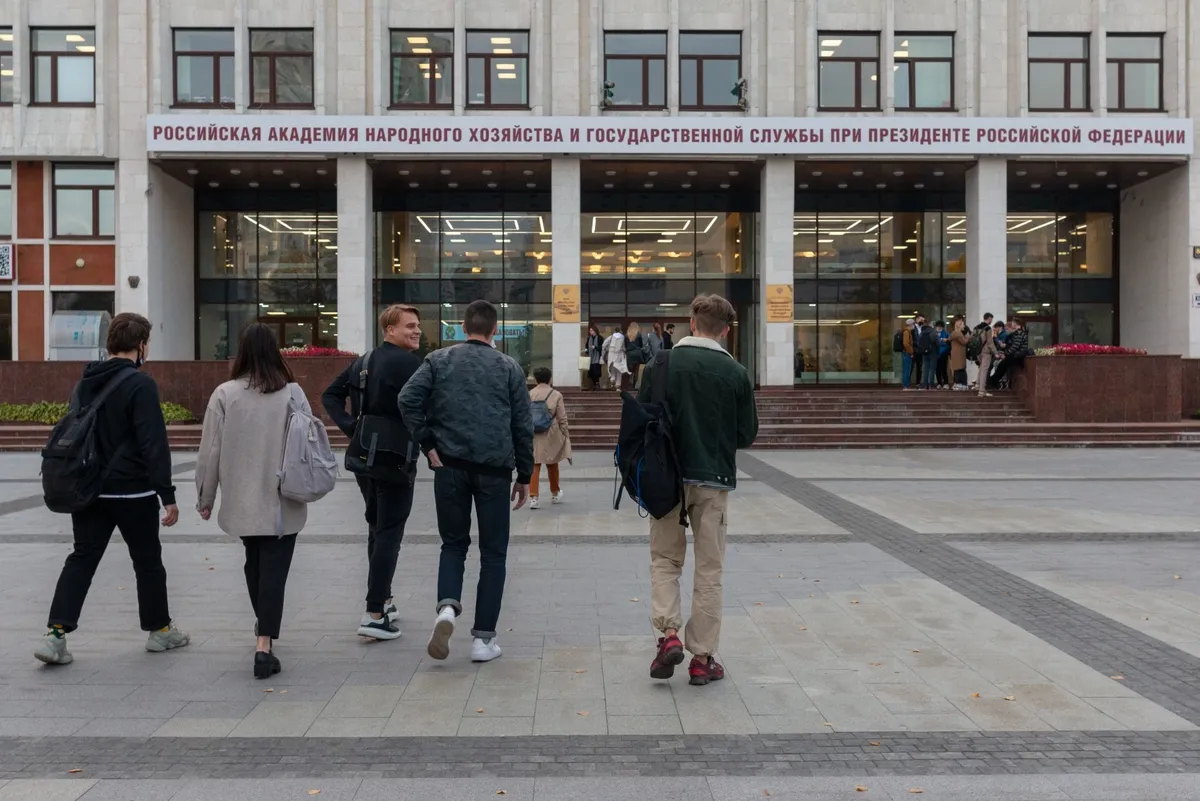
From the editorial office
A few days ago, it became known that a prosecutor’s check in relation to the Liberal ARTS educational program is held in the RANEPA. Prosecutors accuse scientists of "undermining traditional values." According to unconfirmed reports, there are several other similar programs working in Russia under a similar attack. We asked the sociologist Viktor Vakhstein to explain what Liberal Arts is, and whether the Russian authorities should worry about such programs.
There is an old academic legend: when an anti -war movement broke out in American universities and students began to capture administrative buildings, Colonel of the National Guard was sent to negotiate with the protesters. To the question of the journalists “What do they want?”, Topped to him upon his return, he sincerely replied: “I did not understand. There are too many men with long hair and women - with short ones. ”
In this formula - the whole shock from the collision of law enforcement agencies with a liberal education: "There are too many foreign surnames and too few patriotism." In Russia, the phrase Liberal Arts has become a synonym for “distortions of history”, “foreign influence”, “threats of national security” and, as a result, apparently the “fifth column”.
The irony, however, is that the format of “free sciences and arts” is in principle in no way connected with the content of education. The word "free" here does not apply to the sciences themselves (as if science could be divided into "free" and "non -free"), but to freedom of choice in studying them. For example, by entering the first course of the Liberal Arts RANEPAS AND SHANIKS, a student - regardless of what exams he passed - all year listens to philosophy, literature, mathematics, economics, sociology, history, law. Plus, intensive language training and objects that allow you to adapt faster to university life (“analytical reading”, “academic letter”, etc.). At the end of the first year, already having an idea of the specifics of disciplines, he chooses “Major” - his main specialization: from media journalism to sociology, from psychology to foreign regional studies. At the end of the second year, the student must choose an additional specialization - “minor”. It can be associated with its main choice (sociology + modern data analysis methods) or lie in a completely different plane (sociology + architecture or psychology + oriental studies).
The choice of educational trajectory is not limited to the choice of educational trajectory. Inside each profile there is also a set of elective courses. Even deciding to study the “sociology + methods of data analysis”, the student continues to select courses for the sphere of his scientific interests: research, microsociology, the sociology of the city ... Thus, self-determination works, but not on the basis of mythical “sociocultural spiritual values”, but on the basis of research and theoretical languages of describing the world.
The only traditional value that is in the system of science is the value of science itself.
A person “stitched” by Soviet education, this form of learning seems wild. How does the student know what he needs? Where is the educational component? Half of the courses in English - are you preparing political emigrants? Too many different disciplines is a factory of arrears? And where will they work then? Graduates of the Academy of the Prosecutor General’s Office are very worried about the fate of Liberal Arts graduates: they read the names of the courses and see crowds of future dissidents, devoid of “systematic education”, “patriotic education” and not ready for “labor activity for the benefit of the homeland”.
What are the actual paths of those who studied in colleges of free sciences and arts? According to the study of T. Czech (1999), Liberal Arts graduates are twice as often as a career of scientists than graduates of traditional educational programs. The trajectory of Thomas Czech himself is also indicative. In the College of Free Sciences, he studied Homer's Odyssey, Dante's Divine Comedy, the history of constitutionalism and chemistry. Knowledge of ancient and medieval literature did not prevent him from receiving the Nobel Prize in Chemistry 19 years after the end of the undergraduate.
There is a difference between systematic and standardized.
Three innate ailments of education according to GOST - when everyone teaches “what is needed, when it is necessary, as it should” - narrowness, superficiality and monologue.
Having entered the standard law enforcement, the student is still asking questions about the place of jurisprudence in the world, about the connection of law with philosophy, literature, politics, history and social science. But he can’t really look into any of the adjacent areas. The curriculum will not allow. This is narrowness. By the fourth course, the student will know something about the civil and criminal process, about the history of law and constitutionalism. But he will not be able to conduct an independent study (with the subsequent publication in the international journal). For the same reason. This is superficial. Finally, his attempts to problematize, to question the “facts” translated by him will most likely be rigidly suppressed. Monologism is when you get a short answer to a question that you did not ask, from a person who did not think about him.
The problem of narrowness in the program of free sciences is solved due to courses of the first year and double specialization. The problem of surfaceness is due to elective courses. They are read by the leaders of scientific laboratories and projects, which include students in their research. (For example, the English -language article of my colleague in the faculty, leading the direction “Digital Microsocioology”, has just been published, in collaboration with the recent graduate of the undergraduate.) The problem of monologues is solved due to work in small groups, analytical readings, and discussion formats.
Suppose a person armed with a state manual comes to talk with my students about patriotism. They print the slides of his presentations, put next to the text of the current Law “On Education” and arrange a two -hour discussion in the form of a court session: whether this conversation violates only paragraph 3 of Article 48 of this Law or several more points. He tells them about the "protection of the state interests of the Russian Federation." They are divided into groups and conduct an exciting historical investigation: as the idea of “state interest” is connected with the philosophy of Machiavelli, the intrigues of Cardinal Richelieu and the activities of international tribunals. He is outraged by the position of the Fifth Column. They politely remind him that the idea of the fifth column (one of the four versions) was invented by the failed dictator Emilio Mola shortly before his death in a suspicious plane crash.
I am sincerely sorry for this person. According to the results of the conversation, he had no choice but to repeat the phrase of Colonel of the American National Guard.