
Translated material
Russian world: where did the "Special Way" led us
As an inaccessible to the world mind, the mystery of the Russian soul turned into a "special operation"
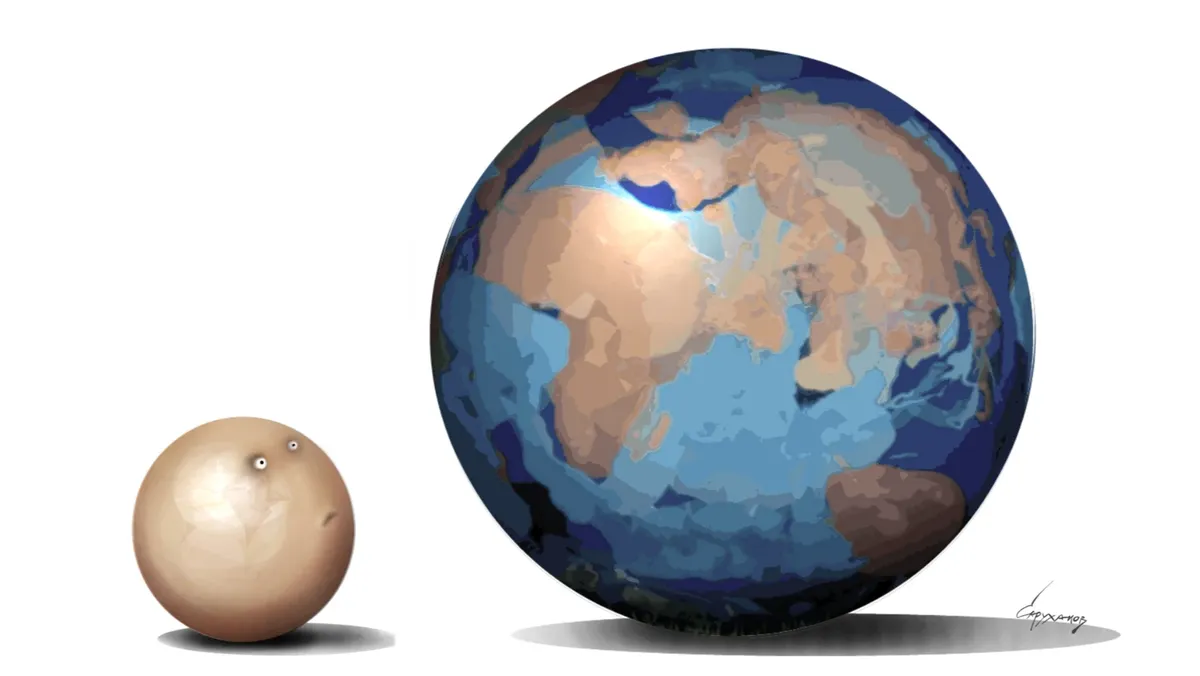
Every thinking who found the strength to get out of the inevitable numbness of the last days has already wondered: how to call Russian political reality now?
Obviously, the most suitable word will be a “crash”. Moreover, not some separate political project, but something much more global. In total, it is more likely, we are talking about the hard, collapsible collapse of the moral price of our Russian being, which stood on the historical horizon for so many centuries. The crash of hopes that once we will come out of our endless wastelands and become part of the universe. Like Dostoevsky: "To be Russian means to be a whole!" But, in addition to the crash, in what is happening to us there is one more. This is the exposure, the disclosure of our collective nature, our natural identity. And this exposure is unbearable than everything. So many centuries to give signs, hint to the whole world of your own secret, at the deep and inaccessible to the mind of the mystery of the Russian soul. And the mystery turned into a "special operation".
* * *
At all times, the Russian identity drew stability in the fact that he carefully fenced off from the surrounding big world. At first she hid herself behind an iron curtain, then - behind imitations and masks.
I put on masks of civilization, enlightenment, democracy and said: look, I am also part of the universal! But she pretended.
Not only those who dominated the country were pretended. Small and not small managers, teachers and teachers, athletes and city deputies - all of them pretended to be carriers of the universe. It is clear that not all, but - in general. And in this whole, Russian identity has always remained "not from this world." She secretly always felt the idea of her “special path”, which, however, was quite synergetic, the conspiracy ideas of the “special department”. Her inner conviction was proportional to her isolation.
But it was decided to violate the established balance of imitation and finally show yourself to the world. Show and approve without any masks. We suffered too long and were invisible, but we are a great tribe, and every remedy is good to make the world reckon with us. At first they were worried in the inner territory, eliminating everyone who really believed in the "all-human." And then they began what outside. The “special operation” began, the purpose of which is clearly the opposite of the “all -human”, but the tribal pride is unrestrained. And of course, the pride of the tribal leader.
* * *
When they talk about Russian politics, both foreign and domestic, everyone notes the hypertrophied role of the state that absorbs almost every phenomenon of social life. “The state is chubby, the people of Hirel” - this is how the historian Vasily Klyuchevsky characterized this. The state is the initiator of both great accomplishments and atrocities. Accordingly, for the events of our days the main defendant is also it.
But, looking now at the detached-calm mood of most Russian people, or even their joyful enthusiasm, there is a doubt: is it really that it is exposed today, you need to see only state evil will?
Is it appropriate to speak here about the state - how does a civilized consciousness understand it?
A common place in the definition of any state is that it is a consensus, a public contract of diverse social forces that learned coexistence. Its purpose is to move people to an agreement, to mitigate their natural hostility to each other. Hence the supremacy of the law, the protection of rights and freedoms, both personal and collegial. Obviously: for the implementation of such a purpose, there should be the representation of all notable social actors, and then the state is a place for their dispute, for a clash and contact of interests and speculations. So those societies where the state was first realized as an idea were arranged, became the subject of reflection: the ancient Greek policy, the ancient Roman republic. It is there that it becomes something much more than the simple, primitive power of the leader’s power. From there, from antiquity, the idea of the state gradually paves the way for the structure of the life of European peoples, who replaced the Greeks and Romans on the historical stage. Through uprisings, reforms, revolutions, agreements, the state is approved as a mobile system of public evolution.
As for the Russian world, if the idea of a concrete state and there once existed in it, then only for a very long time, during the period of Kievan Rus. And although the ancient heritage did not reach us, the public treaty nevertheless ripened from the military democracy characteristic of all barbaric peoples. This period can be rightly considered perhaps the most free era of our history. Land property belonged to communities and tribes, the rights of serfs did not exist in sight. Princes-ruitors had the right to pre-discussed tribute, but not on the personality and not on the land of their subjects. In the cities, on guard of their original freedoms, there was always a veche, and it was very difficult to not take into account his will. It is impossible to imagine that one of the Kyiv princes speaks the manner of the Moscow Tsar Ivan IV:
"And we were always free to complain to our slaves, they were free and execute."
The same story with which we are now habitually identifying ourselves, that is, the story of irresistible centralization of power and its indisputable authority, begins much later. This is the story of a completely different, Moscow era, the princes and kings of which effectively adopted from their cartridges, from the Great Horde, all the methods of repressive management.
“The Khan's rate was transferred to the Kremlin,” the historian and philosopher Georgy Fedotov said about this. Further - more. So far, it has not finally established itself in the heads of the population: sovereign will - this is Russian being.
And in this usual story ours, one can see different things, but not the formation of the state, as it was understood in antiquity or in Europe. Let's just say: the Russian world did not follow the path of the state at all; He did not know either a public agreement, nor civil law, and all the more freedoms. The Russian word "will" indicated more than a spontaneous-sensual than something political. Characteristically, as a set of laws of the Cathedral Code of 1649, indicates the statuses (estate) of the population in the Russian kingdom: “heavy”, “taxable” and “service” people. All are determined by their obligations to the authorities, but there is no question of the fact that these people are citizens. In fact, power was engaged in the formation of estates, because they differed not so much by rights as the obligations in relation to it. Their rights were not at all legislatively fixed. There was no that collegial class cohesion that is so characteristic of Europe and that it was active soil for European civil movements, this basis of developed statehood. It is interesting that the Council Code adopted in the era of Moscow Rus' operated with us for almost two centuries, until 1832, while the European, and the American world has long tried on the Constitution and Billy about human rights.
* * *
How can you determine the ratio of the authorities and the population in the Russian world most of all corresponds to the political science term “prophetic” (from lat. Potestas - power, power). This form of organization of life is characteristic of almost all primitive, pre -class and early class societies. Characteristic features:
division into "their" and "strangers",
The emphasis on security,
Distrust of the outside world, which by default is suspected of hostility.
Of the pressing values in the first place, the preservation of stability is that it has already become familiar and, therefore, safe, as well as the indestructible strength and authority of the ruler, who guarantees the desired stability.
The direct, physically inevitable power of the sovereign in the person of his representatives, his servants - everything is kept on this. Moreover, to determine what is security and stability is also the prerogative of the sovereign.
There is another term suitable for the Russian world and synonymous to the concept of pressing: " Providence." This is a political education, where the authorities separated from the population have absolute supreme and sovereignty. She does not agree with the population, but forces him to fulfill her will; appoints and changes all the rules of the hostel, redistributing resources. In fact, there are only two main classes -
rulers
subjects,
Whose relationships are legalized by the general ideology. The most important function is the priesthood, the task of which includes the sacred justification of the inevitability of this order of things. Classical examples of prototypes that took place in the early history: despotism of Sumer, Assyria, Egypt.
Quite often, the prototype is called the “boss” (English chiefdom ), since the whole system is assembled around the figure of the leader, and the management lies with his close associates. The key point in the managing hierarchy is personal or family ties: the closer to the leader, the higher the status.
The leader directs the main attention to the power support of his supreme position - to the army and domestic police.
Executive and judicial power are not institutionalized and not divided; They are under the control of the close associates of the leader, but only he himself makes key decisions. When, over time and under the influence of the hypnotic authority of the priests, the personality of the leader enters the stage of deification, this excludes any resistance to his subjects. When looking at the modern Russian world, it is difficult to say that it fundamentally distinguishes its political appearance from some ancient Babylonian despotism.
* * *
The fact that we are now observing daily: the mass consent of the Russian population with our authorities. And this is not only a fear of punishment, although fear, of course, too. Here, the principle of internal, psychological identification that gives everyone, and the most miserable individual, a chance to feel like a kind of “special” creature, sharing part of his sacred brilliance with his leader, works more. But more importantly, this individual painfully wants to trust someone, in someone to forget in order to finally get rid of his primitive, animal suspicion, with which he and his ancestors looked at the world for centuries.
Surprisingly, neither married nor parent relations give such a dissolving, narcotic effect of trust, as in the case of identification with the leader.
And the more wary a person looks back at the surrounding being, the more nervous his animal alertness, the more relative to him the leader becomes, like "fortress among storms."
Perhaps it is the chronic distrust of the world that is the special Russian trait, from which everything else. Not curiosity, not the desire to test their forces determine the Russian consciousness and being, but the suspicion, so characteristic of primitive tribes that civilization has not affected. There is no suspicion only what is used to, what has become a routine, conveyor production. And the Russian “special path” turns out to be nothing more than a desire to maintain its usual position in space and time. And also return back what you are used to.
* * *
Our paradox is that the Russian person had the most direct contact for so many centuries, so many opportunities in order to be interpreted with high samples of universal structures. And sometimes kinship arose and often gave completely brilliant effects, but always only at the level of exception, errors, which, in fact, was always the Russian intelligentsia. The Russian world itself in its entirety did not let civilization inside itself. He did not create either the state or the political diversity on which all rights and freedoms are founded. He still looks around with caution and distrust, like his distant ancestor, who once settled in the deaf Drevlyansky forests and tops.
However, in what is happening with the Russian world now, an unprecedentedly unprecedented experiment of history has begun before our eyes. Before, since the calling of the Varangians, the big world has always diligently tried to reach us. From the same curiosity, inherited from antiquity, or simply from the desire to test their forces in new, unknown places - European merchants, monks, warriors and scientists have been frequent guests here. Sometimes they carried a war, a lot more often - a trade or marriage contract, but always - prospects. And since the time of Petrovsky, all their sacraments of arts and sciences have discovered completely and with pleasure. The big world was widely dissolved by its door for the Russian world. And even the iron curtain of Soviet times did not become a radical obstacle.
But now all this is over. Our archaic prototype was measured, balanced and found "non -browning." The big world seemed to finally see that all his investments in the Russian world no longer lead to prospects.
But they lead to a very real danger of a nuclear end. Moreover, the end, perhaps for everyone in general. The Russian world is disconnected from civilization and is provided exclusively to itself. It was given to this “special” suspicion and distrust. Here it is, a month ago, a great experiment of history has not yet been possible!
Of course, not now, not at the peak of “special operations”, but later civilization will become with interest to observe what the Russian world will be capable of by itself. Probably, natural sympathy will be added to interest. But the question is, indeed, between being and nothing.