
Translated material
When the regime falls, we will all come back
How Tbilisi became the capital of Russian political emigration after the outbreak of war
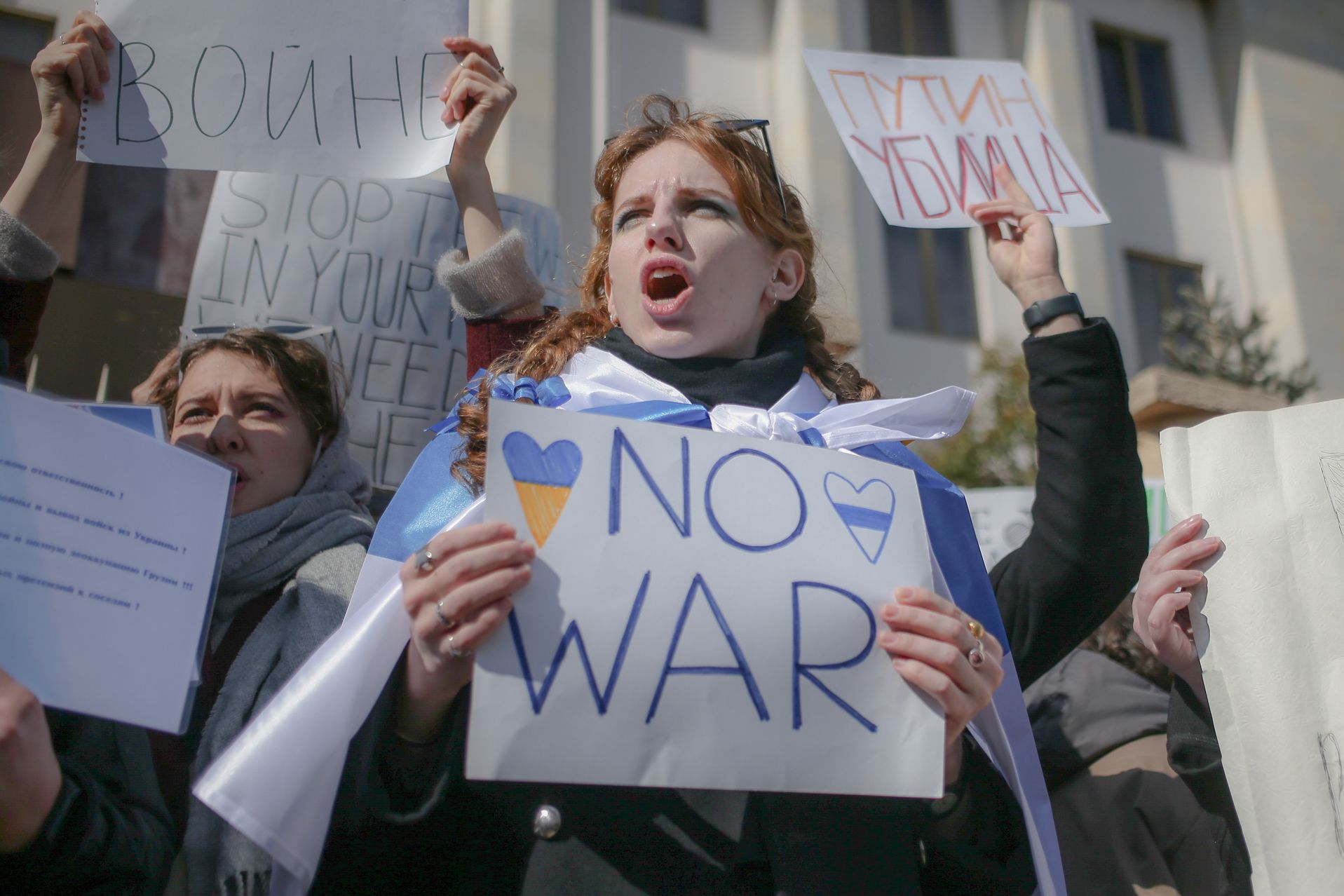
In the first few weeks after Vladimir Putin announced the beginning of a “special military operation” and invaded Ukraine, to Georgia, with which Russia does not have direct air traffic, several tens of thousands of Russians entered, of which 12 thousand remained in the country. Journalist Gleb Herd, who himself was among those who moved to Georgia, tells what problems new Russians face, and how Georgia citizens accept emigrants.
"Other" Russians
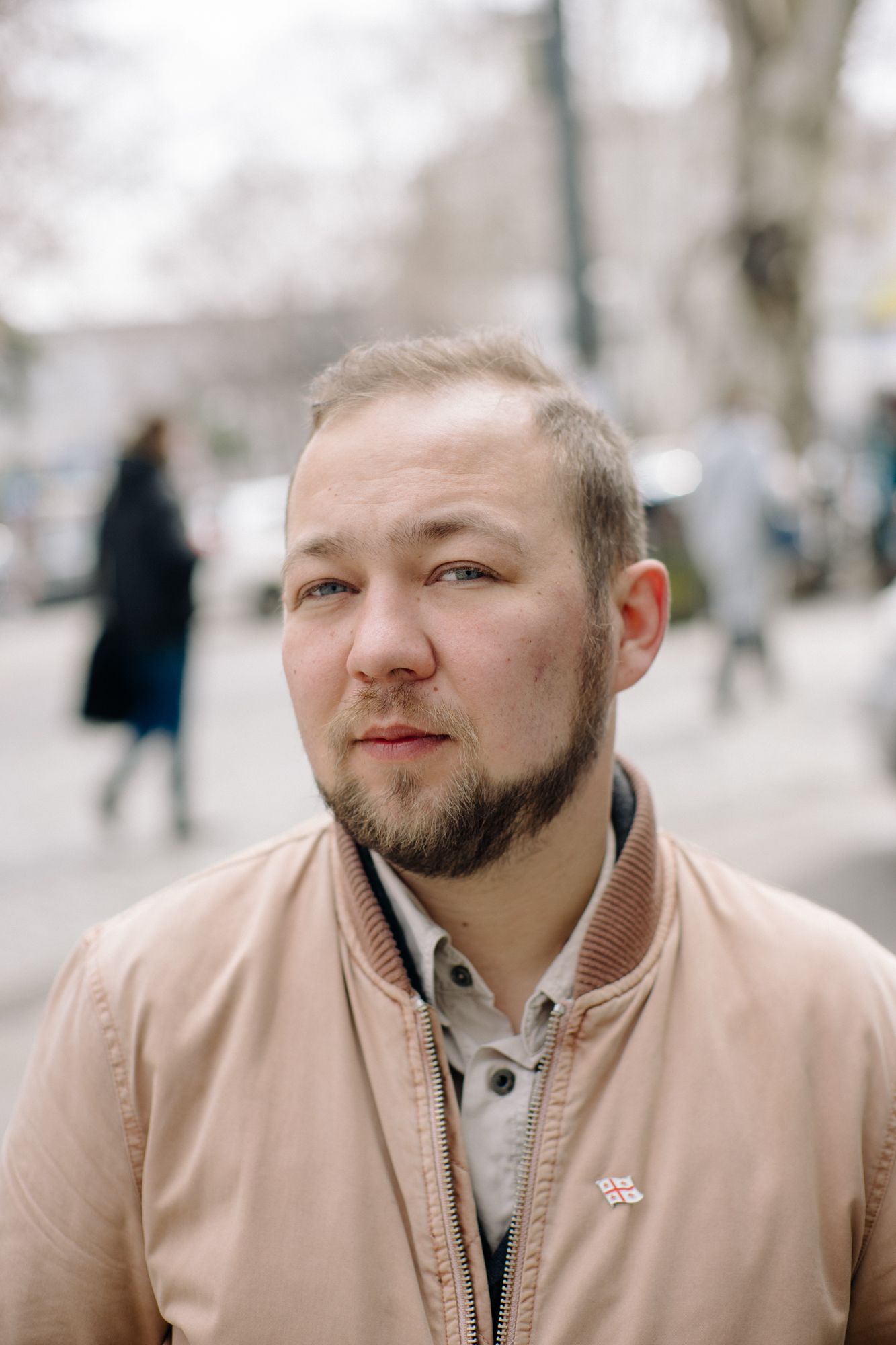
We meet with Vladimir Dubovsky at the Kashveti Temple on Rustaveli Avenue - in the very center of Tbilisi, opposite the parliament building. Vladimir went to Georgia in August 2021, when he realized that he was going to attract him in the case of financing extremist activities: this was hinted at the police in a conversation with the Dubovsky girl, she was stopped right on the street.
Dubovsky is a former coordinator of Navalny’s headquarters in Vladivostok, he began to engage in political activities in the zero. The first action, according to Dubovsky himself, was the burning of a portrait of President Medvedev in Yakutsk against the backdrop of the Russian-Georgian war in August 2008. Then he, a 17-year-old teenager, was taken to the police department and beaten, recalls the activist.
After many years of participation in various opposition movements, Dubovsky was forced to leave the country. With him, his girlfriend Alina Savelyeva emigrated to Georgia. When on February 24, the Russian army invaded Ukraine, Dubrovsky, who had already settled in Tbilisi by that time, offered the Russians who are fleeing the regime and help. “Compatriots, if you decide to leave Russia and you will be able to get to Georgia, then know that I am always ready to help you by accepting several people at home. My resources are limited, but I will find exactly where to sleep, and what to eat, ”he wrote on Twitter on February 24. According to Dubovsky, over the past war in Ukraine for three weeks, he helped 56 Russians.
“I have already ended even acquaintances of my acquaintances. Housing stupidly lacks. A girl arrived without education and work experience, with 200 dollars in a pocket and a toad in a bank. I called a friend of Georgian, who has a hotel business, he called another his friend, his relative also had a hotel. She was given a bed, a small salary and the position of administrator there, ”says Dubovsky.
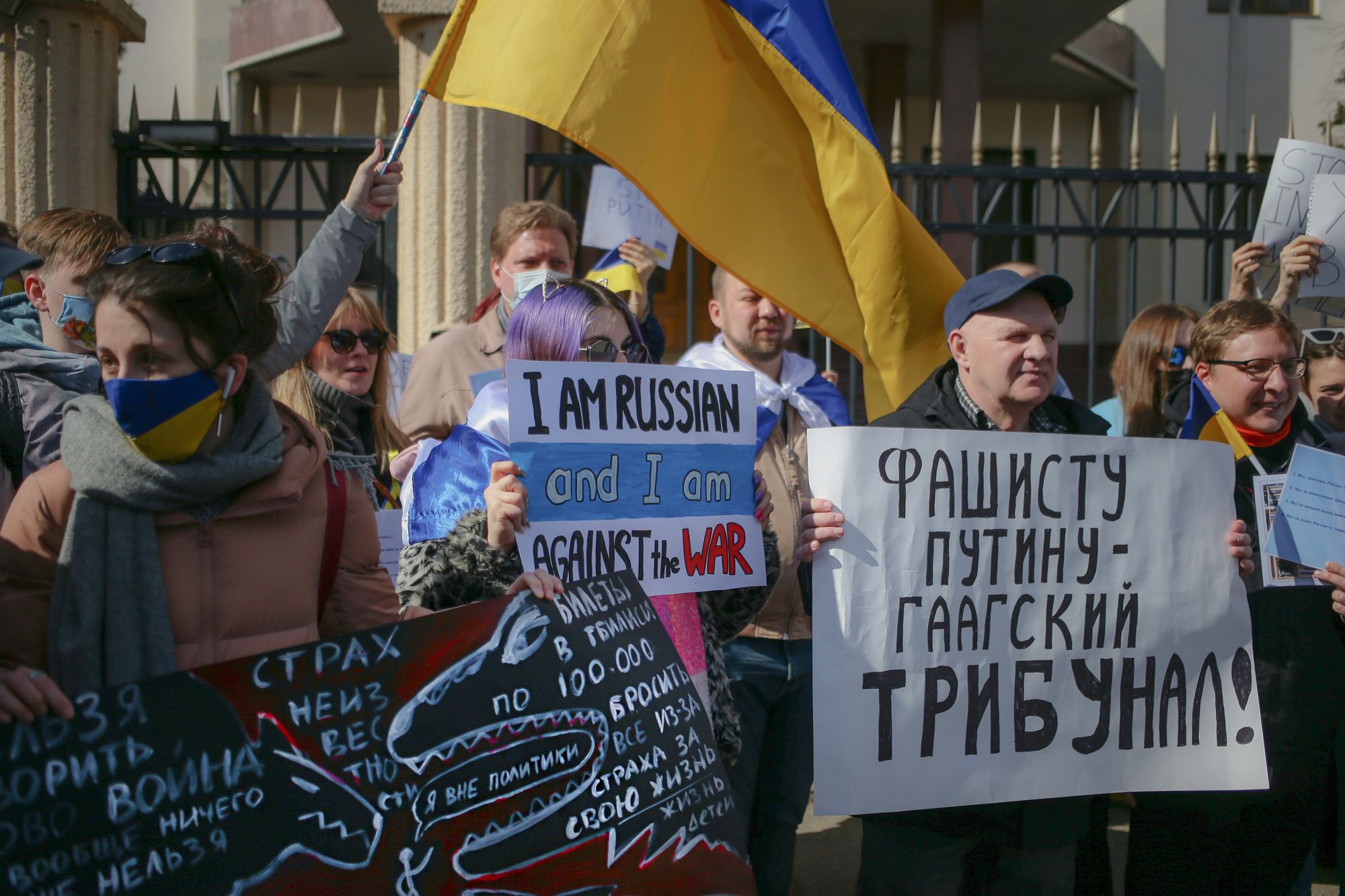
Now Dubovsky’s main task is to unite Russians in Georgia. In a conversation with the Medusa correspondent, Vladimir fundamentally calls the country as the Georgians do - Sakartvo. Almost all its time takes the creation of local diaspora. According to Vladimir, in Georgia, even people with polar views manage to find a common language and self -organize. So, an emigrant who adheres to radical right -handed views, and the extreme left feminist in the conditions of emigration learned to cooperate perfectly: together they collect humanitarian aid for Ukraine, the activist explains.
“I began to worry about Russian guys. I realized that it was necessary to unite and speak out against the war on behalf of the Russians. Now we are planning to register a NPO here. I advocate political subjectivity. Not in the sense that to participate in the domestic policy of Georgia, but for uniting Russians. We go to stocks [against the war in Ukraine], we collect humanitarian aid, recognize the right of Georgia to Samachablo ( the Georgian name of South Ossetia, approx. Medusa ) and Aphazeti ( Georgian name of Abkhazia , approx. Medusa ). We want to show everything Sakartvo that we are different. There are objectively bad Russians - those who support Putin and war. But we are different, and there are many of us, ”Dubovsky explains.
The bells call in the Kashweti temple, and our conversation and our conversation interrupts the appearance of a girl in a bright dress with blood traces drawn on the face. She has a Christian cross on her neck, and the flag of Ukraine will be thrown over her shoulders. She carefully arranges on the ground photo frames with printed screenshots of news about Mariupol bombing, icons and children's toys.
The girl gives Dubovsky a bouquet of a clove, picks up a doll wrapped in diapers, and turns on the Ukrainian lullaby. In addition to the doll in her hands, a photograph of bombed Mariupol with the inscription in the English “Virgin Mary, Save Mariupol” ( Virgin Mary, Save Mariupol, approx. “Medusa” ). Supplying a doll in her hands, the girl cries. Dubovsky gives out cloves to people on the street, and they put them to an impromptu memorial. The wind rises along Rustavel and blows the placed icons. The girl falls to his knees and sobs. A random passerby throws his coat on her shoulders.
The girl in a canvas dress is the name of Lada Titova, she is a shareholder of Femen from Lviv. Titova - half Ukrainian, half Georgian. On February 29, after the start of the war, she came to stay in Tbilisi from Lviv, but now she could not return home: the return ticket burned out, in Ukraine, because of the war, the sky for civil aviation has closed .
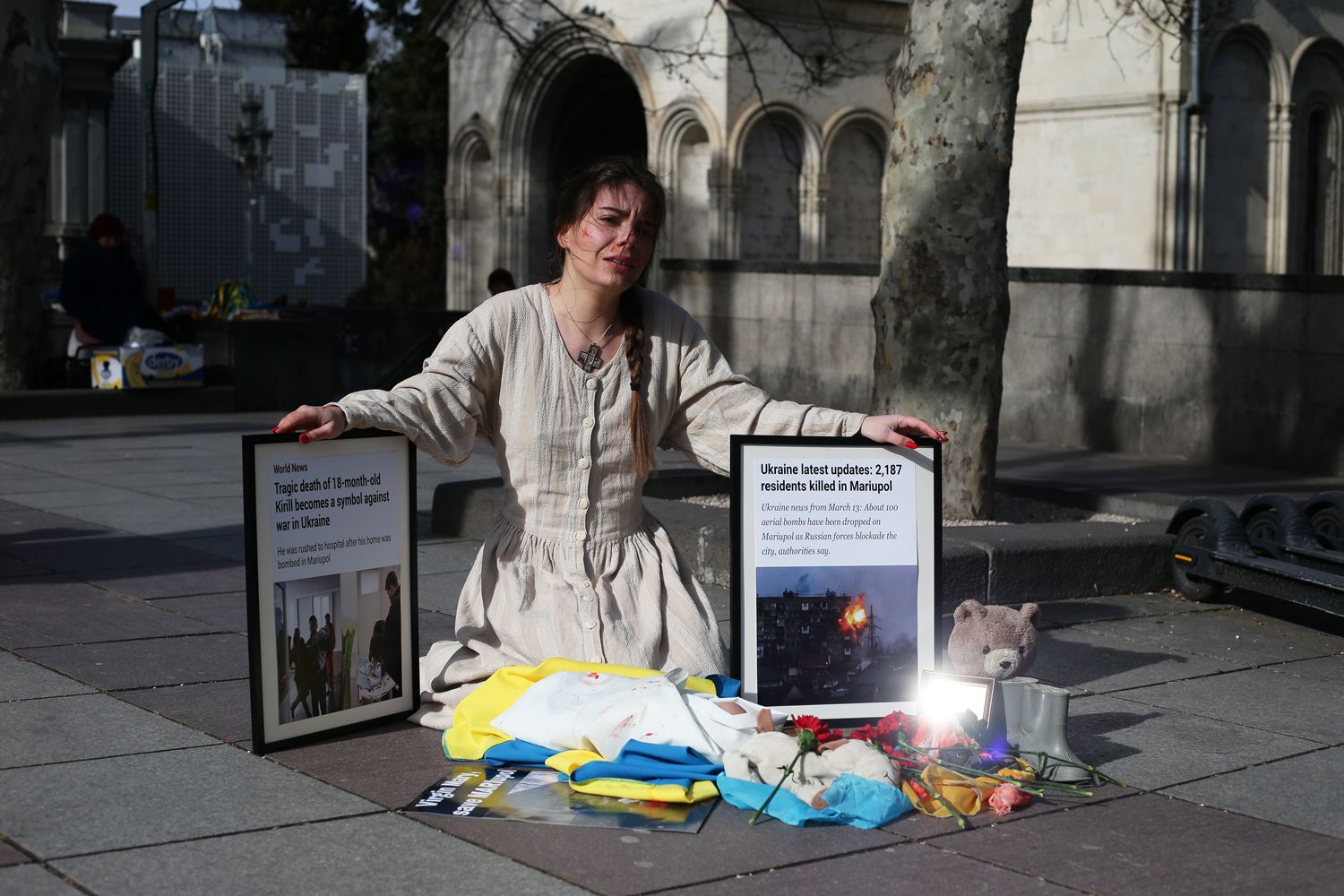
Titova explains his performance by the desire to attract as much attention to war in Ukraine and call people to humanity. “I pray to the mothers of the whole world to take the streets of my cities and ask to close the sky over Ukraine , take it [Ukraine] in the EU, to recognize Putin as a war criminal. My country is now a shield for the world. It is necessary to understand and do everything possible to strengthen it. We cannot talk about humanity while NATO uses young children as a shield, ”Lada says Medusa correspondent.
Its share lasts about twenty minutes. After Lada collects the props, gives an interview to local television reporters and leaves. According to the participant of Femen, she further plans to engage in anti -war actions in Georgia.
A few months after the publication of this text, the ex-employee of the Navalny headquarters in Tyumen, Sergei Oskolkov, publicly accused Vladimir Dubovsky of theft of two political organizations: the headquarters of Navalny in Vladivostok (from where Dubovsky was dismissed ) and the Libertarian party of Russia (from where it was excluded ). Several people accused Dubovsky of not returning the money that he borrowed. Members of the KHR also suspect Dubovsky of cooperation with special services. Dubovsky in a conversation with Medusa rejected all the accusations. According to the activist, he “arose a misunderstanding” with the FBK , and he is ready to return the money. As a refutation of the CHR accusations of theft, Dubovsky provided Meduza with a screen from the phone of his girlfriend, from which it follows that the money was returned . Dubovsky claims that he never worked for special services - and calls all the evidence of this “fakes” . On August 16, Dubovsky was not allowed into the territory of Georgia. Border guards explained the refusal "other reasons provided for by the legislation of Georgia."
Bots and pillars
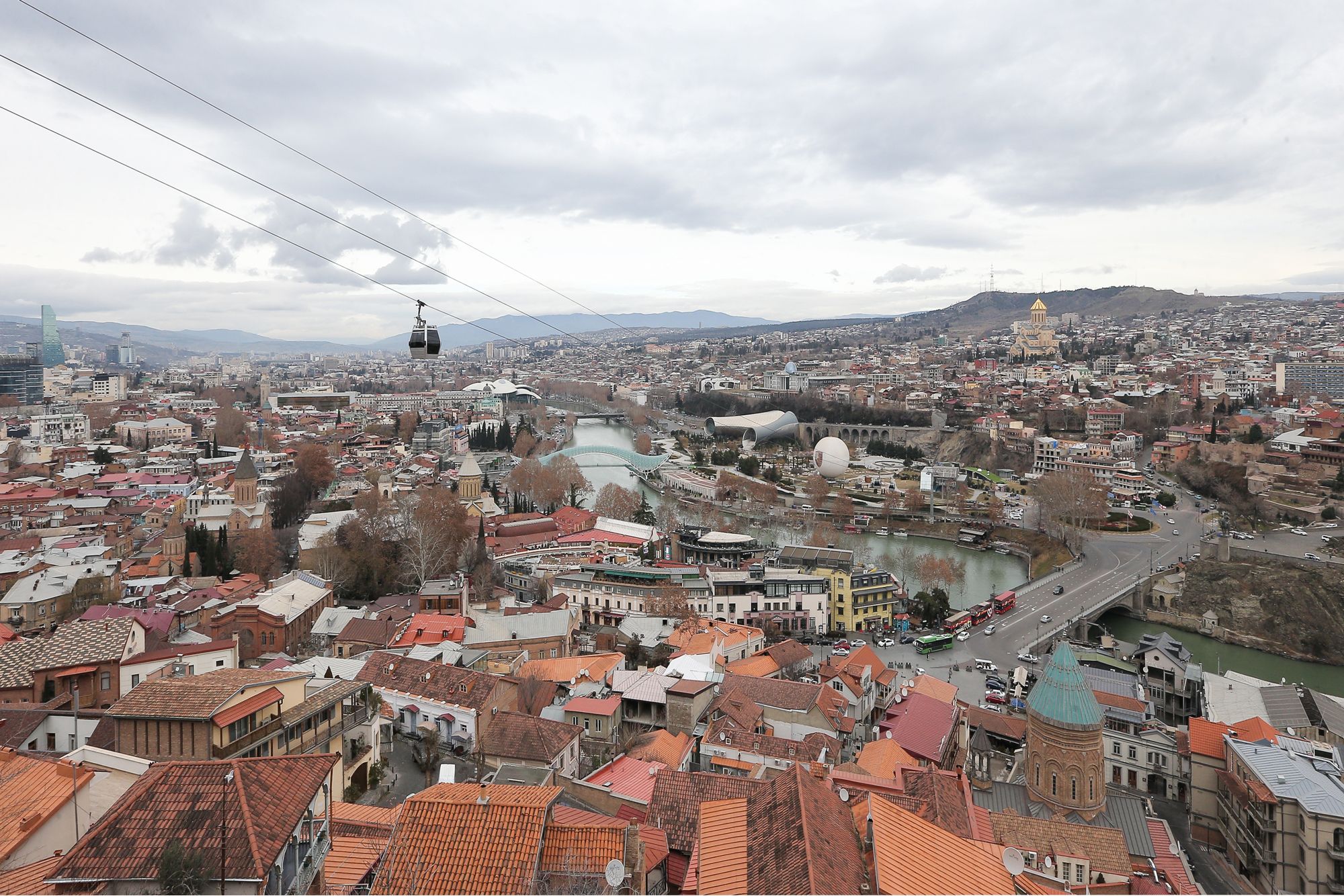
Georgian society has acutely responded to Russia's invasion of Ukraine. In Tbilisi, almost every street from the balconies, Ukrainian flags are hung, on the buildings of government institutions they are adjacent to Georgian. In cafes and restaurants, citizens of Ukraine offer discounts.
The support of Ukraine is also accompanied by the growth of anti -Russian sentiments. On the streets, the inscriptions “Fuck Russia” (to hell with Russia) and “Russians Go Home” are frequent (Russians, go home). The “Putin bunker” is written on the urns, and on the pillars you can find stickers that call not to buy Russian goods. It is proposed to determine them by the first figures of the barcode: the combination "460" means that the product was produced in Russia. There are a lot of such foods on the shelves - these are cereals, dairy products, oil, and canned food.
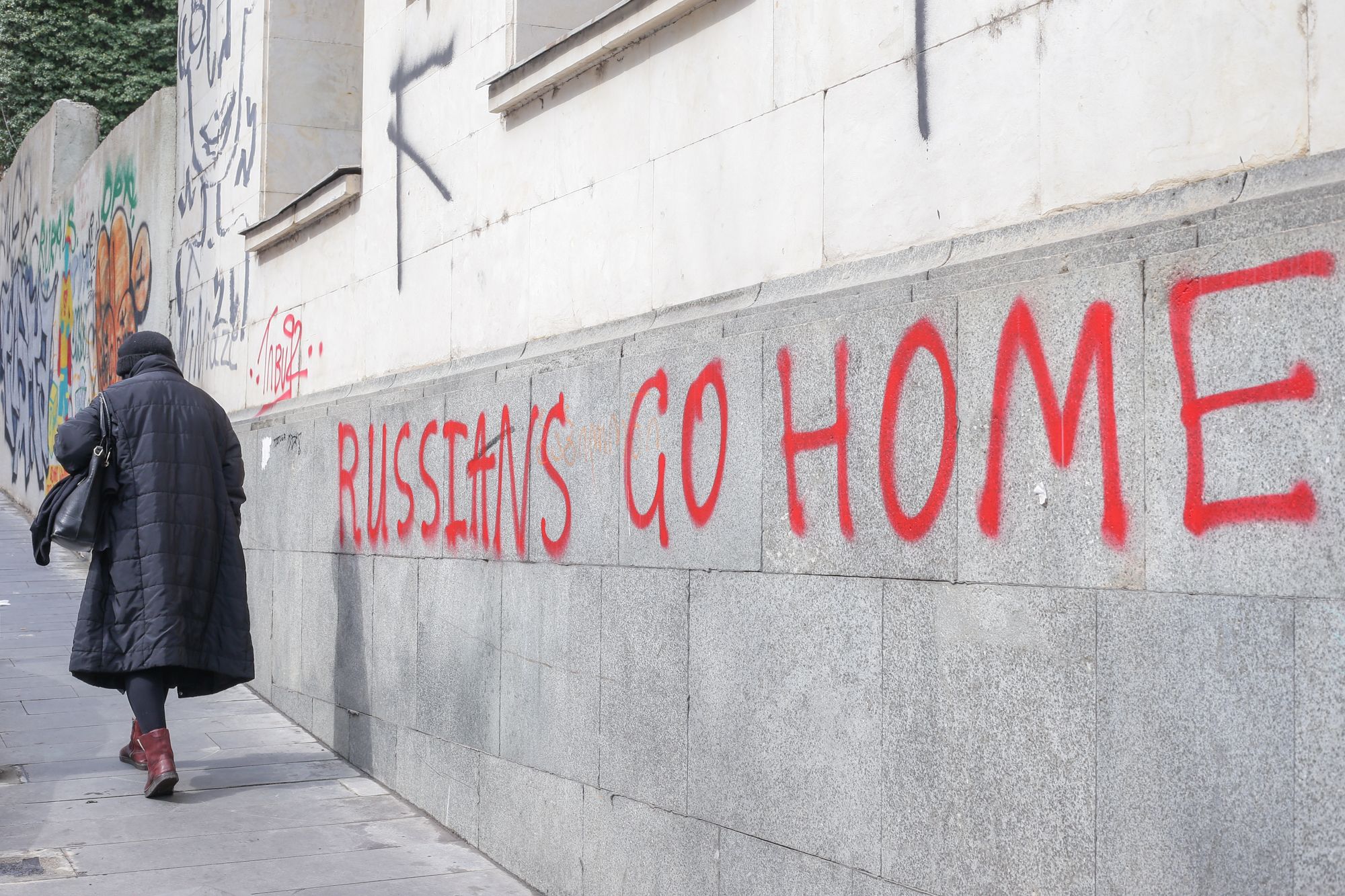
In the first few weeks of the Russian war with Ukraine, more than thirty thousand Russians entered Georgia. Such data on March 17 was voiced by the head of the Ministry of Internal Affairs of the country of Vakhtang Gomelauri. Of these, 17 thousand have already left. The population of Georgia, according to the 2020 census, is 3.7 million people, of which 1.15 million live in Tbilisi. This means that the Russians who moved over the war make up about a percentage of the city’s population: some of the emigrants have already moved to Batumi.
Many of those who are going to leave or have already moved to Georgia from Russia organize mutual assistance chats, their subscribers sometimes face angry messages. So, Anastasia from Rostov-on-Don wrote a message asking for help in the withdrawal of money from Russia to one of the emigrant chats, where several thousand people are consisting. Almost immediately, she received several messages of almost the same content. “You are not happy here, vile invaders, you will not get neither the ounce of the Georgian land, deal with the problems of your country,” wrote one of the senders in Russian.
Vladimir Dubovsky claims that according to his own research , nine out of 10 people who send such messages in Russian and Georgian, they send them from Russia, and the messages that they write on Georgian are translated using the Google translator. It is difficult to check this hypothesis, but the stickers and inscriptions on the walls of Tbilisi say that there are still residents in the city who are not satisfied with the mass Russian emigration.
The activist himself during his life in Georgia, according to him, never met chauvinism. According to him, citizens of the country do not approve of outbreaks of nationalism and try to pull those who suit them.
The coordinator of the Free Russia Foundation Anton Mikhalchuk adheres to a similar position. He left Russia three years ago amid the persecution of its members for cooperation with an unwanted organization. His business was one of the first cases of persecution of Open Russia .
According to Mikhalchuk, the war scared everyone, so some people reacted aggressively. “I do not think this is a global story. Rather, there are many different small stories that have developed in some kind of informational hub. Some people can show aggression, but this does not exist systematically, ”says Mikhalchuk.
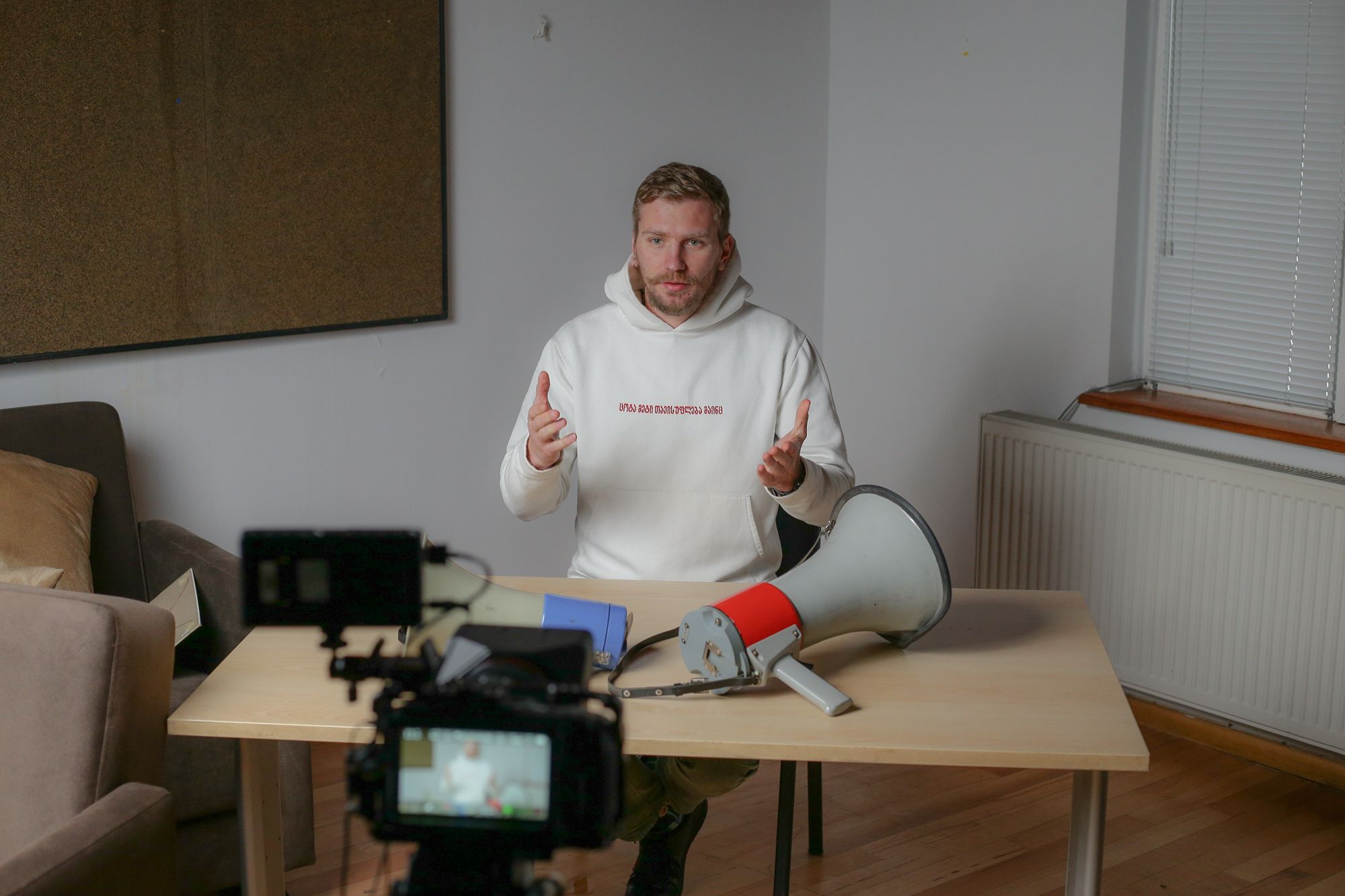
None of the twelve indigenous people of Tbilisi, with whom the report of Medusa spoke for this report, showed hatred of the Russians. The older generation mainly encourages emigrants and asks not to worry, because they are happy here.
According to the 62-year-old resident of Tbilisi Nugzar, in the "his time" it was customary to be friends with peoples, and there was no hostility. The principle of “there are no bad nations - there are bad people” he adheres to now. “Those who say that the Russians are bad - ******** [dumbasses]. So only youngsters think. Your president is bad, so what? Are you to blame for this? It is not accepted in Georgia, ”says Nugzar. “We are always glad to everyone if they are happy with us.”
In the memory of other citizens, the Russian-Georgian war of 2008 is fresh, they do not want to repetition.
“You now ran from there, and who will keep your country? - Kote is outraged, a Tbilisan of 45 years old, who is waiting for a daughter from lessons at the door of the school. -If something happened to my country, I would immediately go out into the street to protest. And you run from there. If everyone leaves, what will happen to your country? I understand that your predator runs, but if you all go here now, then he will come for us. And none of you will help us, you will go further. We all remember 2008 here. ”
Young Georgians surveyed by Medusa were concerned not so much to the arrival of Russians as the political course of Russia.
George is 19 years old, he works in one of the tbilisi bars, where there are many expanses, including Russians. “I have no problems with Russian people. I love to communicate with them, this is an interesting experience. I perfectly understand that those who go here do not support Putin and is not a reflection of his policy, says George. - I understand that they treat you very badly there, and you are not just leaving. The only thing I fear is that after that he will decide to “free us”. ”
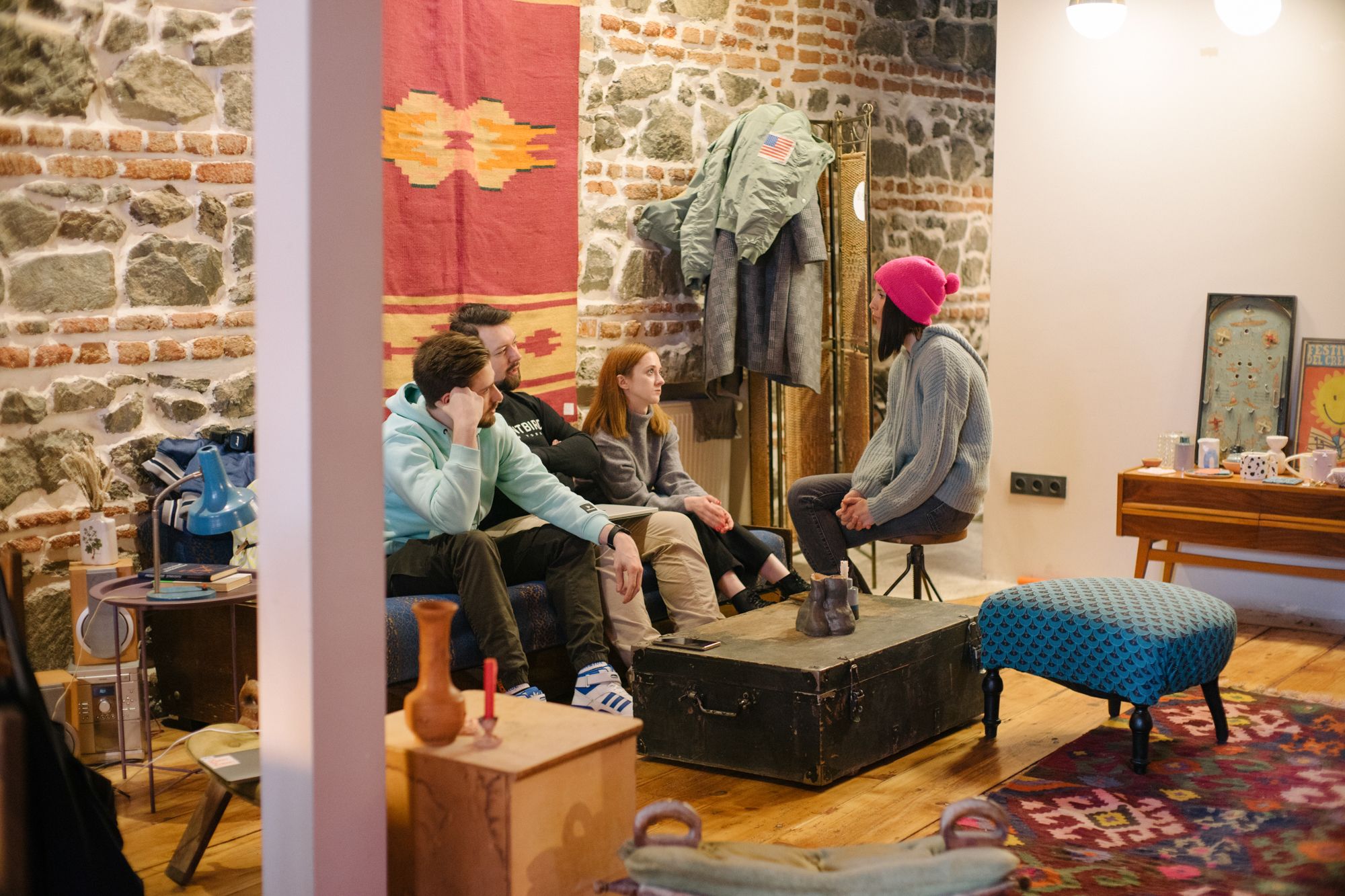
The three main problems of emigration now, explains Anton Mikhalchuk, - housing, work and socialization. Mikhalchuk, like Dubovsky, sees a way out in the creation of the “Russian diaspora”. In his opinion, in the next six months it will become especially active, and not only in Tbilisi. According to his observations, many consider Georgia only as a transshipment point, most of the Russians who arrived here will move on to Europe and Turkey, Mikhalchuk believes. Another part will survive the active phase of war and return to Russia.
“I think that the flow of emigrants is now at the peak, and in the next two to three weeks it will fall. We went to those social groups that were frightened: Muscovites who went to the rally and received a club. I suppose many of them will come back. Those who fled from persecution will not return [in the near future]. ”
A housing issue
Sales manager in the private company Evgenia and her husband, the builder Sergey, left St. Petersburg a week after the outbreak of the war. Sergey was born in the Chernihiv region of Ukraine, in 2006 he moved to Russia, but did not issue a passport, he wanted to remain a citizen of Ukraine: it is forbidden to have dual citizenship in Ukraine. A month before the Russian invasion, Sergei managed to go on vacation to the family in Chernihiv. Now he calls up with the remaining loved ones in Ukraine almost every day.
The last days before leaving Russia, Eugene spent in lines for drugs for diabetes, which by that time had almost no remaining in St. Petersburg. “On the first day of the war, we realized that there is no point in staying. I believe that in Russia there will be no life for normal people. Most of our acquaintances in Russia supports a “special operation”, ”explains the decision to emigrate Eugene.
They decided to go to Georgia because of the mildest entry rules: Evgenia, a civilian of Russia, and Sergey, who has a Ukrainian passport, is 360 days in Georgia without a visa. Then you have to cross the border of Georgia with any country, and you can return. Georgians need a visa to enter Russia.
Even from Russia, Petersburgers booked a guest house for two weeks in Tbilisi - to find housing during this time. But not a single attempt to rent an apartment was not crowned with success. Due to the large influx of migrants from Russia and Belarus, rental prices rose almost double.
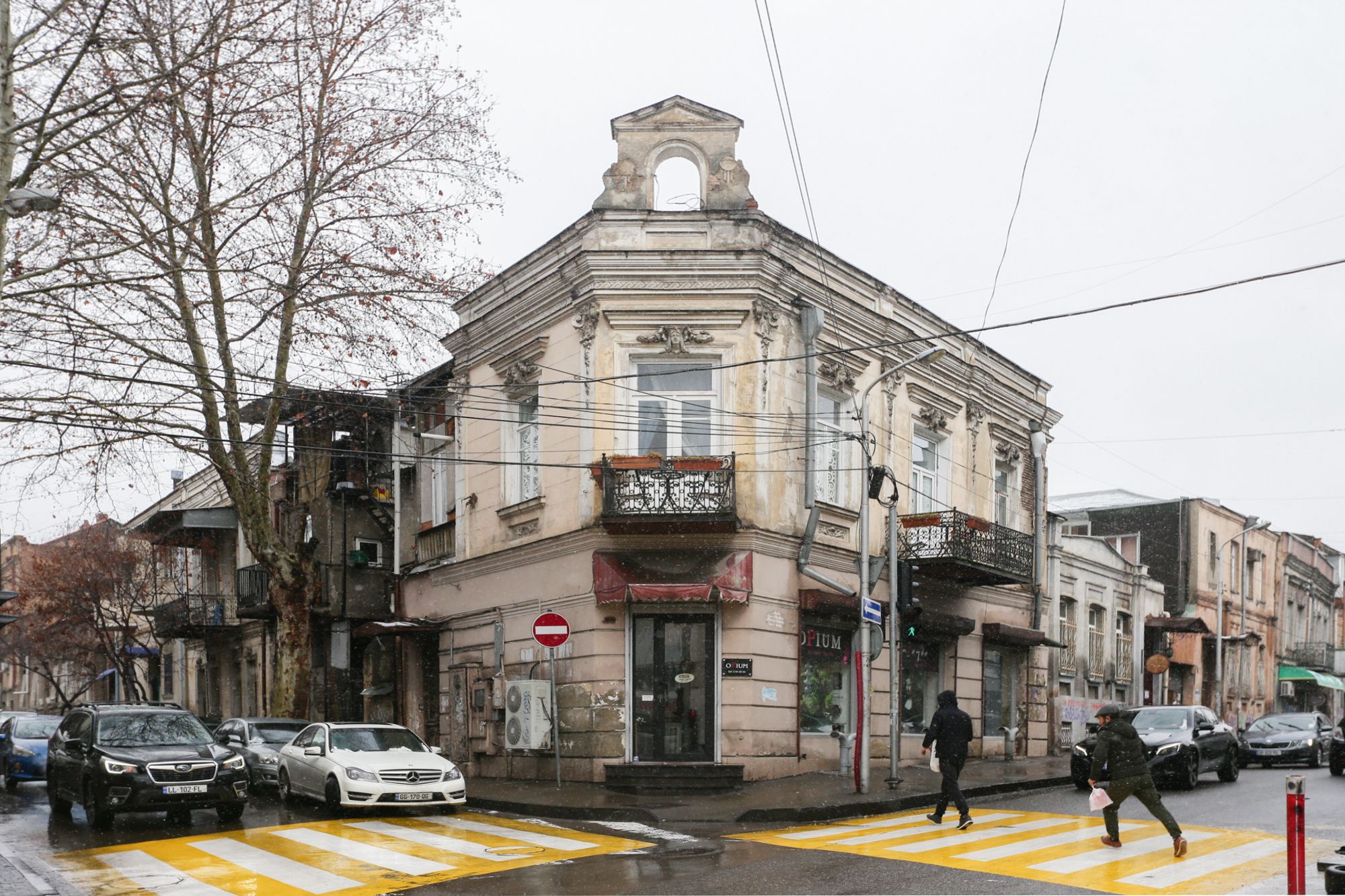
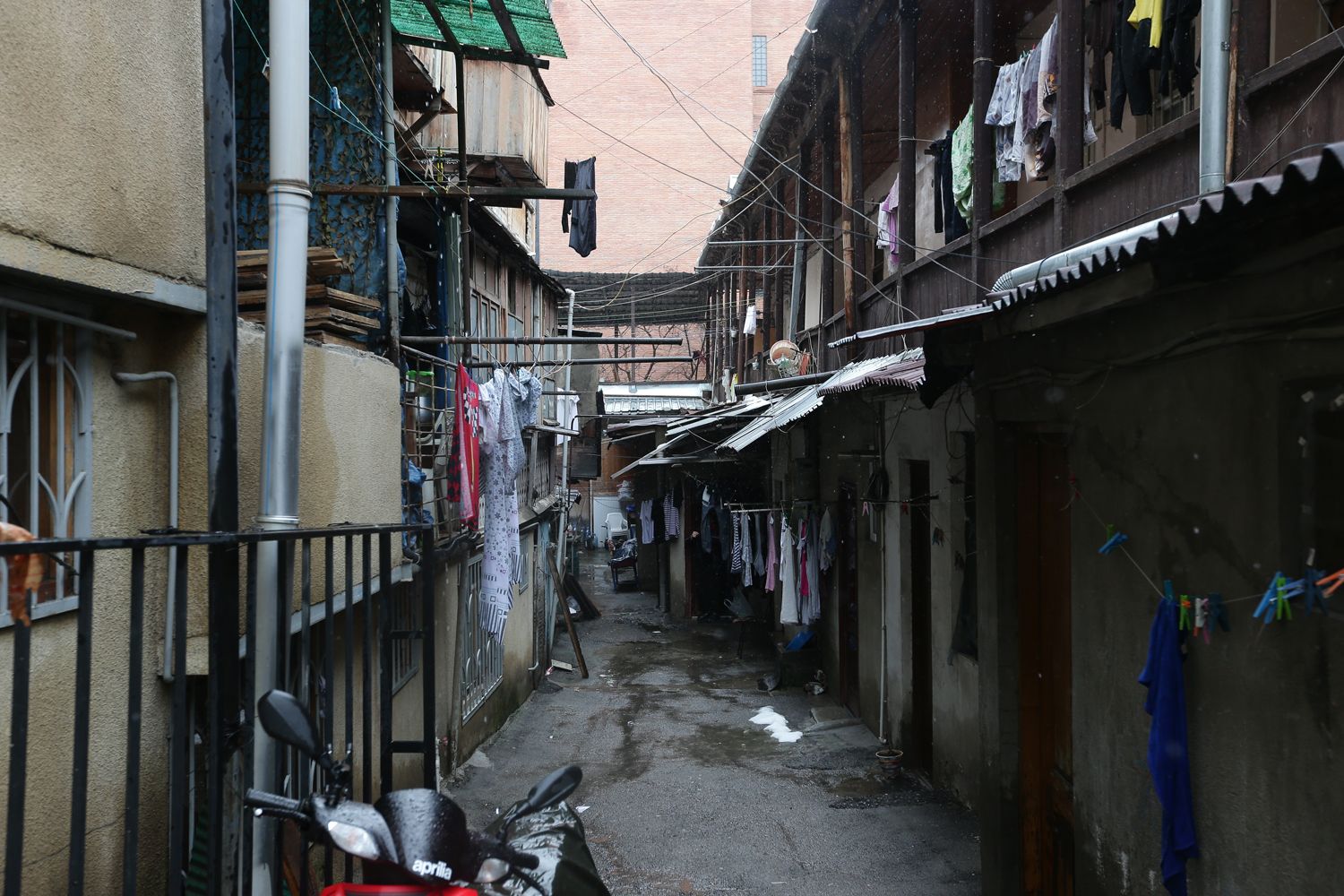
The price of renting a one -room apartment begins at about $ 250 per month (about 26 thousand rubles at the rate for March 21). The average monthly salary in the country according to the Georgian statistics service for 2021 is about $ 440. Most landlords ask for payment in two months at once, but there are those who are ready to rent housing only when paying for three to four months in advance. Some real estate owners fundamentally refused to rent apartments to Russians. In two weeks, Evgenia and Sergey could not find housing.
As a result, the couple, as well as several other Medusa Russian Russians who initially planned to live in Tbilisi, had already moved to Batumi. It is still possible to find an inexpensive apartment there.
To rent housing, the Russians go to tricks. The 23-year-old Vera planned to build a scientific career in Moscow, but after the start of the war she decided to emigrate. According to the girl, living in Russia, she could not be silent about the war, but at the same time did not want to substitute parents engaged in the budget sphere.
Arriving in Tbilisi, Vera and her young man were specially hired by a mediator-carrier so that he communicated with the owners of the apartments instead of them. The intermediary seems to be a relative of potential tenants and agrees on housing. This method helped their friends.
The assistant to Vera and Sergey rented an apartment for them. Before the arrival, the couple did not see housing, it turned out to be dilapidated. The Russians did not want to invest in repairs, it was much easier to rent another apartment. But the contacts of the hosts in order to pick up the bail and move out, the intermediary refuses to give: according to Vera, he says that they will not even talk to the residents - but simply evict.
Nizhny Novgorod Valentin and the eight-year-old son Misha left Russia on March 1, the tickets were taken on the very first day of the war: Valentina realized that "did not want to live in an aggressor country."
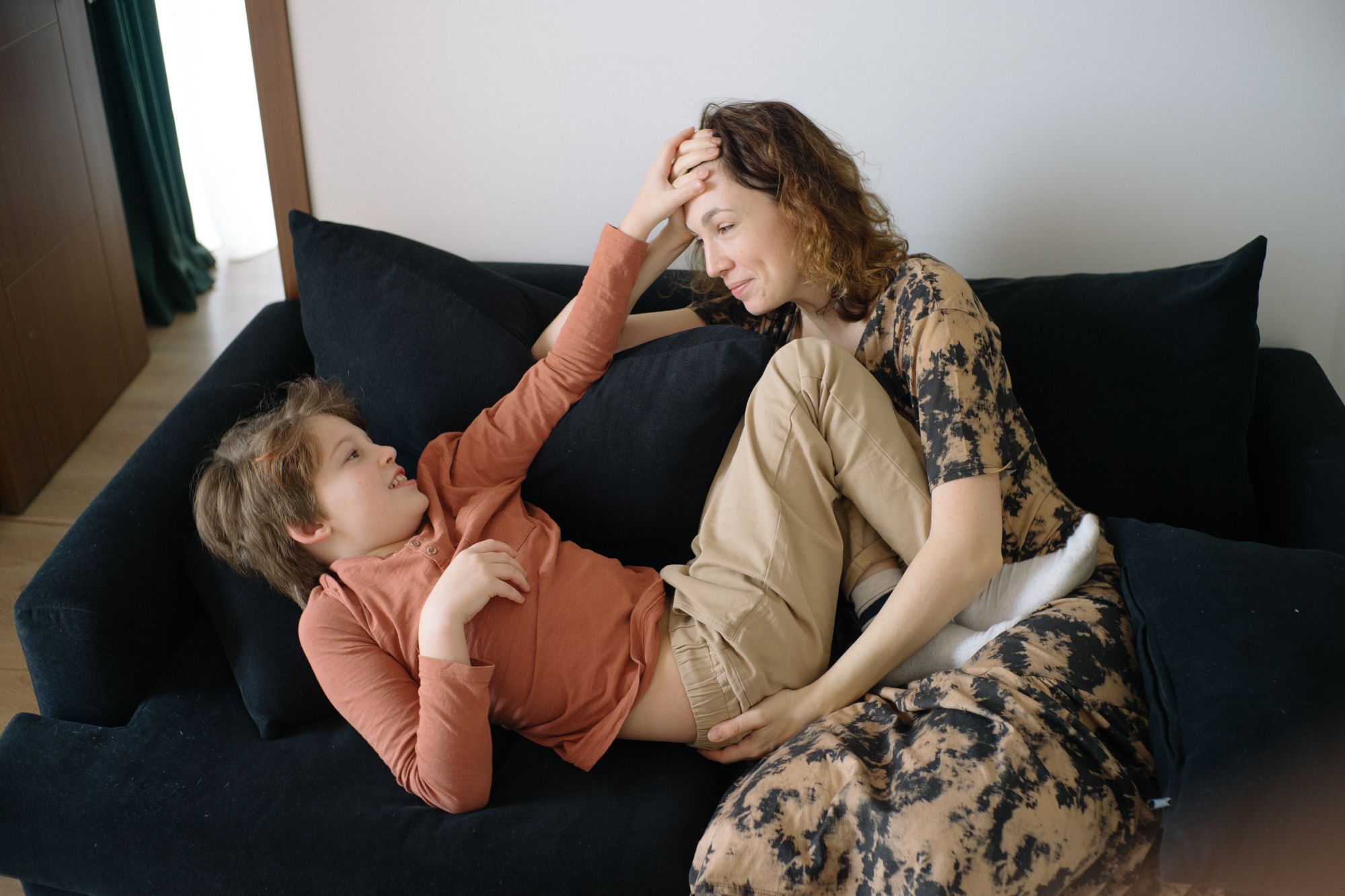
Valentina agreed with a Russian woman who lived in Tbilisi in the last six months that she would translate her apartment: the girl decided to return to Russia. Women agreed on this directly with the mistress of housing - a Georgian who lives in Germany. Валентина перевела деньги за месяц на российскую карту прежней арендосъемщицы, а на следующее утро ей позвонила маклер (торговый посредник при сдаче жилья) и спросила, действительно ли Валентина интересуется этой квартирой. Та ответила, что сняла ее. Маклер поспешила ее разубедить.
«Она сказала: «Мы ни о чем не договаривалась, вы что-то не поняли. Этот залог вам никто не вернет, а сейчас квартира стоит не 500 долларов, а 900. Цены растут, сами понимаете»». Я написала хозяйке, объяснила ситуацию — что я с ребенком, что я отмела все варианты, и мне негде жить. Хозяйка сказала общаться с маклером. Из тех 50 тысяч рублей русская девочка вернула 30 на карту моим родителям», — рассказывает Валентина.
В итоге мать с сыном сняли маленькую квартиру за 650 долларов недалеко от центра, соглашаться пришлось сразу: хозяева предупредили, что после Валентины на осмотр квартиры придут следующие потенциальные арендаторы. Нижегородка в тот же момент подписала договор. «Когда ты вдвоем с ребенком выбирать не приходится», — вздыхает эмигрантка.
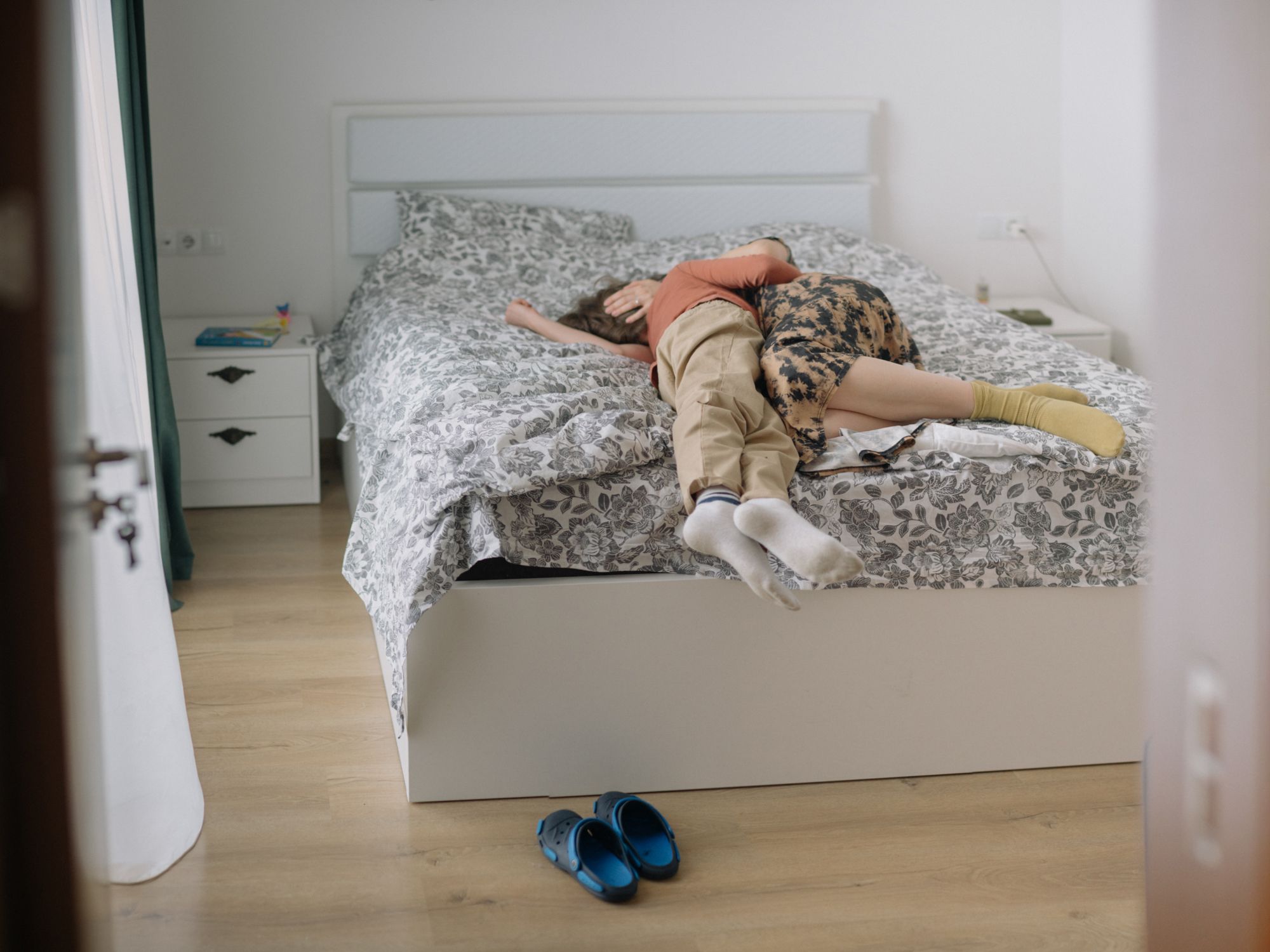
Ее сын Миша учится во втором классе российской школы, уехать пришлось посреди учебного года. Валентина планирует договориться с директором школы об онлайн-обучении до лета, а если не получится — искать русскую школу в Тбилиси.
По словам дизайнера, она переживает отъезд тяжелее, чем сын. Но за две недели в новой стране он сильно повзрослел и пытается поддерживать ее, чем может. Сейчас Миша все время придумывает, куда его мама могла бы устроиться на работу и рассказывает Валентине о ее сильных сторонах.
Деньги и очереди
Другая проблема, с которой столкнулись россияне при переезде — деньги. Уже в конце февраля в российских банкоматах практически закончились доллары, а Visa и MasterCard отключили работу российских карт за рубежом, чем сильно осложнили жизнь эмигрантов. Грузинские банки в то же время приостановили беспроблемную выдачу карт россиянам.
Два крупнейших местных банка — Bank of Georgia и TBC — довольно быстро перешли на новый режим работы с гражданами России. Так, в первом для открытия счета с начала марта нужно было подписать бумагу следующего содержания: «Я соглашаюсь, что Россия — оккупант, вторгшийся в Грузию в 2008 году и в Украину в 2014 и 2022 годах. Я поддерживаю территориальную целостность Грузии и признаю, что Абхазия и Южная Осетия — это Грузия. Я обязуюсь не распространять пропаганду российского правительства и бороться против нее. Я осознаю, что любое нарушение этих правил повлечет за собой аннулирование моего счета».
Сейчас, по словам россиян, которые пытаются открыть счет в Bank of Georgia, бумагу подписывать уже не просят. Но ожидать одобрения для открытия счета россиянам все равно приходится по несколько дней. До войны эта процедура занимала несколько минут.
В одном из чатов эмигранты самоорганизовались и несколько дней заполняли анкету, в которой отчитывались о своем опыте в различных банках (таблица с этими данными есть в распоряжении «Медузы»). Исходя из этих данных, примерно половине россиян в открытии счета в двух банках, которые были самыми популярными среди эмигрантов до войны — TBC и Bank of Georgia, — отказывают. Спасательным кругом для всех стал другой грузинский банк — Credo, который открывает счета за один день. Информация об этом довольно быстро распространилась в чатах эмигрировавших россиян, на самые популярные из которых подписано несколько тысяч человек.
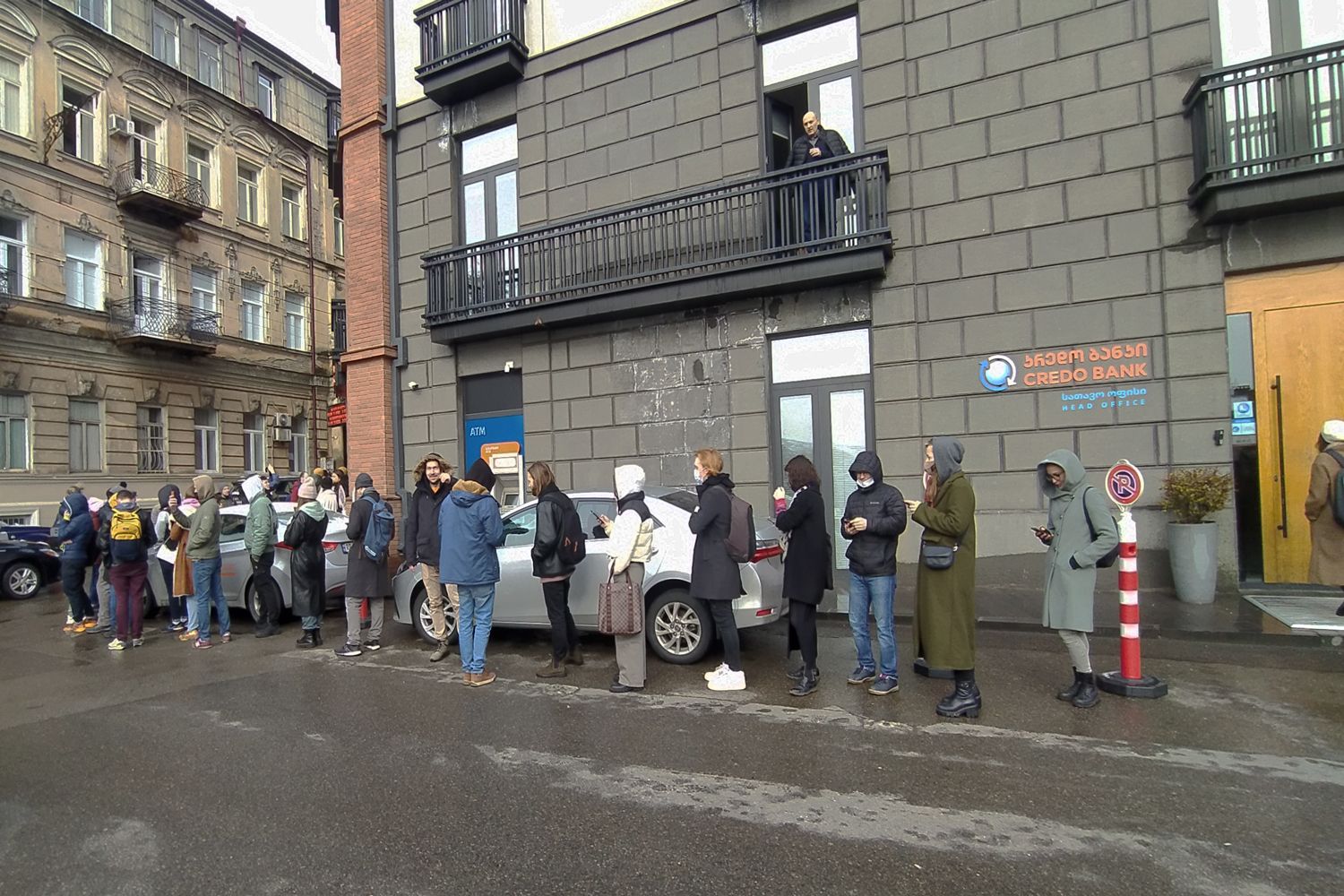
Банк Credo открывается в 10 утра, но очередь в сорок человек стоит у входа уже с половины девятого. Все они — из России и Беларуси. Некоторые переехавшие пытаются открыть счет уже третий день подряд.
Банк открывается, но людей запускают только по четыре человека, им выдают талоны с номерами в очереди. Кто-то сразу понимает, что сегодня открыть счет уже не успеет, и уходит. Другие готовы ждать.
— О, знакомые лица, — радуется девушка, вновь увидев соседей по очереди, с которыми она не дождалась открытия счета днем ранее.
— Сегодня мы 642, вчера были 695! Может, и успеем, — отвечает ей собеседник.
— Все зависит от менеджмента банка. Если они откроют больше окон на счета, то все может быть. Обычно на человека уходит около получаса, — вклинивается в беседу еще одна девушка у входа.
В обычные дни Credo работает до половины шестого, но в последнюю неделю его сотрудники трудятся сверхурочно. Даже в семь вечера там продолжают оформлять счета россиянам.
Один из последних оставшихся у эмигрантов способов вывести деньги с российских счетов, карты которые за рубежом стали просто пластиком, — использовать криптовалюту.
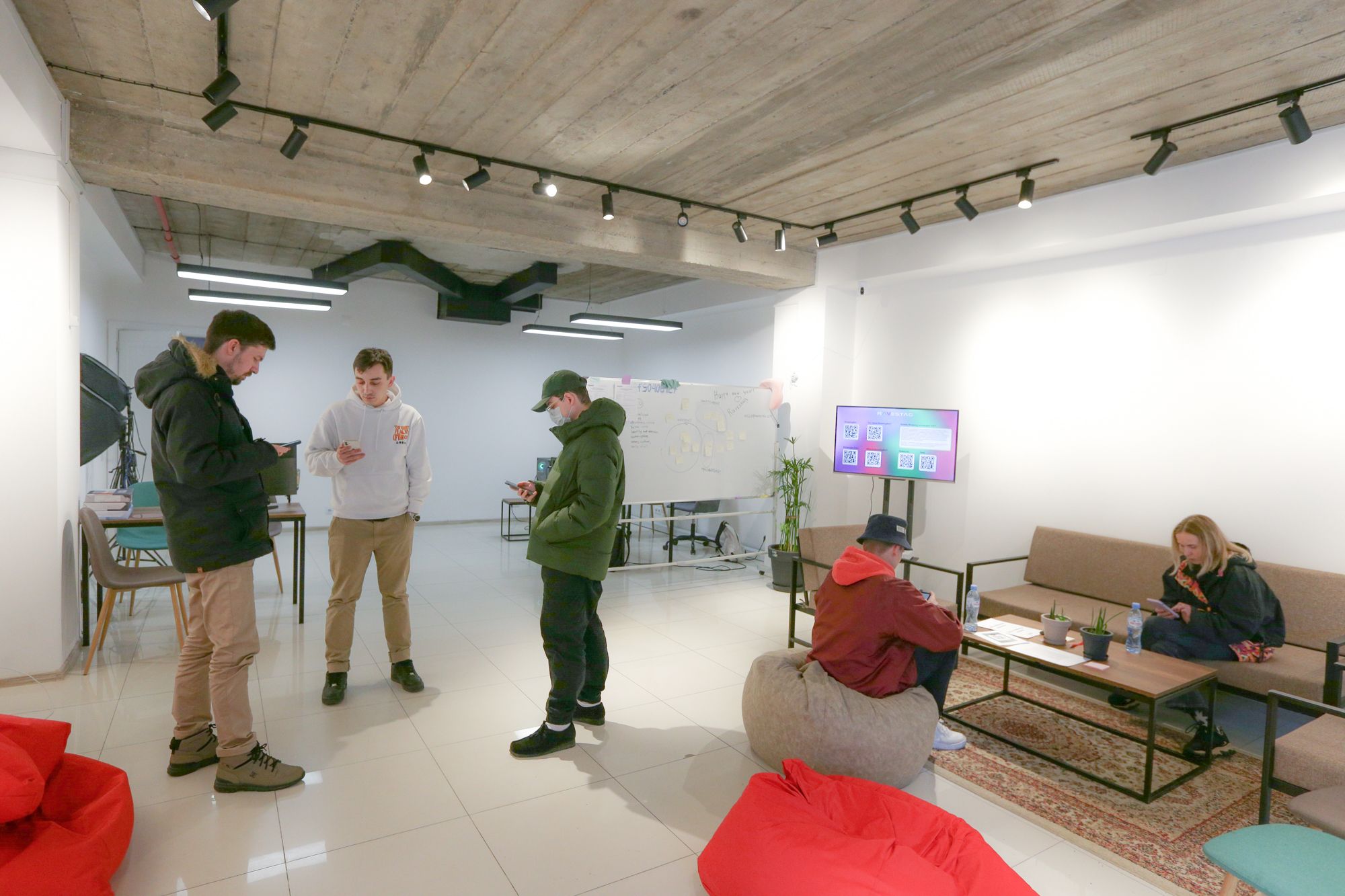
По словам Ираклия, сотрудника грузинской компании Ravestag, которая занимается обменом криптовалюты на обычную, количество клиентов за последние недели выросло в полтора-два раза, но компания пока справляется. «Из-за того, что Visa и MasterCard ушли из России, нам приходится использовать новые способы вывода денег, — говорит Ираклий. — Например, покупку USDT — криптовалюты, которая всегда равна одному доллару».
***
Большинство опрошенных «Медузой» собеседников не планируют надолго задерживаться в Грузии. И Валентина, и Евгения с Сергеем сейчас рассматривают дальнейшие страны для переезда. Все они думают об эмиграции в Европу и возвращаться в Россию не намерены. Исключение — те россияне, кто уехал не только из-за войны, но и политических репрессий. Все они ждут одного — смены режима и возможности вернуться в Россию.
«Когда режим падет, мы все вернемся, — говорит Антон Михальчук, — я принципиально не пытаюсь получить политическое убежище или ВНЖ здесь или в Европе. Это лишит меня морального права быть связанным с российской политикой. А я хочу продолжать эту борьбу до конца, неважно, сколько это займет».
Глеб Голод , Тбилиси (Грузия)