
Translated material
"Granny, I'm sorry, we all went through"
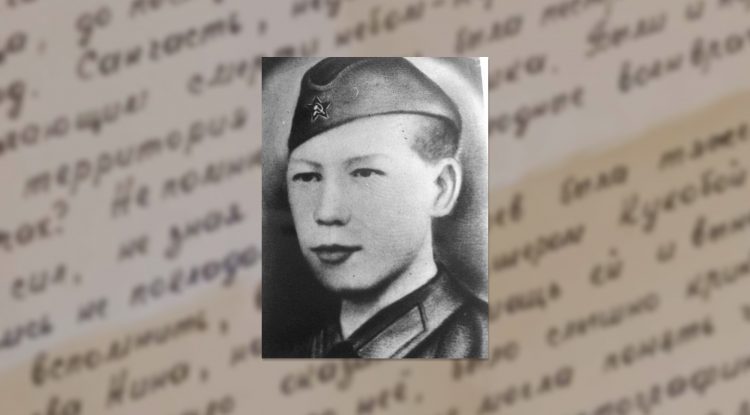
The WWII veteran wrote a letter about the horror of war. Her grandchildren found him during the war with Ukraine
“Today my brother showed me a letter from my grandmother, who died in 2016 at the age of 99. Granny, I'm sorry, we all went through, ”-a 29-year-old resident of St. Petersburg Lisa in March after the outbreak of war in Ukraine wrote such a tweet. We talked with her about the fate of her grandmother and the letter that she wrote.
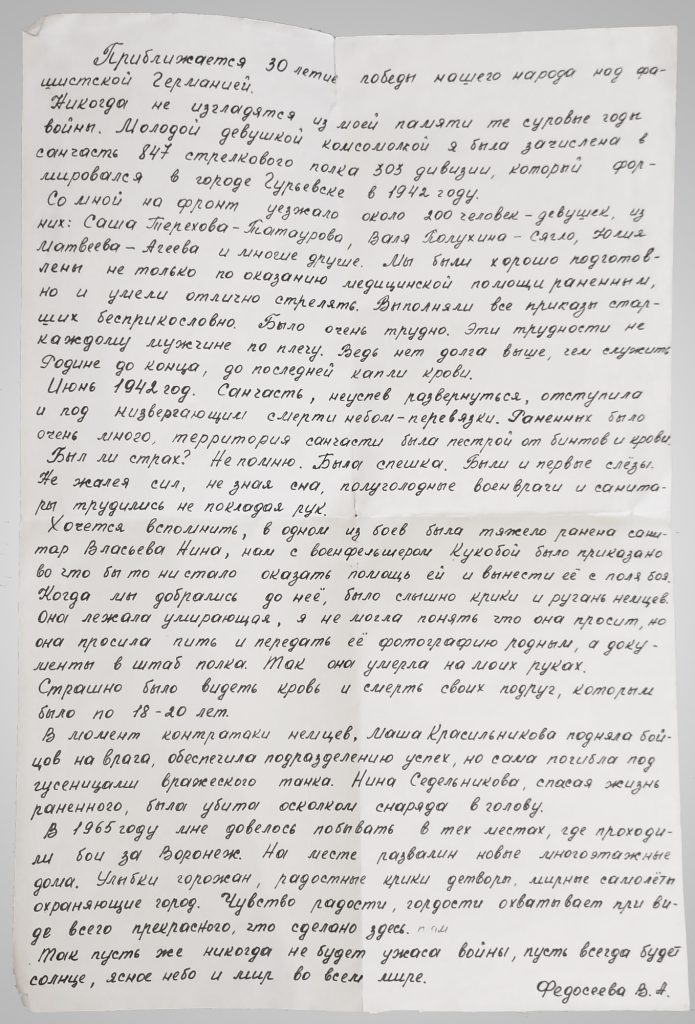
"Cold" deciphered the letter:
“The 30th anniversary of the victory of our people over fascist Germany is approaching.
Those harsh years of the war will never be made from my memory. A young girl, a Komsomol member, I was enrolled in the medical unit of the 847th Infantry Regiment of the 303rd Division, which was formed in the city of Guryevsk in 1942.
About 200 people went to the front with me-girls, of which: Sasha Terekhova-Tataurova, Valya Polukhina-Yasilo, Julia Matveeva-Ageeva and many others. We were well prepared not only to provide medical care to the wounded, but also knew how to shoot perfectly. They carried out all the orders of the senior unquestioningly. It was very difficult. These difficulties are not every man on the shoulder. After all, there is no debt higher than to serve the homeland to the end, to the last drop of blood.
June 1942. The medical unit, not having time to turn around, retreated under the sky that erects death - dressings. There were a lot of wounded, the territory of the medical unit was motley from bandages and blood.
Was there fear? I don't remember. There was a rush. There were the first tears. Not sparing for strength, not knowing sleep, half -starved military doctors and orderlies worked without turning their hands.
I would like to recall that in one of the battles, Nina’s Sanitar Vlasyeva was seriously wounded, I and the military commander of Kukoba were ordered to help her at all costs and endure her from the battlefield. When we got to her, the screams and swearing of the Germans were heard. She was lying, I could not understand what she was asking, but she asked to drink and transfer her photo to her relatives, and the documents to the regiment headquarters. So she died on my hands.
It was scary to see the blood and death of their friends, which were 18-20 years old.
At the time of the counterattack of the Germans, Masha Krasilnikova lifted the fighters to the enemy, provided the unit with success, but she herself died under the caterpillars of the enemy tank. Nina Sedelnikova, saving the life of the wounded, was killed by a fragment of the shell in the head.
In 1965, I happened to visit those places where the fighting for Voronezh took place. On the site of the ruins, new multi -storey buildings. The smiles of the townspeople, joyful cries of children, peaceful aircraft guarding the city. A sense of joy, pride covers at the sight of everything beautiful, which is done here.
So let it never be the horror of war, let the sun always be, the clear sky and the world around the world. ”
Fedoseeva V.A.
Lisa, 29 years old.
My grandmother's name was Valentina Alekseevna Fedoseeva. This is her maiden surname. She was born in 1917 in Guryevsk. This is the Kemerovo region. When I was born, she was already 77 years old. Then she did not work, she was retired. All she had was an apartment and a garden. She got to the front at about 25 years old and survived until 99. She could no longer speak for the past five years. But she died at home in her bed. They looked after her.
In the war, she was concerned, and also, when she dug up a soldier from the trench, some kind of stick fell on top and broke her right hand in two places. From that moment, my grandmother could never put her straight. The hand was always a little twisted, as if lay on top. She wrote the letter with her right hand.
I remember that she had a photograph on the sideboard. I thought: "What kind of handsome guy is this?" And then, when she grew up, he realized that this was a grandmother in her youth. In the photo, she looked like a boy - in military uniform and a short haircut. She is there 26-27 years old, probably.
She often said that during the war there was a lot of lice, that they were everywhere. It was impossible to wash, so the girls were cut briefly. She also recalled that there was nothing. From food they had just a piece of bread.
Every time she talked about the war, she cried. Always. Even after so many years. Therefore, I think that she would be upset if she had lived now. Especially if I saw this sign Z.
I don’t know to whom she wrote that letter. Father said that she sent him to the Guryevsky Museum. And there it was glued somewhere. On the back there were traces of paint. Well, then, apparently, he was given from the museum back. When we moved from Novokuznetsk with the whole family, it came to my brother. Now he found him by chance when he was looking for a marriage certificate in the documents. And he showed him to me with the words: “Oh, look what I have!” I was surprised: "Why are you only showing it now?"
So I read it for the first time in my life and cried. Then she threw the letter to her friends. At first they were surprised, but when they read, they smiled themselves. I thought: if it causes such feelings not only with me, then it needs to be shown to people. At first I didn’t want to write like that [“Granny, I'm sorry, we all shed”], although it spun in my head. But, when my friend wrote the same thing that I thought, I decided that I would sign it.
In the letter there is such a line "So let it never be the horror of war, let there always be the sun, a clear sky and peace around the world." There will be no peace around the world, as it seems to me. Well, at least in the next ten years.
This is the last line, from which it becomes uneasy. I am ashamed and sorry. I have a lot of acquaintances from Ukraine. And I read them on Twitter, I see their posts. They write that they are sitting in bomb shelters and cannot go to work. And I am ashamed that we had such an experience - and now we have "we can repeat."