
Translated material
The quiet roar of the surf
By the 145th anniversary of the birth of the author "Tsusima"
Hardly anyone will immediately call another work of Alexei Novikov-Priboy, in addition to Tsushima, although he wrote a lot. Well, sometimes one standing book is not left of other writers. What can be interesting to us today, Novikov-Priba and what his main novel about, says Vasily Avchenko.Starting from February 24, 2022, we were all in the face of the advancing barbarism, violence and lies. In this situation, it is extremely important to preserve at least the remnants of culture and support the values of humanism - including for the sake of the future of Russia. Therefore, the editorial office of Gorky will continue to talk about books, reminding our readers that the world remains in the world and fiction.
"Tsushima" as a historical book
 In the center of the work is the defeat in May 1905, the 2nd Pacific squadron of Admiral Rozhestvensky in the Korean Strait, at the Japanese islands of Tsushima (or islands-there is no consensus on this, since a strip of water between the two islands in the casts disappears).
Tsushima battle is the decisive battle of the Russo-Japanese War. The deafening defeat of the Russian fleet (Lenin called his article - “defeat”) - and the no less deafening success of Japan, which until then the “adults” the Western powers did not take seriously, believing that the Asians were not able to fight with Europeans on equal terms. Yesterday, super -covered and backward, Japan, having adopted the principles of the organization of the army and navy from the West, declared itself about the power of a strong and having interests on the mainland. (The whole first half of the twentieth century can be considered as a protracted one, with pauses, the war of Japan and Russia for influence in the Far East: intervention, Hassan, Khalkhin-Gol and so on, up to the Manchu Blitzkrieg Marshal Vasilevsky in August 1945.)
The Rozhdestvensky squadron, which connected at the transition from Kronstadt with the squadron of Nevogatov, was supposed to release the besieged Port Arthur, stop Japanese communications at sea and contribute to the defeat of the enemy on land. However, while the fleet went to the ends of the world, Port Arthur passed; Then it was decided to break into Vladivostok.
In the Korean Strait of Russians, the Japanese, who had a clear advantage in the sea, were in wait for the Russians. Of the 38 Russian ships and ships, they were sunk by the enemy or blown up by their crews 21, including 11 cruisers and seven battleships (the last of the battleships, Admiral Ushakov, Vladimir Miklukha, the brother of the Miklukho-Maclay traveler) commanded. Over 5,000 Russian sailors died. Seven ships surrendered or were captured, internal ports before the end of the war - six (including Aurora - a different historical mission was destined for it than death in the Tsushima waves). The cruiser "Almaz", the destroyers "Brave" and "Grozny" broke into Vladivostok. The transport "Anadyr", having left for Madagascar, was able to return to the Baltic.
The Japanese lost two destroyers in battle. Another died due to a collision with another Japanese ship.
Admiral Rozhestvensky, who received a severe wound, was captured, soon after returning to Russia he resigned from the post of chief of the Main Naval Headquarters. He was criticized by the press, insisted on attracting himself to the court, where he asked for the death penalty for himself, but was justified. He lived a recluse, died of a heart attack in 1909.
"Tsushima" as a revolutionary book
The story of the battle is the first, but far from the only plan of the book. She is rather social than battal. “To keep the revolution, you need a small victorious war,” said Minister Pleve, and it turned out exactly the opposite: big and unsuccessful. “Tsushima” is a book not so much about the war as about Russian society at the time of the 1905 revolution, fermentation of minds, revolutionary moods, which during the next big war resulted in first in February, and then in October.
The collapse of the Rozhestvensky squadron at Novikov-Priboy is a harbinger of the quick collapse of the Romanov empire. Apparently, this is why the “tsusim” in the USSR was well accepted and often reprinted. Novikov-Priba, who, under the tsar, was under arrest for revolutionary propaganda and forcedly left Russia (at one time lived with Gorky in Capri), clearly showed the processes that naturally led to the collapse of the old system, and made an unambiguous conclusion: the entire state system is to blame for the defeat of the fleet. His creative aspirations coincided with a social order (it was coincided that the author did not bend under the party line; this is proved by the fact that long before the revolution he published essays on Tsushima “Mad men and barren” and “For other people's sins”, in mood coinciding with his main book and immediately prohibited by censorship).
Tsushima first saw the light in 1932. It was then that Japan, who previously occupied Manchuria, created here, in the northeast of China, the state of Manzhou-Go-a bridgehead for expansion towards core China, Mongolia, and the Soviet Union. Anti -tuning sentiments in the USSR intensified, and the book was very useful. In 1941, Novikov-Priba received the Stalin Prize for it. The victory in Manchuria of the new, already Soviet empire in 1945 supplemented the text, demonstrating the progressiveness of the Soviet system compared to the royal regime.
And “Tsushima”, and numerous stories, and the unfinished novel by Novikov-Pribia “Captain of the First rank”-about small people, sailors, non-commissioned officers. His works should be considered in the spirit of not so much romantic-massly as a socio-Gorky tradition. The sea for Novikov-Priboy is a background, a texture familiar to the author, his image is not a goal, but a means; The fleet acts as a convenient optical device to comprehend social reality.
"Tsushima" as a production book
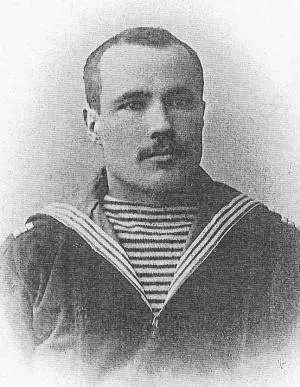 A.S. Novikov-Priba during the Naval Service
Noteworthy is Tsushima and others. This is the only marine book, written not by a navigator or officer, as in the case of Stanyukovych, Kolbasyev, Konetsky, and not a passenger barin, like a Goncharovsky "Frigate" Pallada, but the lower rank.
Novikov-Priba, then just Novikov, served in the Baltic Fleet in 1899-1906. On the battleship "Eagle", who participated in the Tsushima battle and surrendered (Novikov landed for the Japanese for eight and a half months), he was a battery. This word did not come from the battles, as you might think, but from the bottle (in Niderland Bottelier-the vine; but the "Butleger" is not from the bottle, as it might seem, but from the lower leg-bootleg). The battalor, a non-combatant non-commissioned officer, was a kind of manager, who was in charge of clothing, monetary and food allowance of personnel. Among the duties of the battles were the issuance of vodka sailors. Novikov-Priba writes about this with knowledge of the matter and visible pleasure:
“ - Watch guilty and dinner!
Capraul's pipe puffed. Among the team, revival began. Some of the sailors, rattling with iron fortifications, lowered the suspended tables on the decks, others, grabbing copper tanks, raced to the galley, the others, those who loved to drink, hurried to one or another val, lining up in line. For each, half a vodka was relied on, and another half-cup-in the evening, in front of dinner (in a truncated form, the tradition is alive until: red wine is given to submariners. -V.A .). They drank vodka with pleasure, grunted and released jokes:
- Eh, rolled, dear, in the hold of my stomach!
- Well burning.
- And they will give Rum abroad. He is even better. "
(In the “first-ranking captain”, Novikov-Priba will again raise an alcoholic theme-in the same Venichkian spirit: “In the evenings ... Prokhor Savelyich loved to have enough tea glass of vodka, insisted on rusty nails. According to him, such tincture is the most useful-the iron is absorbed into the bloodstream.” Where there are “tears of the Komsomol”! Clips from these people.
With a description of the household details of everyday naval life (“Soup with a lot of cabbage, potatoes, beets, carrots, onions seasoned with a trunk made of wheat flour, red pepper, there was a gust and a grease ... It was impossible to yawn for a single minute, unless you want to stay hungry ... Near the tank, ten spoons flickered.”) It is interesting even to those who are not fascinated by sea battles. The image of ship routine, nuances of marine service allows you to consider the “tsusim” Roman production.
Of course, strictly speaking, this is not a novel, but almost documentary notes, the most valuable evidence of an eyewitness. Along with personal impressions, the author widely used the stories of other sailors and archival data. The peculiarity of the book is in a combination of a personal view with the latitude of coverage, historical elaboration.
"Tsushima" as a naval book
The book of Novikov-Priboy is one of the important frames in the corps of Russian marinism. Although Russia, although it took the ocean spaces a century ago (our whaling flotillas worked with Antarctica, opened by Russian sailors, these are our “strategists” are on duty around the world ocean, this is not even the best, but the only icebreaker fleet in the world), according to inertia, considers itself a country rather a land. The sea theme, despite the presence of a number of beautiful books, is still underheated: the writers do not swim most often, the floating do not write (there are no bad things in the word “swim”, only land salags are opposed to it; all Marinists, from Stanyukovych to Konetsky, the verb “swim” is used completely calmly, and the terms like “captain of distant swimming” speak for themselves). With this in mind, every marine text of Russian literature acquires a special weight.
Sea prose has a characteristic naval humor. Many naval humor and Novikov-Priboy:
“ - Why don't you give an honor?
- It’s guilty, your highly blessed, thought.
The lieutenant swore obscene, tapped his fist on my forehead and said almost affectionately:
“No need to think in military service.”
But when the battle begins (the sailors according to the old custom change into a clean, ship priest sprinkles the guns with holy water) - it becomes no longer to jokes. The narrative turns from a battaller into a battal, and we do not have other such prose at all, because the Russians fought more on land than at sea, and the trenches described much more often the abysses.
“Tsushima” is a very useful reading for us, peaceful city people who know about the sea battle only from the game, where you draw cells 10 by 10. Not to say that Novikov-Priba lells bloody details-but he paints them. Almost impassive (otherwise it is impossible to describe this at all - you can’t stand it) and in great detail.
Several examples.
“A man with a fragmented nape fought in agony.
- The servant of God is communed ...
Father Paisius, catching himself, asked:
-How to call him?
Someone replied:
- The surname is Kostylev, and the name is unknown.
One of the orderlies advised:
- Galvaner, Father, he. So directly and tell me, Galvaner Kostylev. They will figure it out in the next world.
The priest stared at the one who filed such advice, and then mechanically said:
- The slave of God Galvaner Kostylev takes community.
<...>
“When the tendons were grabbed, the elder doctor Makarov ordered me:
- Novikov, take it away!
I took a boot from the operating table with a bloody bone sticking out of it ... The sleeves of the older doctor were fed by the very elbows. The surgical knife in his right hand sparkled. As if in delirium, I saw how they separated the skin with the fat layer and how they cut the meat obliquely, exposing the broken bone ... They bent the left meat of fresh meat on the bone, pulled the skin on it and began to darn with a needle with a silk thread. I continued to hold a boot with a piece of cut off. I was struck by cold perspiration and was very sick. "
<...>
“The man who stood on the present fell and spun on all fours, asking:
- Brothers, where did it go to me?
On his back, between his shoulders, a wet spot blurred in the rags of a torn dress. The face, good -natured and miserable, is quickly bluish. He overturned his back and immediately died. ”
<...>
“The shell exploded near the combat cutting. From the drummer who was here, there was an ugly stump without a head and feet ... The commander of Bar with a pale, sprayed bloody face jumped out of the wheelhouse and, holding a smoking cigarette in his hand, shouted loudly:
- Call me the senior officer of Pokhvisnev!
One of the sailors ran to fulfill his assignment, and he, holding a cigarette in his mouth, dragged on ... and ... disappeared into a warship to control the dying ship. "
<...>
“ - On the spot is killed!
Michman Shcherbachev ... at that moment woke up and asked:
- Who is killed?
“You, your nobleness,” one of the sailors answered.
Shcherbachev scaredly threw back his head and threw his left surviving eye over the faces of the sailors.
- How, I am killed? Brothers, tell me, I'm already dead? "
<...>
“Nazarov turned next to him ... Vestova Nazarov: he had pieces of brain from a fragmented nape. The wounded man mumbled something and, squeezing and unclenching his fingers, stretched one hand, then the other, as if climbing on the bathroom. The iron cornice, circled below the slot around the cutting to pull the fragments, wrapped it inside it. This cornice interrupted to the spine with the neck of one sailor. He frantically wrapped around Nazarov’s legs and, wheezing, held on to them, like a lifebuoy. ”
 Photo: Sergey Strunnikov / Russiainphoto.ru
"Tsushima" as an oriental book
Finally, “Tsushima” is one of the first Russian books about Japan, according to Novikov-Prix-“a country of eternal greenery, blooming chrysanthemums, dancing geisha”, “as smiling as mysterious.”
Until the middle of the 19th century, Japan was fastened with all the buttons, and even today it remains a “thing in itself” to a large extent. If in the 19th century the Russian reader could find out about the country of the rising sun (this title has not responded for a long time: Kamchatka and Chukotka-much in the east of Japan, even Vladivostok east of Kyusu and a piece of Hongsu, and for the inhabitants of Yuzhno-Kurilsk, Japan in the literal sense of the word-the country of the sun inhabited: if you look from Kunashir, the luminary lines. Hokkaido processes) from the books of Captain Golovnin and writer Goncharov, and in the XXI-from Koro-Koro Kovalenin and the “notes of the Hajizin” of Smolensky, then in the twentieth century the Pilnyakov “roots of the Japanese Sun”, the Soschinnikovskaya “Sakura branch” served as a source of scarce information.
"Tsushima" as an occasion to think about the fate of the Motherland
Between the lines "Tsushima", as if behind the scenes, lies many fascinating plots.
Take at least the history of the very battleship “Eagle”, which, having almost a hundred hits, could not continue the battle and surrendered (the mortally wounded commander, the first -rank captain Nikolai Jung, was in an unconscious state at that time, died the next day and was buried in the sea; the sea battle is more democratic than the ground - the admiral is undergoing the same risk, and the sailor and the perishable ship and the perishable ship and the perishable ship and the perishable The commander is obliged to leave the latter). The Japanese repaired the ship and put it into operation called "Iwams". It was he who was the first to come to the Raid of Vladivostok on January 12, 1918 - formally to protect Japanese subjects, which marked the beginning of almost five years of intervention in the Far East (the Japanese will leave only at the end of 1922).
The fate of the Orel officers are also indicative, by which you can study the history of Russia in the first half of the twentieth century.
The captain of the second rank Konstantin Swede (in the book-senior officer Sidorov) after the revolution he served as an assistant chief of staff of the Workers 'and Peasants' Red Fleet, died in Leningrad in 1933.
In 1918, the mine officer Vsevolod Modzalevsky was arrested on charges of counterfeiting, subsequently worked in the Clotflot, in 1931 he again was arrested on charges of espionage, swam in the Arctic, died in 1936 in Leningrad.
Artillery officer Fedor Shamshev, after the revolution, emigrated to Denmark, midshipman Oleg Shcherbachev to Italy.
Vladimir Satkevich served in the RKKF, taught at the Frunze Naval School, rose to the Contamiral Engineer, wrote textbooks on naval affairs, died in 1976 at a hundred of life.
Lieutenant Leonid Larionov served in the Baltic, worked in the Central Naval Museum. He wrote works on the history of the fleet, helped Novikov-Prikam in the work on Tsushima. He died of exhaustion in the besieged Leningrad.
Lieutenant Konstantin Slavinsky, heavily wounded under Tsushima, worked in Sudows, in 1930 he was arrested on charges of espionage in favor of Estonia, sat on Solovki and Belbaltlag. In 1940 he was released, exiled for three years in Syktyvkar, where he died in 1944.
Illarion Bibikov was written off from the “eagle” in Madagascar, on the way to Tsushima. After the revolution, he emigrated to France. During the Second World War, he entered the Germans as a translator. He died with his wife in 1944 in Sherbur from the explosion of an air bomb during the landing of the Anglo-American troops in Normandy.
Alexander Bubnov (in the book - Vorobeychik) participated in the civil war on the side of the whites, was the chief of staff of the Black Sea Fleet. Emigrated. In Yugoslavia, he became the founder of the Navy and Navy, died in 1963.
Michman Yazon Tumanov (Tumanishvili) fought at the whites, emigrated. The author of the notes "How a Russian Marine Officer helped Paraguay to fight with Bolivia."
The midshipman Nikolai Sakellari, after the revolution, taught, became a professor, doctor of military sciences, the founder of the Soviet school of navigators, the author of the works “Navigation”, “Conversations of shipbuilding”, “Notes on the deviation of the compass”, etc. He died in Leningrad in 1936. “I remember the smell of his pipe smoke, which remained in the damp of the ceremonial after the passage of the navigator into the harbor of the apartment along the stone fairway of the stairs ...” wrote Viktor Konetsky, who lived in the same house with Sakellari in childhood.
Vladimir Kostenko appears in Tsushima as an engineer Vasiliev. В 1908 году, будучи в командировке в Англии (наблюдал за постройкой крейсера «Рюрик»), свел руководителей Боевой организации эсеров Азефа и Савинкова с революционными матросами для организации покушения на царя, который должен был посетить корабль. В 1910 году был арестован за политику, впоследствии помилован. После революции занимал руководящие посты на судостроительных предприятиях в Николаеве и Ленинграде, участвовал в создании заводов того же профиля в Комсомольске-на-Амуре и Северодвинске. Автор трудов по вопросам судостроения. Помогал Новикову-Прибою в работе над романом. В 1928 году арестован, в 1931-м освобожден. В 1941 году снова арестован, год спустя освобожден. В 1945 году удостоен ордена Трудового Красного Знамени, в 1950-м — Сталинской премии. Входил в руководство института «Проектверфь». Умер в 1956 году, впоследствии реабилитирован.
Врач Алексей Авроров в конце 1905 года был арестован за участие в вооруженном восстании под руководством лейтенанта Шмидта и в состоянии психоза направлен на лечение. Продолжил службу, но в 1908 году был списан на берег в связи с психическим расстройством.
And so on; и это — лишь один из почти четырех десятков русских кораблей, бившихся при Цусиме.
***
Писательские псевдонимы бывают разные. Голиков на той единственной Гражданской стал Гайдаром, Фадеев — Булыгой. Первый сделал боевое прозвище псевдонимом, второй вернулся к фамилии отца.
Гликберг стал Черным, Бугаев — Белым.
Климентов — Платоновым, Зубцов — Зазубриным...
Есть псевдонимы семантически окрашенные: Горький, Бедный, Веселый, Голодный, Приблудный. Они становятся частью художественного текста, в отличие от псевдонимов тусклых («Евгений Петров»), настраивают читателя, как камертон.
В этой же «говорящей» категории — Мамин-Сибиряк и Новиков-Прибой (у них обоих еще и редчайшие отчества: Наркисович и Силыч). Даже не снимая книги с полки, читатель примерно понимает, что там под переплетом.
Прибой может грохотать, может едва шелестеть. Но он никогда не стихает, не должен стихать. Наглухо замолкает он только в одном случае: перед цунами.