
Translated material
“We decided to check what happens if you ignore Russia's requirements.” 23 years ago, the bombing of Yugoslavia began. How do those events look years later?
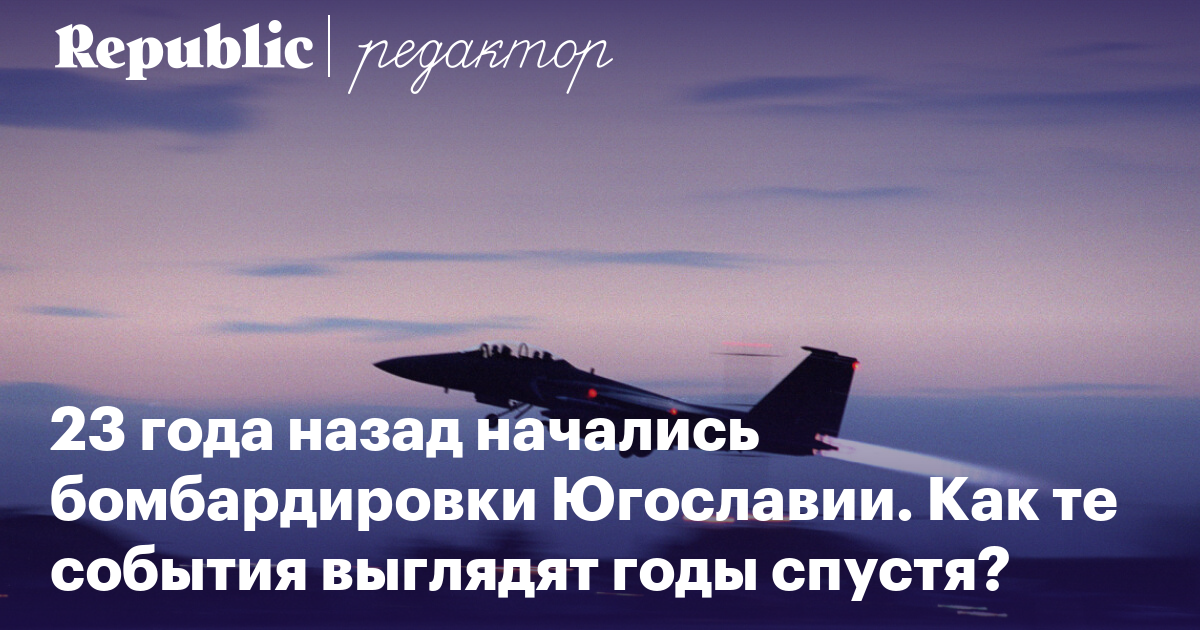
23 years ago, on March 24, 1999, NATO forces began a military operation against Yugoslavia, under the code name “Union Force”. Why in Russia they still see the injustice and act of US dominance in that campaign? Could NATO do otherwise in those conditions? Is it possible to justify the Russian special operation in Ukraine by that NATO air operation in Yugoslavia? The military observer Alexander Golts thinks about this in a conversation with Republic.
"It was a test of a new system of relations between allies within NATO and the role of an alliance in the international arena"
- The decision to bomb Yugoslavia in 1999 is still criticized from different sides. And, probably, there will never be consent. Looking back, how convincingly the rationale sounds that it was necessary in order to avoid the humanitarian catastrophe and genocide in Kosovo?
- To a certain extent, with such an interpretation, one can agree. This interpretation arose not by chance. She arose from the experience of Yugoslavia after her collapse. This experience was that the leader of Serbia and Montenegro, Mr. Miloshevich was looking for and found a solution to internal problems (he had the same internal problem - to be in power) to wage constant wars in the territory of the former Yugoslavia. It all started with Slovenia, then there was Croatia - there was not a very long, but very bloody war, then a long Bosniy epic, which gave rise to a large number of bloody episodes: Sarayev’s siege, a massacre in a cut and so on - all this ended with the Deyton agreements.
And in 1999, a clear picture of what would happen in the near future was drawn before the leaders of the West. The Serbian regime was clearly going to deal with Kosovo Albanians and at the same time solve the internal problem of legitimacy. And for Europe and the United States, this meant a repetition of the Bosnian version - millions of refugees. But European countries were not ready for such an influx of destitute people. At some point, it was decided to find a council on Milosevich.
But, in addition, it is appropriate to say that at that time it was not clear who plays what role in the new situation of forces in the international arena. Not even 10 years have passed after the collapse of the USSR. In this regard, one of the Western mistakes was that the arguments of Russia were not accepted. From the position of Russia simply dismissed. This largely predetermined the dynamics of Western relations with Russia in the future.
- Many politicians, experts on international relations called the alliance actions with a gross violation of international law, as a result of which about 2 thousand civilians were killed in Yugoslavia. The operation was carried out in violation of international law, without the approval of the UN Security Council. In your opinion, how did it become possible at that time?
- Following a conflict in Yugoslavia, NATO was not going to enter into a direct confrontation with Russia. A little later, such a risk arose. As we recall, at some point a company of Russian paratroopers was thrown to capture the airfield next to the capital of Kosovo-Primetina, in order to thus defend Russia's right to independently participate in the further settlement of the conflict. And then the Commander -in -Chief of NATO in Europe Wesley Clark told British General Michael Jackson to knock the Russians out of Protina. The latter reacted sharply to this, saying that he did not want to start the third world war because of (then an obscene word) Albanians.
As for violations of international law, international law is a general term. The well -known fact is that the operation began without the UN Security Council resolution. But I must note here that without this resolution a huge number of other wars in the world began. From the very beginning, the death of civilians from the very beginning was a serious problem of this operation. I remember how merciless criticism of NATO James Shea was subjected to, when he used the words “Collateral Damage”-accompanying damage, speaking of the dead civilians.
That is, yes, the operation took place without the UN Security Council resolution, which was posted. And, note, indirectly justified this operation. In the same way, many other powers act, without requesting the UN Security Council resolution.
Speaking of humanitarian law, it should be said that the NATOs during bombing tried to avoid the death of civilians. This did not always work out. But it is impossible to blame NATO for deliberately violated the rules of war. Different opinions sounded on this issue, but they never led to anything specific.
Subscribe to read the whole
Make a subscription Redefine.media to read Republic
Subscribe [you can pay for a Russian or foreign card. The subscription is extended automatically. You can unsubscribe at any time.]
Where are the money subscribers going