
Translated material
“The Gabeshniki searched for the leader, who was called the" president. " How the largest anti -war demonstration of Soviet hippies was dispersed
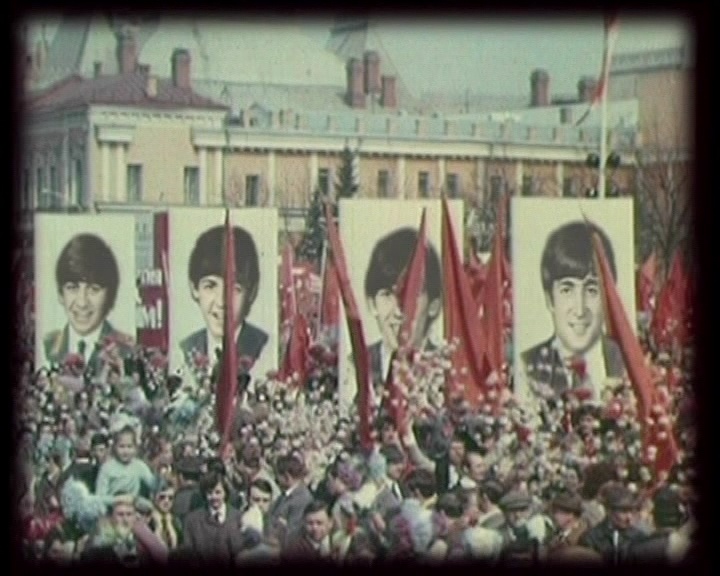
Frame from the movie "In everything I ask you to blame the" Beatles "", 2004
“In our country, the love of the people for the party and its leaders has been cultivated for many years. This book will talk about the love of hundreds of thousands and even millions of young and not very Soviet people for beautiful music and four foreigners who performed it, ”writes Dmitry Karasyuk in the preface to his detailed, impressive in terms of volume and diversity of sources“ how we loved the Beatles. The history of bitlomania in the USSR ”(recently published in the publishing house“ Cabinet Scientist ”). Someone must have a mass adore of the Liverpool Four must be more associated with hysteria of fans in the West, where the speakers did not have enough power to drown out the heart-rending screech of fans sobbing and falling into fainting at concerts of their idols. But on this side of the iron curtain around the legendary group, passions were in full swing, although a slightly different kind. In the fragment we have chosen - about the activity of Soviet bitlives in the vastness of the USSR. In particular, about the semi-delayed action of an apolitical long-haired youth, who, protesting against the Vietnamese war, in the summer of 1971 tried to walk along the streets of Brezhnevskaya Moscow under the slogans of John Lennon's songs. For the authorities, this timid manifestation of pacifism has become the largest anti -Soviet demonstration in the history of the capital - with everything that arises.
The new youth subculture arose quite in advance. In the September issue of the magazine “Around the World”, for 1968, an article by Henry Borovik “Walking to the Country of Hippephundia” appeared. An experienced propagandist, on the one hand, rejoiced that American teenagers flee from their bourgeois parents, rejecting their false values, and on the other hand, he mocked the soullessness and wildness of the adolescents themselves. As it happened more than once, the article caused an unexpected effect - thousands of Soviet boys and girls became interested in the eyes of their overseas peers and wanted to be the same as them. The Beatles contributed to this, whose song “All You Need Is Love” considered the first Soviet hippies to be their anthem. In large cities of the country, companies of long -haired young people appeared in clothing of varying degrees of shelling. They did not interfere with anyone, simply, sitting in parks and squares, they sang under the guitar most often English -speaking songs. In the evenings, hippies moved to someone home, where they continued to rest culturally, drinking alcoholic drinks. They did not like strong, preferring cheap port.
The overseas word "hippie" quickly Russified. Children of flowers growing on domestic grounds began to be called hippans, hippers or hip people. In Sverdlovsk, a few hipsts gathered on the embankment of the city pond, where in the evenings the Beatle songs sang with coordinated chorus. “It was so beautiful that all the mouths opened,” says Alexey Khomenko, later the musician of the Nautilus Pompilius group. - We looked progressive: cool, hair a little longer than the permissible. The police once forcibly took me to a hairdresser for a forced haircut, accompanied by moralizing. Such an act of edifying violence turned out. ” Those who more like not to sing, but to chat, dug around the monument to Yakov Sverdlov, or simply “Yashka”. These were mostly students of the university located nearby. Musical hipsts in a whisper retold terrible rumors, as if one of the "talkers", having a little sorting out alcohol, wanted to saw off a metal finger. “In fact, everything was much more harmless,” recalled the Yekaterinburg writer Andrei Matveev. - We were not any hippies, but we did not know about it and tried very hard to be them. We were drunk, Bitlov listened, we carried all nonsense, tried to experiment with some pills, but instead of psychedelic visions we received only vomiting or diarrhea. In general, the entertainment was innocent. ”
The public belonged to young people unlike her with obvious condemnation. “At that time I looked like everyone else: long hair, striped Klecha made of tarpaulin, instead of a jacket, a green military tunic, rag colored boots on the platform,” recalled Alexander Gasilov, another bitnum with experience. - For this he constantly suffered the mockery of respectable Soviet citizens. About people like me often said: "Not a girl, not a guy, but it!" In the military registration and enlistment office, the officer on duty with a cry that I, because of the hairstyle, is not worthy of the title of Komsomol, tore my certificate of deferment of an draft into the army. It happened that the police dragged me by the hair and tore my Kleesh ... I had to experience a lot of things in my youth only because outwardly I did not look like it was customary in the USSR. ”
Subscribe to read the whole
Make a subscription Redefine.media to read Republic
Subscribe [you can pay for a Russian or foreign card. The subscription is extended automatically. You can unsubscribe at any time.]
Where are the money subscribers going