
Translated material
The ruble sharply strengthened to the dollar and the euro. Does this mean that the economy is restored? And what will happen next?
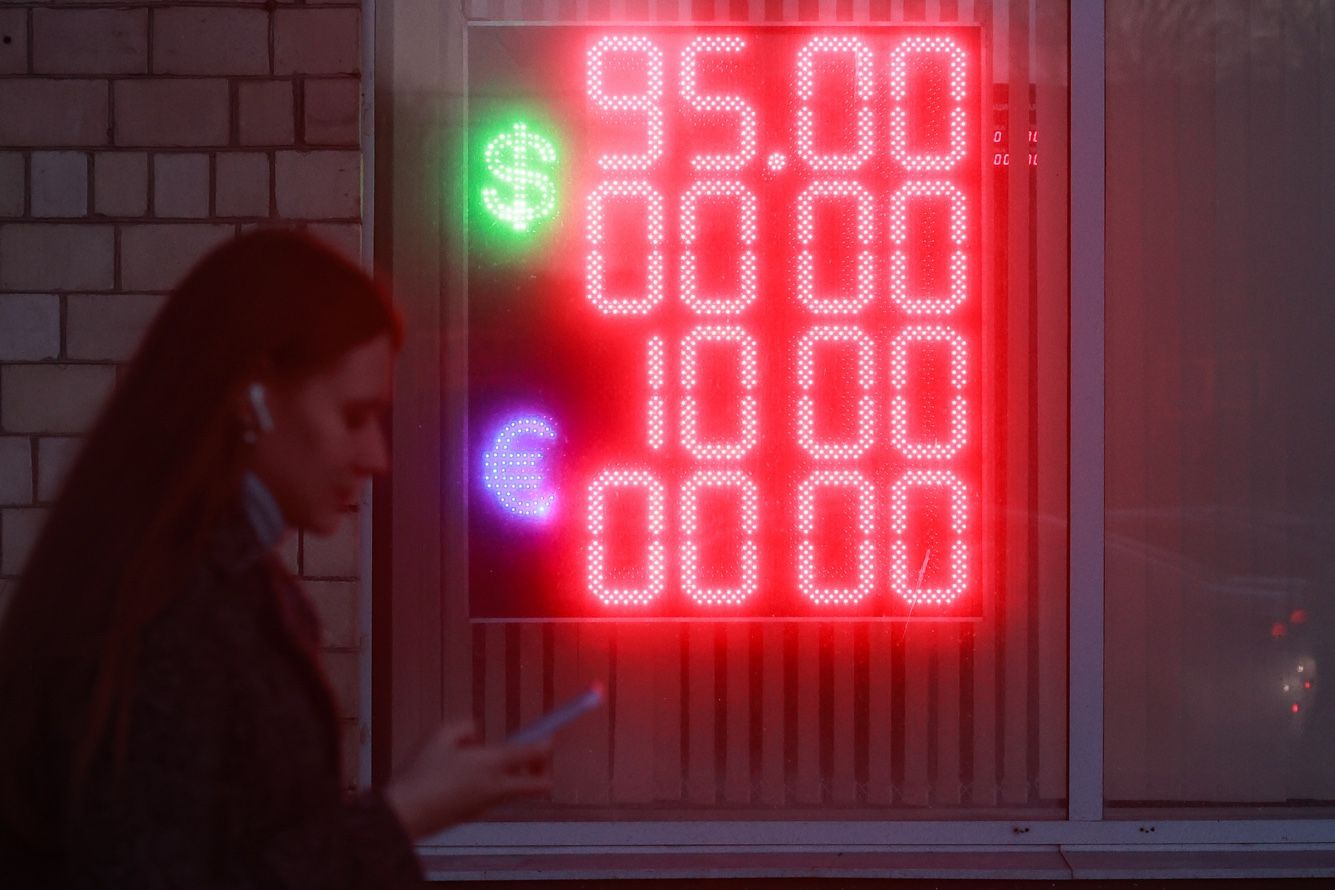
On March 29, the dollar rate dropped below 88 rubles. This has not happened since the first days of the war, and in early March, the dollar cost more than a hundred rubles. The euro year then was about 140 rubles - today it amounted to 97 rubles. What are the reasons for such a sharp strengthening of the ruble and can it return to the pre -war indicators? Medusa talked about this with an economist, director of investment of Loko-Invest, Dmitry Polev.

- What is the reason for such a noticeable strengthening of the ruble?
- Indeed, from March 10 we have a steady growth of the ruble. In principle, the turnover [currencies] were quite low, a large number of market participants left - non -residents , part of the population , company, importers.
The conditions for the growth of the ruble were created from the very beginning with a requirement to sell 80% of foreign exchange earnings and other restrictions on financial transactions. That is, even if the energy export sank slightly in volumes, then the prices for raw materials are more than compensated for this-and this is a plus. Export revenue is more stable than imports, which, against the backdrop of uncertainty, has decreased very sharply-due to logistics, due to problems with transport, with payments. Importer companies sold, rather, just reserves of goods that were, unable to fully purchase new parties.
- How did the departure of foreign companies affect imports to Russia?
- This is just a key question. We do not know how the intentions and statements that companies are suspended in Russia or leave, affect the operations themselves. That is, some companies could really suspend their work-this is a complete stop in terms of imports, some companies can continue to work. Here the question is - how much imported components, raw materials, services, and so on were prone to shocks. But in any case, it is clear that now imports have fallen strongly because of all these factors. Thus, the surplus of the trade balance is formed, which also supports the ruble.
In addition, we had large volumes of flows between companies - when, relatively speaking, Western companies led local [Russian] daughters that earned and repatriated part of the profit to the West. This year, investors expected very large dividends from Russian companies, now many of them will either be reduced or generally canceled. These flows are now largely closed. There are no non -residents in the stock market and bonds, they cannot withdraw the currency. All this combination of factors plays exclusively in favor of the growth of the ruble.
Honestly, in our comments to customers last week we allowed growth to 85-90 [rubles per dollar in the future], but I did not think that this would happen so quickly.
-And the idea of selling gas for rubles somehow influenced the course ? Some experts note the benefits of such calculations. Do you agree with this?
- From my point of view, this is an informational noise, it is often used as one of the arguments, why the ruble grows like that. Perhaps there is some kind of emotional component: maybe someone from the population could sell their non-cash or cash dollars. But fundamentally, this [calculation for gas in rubles] is not a key factor in strengthening the ruble.
- How much is the currency control holding back the fall of the ruble?
- Of course, he is very holding back. The meaning of these restrictions was to remove the risks of destabilizing the foreign exchange market, the financial system, excessive demand for currency and, as a result, the outflow of capital. Just for this, currency control was introduced. Strictly speaking, we can easily return to the levels of 70+ [rubles per dollar], that is, to the levels that were observed at the end of last year and at the beginning of this. Technically there are no barriers for this.
- That is, a return to “pre -crisis” values is possible?
- Yes, formally speaking, according to our gross estimates, the prospect of further significant strengthening of the ruble remains with unchanged [currency] restrictions.
One of the arguments why the government and the economic unit can continue to support the strengthening of the ruble is inflation. A strong ruble will bring down the inflation shock , which is unprecedented by modern standards. The second argument is that the policy of forced or conscious import substitution will pass a little easier with a stronger ruble. In conditions of inevitable rise in the cost of logistics and other elements of production chains, import substitution will be corny to companies, the government is less.
- It turns out that now there are three main factors that support the strengthening of the ruble - this is the drop in imports, the conversion of export revenue into rubles and the currency control of the Central Bank?
- By and large, yes. There is also an important point that can influence - we have stabilized the situation in banks. The population carries money there, which indirectly shows that people have calmed down and there are no panic moods.
In this sense, there may be a conversion of dollars back into rubles. Because [when the ruble has just begun to fall] there was no shortage of comments [experts], predicting 200-300 rubles per dollar. It is clear that these were the predictions completely divorced from reality. And in the framework of such an information component, people see that the ruble has returned to more understandable levels. This factor can provide additional stabilization of the course.
- These are all financial measures. Did the results of today's negotiations between Russia and Ukraine have influenced the ruble, within which it was decided to “radically reduce” military activity?
- Today's news based on the results of negotiations is an important trigger, without which the ruble would not move like that. The conditions for strengthening the ruble were originally created, but this news could just speed up the movement that we see. And, perhaps, if a positive de -escalation message is preserved, this will additionally play in favor of further strengthening the ruble, even from current levels.
- With such a strengthening of the ruble, currency control can be softened or canceled ahead of time ?
- Everything will depend on how the Central Bank and the authorities will evaluate the prospects of the payment balance. Now a huge number of important unknown people remain: what will happen to the supply of energy, what will happen to Nesiriev export, which is less critical for the West. From the part of some companies, there may be a voluntary rejection of Russian products.
No less imports. What is precisely lost, what can be obtained in other countries and how fast, which part of critical imports will remain - without which production can be corny to stand up or will be very reduced. Therefore, as soon as the authorities with greater certainty can form some forecasts for the payment balance, it will already be clear how the introduced restrictions on the part of the Central Bank may change. So far, I think the Central Bank will not rush to change the current conditions. Plus, the geopolitical history is still uncertain, sanctions threats are periodically sounded-all this will require some expectant position from the Central Bank and the government.
- What risks for the ruble are left now? What can be very weakened by the course again?
- You can come up with a sufficient number of scripts. For example, any significant restriction on the export of Russian raw materials, some additional restrictions on the financial sector or key sectors. So far, the scale of possible fluctuations in import-export is quite large to give unambiguous forecasts to the ruble. From local moments - a deficit of goods sensitive for people and stored inflationary expectations, in which citizens will consider currency as insurance for maintaining savings.
But these scenarios do not look inevitable. You can keep in mind that before all the events [before the war] the course was 73-75 rubles, at the peak we saw 100+. I think that the authorities are not interested in the course to be 100+ or even about 100. But the range is 75-95 [rubles per dollar] in the near future can be rudely considered as a realistic landmark.
We talked about Nadezhda Metalnikova