
Translated material
Russia announced that he would “radically reduce military activity” in the Kyiv area. Does this mean a radical fracture in favor of Ukraine?
Short answer: everything is more complicated, it is worth expecting exacerbations in the Donbass
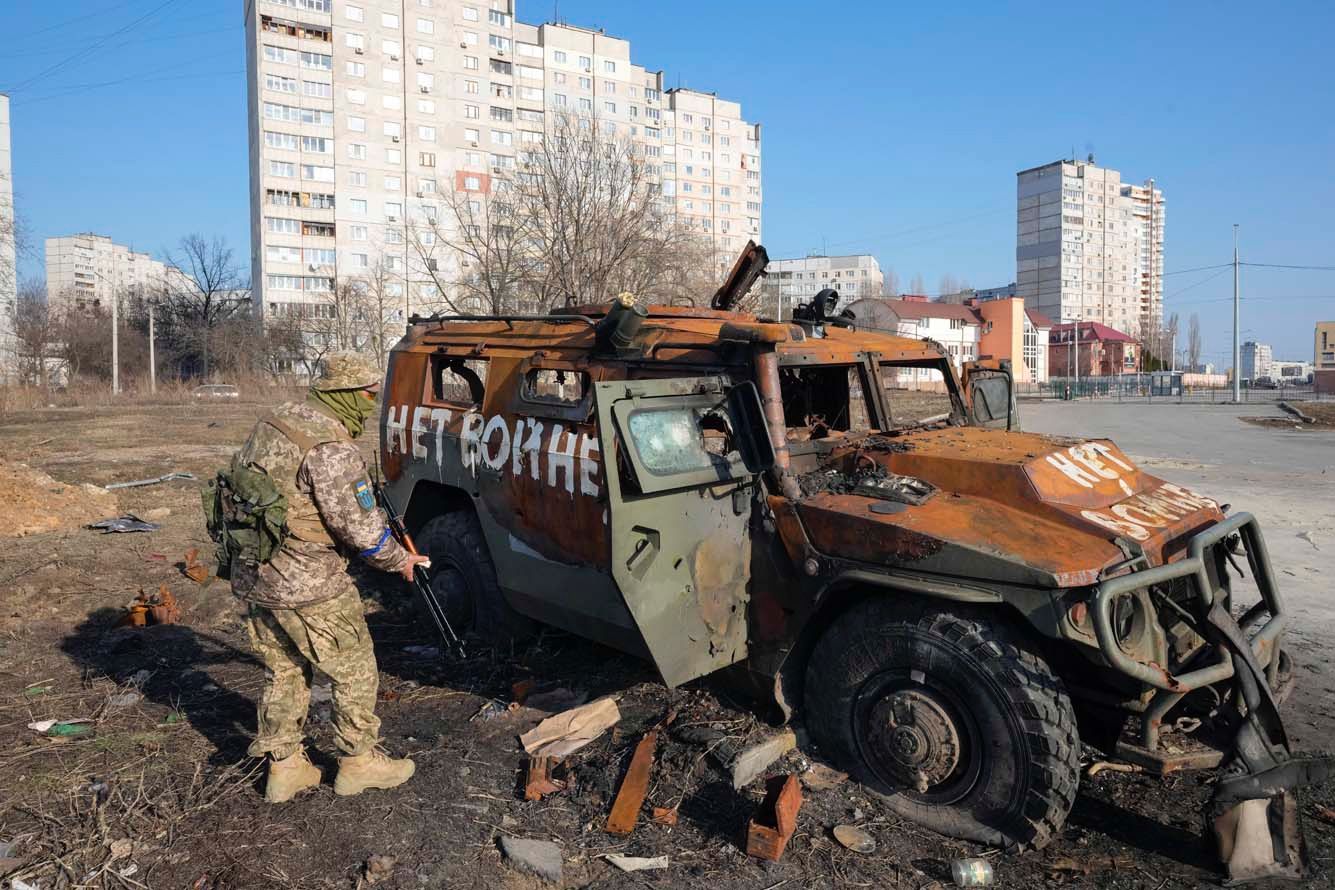
The representative of the Ministry of Defense of the Russian Federation, Colonel General Alexander Fomin on March 29, after negotiations between the delegations of Russia and Ukraine in Istanbul, said that Russian troops were “radically, at times, reduce military activity in the Kiev and Chernihiv directions.” This decision is directly related to the new Russian plan for the continuation of the war: the command is going to concentrate all the forces for the environment of Ukrainian troops in the Donbass. The Kiev operation of the Russian troops, obviously, failed, and the victory in the Donbass could theoretically allow the Kremlin to end the war acceptable to him.
In this text, the editorial office is trying to evaluate the combat situation in Ukraine on the basis of available data. "Medusa" opposes the war and for the speedy return of Russian troops home.
General Fomin did not say the details of what is meant by “cardinal reduction”, promising that the General Staff would do this later. It is only announced that the “de -escalation” will not mean a ceasefire. In addition, the Ministry of Defense expects that "in Kyiv the corresponding basic decisions will be made." It is likely that Ukrainian troops should also, following the example of Russian, radically reduce military activity.
At the same time, the events of recent days in the Kiev and Chernihiv directions show that the “reduction in activity” (if Ukraine joins it) is difficult to call a concession from Russia. As Medusa alreadywrote on March 24, the Russian offensive in order to surround Kiev from two directions-from the north-west through the Chernobyl zone of alienation and from the northeast through the Chernigov region-it was stopped.
Why did the "campaign to Kyiv" stalled? (in great detail)
- After in the early days of the war, Russian troops occupied the Antonov Airport area 25 kilometers northwest of Kyiv, the pace of offensive in the vicinity of the Ukrainian capital slowly slowed down. The offensive was carried out south, bypassing Kyiv from the west - along the Irpen River, the floodplain of which was flooded after the flesh explosion (who exactly did this is unknown for certain, but Ukrainian troops received benefits from this). Slotting is clearly visible in the satellite images of NASA. Ukrainian artillery across the river continuously struck the flank of the advancing Russian group.
- From the other flank, the Russian group was attacked by Ukrainian troops from Zhytomyr. As a result, Russian troops were not able to ensure the safety of the flanks and rear: the width of the front of the offensive in the southern direction did not exceed 30 kilometers, the entire location of the Russian group was shot through with Ukrainian artillery.
- The farther the Russian units advanced south, the harder the situation with their supply, interaction with neighbors and command, as well as with other branches of troops, became difficult. As follows from the radio intercepts of negotiations between Russian commanders in the area of the city of Makarov and near the Kiev -Zhytomyr highway (theypublished The New York Times, it is impossible to confirm their authenticity), the troops were deprived of all the necessary supply, including fuel for tanks; There was no aviation support. Judging by the photo and video shot in this area, the Russian units suffered heavy losses in equipment right on the highway and in the villages on both sides.
- In the fourth week of the war, the situation for the Russian troops worsened. First, a new attempt failed to protect the flanks of the Russian group advancing to the west of Kyiv. Russian troops crossed the Irpen River, occupied the village of Moshchun and tried to finish the blocking of Kyiv from the north. This would allow them to protect one of the flanks from attacks. An offensive in the area of the village of Nemeshaevo was undertaken on the other flank. However, both operations failed. Moshchun and Nemeshaevo by the Russian troops are lost, as well as the crossing through Irpen near Moshchun.
- Ukrainian troops tried to conduct a counterattack against the entire Russian group to the west of Kyiv: by March 24 they took Makarov, which posed a threat to the entire Russian group south of the Kyiv -Zhytomyr highway. However, the Ukrainian troops failed to develop success: they were stopped at the outskirts of Makarov by the fire of Russian artillery. Judging by the melee and video conducting, the Ukrainian troops, who were coming from the combat area, could not advance on another flank- in the city of Irpen. Now the spill of the river of the same name is already interfering with their offensive.
- By March 29, the situation in the west of Kyiv stabilized. The parties continue artillery shootings; About where the shells lie down, you can judge by the NASA firemap . Judging by it, Russian artillery continues to strike south of the Kyiv -Zhitomir highway in the Makarov area, the Ukrainian one is in the location of the Russian units in Irpen and in the Makarov Airport area. On March 29, large fires (probably due to artillery fire) were recorded in the area of the village of Maidanovka on the western flank of the Russian group.
- In general, in this area, Russian troops have not been thinking about the offensive for more than a week. A part of the Russian units from the front (or their rotation) was recorded . The allocation of part of the forces was also noticed by US intelligence. Thus, the mutual “cardinal reduction in activity” in this area is consistent with the interests of the Russian command.
To the northeast and east of Kyiv there was a similar situation:
- Russian troops found themselves on the eastern outskirts of Kyiv - near Brovary, Borispol airport and in the vicinity of the Kyiv - Kharkov highway - having traveled before that a long and difficult way. Some of the troops reached almost Kyiv through the forests of the Chernihiv region; The regional center was never captured. Only at the end of March, the Ukrainian command reported that Chernigov was practically surrounded. At the same time, Russian supply columns continued to attacked all the way from the Russian and Belarusian border to the outskirts of Kyiv, which could be fixed using photos and videos that the Ukrainian military laid out almost daily.
- This is probably why the Russian troops were not able to reach Kyiv at once. An attempt to approach Brovary - an important point of basing Ukrainian troops - the forces of two tank companies ended with losses in ambushes on its outskirts. Russian troops only occupied the village of Great Dymraka ten kilometers from Brovars, where they dug.
- East, a group came up to the outskirts of Kyiv on the 10th of March, which began the war under the sums. She also had to go around cities that played the role of the resistance points of the Ukrainian troops; Group columns were also subjected to daily strikes.
- As a result, the troops did not reach the highway Kyiv - Kharkov, as well as Boryspil Airport.
- In the fourth week of the war, Ukrainian troops began counterattacks here and here: the Great Pymerka was attacked. However, the seizure of the Ukrainian village, which became an important base of Russian troops in this area, was not reported.
In general, in this direction, the continuation of the Russian offensive is hardly possible. The Russian army has no strength to completely protect stretched from Chernigov, Sumy and Pripy the communication of groups that reached the outskirts of Kyiv. So the “cardinal decrease in activity”, especially if it allows you to release the troops, is beneficial to the Russian command.
It is important that the stop of the offensive near Kyiv was clearly not part of the Russian war plan. The troops in the north of the country were stopped by stubborn Ukrainian resistance. The Russian army could not achieve goals at once in all directions (for this it initially did not have enough strength), so its command decided to correct planning errors and concentrate all the forces in the Donbass, where there is a theoretical opportunity to inflict a decisive defeat of the enemy.
How do we know this?
From the video and photos that eyewitnesses of battles publish on social networks. This makes it possible to objectively record at least part of the events of any modern conflict. We inflicted most of the “documentary evidence” on the map of Ukraine on the first day of the war.
The events of the last days - on our interactive map
Sources for the card see here
Three options for "reduction of activity" are possible
- Russian (and Ukrainian) troops as a whole will remain in the current positions and cease large -scale attacks on each other. This option can significantly improve the operational situation in general for the Russian command: it will be able to freely use all reserves in the Donbass in the direction that it considers decisive for the outcome of the war.
- Another option is much less favorable for the Russian command: “reduction in activity” will be one -sided, Ukrainian counterattacks in the west and east of Kyiv will continue; The Ukrainian troops will be able to at least stop the transfer of all reserves to the Donbass and to the south of the Kharkov region.
- The third option could be acceptable from a military point of view, but bad from political - the withdrawal of troops from some districts in the Kiev and Chernihiv direction. The troops that received the experience of the war in difficult conditions (and not victims of defeats) could be used in the offensive in the Donbass; However, politically abandoning the positions near the capital of the enemy will radically worsen Russia's position in negotiations. In addition, where the Russian command allocated the troops to this day (under pressure from the Ukrainian army or due to the impossibility of supplying them), this was accompanied by big losses: this was the case in the Nikolaev region in mid-March and in the Trostyantz in the Sumy region in late March. Both times, the Ukrainian army, which occupied the former Russian positions, demonstrated dozens of units of the enemy’s hit and abandoned equipment.
And now the main thing: what does Russia want to achieve in the Donbass?
Until now, the troops for a large environment in the Donbass have clearly been not enough. But in recent days (judging by numerous videos with columns of equipment), Russian groups in areas south of Izum (south of the Kharkov region), north of Donetsk and Gulyipol (Zaporizhzhya region) received reserves from other directions. It is they who should, according to the plan, voiced by the Ministry of Defense, to surround a significant part of the Ukrainian army in the Donbass and thereby decide the outcome of the war.
It is probably assumed that the Ukrainian command will not be able to organize from the Donbass to the Dnieper all troops ( from a quarter to a third of all Ukrainian forces - about 70 thousand people) in the conditions of the superiority of the enemy in the air. The fact is that the Ukrainian military really demonstrates stability unexpected for Russians when they defend themselves on equipped positions and cities, and also apply counterattacks next to them under the guise of their artillery. However, if they have to make marches under the pressure of the enemy and air bombing, then they can bear very big losses (as it was with the 59th APU brigade in the early days of the war, when it erupted from the encirclement near Kherson). And the environment of such a large group (which, unlike the group in Mariupol, will not be possible to sacrifice the army to radically loosen the army without risk) will force the Ukrainian leadership to make concessions.
But in any case, all these attempts to freeze military operations in one place in order to deliver a decisive blow in another, they make sense only if this decisive blow is effective. However, Russian troops (as well as Ukrainian) did not show the ability to overcome the defense built on the concentrated fire of artillery, which is introduced and adjusted from drones.
Thus, the Russian troops, which were advancing from the Izyum and Balakli region in the rear of a large Ukrainian group in Slavyansk and Kramatorsk (there is the headquarters of all troops in the Donbass), were stopped by artillery fire and counterattacks in the hussarovka area and suffered heavy losses. In general, the battles south of Izum have been going on for more than a week, but the advance of the Russian troops did not exceed 10 kilometers. The equally modest success in the forces of the self -proclaimed DPR and the Russian troops, which are trying to hack the defense of Ukrainian brigades, which they have equipped since 2015.
Meanwhile, in order to cut the ways of supplying Ukrainian troops in the Donbass, Russian troops need to overcome about 200 kilometers, despite the fact that the Armed Forces will probably attack the attacks of the advancing group both from the Dnieper and Zaporozhye and Donbass.