
Translated material
When federal media talk about people with HIV, in 73% of cases they use unacceptable vocabulary
The main thing from the study on how the HIV is told in the media, social networks and on the sites of departments

Although HIV infection is quite common in Russia, a surge of interest in it happens mainly on thematic days, and people living with HIV are subjected to Stigma. This is expressed, among other things, in the words that journalists, users of social networks and officials choose. In early April 2022, the Association, which helps people with HIV, prepared an analytical report - it contains data on how often in the media , on official resources and social networks they use incorrect vocabulary in relation to people with HIV, as well as people from vulnerable groups and high -risk groups. In addition, in this work you can find data on how often it is publicly said about the methods of HIV prevention not supported by the state. The report was prepared by the research date Vyacheslav Romanov and political analyst Bogdan Romanov.
Unacceptable vocabulary is very popular at all sites
A negative attitude towards people living with HIV, as well as to those who are in high -risk groups and in vulnerable groups , only contributes to the spread of the virus. Due to Stigma, people can less willingly seek medical help, and a person who is not undergoing antiretroviral therapy can more actively transmit the virus. According to the authors of the work, the stigmatization of people from high -risk groups can create in people who contrast themselves with a false sense of safety.
Stygmatization can be expressed in vocabulary. “Profile international organizations emphasize the importance of vocabulary in the formation of ideas affecting the behavior of participants in public relations and strengthening global response measures in connection with the HIV epidemic,” the report said.
For this work, the authors, based on the leadership of Yunads on terminology, media dictionaries, consultations of 28 experts of specialized associations and other sources, compiled a list of permissible and unacceptable words regarding the listed groups of people. “A distinctive feature of the dictionary is the inclusion of obscene vocabulary in it, widespread and often not modified on social networks,” the report said.
More about vocabulary
Permissible vocabulary
- Drug consumer
- drug user
- drug addict
- Consumer of injection drugs and other drugs for non -medical consumption
- HIV person consuming drugs for non-medical purposes
- consuming injection drugs
Unacceptable vocabulary
- addict
- Torchka
- obdruded
- about *** OS
- Stubborn
- Awriter
- Khmyr
- Narik
- Nark
- needle
- Heroin
“Almost three quarters of publications [in federal media] use stigmatizing vocabulary in relation to people with HIV,” the report said. - We are talking about a greater frequency of use in their description of the words “patient”, “victim”, “infected”, “carrier” and others, considered as unacceptable. ” In the regional media, the situation is about the same.
Of the popular social networks in Russia, most often unacceptable vocabulary in relation to people living with HIV and people from high -risk groups are used on VKontakte networks and classmates. The best things are on Facebook.
“Official sites of authorized healthcare authorities are less likely to use unacceptable vocabulary, even in comparison with the media. <...> Perhaps this is due to a more stringent style of official publications, as well as with a greater immersion in HIV/AIDS issues of representatives of the press service, ”the report said.
If we talk about people from high -risk groups, then the media and social networks most often use unacceptable vocabulary in relation to people who use narcotic substances.
Journalists and users of social networks confuse HIV and AIDS
This is the difference
HIV is a human immunodeficiency virus. AIDS is a syndrome of acquired immunodeficiency. Once in the body, HIV destroys the cells of the immune system CD4⁺-lymphocytes. If the damage is serious enough, then a person begins to appear various infections that would not develop with a healthy immune system. In addition, specific oncological diseases arise, as well as conditions that could not be without HIV infection. This is called AIDS. Fortunately, now this happens less and less: thanks to the use of antiretroviral therapy, the disease does not progress and AIDS does not develop.
According to the authors of the report, journalists in their materials mistakenly use the words “HIV” and “AIDS” in 6–21% of cases. It cannot be argued that the number of errors decreases over time.
Most often, mistakes are made in social networks - in 43% of cases, but there there is a large scatter depending on the social network: in Instagram, terms are incorrectly used in 16% of cases, and in “classmates” - in 71% of cases.
On official resources, terms do not confuse the terms.
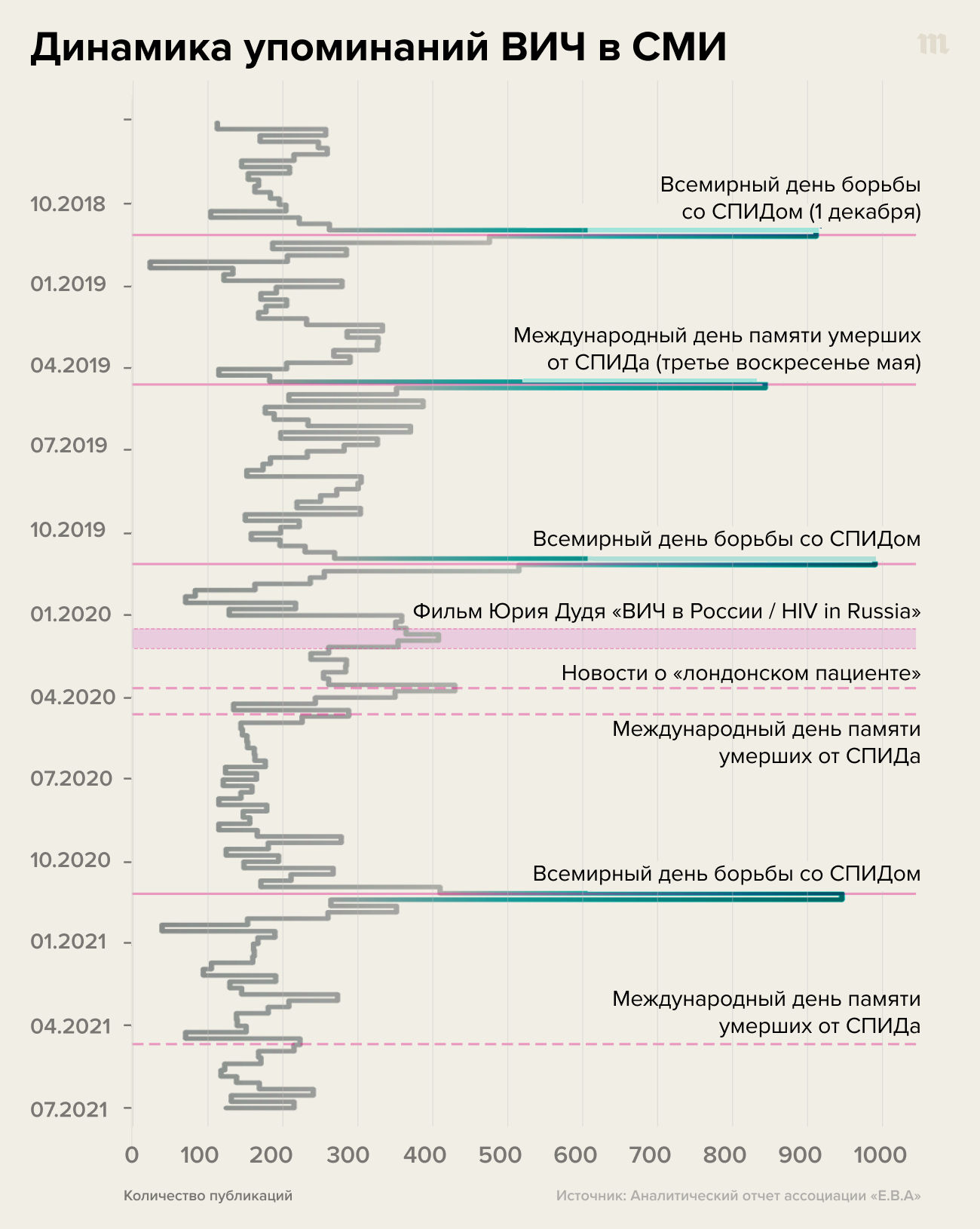
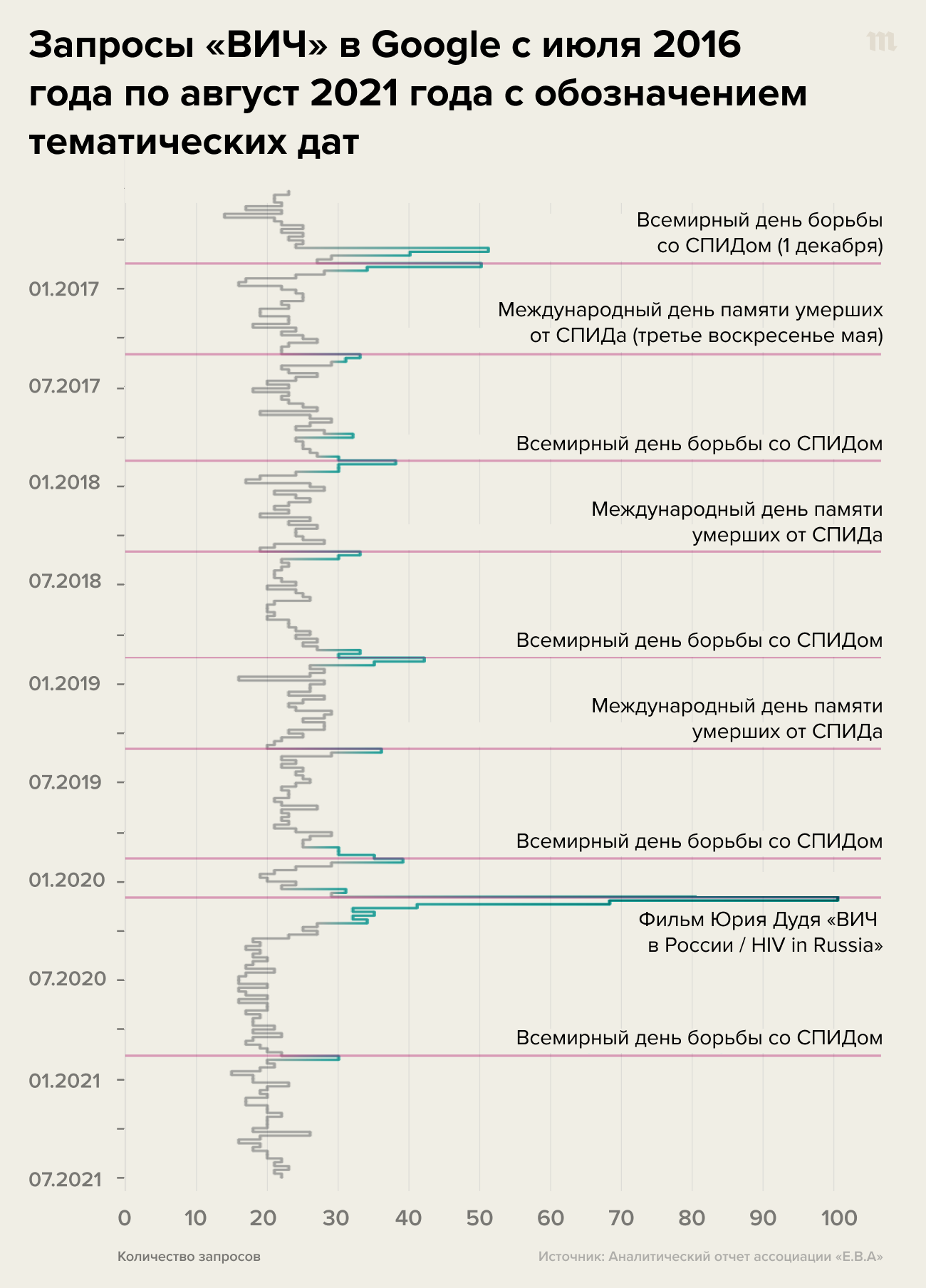
Interest in the topic arises closer to thematic dates and thanks to Yuri Dudu
December 1 - World AIDS Day, the third Sunday of May is the International Day of Memory of AIDS. Before and after these dates, the number of HIV publications in the media is growing. However, in the past two years, the International Day of Remembrance of the Deud does not cause such a surge. At the same time, in recent years, one can see a wave of interest due to news of the "London patient."
On February 11, 2020, Yuri Dudia’s film “HIV in Russia / HIV in Russia” was released, which also led to more publications about HIV and a strong growth in the corresponding requests in Google.
Some topics very rarely arise in the official agenda, despite international recommendations
Some HIV prevention strategies, although recommended by the international professional community, are implemented in Russia at best with the help of non -profit organizations (condom distribution, sexual education, support groups).
This topic occupies only a small part in the federal media and official resources in comparison with the prevention and treatment approved by the state . But in thematic groups in social networks about the importance of using condoms, they speak much more active.
“A number of key groups in the context of HIV/AIDS (homeless, homeless) are ignored in the media agenda, and the authorities in official rhetoric, in principle, do not pay attention to key groups,” the report said. -<...> In all sources, there is an imbalance of topics regarding individual key groups: due to focusing on young people, other groups that need to be not covered in protection and support remain not covered by attention. This is especially noticeable on official sites where the design of the agenda avoids the inclusion of not only homeless and homelessly, but also almost all other specific names of key groups. ”
Rethered by Daria Sargsyan