
Translated material
Genocide anatomy
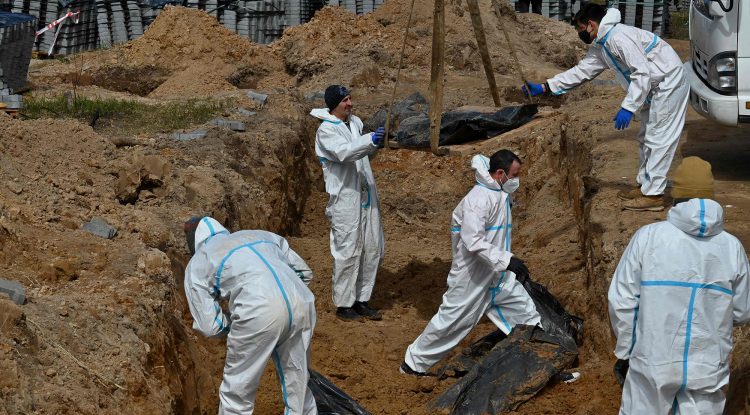
Writer Sergei Medvedev - about what is behind the tragedy of Buchi and Mariupol

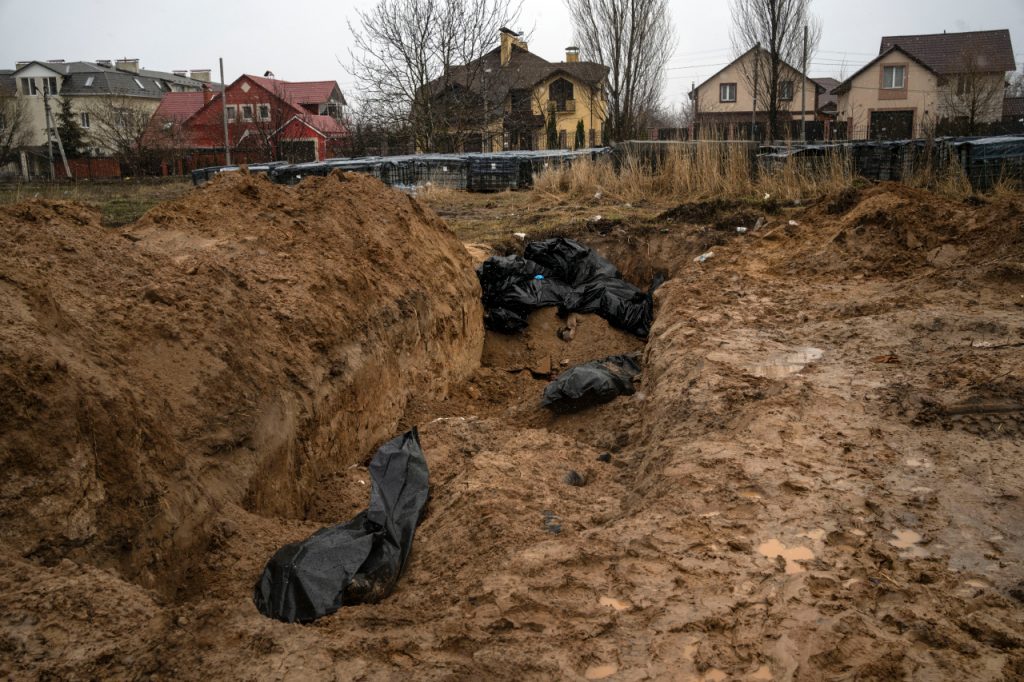
Bucha, Irpen, GOSTOL ... From late the evening of April 2, when the first photos from the streets of these quiet towns left by the Russian army appeared in the media and social networks, their names became synonymous with the war crimes of Putin's Russia. The terrible shots flew around the whole world - dozens of executed residents on the streets, near their houses, in yards and on the sidewalks, some with their hands, finished in the head, others with traces of torture. People lying next to bicycles shot on the go. The ditches littered with killed people, lying nearby family members, as if in a woman’s tier, hands and heads sticking out of the ground. The corpses covered with car tires - the invaders, leaving, tried to burn them. Numerous evidence of mass rape of women. The total number of victims has yet to be counted. In Buch alone they talk about 300 dead. Blood crumbles in the veins and the tongue is numb when listing these apocalyptic scenes. Only the biblical "go and look."
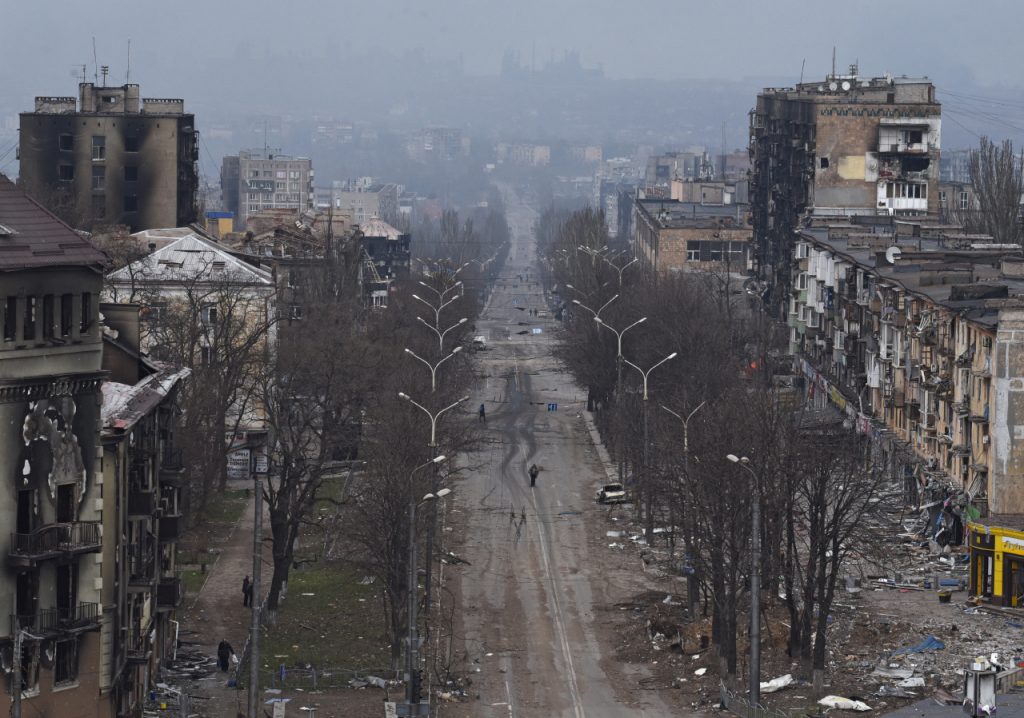
A separate line must be remembered by Mariupol. What is happening in this city, which occupies a key position on the jumper between the Donbass and the Crimea, has long been over the line of war crimes and is increasingly called genocide. This is not a metaphor and not a rhetorical technique - this is an objective recognition of the fact that Russia set its goal to destroy the half -million city.
The object of genocide can be not only a national group, but any community, including the population of the city. The five -day blockade of Mariupol and the lack of humanitarian convoys cut off the population from water, food, electricity, heating, medicines and mobile communications. “Green corridors” are sheated, evacuation is difficult - people spend days in lines to leave without heat and nutrition, and as a result, many are not able to leave Mariupol. Tens of thousands of inhabitants are forcibly exported to Russia, where they fall into filtration camps - this is more and more like a deportation. At the same time, evidence of looting, robberies, rape, unmotivated executions of civilians by Russian soldiers in the occupied territory.
But the main sign of the genocide is the bombardment of residential quarters and goals that are not related to power or military facilities, from which the destruction of the maternity hospital is allocated (the frames of the mortally wounded woman in childbirth, which is watching whether the child has survived the whole world) and the Mariupol Drama Theater, in the basement of more than a thousand women and children - with the direct hit of the 300 bombs 300 The Mariupol City Council reported that “information appeared from eyewitnesses” about the death of about 300 people as a result of a blow to the drama theater. However, the exact numbers following the results of the work of rescuers who disassemble the blockages have not yet been published. - approx. “Cold” ).
At the moment, Mariupol is 90%destroyed, there is not a single whole building left in it - it resembles Coventry, Stalingrad or Dresden after bombing. The city authorities estimate the number of dead inhabitants of five thousand people, of which 210 are children.
The International Tribunal will deal with these crimes. A separate question whether it will be possible to detain and deliver the accused there, but the court will undoubtedly be. However, an even more important court should take place within the Russian society itself: the tragedy of Buchi and Mariupol, like the whole war against Ukraine, should become the subject of surgical, without anesthesia, reflection. It is necessary to understand how the possibility of genocide is born inside Russian culture and Russian society - because it is impossible to turn away from this absolute event, from this anthropological catastrophe, to recognize its external, alien: all this is done by the Russian army, Russian citizens, with the complete indifference of the overwhelming part of Russian society, which calms down by the illusion of ignorance, is deceived by suspicion of fake or simply revels in ecstasy collective approval.
How does society turn into a fascist mass, is this a collapse, a reversing not only of Russian civilization, but of the Russian culture itself, if we admit that national culture is not just an abstract set of texts and images memorized from school, but a living process (re -) of their own values and symbols? Can a culture at all prevent with its “humanistic pathos” and the “tear of the child”, is “poetry after Buchi and Mariupol” possible?
From Grozny to Mariupol
The Russian war crimes are not unique: in the end, the Muslim Muslims in Srebrenitsa, and the use of chemical weapons against the Kurds in Iraq, and the million Tutsi genocide in Rwanda, and the continuing extermination of Uyghurs in Chinese Sinjan were also on the memory of my generation. Moreover, referring to our own recent history, I understand that about the same, the same methods were done in Chechnya in 1994-1996 (and this was also not a “war”, but “Operation to restore the constitutional order”) and in Syria since 2015: bombing of civilian objects (hospital in Aleppo), cleaning of villages and residential quarters (recall the Chechen. New Aldes or Samashki, where from 100 to 300 inhabitants were shot).
Those crimes went on tangent to our public consciousness, did not become the subject of a wide discussion, legal assessment, memory-just like a million Afghans who died during the Soviet invasion in 1979-1989 are forgotten ( some researchers of this war evaluate this number twice as much.-Note of the “cold” ). And that is why the straight line of the post -Soviet thirty years lay from Grozny through Aleppo to Mariupol.
But still there is a difference. The fact that Afghanistan, Chechnya and Syria were not reflected in Russia as war crimes, is more likely to speak about the colonialism and racism of Russians: Chechens and even more distant Afghans and Arabs were “others”, and the vague sense of injustice quickly dulled, erased. Ukraine in this regard is incomparably closer, both territorially, and culturally, and in blood. The distribution of mobile Internet and social networks is a hundred-stringing events, and Ukrainian mass media also document the crimes of the invaders. However, for most of the Russian population, all this is not an argument, they prefer not to notice a humanitarian and moral disaster at their side, preferring to believe the fakes of Russian propaganda: I believe that the problem is not in zombie spectators by television, but in conscious blindness and deafness, in filtering and displacing of uncomfortable information.
As a result, genocide remains unidentified for the majority of the Russian population, the fascist is different (Ukrainian, American, German from the film about the war), and not you yourself, and the mass consciousness, if it does not always support, normalizes this war, makes it part of everyday life, routine. And here the main problem is concluded: war crimes are not excess, but a civilizational norm. So Russia is fighting, otherwise it does not know how - dirty, blood, inaudible, with a large number of corpses.
Violence in Russia has practically no legal and cultural restrictions, it is the final argument in the rapidly archaizing country. Physical or symbolic, violence is normalized everywhere: in the family and at school, in the army and in prison, in the relations of parents and children, men and women, bosses and subordinates, police and citizens. Society habitually frowning, learning about new cases of mass tortures in correctional colonies, a pre -trial detention center, but what, even in the ATS on a neighboring street, is also familiar with this. And the next scandal with the publication of video recordings of torture (the same archive of Vladimir Osechkin), having demolished a couple of goals of secondary performers, quickly calms down - and the torture system continues to bloom under the canopy of the Ministry of Internal Affairs and the Federal Penitentiary Service, bringing the notorious “sticks” of reporting and the next title.
The tragedy of Buchi and Mariupol is just an extrapolation of the habits and practices of the Russian violence on the population of a single Ukrainian city, multiplied by the deadly power of modern weapons.
Life is a penny
In the origin of war crimes, another generic feature of Russian civilization is important: total contempt for human life. Nowhere did this manifest itself as clearly as in the pandemic of coronavirus in 2020-2021.
Covid showed two things in Russia. On the one hand, the inability and unwillingness of the authorities to fight Pandemia. The repressive and supervisory apparatus, rebuilt in recent years to combat dissent and mass protests, has not been involved in the sanitary and epidemic front: with the exception of hard quarantine in Moscow in March 2020 (which, apparently, was the personal initiative of the mayor Sergei Sobyanin) and the episodic revealing raids of the police) and a strict policy was not implemented in Russia Wearing masks and compliance with a social distance, the vaccination campaign was simply failed, despite the early availability of a cheap and effective domestic vaccine, and measures to support the population and business were ridiculously small.
On the other hand, stoic indifference to their life and health showed the population, distinguished by the highest levels of Covid dissidentia in the world, Covid consoirology and anti-vaccinating, as well as the total neglect of citizens to sanitary and anti-epidemic measures. We are talking about the peculiar fatalism of Russians (“who is destined to die - die”), about the Russian tendency to risk (“courage”), about the low value of life in the country.
The origins of this can be sought in many centuries of slavery (not only the serfs, but also the landowner, obliged to the sovereign with his life and estate, from here, according to Lotman, and the culture of the duels and the card game at the Russian nobility), in the military-colonial nature of the state, in the police and practices of everyday violence ... These sociocultural premises have led to his body. The fact that a unique public agreement has developed in Russia: the “nonsense” of the authorities, who quickly realized that people are ready to come to terms with the poor availability of medical services and with high mortality, if only they would not touch their usual lifestyle, crossed with the “indulgence” of the average Russian, and the result was a record among developed countries Excessive mortality.
Such a disregard was transferred to Russia both to this war - and in relation to the lives of the civilian population, and in relation to its own army, which, as in Chechnya many years ago, is thoughtlessly thrown into a bloody meat grinder, is shot in columns on the march, driven on tanks and armored vehicles in the thick of the urban development, where it is bombarded and burned in its iron boxes. What is only Chernobaevka, the village near Kherson with a population of 16 thousand people, where the airfield strategically important for the Russian group is located: the Russian army took and left it already 14 times ( the Ukrainian authorities are talking about this, but the Russian Ministry of Defense after its message on February 27 did not comment on the information about the airfields with Ukrainian military. Having lost, according to the Ukrainian side, up to 50 helicopters, 100 tanks and many soldiers and officers, including two lieutenant generals.
Chernobaevka has already become a meme in Ukraine, the synonym for Russian military failures, the mediocrity of command and indifference to losses. How many such stories we know from the Great Patriotic War-from the “Nevsky Piglet” near Leningrad, where they put up to a quarter of a million Soviet soldiers (in the 1960s, the newspaper Pravda wrote about 200 thousand dead on the Nevsky Pyatka, but in the 2000s Russian historians and the Committee of the Leningrad Veterans gave other grades-from 50 to 68 thousand dead. In 2019 in the book of the Museum-Resistant. The “Blocks of Leningrad” was estimated at 110-120 thousand people.
And in this sense, genocide in Ukrainian cities is natural, this is a logical and terrible result of the last thirty years. He shows the whole depth of the decomposition of power, army and society in Russia: moral decay and professional degradation, corruption and theft, the cult of strength and low value of life, conformism and indifference in society - all this manifested itself not only in the very fact of a criminal war, but also in the barbarian methods that it is conducted.
God do not bring to see the “Russian world”, meaningless and merciless. The memorial bell now sounds: Bucha, Irpen, Gostoel, Mariupol.
The author’s opinion may not coincide with the opinion of the editorial office .
Sergey Medvedev - professor of free university (Moscow), host of the programs of Radio "Freedom", writer, author of the books "Park of the Crimean period" and "Runner Man" .
Photo on the cover: Zohra Bensemra, Reuters/Scanpix