
Translated material
"The main weapon of propaganda is emotions"
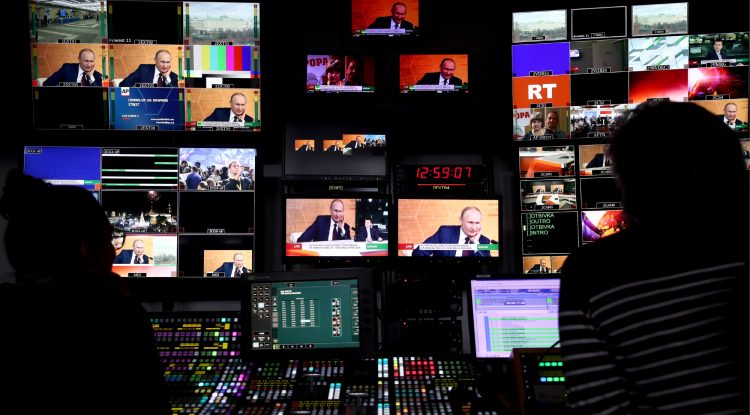
Biologist Irina Yakutenko explains how our brain absorbs propaganda and how to resist it
The molecular biologist and scientific journalist Irina Yakutenko for the past few years said what was happening around the Pandemia of Coronavirus: in 2021, she published the book “The virus that broke the planet”. With the outbreak of war in Ukraine, Yakutenko began to disassemble the work of propaganda from a scientific point of view on her YouTube channel . "Cold" talked with her about how the Russian state media manages to make people believe in a lie - and how to deal with it.
Many perceive state propaganda as something sinister, hypnotizing. Is it possible to make it out and understand what techniques it works at the expense of?
Let's start with the main ones. Usually I talk about this using the example of lemon and tangerine countries . Suppose Mandarinia wants to attack lemon. How can such a solution be justified to the inhabitants of Mandarinia? The first technique is detachment, hanging on the inhabitants of another country, in this case lemonia, labels.
All healthy people are inelerant of murders, also healthy people sympathize with those who get into trouble. Therefore, it is necessary to create an image representing the inhabitants of another country as an absolute evil. It is important to imagine them not just bad, but exactly total evil. For example, we can say that not people, but fascists live in tangerines. This technique was used in Nazi Germany: the Jews were represented as fuccons of hell, and therefore it seemed not to be shameful to kill them. We will send them all and destroy them so that our beautiful Germany flourishes.
Another technique that helps to divide is to make a scapegoat out of a person or group of goats. That is, a really existing problem is selected or the non -existent problem is invented, and the group is accused of this problem against which propaganda will be directed.
The main weapon of propaganda is emotions, not the mind. As soon as we turn on the head, we spend efforts to think that they are conveyed to us, we can find lies and distortion. In order for people to analyze less, propaganda presses on emotions. Emotions are much stronger in terms of exposure than the incentives that we receive from the areas of the brain responsible for the analysis and construction of logical chains. Therefore, propaganda seeks to lead you away from logic.
What kind of propaganda techniques do you use to divide?
-For dividing some group, you can attribute to her the most terrible crimes. Moreover, the worse they will be, the better. It seems to be illogical. However, the purpose of propaganda is to create a very strong feeling that opponents are bad. The more monstrous the crimes of which we blame our unfortunate Lemonians, the better: then the inhabitants of Mandarinia will have the feeling that the Limonians can not only attack and destroy them, but you need to do it.
Propaganda, especially if it is a state machine, can even invent all evidence. Who hears a handful of people who will prove that this is all inventions, that the “new” shots shown - five years ago? Another handful of people? Especially if this handful does not have access to mass broadcasting, unlike state propaganda.
When propaganda speaks of those against whom it is directed, it always uses emotional cliches and derogatory expressions. You can’t say anything good, you always need to use an insulting language. This is also important, because as soon as you start talking more or less objectively, it immediately knocks down the effect, switches the emotional component to the logical one. And this is what propaganda is trying to avoid. In fact, you can continue endlessly, a million of these tricks.
According to your observations, have the techniques of Russian propaganda have changed since the beginning of the war? In addition to the fact that the broadcasting grid has changed and the number of news releases increased?
- Changing the broadcasting grid is a very important technique. When the same thing is pouring on you from all sides, several features of the work of our brain are being triggered at once, which make people believe in what they say. For example, one of these features - we can call them bugs - we consider familiar to the truthful or at least convincing.

Why did such bugs appear in our brain?
Over the millennia of evolution, our ancestors lived in a lack of information. In such a situation, making decisions based on the analysis was pointless - too little data. Plus, for a long time, the living creatures of the zone, responsible for analysis and logic, were poorly developed. But even creatures in whom these zones have already appeared rarely use them “directly”. To think seriously - it is difficult, for a long, physically uncomfortable and also requires a lot of energy. Therefore, employees of intellectual labor are not less than workers who are engaged in physical labor, albeit otherwise.
So, we do not like to think-but the decisions must be made constantly. Therefore, our brain invented a lot of empirical rules, which allow not to include the cost “thought of the Duman”, but to act as we already acted before, by analogy. “We have already encountered this phenomenon several times. It did not lead us to nothing bad. So, it enters our picture of the world as safe. ” It turns out such a workaround in order not to think and act automatically in familiar situations, without spending a lot of energy. Often this works - most situations do not require complicated thoughts in ordinary times, but sometimes such brain laziness leads to the fact that a person radically incorrectly assesses the situation.
For example, on the Bag “familiar means true”, advertising is based. We heard the name of some washing powder in commercials many times, we come to the store, we see one hundred names of washing powders and unconsciously select the one whose name we know. You don’t remember where you heard this, you don’t remember what context you heard this, especially if this context did not have an emotional load. But you remember what you heard, it means, probably, this is something that you can trust.
And does it work with propaganda?
Yes. There are a large number of research on this score. Suppose you hear a certain statement, and for the first time it seems to you shocking, unacceptable, implausible and so on. But when you hear this statement again, it is for a time-in the case of some statements, as the studies show, even in the second-you will have tolerance to it. The statement ceases to seem shocking and begins to seem acceptable simply because you have already heard it and, as it were, are used to it.
The same bug of our brain can also change the worldview because Russians who do not have VPN cannot find out another point of view. In such a situation, another “simplifying” feature of the brain of the brain is triggered: when we get the same information from different sources, this strengthens us the belief that the information is reliable. That is why the removal from the ether of all sources with a different point of view is an axial, but extremely powerful technique. Because he not only cuts away people from “wrong” information, but also increases the amount of “correct” automatically, since the formed vacuum at least partially fill news and political programs. Even the people who say “I am outside the politics, I am not interested in all this”, just between the films in five news releases will still hear the interpretation of events translated by propaganda.
But can the emotionality of propaganda achieve such an intensity that even the most devoted viewer will push away? Or is there no bottom here?
There is no research on this topic, because such an emotional encouragement of propaganda occurs when some serious conflicts occur. But during the conflict, we cannot conduct strict experiments. We have to be content with the data that the post -facts appear. Well, in principle, the subject of study is such that we can almost always study only what has already happened, create and implement some experimental propaganda incentives and investigate their influence on large masses of people for many years technically unrealistic.
A classic example is Rwanda and “Free Radio and Television of a Thousand Hills”. In Rwanda there was a long conflict of the peoples of Tutsi and Huta. The hut was approximately 85% of the population, Tutsi were a minority. At some point, the country was earned by "free radio and television of thousands of hills." It was a propaganda radio that transmitted some kind of music, the show and, between the case, was engaged in the division of Tutsi-for example, they were compared with cockroaches and offered a hut to “chop tall trees”-the tutsi are high in growth. That is, there was no talk of any moderation or preservation of a good mine. And when the conflict reached the apogei in 1994, a massacre began, which lasted several months, in which, according to various sources, it was destroyed from five hundred thousand to a million tutsi. The post -fact of data appeared that showed that where the “free radio and television of thousands of hills” caught better, the percentage of people who participated in the massacre was higher.
Those who are fighting propaganda really want data that someone had stopped listening to propaganda or listening to some other propaganda, propaganda of good, changed his mind and switched to the bright side. But there are no such data, because it is very difficult to get. There are some isolated cases when we see that people on the other side of the barricades suddenly decide on some desperate actions . But we do not know what exactly encouraged them to do this, and we can not dispose of some convincing factors that could be extended to everyone.
That is, there is no way to convince those who have been influenced by state media for a long time?
Unfortunately, most likely, in most cases this will not happen. People have been living in reality for many years created by propaganda, and it is unlikely that even her strengthening will force them to believe in her crazy. Our brain is very fond of patterns, because patterns mean security - another of the simplifying tricks of our brain. The whole history of mankind people received a huge amount of information from the environment. We caught some random signals and made a picture of the world out of them, explaining how it works. It could be a completely false picture. For example, if thunder rattles, this is an angry God, and he must be appeased, so we will cut a sheep. Rave? Of course, but people were much calmer, the illusion of control was created - they still could not understand the real causes of thunder at that stage of development. This feature of the work of our brain helped us survive for centuries. In order for a person to feel in relative safety and engage in something creative, and not only to be afraid, he had to have an idea of what and why is happening around-it does not matter how much these ideas corresponded to reality. And after this picture was formed, it is very difficult to change.
An example from history: many residents of Germany, who showed concentration camps immediately after the war, refused to believe that people were killed there. It would seem: you saw Dahaau or Buchenwald, mountains of corpses, torn teeth, gas chambers, you must understand that everything that the Reich government told you is not true. But this does not work on everyone.
Since the beginning of the war, news regularly has appeared that employees of the GOSTELEKANALS are quitting. This cannot be an example of “overfeeding” by propaganda? Even if the employees who themselves cook in it and distribute it themselves are not able to endure it anymore.
To transfer TV workers who opposed propaganda, there will be enough fingers of one hand. At the same time, tens of thousands of people work on television. And this is a manifestation of another bug of our brain: he does not know how to distinguish isolated cases from statistics. This bug actively uses propaganda: we are shown one vivid example and immediately make a false conclusion "means that they are all the same." No, doesn’t mean. It is always necessary to stop yourself so as not to give out to the real one, because our brain loves to extrapolate single examples for the overall picture.
I think that people who are at the top of the propaganda vertical are well aware: what they say is not true. Although they cannot but have a distortion of the picture of the world, albeit a little different, because they are not recipients, but manufacturers.
This is all well described in literature, because, for example, Soviet propaganda was also very strong. Say, in the work of the Strugatsky "inhabited island." If you remember, there were towers that translate the signal that ordinary inhabitants did not feel, and at the “geeks”, as propaganda called them, a terrible headache began. And then it turned out that the opposition was “geeks” - and the entire ruling class, which, when the towers turned on, was hiding in their rooms, because they had exactly the same headache. The Strugatsky analogy, of course, was built based on Soviet propaganda, bearing in mind that people who create propaganda perfectly understand what they are doing.
There are a bunch of facts that prove that propaganda is lying. And they are all in the public domain. Why are those who support the war often do not even try to analyze them?
There is another feature of our brain: we do not like to change the status quo. We evaluate responsibility for the action as more difficult than responsibility for inaction. This is a consequence of the same evolutionary mechanisms. If you live, everything is fine with you, you are not threatened with death right now, then it is worth maintaining this lifestyle as long as possible, because you see that he brought you well -being for many years. Therefore, there must be “good” propaganda that will take into account this feature.
Many people who speak with their relatives who have believed the state propagand are trying to contrast her with facts. But it doesn't work so simply. As I said, propaganda is about emotions, and facts and their reconciliation are about logic. And these are completely different parts of the brain. When you talk with relatives in high colors, the logic immediately turns off. You can only fight emotions with other emotions. An attempt to present facts that contradict theories of interlocutors will only lead to an increase in irritation. It is as if you are trying to destroy a house in which a person lives for many years and feels relatively comfortable. That is, you behave like an enemy. And trying to convince people in this way, you only consolidate the conviction of the opponents that they are right, plus you begin to be associated with negativity.
Attempts to convince someone with the help of logic are often unsuccessful because people calmly live with conflicting beliefs. This was especially noticeable during the pandemic of coronavirus. Anti-Vaccinators do not want to be vaccinated with vaccines that have passed all kinds of checks, hundreds of millions of people received them, and these same antivacials often buy up phophomicins that have not passed any normal checks at all. Most people live with a bunch of such logical inconsistencies, this is the norm. Many are trying to argue on the Internet, with relatives, acquaintances. Maybe you don’t have to do this, because such disputes require large energy consumption, and the probability of success is almost zero. To change the picture of the human world, push it out of it, you need some strong emotional impact, personal impressions. They cannot be obtained if we are sitting on our warm sofa and listening to the news, and we are not where you can see everything with our own eyes.
Therefore, the first question is for those who want to convince their relatives: do you need to do this at all?
And if the answer is "yes"?
If you still want to try, then you need to go from the other side. Why can Arnold Schwarzenegger have an impact? Because these words say Schwarzenegger. One of the problems when you begin to convince your relatives is that you are not authority for them. This can be very disappointing to recognize, especially if it concerns a close relative, but the fact remains.
For the older generation, authorities are some celebriti, which they often see on TV. Our tendency to believe authorities is another evolutionary training mechanism. We cannot empirically verify and independently repeat all the experiments that humanity has conducted over the centuries of the existence of science. People always studied, trusting the authorities: the elders told how everything was arranged, and the descendants simply believed this and acted appropriately. Therefore, there is such a bypass: if you want to convince a person, you will enlist the support of the one to whom he trusts.
And if none of the people who are authoritative for relatives opposed the war?
Then you can also act through emotions without trying to shake the usual beliefs of a person. Нужно показать, что, какая бы правильная картина мира у собеседника ни была, нужно идти на компромиссы и разрешить конфликт, потому что с обеих сторон уже слишком много жертв. Некоторые люди оправдывают убийства мирных жителей, и это чудовищно, особенно если это ваш близкий человек. В этом случае вы понимаете, что вряд ли сможете общаться долго, потому что такое оправдание — бесчеловечно. Вот с этим можно попытаться бороться, тоже за счет эмоций.
Но сначала нужно перестать ругаться и конфликтовать. Психологические исследования подтверждают: как только возникает конфликт, человек перестает воспринимать аргументы. Доводы неприятного человека сразу воспринимаются как негативные, и вы их даже не пытаетесь оценивать логически, вы сразу их отрицаете. Нужно найти эмоциональную точку, на которой вы можете сойтись. Поговорите о детях, которые сейчас погибают. Или о проблемах, которые появились из-за введения санкций: например, сложно найти какие-то лекарства. Вам, конечно, будут говорить, что в этом виноваты плохие американцы. С этим можно согласиться и кивать головой: американцы, конечно, плохие, но лекарства-то не будет, пока идет военный конфликт, поэтому надо, чтобы он закончился.
После того как вы перестали ругаться и нашли общую точку, можно пытаться аккуратно рассказать факты, которые были бы достаточно эмоционально сильны, чтобы напрашивался вывод, что все это нужно прекратить. Я не уверена, что эта тактика может оказаться успешной. Но есть исследования, которые показывают, какие тактики неуспешны. И исходя из этого можно предположить, что может работать.

Вы в своих роликах тоже приводили видео Шварценеггера как пример «хорошей» пропаганды. Какие еще механизмы там задействованы?
Оно построено по канонам сторителлинга. И Шварценеггер начинает его именно с общей эмоциональной точки. Говорит о том, как он был мальчиком, как он любил советского тяжелоатлета Юрия Власова и как однажды с ним встретился. И даже конфликтовал с отцом из-за фотографии Власова, которую повесил у себя в комнате. Он признается в том, что любит русский народ, что это прекрасная нация, что он перед ней преклоняется.
Он актер, и хорошо видно, какую эмоцию в какой момент он выражает. А у нас есть зеркальные нейроны, которые помогают нам ощутить эмоциональное состояние другой стороны: они считывают, какую эмоцию испытывает другой человек, и как бы воспроизводят ее в нашей голове. Поэтому мы и способны на эмпатию. Арнольд Шварценеггер прекрасно воздействует на все зеркальные нейроны слушателей именно потому, что он очень хорошо передает эмоции. Он говорит «убийства детей», «оторванные конечности» отдельными фразами, чтобы вы это услышали и прочувствовали.
Государственная пропаганда бьет по эмоциям, но независимые СМИ обычно пытаются соблюдать процедуры и воздержаться от прямого воздействия на эмоции. Значит ли это, что они проиграют противостояние с госканалами?
Противостояние исходно проигрышное из-за разницы в аудитории. И это тоже надо понимать. Первое, что происходит в странах, когда диктатура выходит на серьезный уровень, — это уничтожение всех независимых СМИ. Сейчас люди могут уехать, и физически уничтожить СМИ сложно, но усложнить им жизнь можно, и мы видим, как это происходит.
Я нахожусь за границей, и у меня ничего не заблокировано, я могу читать любые источники информации. Какой процент людей в России заморачивается с VPN, знает, какие каналы надо смотреть, какие аналоги создали журналисты независимых СМИ? Это минимальный процент, и эти люди, скорее всего, и так уже против войны.
Еще одна особенность человеческого мозга — информация, которую мы получаем, подкрепляет нашу точку зрения. Все соцсети это подпитывают, подкидывая нам посты, похожие на те, которые мы лайкали и с которыми мы взаимодействовали. Это только укрепляет информационные пузыри. То есть люди из разных инфопузырей со временем все дальше отдаляются друг от друга, общество поляризуется.
К вопросу о том, что пропаганда давит на эмоции, а борцы с ней пытаются быть объективными: да, это снижает убедительность другой стороны, особенно на нелояльную аудиторию. Но вот Шварценеггер подает объективные факты в такой форме, которая воздействует на эмоции. Не так просто научиться это делать, и не каждый жанр это позволяет. Это сложнее, чем просто рассказать о фактах: надо думать о форме, о том, как рассказать, каким видеорядом сопроводить, как выстроить эту информацию по законам сторителлинга.
Конечно, гораздо проще придумать с нуля какую-то эмоциональную историю или запредельно раздуть существующую и снять про это красочный сюжет. Рассказывать эмоционально и не искажать при этом факты — сложнее. К сожалению, у независимых СМИ сильный противник.
Фото на обложке: Сергей Бобылев, ТАСС/Scanpix