
Translated material
Most are imaginary
Sociologist Philip Chapkovsky found out how many Russians can actually support the war
On April 8, rapper Oximiron stated that the results of hundreds of questions about the support of war with Ukraine cannot be believed, and in fact, “tens of millions of Russians” oppose the war. A few days before, sociologists Philip Chapkovsky and Max Shaub conducted a scientific experiment , which showed that the real figures for support for war in Russia can be one and a half times less than those that voiced sociological services. At the request of the Cold, Chapkovsky talks about how this experiment was arranged and what its results may mean.
At the end of March, Levada Center, the only independent sociological service in Russia, which is customary to trust, announced the survey data, which showed that 81% of Russians to one degree or another support the war with Ukraine. If these data are correct, supporters of the position that all Russians are to blame for war crimes, receive a powerful argument in their favor. Those who do not support the concept of collective guilt are easiest to question the declared sociological fact to question.
The fact that the results of the Levada Center survey should not be trusted, a variety of people said-from rapper Oximiron to sociologist Alexei Titkov and economist Konstantin Sonin . These are very different people, but their arguments are the same: to take the results of such a survey in a country for a pure coin where the word “war” can be obtained for 15 years in prison, somewhat naive.
The effect of the observer
Like any other information, it is not worthwhile to accept the results of any sociological studies - about why this is especially true in the case of surveys, the sociologist Grigory Yudin wrote a lot. One of the problems with the interpretation of the results of any survey is the so -called observer effect.
In the late 1920s, at the Illinois, the Illinois electric factory conducted an experiment to study how various levels of electric lighting affect labor productivity. The amazement of the researcher Elton Meyo, the brightness of light on labor productivity influenced much less than the fact of the experiment: during this period, the factory staff began to work better. Meyo explained this by the fact that increased attention motivated more intensive activity. This story, in many respects, mythological and not very confirmed by real data, benefited science, forcing me to think that the very presence of researchers could have an influence on the studied.
In the film of the Cohen brothers “The Man who was not”, the protagonist’s lawyer capacally describes this effect as follows: “You look at things, and your gaze changes them. And you don’t know what really happened or what would happen if you had not put your nose there. ”
Over time, the researchers decided to put the effect of the observer in the service of science. They began to manipulate subjects and measure how this will affect the result. For example, in 1990, before the presidential election in Nicaragua, sociologists conducted two identical surveys about the degree of support of the ruling candidate Daniel Ortega. The only difference was that in one case the interviewers conducting the survey recorded the answers of the respondents with a ballpoint pen in the flowers of the Ortega party, and in the second - in the colors of the opposition party. In the second survey, Ortega’s support was almost 15% lower. Also, during a survey on the degree of religiosity in Egypt, the interviewers in the burqa received higher data on the share of Muslim believers than researchers, dressed less traditionally.
In modern Russia, in wartime conditions, there is some temptation to declare that the whole thing is fear, and it is precisely because of him that the answers that a person gives a sociologist will differ from what he really thinks. Reality, as it seems, is more difficult. In addition to sociological manipulations, a majority also affects a person. Or rather - our idea of what the opinion of the majority is. In the most important and, unfortunately, not translated into Russian, the book of the economist and political scientist Timur Kuran “Private Truth, Public Lies” ( Private Truths, Public Lies ), he describes the model of falsification of preferences : according to her, people more prefer to choose the majority opinions, the larger size in their opinion this is the majority.
Giving those who hope to change the regime in Russia, some hope, Kuran writes that often this is the most imaginary. Often a small external shock is enough for the belief that you are in the minority with your private preferences, evaporated. As Kuran concludes, which is why revolutions often find us by surprise.
It is difficult to correct conformity and other external influences, to a certain extent sewn into our consciousness. Oddly enough, try to establish “true” preferences, cleared of banal fear of the consequences for an honest answer, a little easier. There are quite a lot of such methods, but the most popular of them is the so -called “list experiment”. With the help of him, they studied homophobic and racist sentiments in America, the consumption of marijuana among students, the prevalence of bribes in Costa Rica . The goal in all these cases was to find out the true opinion on the sensitive issue, slightly reducing the feeling of discomfort for the respondent.
Our experiment
Therefore, when everyone began to argue about the results of the Levada Center survey, I suggested Max Shauba, my colleague from the University of Hamburg, to conduct a “list experiment” regarding the Russians support in Ukraine. The temptation was too great to try this fairly standard procedure on such a burning issue.
This is what we did. Using the Toloka crowdsourcing platform, on which tens of thousands of users of all ages throughout Russia were registered, we asked 3,000 Russians to fill out a short questionnaire (1632 people took part in the Levada Center survey; this is the usual order of numbers for sociology, which allows you to draw up a representative sample). In addition to standard questions about age, field and education, all participants were proposed to support or not support several statements.
The essence of the experiment was that for two arbitrarily selected halves of the participants in the statement of statements, they differed. The first part saw a list of three points:
- Increasing monthly benefits for poor Russian families
- Legalization of same -sex marriages in Russia
- State measures to prevent abortion
These participants were supposed to answer with what quantity of these points they agree (from 0 to 3), without calling specific allegations - this is the principle of an payroll experiment. After that, they were asked if they supported the “actions of the Russian armed forces in Ukraine” (we chose the same wording that the Levada Center used in our survey).
The other half of the respondents saw the same list of statements, but the fourth item was added to them: "The actions of the Russian armed forces in Ukraine." These participants were also invited to indicate how much they agree with these points (this time from 0 to 4). They did not ask a separate question about the war.
Why did we choose these three points in addition to the only interest in us about the war? The secret is that a person feels protected enough, choosing any number.
Imagine a list in which, according to the responsible one, everyone agrees with all points except supporting the war. In this case, choosing 3 out of 4 in response, the respondent publicly reveals his true preferences about the war. About the same thing happens if, according to the participant, everyone or almost everyone does not agree with any of the three points. Therefore, the easiest way to avoid these situations is to include one item with which is supposedly according to the majority (increase in benefits), the point with which, according to the absolute minority (legalization of same -sex marriages), and one more, where the opinion would be divided approximately in half (prevention of abortions). The fact that this is the case, we knew from previous studies.
Thus, the only difference between the two groups of the respondents was that one of them was supposed to mentally agree or disagree with the statement of supporting the war, therefore, the difference between the number of answers with which the respondents agreed in the first and second group gives us an approximate assessment of the supporting war. In other words, if in the first group people on average indicated 2.2 of the three points, and in the second - 2.7 of four points, then the warfare level is 0.5 points, or 50% of the participants.
At the same time, half of the participants, we asked the question of supporting the war, also directly - and, accordingly, could compare the “straight” and “list” level of support.
The results of the experiment are as follows. 68% of respondents spoke directly in support of the war. However, a completely different support assessment is reconstructed through the list experiment - 53%. And this is a very significant difference.
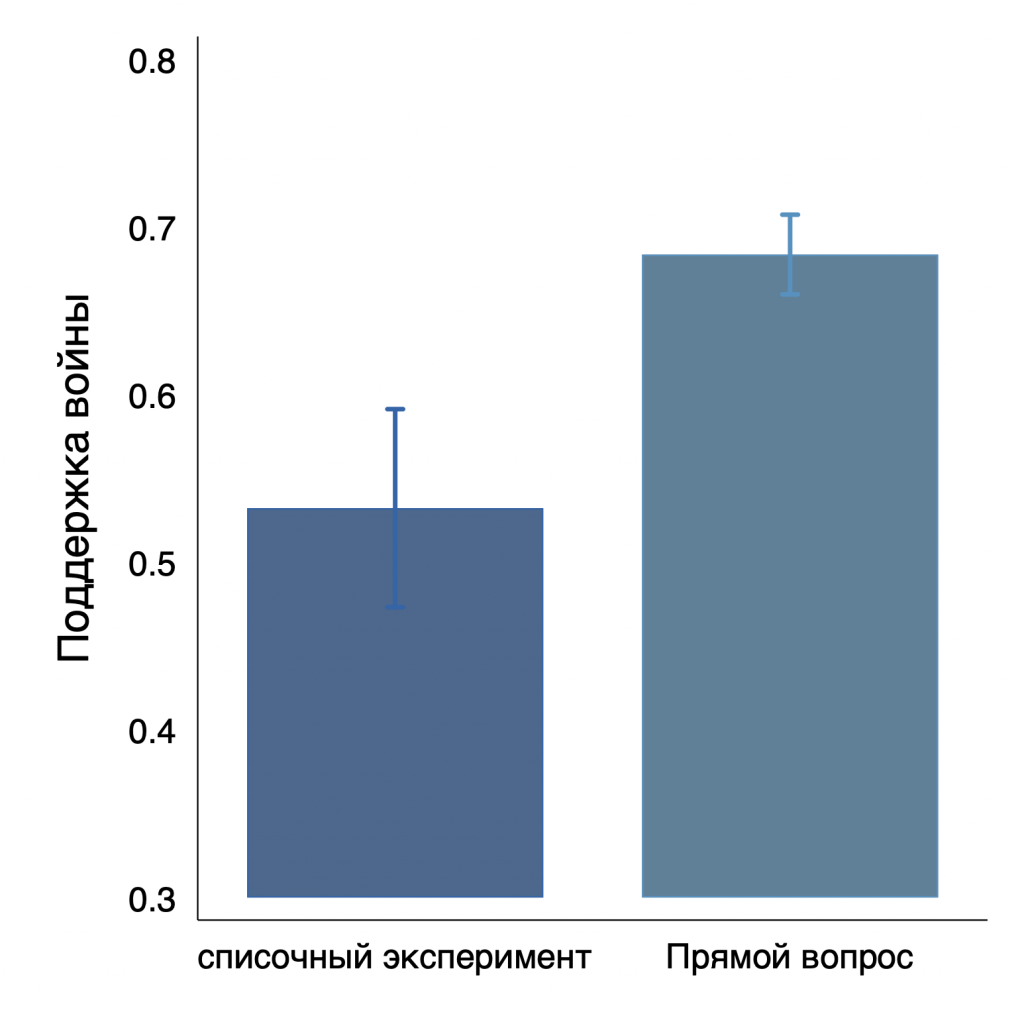
Of course, the thesis that the list experiment reduces the factor of fear is easy to criticize: if a person is truly afraid to be exposed, then he will even be careful in such a “veiled” survey. Or he prefers to answer that he agrees with all points, or simply close the page from sin away. However, as our figures show, there were few such people: a little less than 100 people left the survey without completing it, and only 50 out of 1,500 decided to agree with all four points.
Does this mean that in reality the war is supported by the non -vast majority of Russian citizens, but only a little more than half? As I said, it is always dangerous to sincerely believe the numbers - including ours. For example, the Toloki audience is very different from the population of Russia as a whole: for example, while a quarter of the country's population is made up of women over 40 years of age without higher education, in our sample there are only 7%. But even in our sample you can see the following:
- A significant (exactly more than 10%) part is afraid to say what is thinking about the war.
- Among young women, this share is noticeably higher.
- Even higher, the number of those who hide their preferences are among the inhabitants of small cities (the population is less than half a million people) - there it is more than 20%.
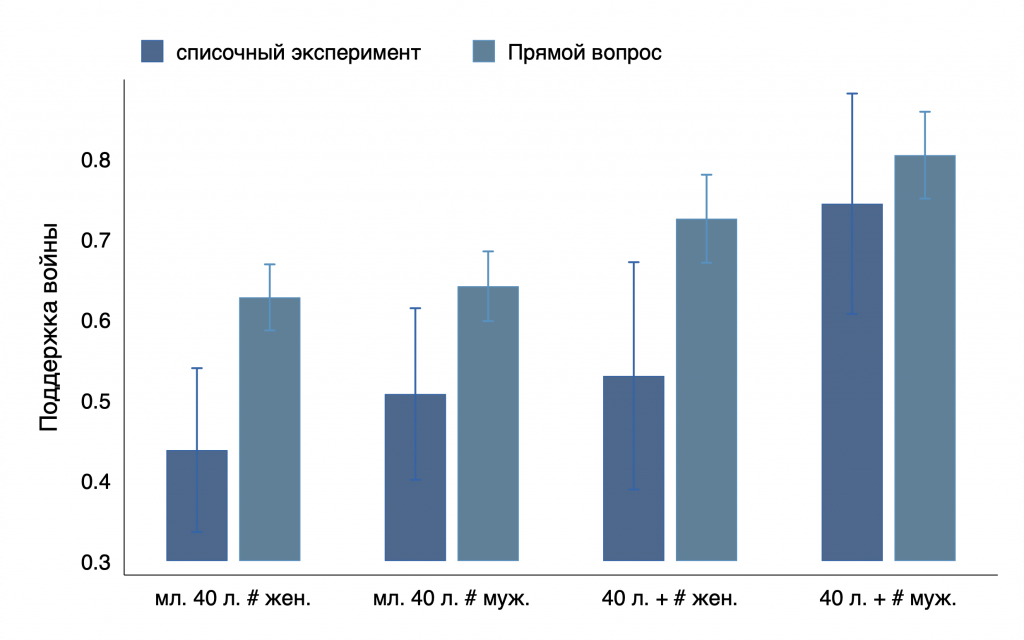
What will happen to this group further depends on the development of events: on how much repressions towards dissenters will increase, from how much the group supporting the war will be consolidated and broadcast to the pacifist minority their ideals. A month later, we plan to repeat the experiment with the same participants and see where their views moved during this time.
If you return from strict science to speculation, I would say that this description - young women from small cities - is very similar to the description of the wives of those people whom the Russian state sent to kill and die in Ukraine. So far they are scared to talk about the war. But this does not mean at all that they approve of it.
Philip Chapkovsky - PHD, author of the dissertation on sociology at the European University in Florence, until April 2022, a researcher at the International Laboratory of the Experimental and Behavioral Economy of the Higher School of Economics.
Photo on the cover: Sergey Savostyanov, TASS/Scanpix