
Translated material
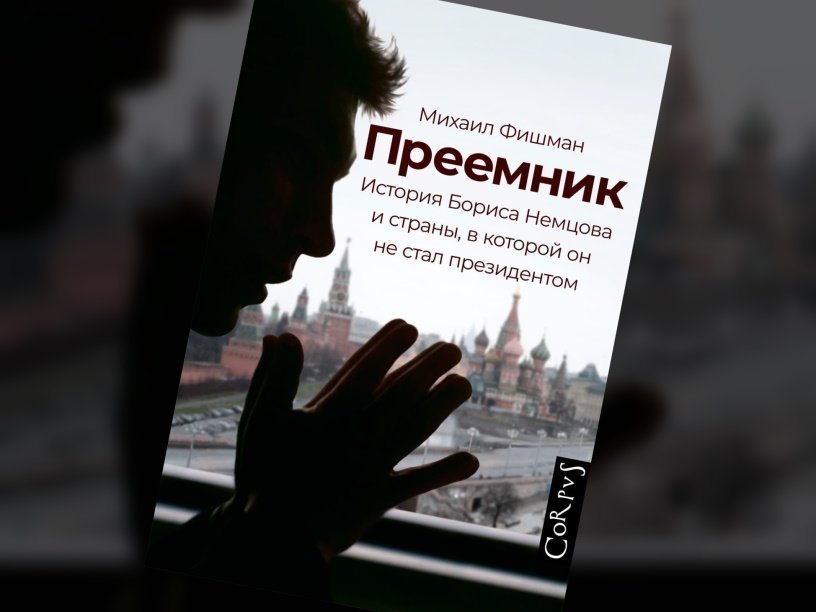
Mikhail Fishman: The successor. The story of Boris Nemtsov and the country in which he did not become the president
Mikhail Fishman 
Corpus Publishing House represents the book of Mikhail Fishman “The successor. The story of Boris Nemtsov and the country, in which he did not become the president. "
The famous journalist Mikhail Fishman talks about Nemtsov and Russia. The book is a trip on the history of the country, capturing all key events starting with Gorbachev perestroika when Nemtsov came to politics, and ending with the murder on the Moskvoretsky bridge on February 27, 2015. Based on hundreds of interviews and archival materials, this book is about how Russia became a free country and how it lost its acquired freedom step by step.
We offer to read a fragment of the book telling about the beginning of the First Chechen War.
Khasbulatov is taken out of the game
Just at the time when negotiations with Dudaev broke, the Khasbulatov star flared brightly in Chechnya. His liberation in February 1994 became a holiday for Chechnya, in the republic he was met as a hero. A serious politician, a professor of economics, in the recent past, one of the first persons of the state, moreover, repressed by Yeltsin - disappointed in Dudaev, Chechen society has hoped for Khasbulatov. Khasbulatov traveled to Chechnya, and 200-300 thousand people went to rallies in his support. Khasbulatov himself did not claim power in Chechnya, at least openly, he said that after Moscow this was no longer his level. However, the authorities sailed from Dudaev’s hands, and the “peacekeeping group of Professor Khasbulatov” naturally became the point of attraction of the anti -Dudaevsky forces.
The take -off of Khasbulatov could not like the anti -Dudaevsky opposition: they are fighting with Dudaev for several years, and then the Moscow pimple flew and removes the cream. Umar Avturkhanov, one of the opposition leaders, the chairman of the Provisional Council of Chechnya, created in December 1993 with an eye on Moscow, controlled the northern plain part of the republic-the so-called Nadterier district-and had long offended the thresholds in Moscow with requests to give him money, military equipment and weapons to overthrow Dudaev.
In Moscow, they could not even think about beting on Khasbulatov. For Yeltsin, for the whole federal government, he was an enemy. It was impossible to even hint about this in a conversation with the president. According to Yevgeny Savostyanov in his memoirs, the then deputy head of the Federal counterintelligence service (FSK, the future FSB), who was responsible for solving the problem of Chechnya: "The detachment of the former chairman of the Supreme Council clearly demonstrated by Avturkhanov became its considerable dignity." In addition, Khasbulatov was not perceived as a serious player who was able to deploy the situation in Chechnya. “It is not clear why Moscow itself did not want to use Khasbulatov in the Chechen crisis,” the Kommersant newspaper wrote at the end of August. -Either because of the memories of the confrontation between the White House and the Kremlin, or because of the ignorance of the real situation in the republic. According to observers, the first one dominated, but the second one also takes place. ”
Then, in the summer-autumn of 1994, Moscow, with a high probability, was enough not to do anything at all, and Dudaev’s regime would have fallen. “By the fall of 1994, Khasbulatov’s popularity reached such a level that it seemed a little more - and Dudaev’s power would not stand,” wrote Musa Muradov. As Sergey Stepashin admits a few years later, then the head of the FSK and one of the participants in those events, “just some people did not have enough patience to wait until the Chechens themselves solve issues among themselves. I really wanted to help, push the process ... ”Khasbulatov was taken out of the game. A year later, in September 1995, Yeltsin himself will remember him: “He has a high rating in Chechnya. Why remember him the past? We must invite him and talk. In addition, I think he has significantly wiser during this time. ” But it will be too late.
The solution that hung in the air
In the summer of 1994, terrorist attacks near the Chechen border - captures of buses with hostages - not just became commonplace, but took place as on a schedule: exactly every last Thursday of the month. The robberies of trains and sabotage on the railway continued. The Kremlin studied video films with executions of people in Chechnya. Avturkhanov appealed to Yeltsin and asked for help.
By the beginning of July, advisers offered Yeltsin several options for actions - from recognizing Chechnya's independence to military operations. They themselves recommended supporting the pro -Russian opposition, without participating in the events directly, and Yeltsin agreed with them. “Russia has come to intervene,” Yeltsin described the state of affairs. - The stages of the plan were such. Gradually carry out a smooth stuffing into Chechnya of anti -Dudaevian sentiments and forces. Help money, if necessary - specialists. To ensure that the people themselves drive out Dudaev. ” The Kremlin put on Avturkhanov and his temporary advice. By mid -August, they received several dozen units of military equipment and more than two million dollars at their disposal. In Chechnya there were fights - the civil war entered the hot phase.
By the beginning of October, Dudaev’s forces suffered several defeats, and in Moscow they discussed how to equip Chechnya when Dudaev leaves. In the middle of the month, the temporary council detachments practically took Grozny with storm, and after that Moscow decided on a secret operation: to strengthen the opposition’s tanks, storm the Grozny again and finally overthrow Dudaev. Savostyanov does not specify who belonged to the idea of Russian soldiers and officers who sounded at the final meeting in the General Staff - contrary to the decision not to intervene directly.
He protested, but unsuccessfully: “You can’t be silent, and I said that it is better to get people abroad. No, they objected to me, there is nothing to complicate everything, the decision has been made, and the work has already begun. ” So inside the combat vehicles, thrown in the morning of November 26, several dozen non -shared Russian soldiers turned out to be stormed by Grozny. An attempt to overthrow Dudaev, who, according to the plan for Washington in April 1961, operation in the Gulf of Pig*, ended with exactly the same failure. The attack turned out to be rebounded in time, fire support from the air did not come, and Dudaev was completely ready to attack and caught his opponents in a trap.
“They told me,” Anatoly Kulikov later recalled, by that time the commander -in -chief of the internal troops, “that Avturkhanov almost poured cognac in glasses, celebrating the victory when the militants began to shoot tanks on the streets of the city. Their crews, equipped mainly by Russian troops, got involved in battle, but were not supported by the opposition detachments and died partly, and sorted into prisoners. What was started as an adventure was simply doomed to defeat. ”
Over the next two days, Russia was experiencing a national shame: in television reports from the formidable captured tankers, the tankers admitted that they were Russian military personnel, Dudaev threatened to shoot everyone if Russia did not recognize them, and the Minister of Defense Pavel Grachev denied: “The armed forces, in principle, did not participate there ... on the side of Duda and a large number of opposition are fighting on the side of the opposition. Mercenaries. "
It was then that Grachev uttered his famous phrase that the problem of Chechnya could be solved by one parachute-long regiment within two hours-he meant that if a regular army was advancing on the Grozny, the result would be different.
The defeat is always an orphan: both camps surrounded by Yeltsin, Power and Civil, for decades will then accuse each other of unleashing the war. It is known that it took place at a meeting of the Security Council on November 29. Nikolai Egorov, recently appointed by the Minister for Nationalities, made the main report - read, for the Caucasus’s Affairs, - Korzhakov’s protege, a supporter of the power operation and, as they said, “Second Yermolov”. He said that seventy percent of the Chechens will support the entry of troops. Everyone voted for the invasion. One Grachev objected. The picture is directly opposite, he said, “seventy percent of the Chechens will be against us,” and suggested at least to postpone the beginning of the operation: “It is inappropriate to introduce troops, especially in December,” he subsequently listed his arguments. - If you enter, then only in the spring. And before that, crush Chechnya economically. Then take Grozny into the ring and wait for the rebels to surrender. In the rest of the territory, work with the population, arrange a normal life ... "
But Yeltsin has already made the decision: it just hung in the air and could not but materialize. On the one hand, he realized his moral duty - to stop lawlessness in Chechnya. On the other hand, political circumstances were pressed against him: the victory of the warlike Zhirinovsky in the parliamentary elections demanded some answer. As a member of the board of the International Memorial ** Human rights activist Alexander Cherkasov formulated, the policy against Chechnya was an “attempt to intercept the electorate through the interception of the slogans of the opposition, an attempt to return the postponed province in the Empire’s bosom in order to raise the falling rating of Yeltsin.” In addition, by the end of November, Russian internal troops were already standing along the border of Chechnya. The shameful defeat of the tank column in Grozny was the last straw.
Therefore, when at a meeting of the Security Council on November 29, Grachev opposed him, no one believed him: he himself had just announced the whole country about one paratrooper regiment. All those present attacked him. Prime Minister Chernomyrdin completely proposed to send the head of the Ministry of Defense to resign-for cowardice and ignorance of the situation. Andrei Kozyrev, then the Foreign Minister, was also present at that meeting.
“I knew Yeltsin well,” says Kozyrev, “in the expression on his face, he realized that he thinks: Pasha simply does not want to take all the responsibility, she wants to get rid of. No one took his warnings seriously. ”
Moreover, no one was waiting for a protracted war - the Kremlin chiefs tuned in to a quick surgery. No one could imagine in November 1994 that Chechnya would become the Russian Vietnam and that the Russian army, the heiress of the powerful Soviet army, would not break Dudaev and would not return Chechnya under the control of Moscow for a month maximum. (Exactly the same soon the news of the upcoming war was also met in Chechnya. Locals looked at Dudaev as crazy when he showed the television with a pointer in their hands on how the Chechen militias would undermine Russian tanks. It’s ridiculous: that the small republic can contrast the armed forces of the world superpower at the end of the meeting?) In the end Present a plan for entering troops. Grachev asked for at least a month. 10 days, cut off Yeltsin.
On December the Twelve, the army entered Chechnya. The war, which will lead to tens of thousands of victims and change the future of the country, could no longer be stopped.
3D film about Stalingrad
In early January 1995, activist Stanislav Dmitrievsky, the one who in May 1988 put tents in the center of Nizhny Novgorod, protesting against the destruction of the old square, and entrepreneur Igor Kalyapin, one of the founders of the Nizhny Novgorod Society of Human Rights, decided that they should go to Chechnya. The war has been going on for a month. Kalyapin, his acquaintances of the Nizhny Novgorod riot police, returning from the locations of the Russian troops, said that there are young-haired young soldiers scared to death in all directions in all directions.
From news and television portions - mainly NTV television companies - it was clear that the blitzkrieg broke, that the assault on Grozny on the night of January 1 was faced with serious resistance that the military says, it was impossible to believe, but it was not easy to make a clear picture of what was happening. “I well remember this intuitive feeling that something very important is happening there,” Dmitrievsky recalls, “that the fate of the country is being decided.” And they went.
On January sixteenth, they reached a sanitary car with doctors from Ingushetia to Chechnya, and there they were detained by Chechen militias. They spent two days in one of the Chechen villages, and then for several days in Grozny. “I had a shock,” says Dmitrievsky. - We got into the very bake. It was a 3D film about Stalingrad. On the first day there was such a feeling. On the second day it became scary. " Activists realized that the assault on Grozny on December 31 turned into a disaster, full of defeat of the federal forces that entered the city. As General Lev Rokhlin, who commanded one of the advancing groups, will later say, “the operation plan developed by Grachev and [the head of the General Staff] Kvashnin was actually a plan for the death of the troops.” The defense of Grozny was led by Aslan Maskhadov, in Soviet times a colonel and commander of the artillery regiment. A talented military leader, since then he will become the head of the Armed Forces of Dudaev.
The script was repeated on November 26, only this time the number of dead soldiers reached one and a half thousand, and their bodies lay for weeks on torn city streets. By the time Dmitrievsky and Kalyapin were in Grozny, federal forces controlled about a third of the city, firing other parts of its artillery fire.
The city is taken - more precisely, the ruins that remained from it - will only be by the end of February. How many civilians died in Grozny, and then throughout Chechnya, no one will ever know. (For example, only in 2008, a mass grave with the remains of eight hundred people who died in the winter of 1995 would be discovered in the city only in the city.) In the spring of 1995, the cleansing of the villages of the Samashki by internal troops, during which about a hundred civilians, including women and children, will be called a large international scandal.
“There are no traces of shots on the houses, houses are burned, people are killed. The corpses are burned with ampoules from the Hound Flame Bumblebees - this was the massacre in the description of the human rights activist Alexander Cherkasov. In total, as human rights activists later conclude, up to 50 thousand civilians and about 6 thousand Russian military personnel died in the First Chechen War.
The unpopular war in Chechnya became immediately, even before its beginning - and quickly turned not only into military and humanitarian, but also into a full -fledged political catastrophe. In December, several high -ranking generals, including the First Deputy Commander of the Ground Forces of General Edward Vorobyov, refused to lead an unprepared and extremely risky military operation from their point of view. Both the left and liberals protested against the war. Both those and others saw in the war an offensive on democratic orders in Russia itself.
“1995 can be a year when still unstable market institutions will be broken by a year that can cause an irreparable blow to democratic rights and civil freedoms in Russia,” Yegor Gaidar said immediately after the assault. Most recently, Grigory Yavlinsky, together with other deputies, went to Chechnya to rescue the soldiers captured during the attempt of the November assault on the Grozny - now he also opposed the war loudly. Several parliamentarians, led by the famous Soviet dissident, the Commissioner for Human Rights by Sergei Kovalev, was hastened to Chechnya and met Tormroly in the city itself, hiding in the basements of residential buildings and in the Dudaevsky Palace - their stories complemented the picture of the tragedy that happened there (and Chechen commanders skillfully used the peacekeeping mission of deputies in propaganda goals). Since January 1995, the Russian regions - Nizhny Novgorod was no exception - coffins began to come, and from each region of the mother they rushed to Chechnya to save their sons. The protest against the war covered the whole country during its first one and a half months.
The Dudaevites understood that Dmitrievsky and Kalyapin arrived with the humanitarian human rights mission. Shamil Basayev, whose name then they did not say anything to both of them, treated them to the dining room and even helped to find one of the prisoners, and then he was released. Activists talked with prisoners, recorded data, took notes from them to transfer to relatives. With them captured by Russian soldiers, they turned normally, although the executions of the prisoners happened even then, and very soon, by spring, cruelty and atrocities on both sides will become commonplace. (Dmitrievsky and Kalyapin took refuge from bombing, including in the basement of the Grozny Church of Mikhail Archangel, together with his rector Anatoly Chistyusov. A year later, the priest would be shot as an agent of Russian intelligence.)
Among the prisoners at the Dmitrievsky and Kalyapin headquarters, not only the military personnel who were recently captured during the assault were met . They stumbled upon those who spent more than a month in the basements of the city of Grozny - without making a single shot. These were officers of the internal troops of the Shumilovsky regiment, stationed near Nizhny Novgorod. On December 11, the regiment was located on the territory of Dagestan, next to the Chechen border - ensured the introduction of General Rokhlin’s tank corps into Chechnya - when a crowd of local residents suddenly cut the road to the military. The old people, women and children rushed under the wheels of armored personnel carriers, the soldiers had an order not to open fire, but even if there were no orders, they would not shoot. The military quickly surrounded. 58 people were captured by the Chechen militants clinging into the crowd. Seven officers and twelve soldiers the next day were transported to Grozny cellars.
In the house of officers of the Nizhny Novgorod garrison, an information center was already functioning , where one could find out about the fate of a soldier who left for Chechnya. The local committee of soldiers' mothers is located in the architect’s house. Rumors walked around the city: on the border with Chechnya, soldiers live in bad conditions and are not norment. Идея и маршрут поездки родились у Немцова быстро: Шумиловскому полку нужны моральная поддержка и гуманитарная помощь. И в конце января губернатор уже звонил тележурналистке Нине Зверевой: «Летишь со мной в Чечню? Полдня на сборы». Нина Зверева работала на одном из центральных каналов, и это Немцову было важно: популярный губернатор рассчитывал, что вся страна увидит, как он помогает идущим на войну землякам.
Слухи оказались правдой. В Дагестане, в расположении Шумиловского полка, Зверева снимала солдат: худые и замерзшие, страдающие от вшей, в свои 18–19 лет они выглядели максимум на шестнадцать. Рядом с любым дудаевским гвардейцем они казались подростками. Это были внутренние войска, но к середине 90-х в таком состоянии была вся российская армия.
В разговорах Немцова с военачальниками Зверева не участвовала, но по обрывкам фраз еще в самолете поняла, что речь идет о вызволении офицеров, попавших в плен в декабре. Тогда, в конце января, Немцов провел на границе с Чечней всего одни сутки, и половину из них — всю ночь — шли переговоры с чеченскими полевыми командирами. Косвенные данные позволяют сделать вывод, что речь шла в первую очередь об освобождении командира батальона подполковника Виталия Серёгина и майора Вячеслава Афонина — их видели в Грозном Дмитриевский и Каляпин и даже привезли документы Афонина в Нижний Новгород.
Те переговоры не увенчались успехом. С утра Немцов был очень мрачен, вспоминает Зверева, ходил из угла в угол и повторял: «Всё очень плохо, всё очень плохо». Чеченцы требовали денег — торговля заложниками постепенно набирала обороты, — а у Немцова их не было. К весне 1995 года выкуп похищенных заложников превратился в неформальную государственную политику. Очень скоро, в марте, когда Немцов снова прилетит в Чечню, командующий внутренними войсками Анатолий Куликов так и скажет: «Принимаем все меры, вышли на чеченских авторитетов, чтобы выкупить наших солдат, не пожалеем никаких денег на это». И не только денег: нижегородский журналист Андрей Белянинов отчетливо помнит, что пленных освобождали в обмен на новые «Волги» с завода ГАЗ. Логично: в отсутствие наличных «Волги» были единственным ликвидным активом, которым мог воспользоваться Немцов. Выкуп пленных стал тогда его постоянной заботой.
Некоторых удалось освободить. Виталий Серёгин проведет в плену больше девяти месяцев. А тело Вячеслава Афонина так и не найдут. Тогда же, весной 1995-го, как вспоминает Каляпин, у Немцова родилась мысль: собрать подписи против войны в Чечне.
* Операция в заливе Свиней — разработанная ЦРУ военная операция по свержению Фиделя Кастро, в ходе которой американский десант должен был прийти на помощь кубинской оппозиции. Операция потерпела полный крах: вооруженные силы кубинской революции были готовы к вторжению и разгромили противника. Фидель Кастро лично участвовал в боях и в итоге только укрепил свое положение, сплотив кубинцев перед внешним врагом.
** В соответствии с законом «об иностранных агентах», мы вынуждены указать, что правозащитный центр «Мемориал» и все его филиалы были внесены в «реестр НКО, выполняющих функцию иностранного агента». Кроме того, Международная общественная организация «Международное историко-просветительское, благотворительное и правозащитное общество "Мемориал"» включено в реестр НКО, выполняющих функции «иностранного агента». 5 апреля вступило в силу решение суда о ликвидации Международного Мемориала. The activities of the organization "Memorial" and all its branches are prohibited in the Russian Federation.