
Translated material
Hiroshima skin
From the biography of the father of the atomic bomb
“Robert Oppenheimer. Life in the center ”is the first full biography of the great scientist who led the project to create an American atomic bomb. Today, Gorky publishes an excerpt from the chapter of Los Alamos 3: Severe forebodings, which tells how the joy of successful tests was replaced by Oppenheimer with horror when it was time to put his brainchild in practice.Starting from February 24, 2022, we were all in the face of the advancing barbarism, violence and lies. In this situation, it is extremely important to preserve at least the remnants of culture and support the values of humanism - including for the sake of the future of Russia. Therefore, the editorial office of Gorky will continue to talk about books, reminding our readers that the world remains in the world and fiction.
Ray Monk. Robert Oppenheimer. Life in the center. M.: Publishing house "Case", 2022. Translation from English by Anna Vasilyeva. Content
 On July 23, 1945, a week after the Trinity test, US Minister of Minister Henry L. Stimson recorded a conversation in his diary that took place with George Marshall, chief of staff of the ground forces that day. They agreed that "now, with our new weapons, we will no longer need the help of Russians to conquer Japan." The next day, Truman told Stalin about the atomic bomb. Rather, as he later recalled: "I mentioned Stalin in passing that we had a new weapon of extraordinary destructive power." To the great surprise of Truman, Stalin did not show much interest. “He only said that he is glad to hear this and hopes that we can“ use it against the Japanese ”.” Stalin, of course, already knew a lot about the Manhattan project, and in May Fuchs informed the councils that the test of the bomb was scheduled for July, and Truman and his advisers did not know that the Soviet Union was already conducting its own project for creating an atomic bomb, accelerating thanks to Fuchs, Greenglass and other information.
On the same day, when Truman had this strange short conversation with Stalin, a directive compiled by Grovs and approved by Marshall and Stimson was transferred to General Karl Spiatatsu, the new commander of the strategic naval forces, which were supposed to be responsible for the delivery of the bomb. The air forces were said in the directive, they will deliver “the first special bomb, immediately after August 3, as soon as meteorological conditions allow, to one of the following purposes: Hiroshima, Kokura, Niigat and Nagasaki”. Two days later, the Potsdam Declaration was published, calling for the Japanese to surrender and determining the conditions of surrender, acceptable for the United States and Great Britain-on the same day, the new Prime Minister Clementie Clement, who confidently circled Churchill in a general election, came to power on the same day.
“Huge ground, sea and air forces of the United States, the British Empire and China,” the declaration said, “were made to strike a final blow to Japan.” And therefore: “We are urging the Japanese government to proclaim now the unconditional surrender of all the Japanese armed forces and give appropriate and sufficient assurances in their good intentions in this matter. Otherwise, Japan is waiting for quick and absolute destruction. ” Truman instructed Stimson that the directive of July 24, which orders General Spiasu to use the bomb after August 3, immediately, as soon as the weather allows, "will be valid if I do not report that the Japanese agreed with our ultimatum." On July 28, Tokyo Radio announced that the Japanese government would continue to fight. The official response of the Japanese sounded like “Mokusatsu” - the meaning of this word caused many disputes among historians. The United States interpreted him as “ignore”, but it can mean “treating silent contempt”. Neither one nor the other meaning, of course, could be regarded by Truman as acceptable, and therefore Japan now had to face the “quick and absolute destruction” promised by the Potsdam declaration.
In Los Alamos, by this time, the euphoria from the Trinity test was replaced by gloomy moods when they began preparing a real bomb. Many were overtaken by the terrible realization that, as Sam Allison put it: “They are going to take this thing and fry hundreds of Japanese!” There was nothing left of the winner, which Oppenheimer, according to Rabbi, went right after Trinity. His secretary Ann Wilson recalls that he looked more depressed than triumphant, as if he thought: “Lord, what we have done! All this work is to kill thousands of people. ” Once, noting that Oppenheimer looks especially depressed, Wilson asked him what was the matter. He replied: "I just can’t stop thinking about all these poor little Japanese."
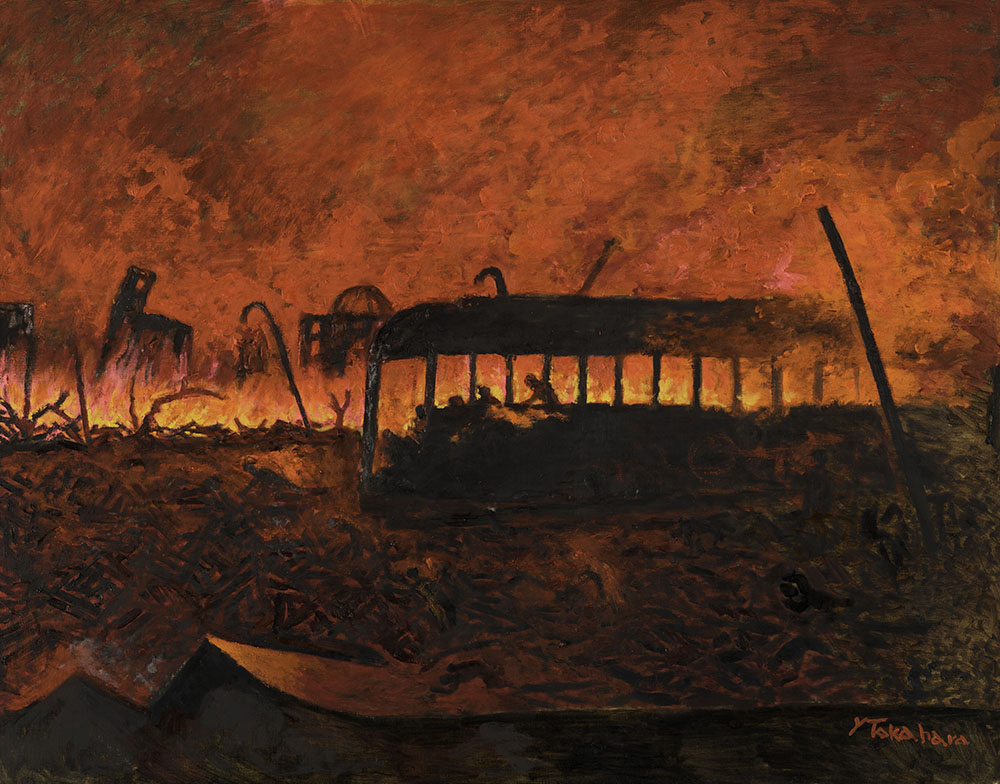 Yoshio Takahara / Hiroshima Peace Memorial Museum
On the day of Trinity testing, the Baby corps was sent to Tinian, an island in the western part of the Pacific Ocean, south of Japan, from where the US Air Force was going to take out atomic bombing. Soon after, the enriched uranium was sent by the plane, which had to be placed inside, and the final assembly of the bomb was supposed to be performed by a team of about sixty people from Los Alamos, including Dika Parsons, Luis Alvaresa, Fila Morrison and Robert Serber. To fulfill this special task, scientists were put in military uniforms and awarded the title: Serber, to his great pride, was promoted to colonels, Alvarez - to the lieutenant colonel, and all the rest to the captains. Two barracks at the air base served as “laboratories”-one for the “baby”, the other for the “fat man”.
Which of the four Japanese cities, mentioned in the directive, General Spiassu, bombed first, decided only a few days before the raid. On July 30, Spiatats telegraphed to Washington that he heard that Hiroshima is the only four of four prisoners of war of war from among the allies. In response, he received an order: "The priority attention should be paid to Hiroshima." On the same day, they completed the assembly of the “baby”, and General Farrell reported to Grovsu that everything was ready for departure the next day, August 1. However, the weather did not allow-because of the typhoon, departure was impossible.
The pilot of the B-29 bomber, which was supposed to drop the bomb, was chosen by Colonel Paul Tibbets. On August 4, after three days spent in stressful expectation of suitable weather, he collected the crews of seven aircraft for pre -flight briefing, which were supposed to participate in the mission (one for a bomb, three for evaluating clouds the targets a day before the blow, two for photographing and observing the bombing, and the seventh as a spare in case the first one is out of order). The crew members were amazed when, having arrived at the briefing, they found that military police officers armed with rifles guard the premises. They were even more surprised when Tibbets introduced them to Dick Parsons and he said that the bomb that they were going to drop was the most destructive weapon from ever created. After Parsons, Tibbets made a short speech to his people that they had the honor to take part in the raid, which "would bring the end of the war at least six months."
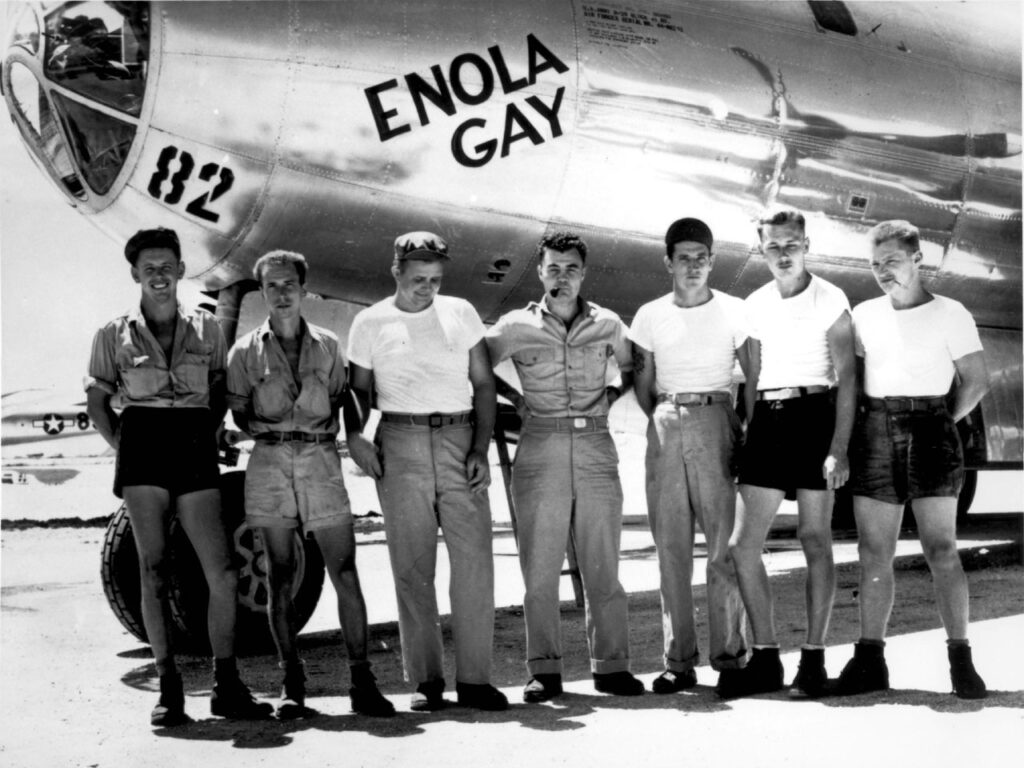 The crew "Enola Gay". In the center - pilot Paul Tibbets
The next day, Tibbets named the plane, which he chose for the flight, by the name of his mother - “Enola Gay” - and found an artist who managed to write this name with letters one foot on his nose under the gland of the cabin. A few hours later, at 2:45 am August 6, the newly made Enola Gay flew off Tinian in the direction of Hiroshima. In the air, Tibbets announced to the crew that the weapon in the bomb compartment was actually an atomic bomb. The flight took more than six hours. At 9:14 Time Tiniana (8:14 a.m. local time), the crew was discharged the bomb on Hiroshima. “Guys,” Tibbets announced on the internal connection of Enola Gay, “you have just dropped the first atomic bomb in history.” The crew members saw a dazzling flash; Then two shock waves of such a force followed that it seemed to them as if they had come from a heavy gun. After the second shock wave, Tibbets recalled: “We turned to look at Hiroshima. The city hid this terrible cloud ... a seething, like a mushroom, terrible and incredibly high. "
Looking back, the crew members watched with reverent horror as in the place where the city was just located, now, according to one of them, “boiling black oil”. The best review was Robert Caron's tail:
I tried to describe the mushroom, this seething mass. I saw fires flashing in different places, like flames bursting from coals. I was asked to count them. I asked: "Count?" Damn it, I surrendered to fifteen, they flashed too fast so that they could be counted. I still see this - both a mushroom and a seething mass that looks like a lava or Melases that covered the whole city; It seemed that it flows out, in the foothills, where small valleys go into the plain, and fires lit up everywhere, so very soon it was difficult to make out anything because of the smoke.
With a capacity of 12,500 tons of TNT, the Hiroshima bomb was far from as powerful as a “fat” tested in Trinity. However, for the inhabitants of Hiroshima it was a destructive force, the existence of which none of them could have imagined. The temperature in the epicenter of the explosion was unthinkable - 3000 ° C: this is enough to burn everyone within a radius of two miles. Not only the heat and power of the explosion terrified the city’s population (assessed at 255,000 people), but also the surprise of the liberation of this force. “I just could not understand,” one of the witnesses later said, “why did the surroundings change in an instant like that.” The nightmare, experienced by the population of Hiroshima, with burning intensity and liveliness, was conveyed by writer John Khersi in a long article based on the stories of eyewitnesses, which was published in the New Yorker in August 1946. The magazine devoted the whole number to this material, which was never done either before or after. In this case, as the editors explained, they did “from the belief that few of us are aware of the whole incredible destructive power of these weapons, and everyone needs to find time to think about the terrible consequences of its use.”
The article has become a real publishing sensation. The number was sold just a few hours after the exit, the article was completely read on the radio, a book immediately came out, which immediately became a bestseller. To some extent, the story of Herssey about Hiroshima was the embodiment of the hope that Bor inspired Oppenheimer. When it turned out that there was no real danger that the Germans would be the first to create an atomic bomb, this hope served as a justification for continuing to work on a bomb and for consent to its application against civilians; The hope that the shock from the unthinkable power of this bomb will be so great that it will force the peoples and government of the world to unite in international cooperation in order to put an end to the war.
Of course, little can be worse than those scenes that Khersi describes very dryly, which is why they are impressive even more. Not trying to describe the destruction, he focused on the stories of specific people, for example, Rev. Kioshi Tanimoto, who at the time of the explosion helped his friend transfer things to the house two miles from the city where they would be safe, because, like all the inhabitants of Hiroshima, they were afraid and waited for the upcoming bombing (Hiroshima was the only big city, except for Kyoto, which was still not yet. He was subjected to heavy bombing). Along the way, they heard the air aircraft siren that warned about the approach of American aircraft, and then a signal of the end of the end of the end of it was when it became clear that only three aircraft were flying. Then, still not having time to go into the house (about two miles from the epicenter of the explosion), they saw a terrifying flash of light. Tanimoto rushed to the ground. When he got up again, he saw that his friend's house collapsed. He ran to the city, thinking that he could help people. On the way to the center of the city, he met hundreds of very charred people running in the opposite direction. He saw around only destroyed buildings, fires, wounded and dying. In order to save people cut off by fire on the sandy shallows of the Asano Park, he found a boat in which, to his horror, he found five almost naked and very charred dead men. Praying and apologizing, he freed the boat and began to transport the wounded away from fires. On one shame, Tanimoto saw a group of about twenty men and women and, as Khersi writes:
He adjusted the boat to the shore and began to persuade them to climb on board. They did not move, and he realized that they were too weak to rise on their own. He leaned over and tried, taking his hands, to help the woman climb into the boat, but only her skin remained in his hands, slipping like huge gloves.
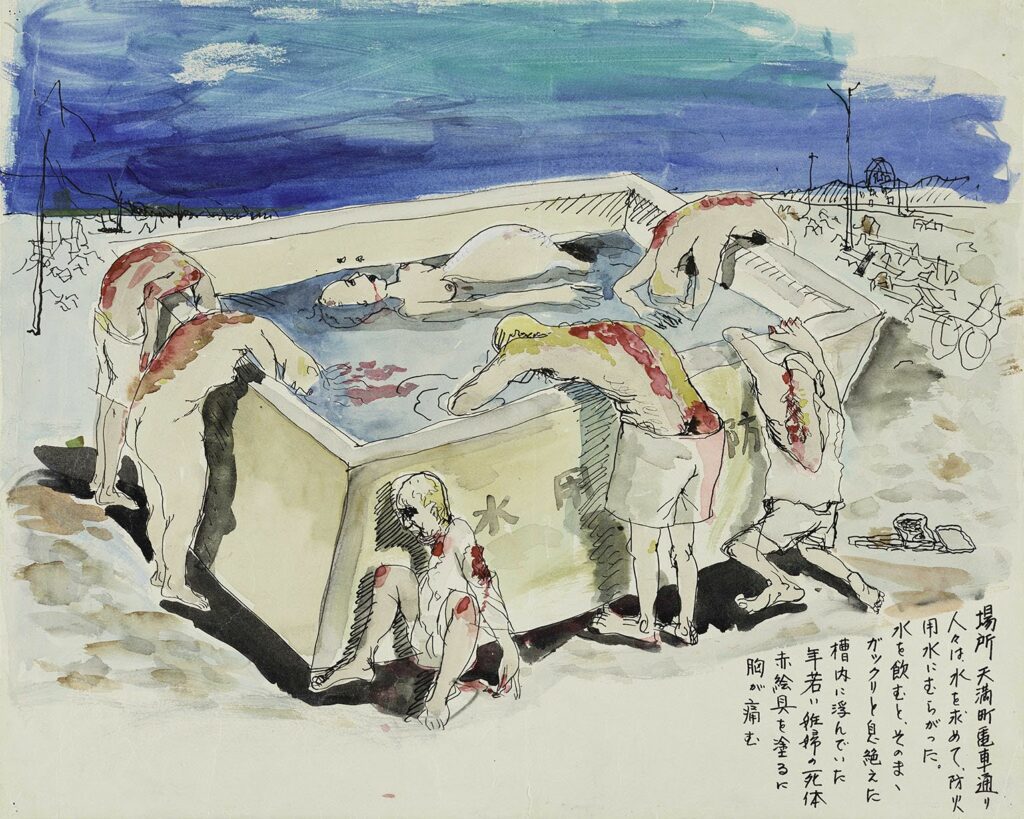 Akira Onogi / Hiroshima Peace Memorial Museum
Subsequently, many evidence of eyewitnesses was published that confirm the terrifying stories of Khersi and add heartbreaking details. One person recalls that the streets were filled with people with a charred skin hanging. “Many of them died along the road - I still see them in front of me like walking ghosts.” Among other horrors were “a woman without a jaw, with a tongue hanging from her mouth”, “people with crawling guts and brains”, “lying a dead child, through whom one more, which seems to have crawled, trying to escape, both charred to black.” Another person shocked more than all these horrors that when he climbed the hill and looked down, he saw that “Hiroshima disappeared ... Hiroshima was not - that’s what I saw - there were simply no Hiroshima.” Almost all buildings in the city (according to official estimates, 70,000 out of 76,000) were damaged or completely destroyed. As for the victims, there are some disagreements here, but the most reliable assessment, apparently, is 135,000 people, of which 66,000 were killed and 69,000 were injured. In other words, the losses amounted to more than half of the entire population. Of the people who were at a distance of 3,000 feet or closer to the epicenter of the explosion, the bomb killed more than 90%.
A few more weeks will take place before shocking the details of the suffering caused to the inhabitants of Hiroshima will become known to the scientists who allowed this to happen. Most of them learned even about the fact of the bombardment only a day later. Two exceptions were Dick Parsons, which was on board Enola Gay during her historical mission and was supposed to fulfill the latest assembly stages during the flight, and Luis Alvarez, flying on one of two observation aircraft accompanying Enol Gay. The first of those who were not in airplanes was the news was learned by General Farrell, who was on the island of Tinian. At about 9:40 am local time - twenty -five minutes after the explosion - Farrell accepted the radiogram from Parsons from Enola Gay, heading back to Tinian:
Dick - Farrell: the results in all respects are convincing and successful. Immediate actions are recommended for the implementation of further plans [that is, preparation for the second bombardment]. There are more visible consequences than in Alamogordo. The goal was Hiroshima. We return to Tinian, the board is normal.