
Translated material
Old Believers in Siberia: do they have a future
The Old Believers continue to live in Siberia and do not refuse their way of life and faith. Some consider them conservatives, others, on the contrary, are called adherents of stability, continuity and respect for the traditions of ancestors. About the Old Believers-“Poles” in Altai and “Family” in Transbaikalia Taiga.info said the editor-in-chief of the scientific and historical journal “Siberian Archive”, Doctor of Historical Sciences Vladislav Kokouilin.
Taiga.info: Let's start with how the Old Believers ended up in Siberia?
-Siberia was not only a place of hard labor and exiles, as it was sometimes portrayed by Soviet historians after the ideologists of the Marxist-Leninist teachings. But it was also not a country of conditional free Cossacks. It is enough to note that by the time of 1861 reforms in Siberia, convicts and exiles, as well as political exiles, were only 7% of the population. The rest are service people, peasants and other categories of the population. But among them were the Old Believers who went to Siberia, disagreeing with the policy of central authority, both in the field of religion and in the field of replacing old life with a new one during the years of Peter's reforms. Plus, the Old Believers, resettled to Siberia by the tsarist government.
Taiga.info: Who are the “Poles” and “family”?
- In the XVII - beginning of the 18th century, large groups of Old Believers fled to Ukraine, Belarus and Poland. But in 1764, when the former lover of Catherine II, Stanislav August Ponatovsky, became the king of Poland, the Old Believers were expelled from these territories and sent to Altai and in Transbaikalia. In Altai, they received the name "Poles", and in Transbaikalia - "family".
Taiga.info: How did they get in a new place?
- Initially, they settled along the tributaries of the Selenga River, in these places the soil is very fertile. So there were such villages as Bichura, Kunalyale, Urluk, Hilkota, Malo -Arkhangelskoye and others. The Buryats considered these territories their own, and at first, skirmishes were not uncommon because of the territory. But gradually the life of the Old Believers began to improve.
It should be noted that they not only well settled in a new place, but also had a huge impact on the local population. In particular, they began to use plows for plowing the earth, which, of course, increased the amount of bread grown. They fed bread not only Irkutsk, but also sent his large parties to the Amur, which was just mastered during this period.
The apiaries, who were held by the Old Believers, gave so many good honey that he was directed in large batches to the Irbit and Nizhny Novgorod fairs, where he was in great demand.
"Family" also equipped the tract from Verkhneudinsk (modern Ulan-Ude) to Chita, which was built in the first half of the 19th century. And then they built a tract from Yakutsk to the port of Ayan. Moreover, in harsh Yakut conditions, they were able to grow wheat and vegetables.
Taiga.info: What was the number of these groups of Old Believers?
- Assessments of their number can only be approximate. After all, they did not participate in the censuses, they were not recorded in metric books. At one time, academician Nikolai Pokrovsky dealt with this problem. But after a thorough study of all documents, he was forced to admit that even the approximate number of different groups of Old Believers cannot be called. However, the approximate number of “schismatics”, which were sent to Siberia from Poland, Belarus and Ukraine under Catherine II, are known. This is approximately 20 thousand people.
Taiga.info: How did the Old Believers meet Soviet power?
- We know little about their life during the years of revolution and civil war. But we know that in 1928-1932 (in the midst of collectivization), the Old Believers rebelled in some villages of Transbaikalia. These uprisings were brutally suppressed. All Old Believers Churches, Chapels and prayer houses were closed.
However, during the Great Patriotic War, the Old Believers bravely fought on the fronts of the war, and those who stayed in the rear did "everything for the front, everything for victory." Five Old Believers from Transbaikalia became the heroes of the Soviet Union. It says a lot!
Taiga.info: How do the Old Believers live today?
-They still observe the old faith, support traditional life, strictly observe the covenants of their ancestors: respect for the elders, hard work, caring for younger ones, a ban on smoking, a sober lifestyle, reading books in the Old Slavonic language. By the way, about smoking, it is at the "family" Transbaikalia that the proverb is common - "who smokes tobacco is worse than dogs."
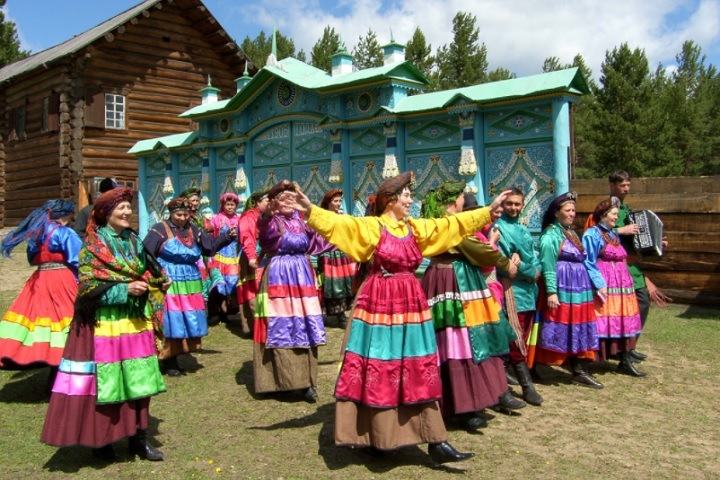
No matter how strange it seems in our time, they have no passports and the Internet. Some Old Believers live in quite inaccessible places, which they can leave only with the help of a helicopter. However, in some Old Believer villages, a tractor and Zhiguli have long been not uncommon. There are first -aid posts, but the Old Believers prefer to be treated with ancient folk remedies. There are sewing machines, but they sew their clothes themselves, do not buy. Therefore, if you suddenly find yourself in the village of the Old Believers of the 1960s, then you immediately give the impression that you got into a historical film-women in sundresses with a plain shirt under it, a sash (belt), a pan (clothes like a apron, only a brush) and a brush, over which a scarf or shawl was worn. In the summer, women wore chirks, in winter - ichigi. Men are necessarily with beards. True, these details of clothing and appearance today become the property of the older generation. Middle -aged people and youth wear the same clothes as the rest of the Russians, and many broke up with the beards. Not pancakes are baked on the holidays, but by pancakes, even on Shrovetide, which, despite its bright pagan character, “family” notes.
The villages are well -groomed, solid houses, the center of the village is a temple. But, paradoxically, in their beliefs, the features of ancient Slavic paganism are preserved, for example, in the garden, each vegetable bed in its length is necessarily located from north to south, the western-eastern orientation is associated with the location of the grave and is therefore considered unfavorable for plants. They believe that demons can settle in the uncovered dishes with food. There are many other features that are understandable only to ethnographers.
The monastery have survived - small log cabins or huts from wooden boards with a lounger without pillows, with a table, a chair, a red angle with icons and books. The monastery are located in hard -to -reach places and are closed for outsiders, they are associated only with individual representatives of the Old Believer community, which deliver food from time to time.
Taiga.info: There is an opinion that the Old Believers are gradually going into history. Is it so?
- There is no one yet. But in a pure form of Old Believer settlements, less and less remains. And in those who remain, the Old Believers are gradually erased. By the way, with the life of the Old Believers you can get acquainted not only in the Old Believers, but also in museums. For example, in the villages of Khasurt, Tarbagatai and Nikolsk, there are museums of the "family" estates; The open area showing the farm of the "family" is in the Khorinsky Museum of Local Lore. There is even such a museum as the church-Archaeological museum of the village of Tarbagatai.
There is a numerous scientific and popular science literature, in which many features of the life of the Old Believers in the past and the centuries before last are described in detail, as well as those processes that occur in their midst today.
Prepared by Vladimir Kuzmenkin