
Translated material
Here they are at home, but we have no houses
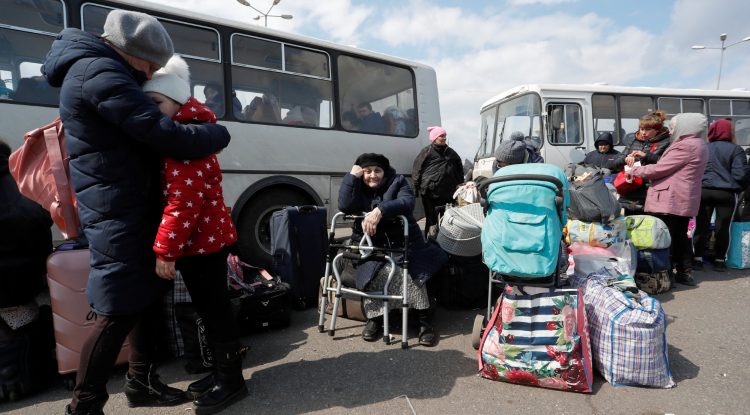
How Ukrainian refugees are evacuated to Russia and how they live in the country that attacked them
Since the beginning of the war in Ukraine, more than 5 million people left it. Of these, about 500 thousand were evacuated to Russia. For many residents of Mariupol, the battles for which have been going on for a month and a half, it was the only way out: someone had no car, somewhere the roads were destroyed. The Ukrainian authorities consider these people hostages; According to some reports, in Russia refugees are intimidated and trying to impose an official Russian view of the war. "Cold" tells how Ukrainians are met in Russia-and how they themselves are experiencing a flight to the territory of the aggressor country.
Beijes crosses the border
In the neutral zone on the border between Ukraine and Russia near the village of merrily, a cheerful manner is a huge queue of buses, on the windshields of which the letters Z are glued and private cars. And in those and in others - refugees from Ukraine. They spend several hours here, or even a day.
A man with a plastic children's pot in his hands comes out of the car - he leads his daughter to the toilet. The doors and trunk of its cars are sparkled with bullets, the rear window is knocked out, instead of it - a film planted on the adhesive tape.
I saw all this, having arrived early on the morning of April 1 at the Border checkpoint, a resident of Rostov Denis Gutsko. The writer, who in 2005, received the Russian Bucher Award for a novel about a man who is trying to obtain Russian citizenship after the collapse of the USSR, Gutsko went to the border with Ukraine to help refugees: distribute food, medicines, diapers and gaskets to them.
On the side of the track in the neutral zone there is a tent where three volunteers are prepared for lunch: they pour soup from thermos, put buckwheat with stew, pour boiling water on noodles and potato puree. “In front of the tent-the silent line of very tired, some bruised, lost people,” says Gutsko. “Some, holding back tears, ask if the passports are selected, whether it will be possible to return [to Ukraine].”
The hardest thing, says Gutsko, he had to look at people who show that recently they lived well - and now they don’t give a damn how they look. “Women with manicure, whose hands were once well-groomed, and now everything is in the mud, in the soot, which, apparently, does not wash. In greasy jackets, which until recently were decent. In some scarves that are very good at this jacket, in shoes that sits very well on his feet. They are also suitable for you, a man, no longer embarrassed, ask where to get the gaskets. ”
Many refugees stood in line for food in the second, for the third, fourth time: they could not eat. “Someone averted his eyes when you met with him. I saw that you recognized him, ”the writer continues. - There was a man similar to the homeless: problems with speech, shaking hands. Simply, probably, a lonely person, whom there is no one to take care of. He stuffed food into himself, did not have time to chew, shoved and shoved. He filled his mouth, with difficulty swallowed. "
For people who have not eaten for a long time, it is better to first give liquid warm food, explains Gutsko. Therefore, three times a day, thermos with a soup was brought to the neutral zone - but there was a strong wind, and the soup was cooling quickly. “You will not open these thermos every time, close. You opened it and went-someone asked for something, you were distracted, took a diaper, and the thermos is half-closed. ”
People did not take cold soup anymore - and the volunteers gave it to the dogs, whom the refugees brought with them. “I remember the shepherd, which first slashed from one bowl, then immediately from another - I marked. Beijes snooped in her legs, she wiped him off the bowls. She raised her head, looked around - a bag rustled nearby. The owner says: “She thinks that they will give something else.” I didn’t wait and then I already got seriously: I ate two pieces of bread, I got both bowls. ”
Thermos with food Gutsko dragged along with the border guards. He remembered that they did not speak either volunteers or refugees - the interlocutor of the “cold” suggests that they simply banned it. After eating, some people became ill after eating, and they returned to the tent to ask for medicines for indigestion. “I put food to the teenager,” says Gutsko. - He and his family ate, went to their car. And then suddenly I see this teenager again: he stands nearby, writhes in pain, and another volunteer gives him a tablet. ”
Gutsko says that he went to help the refugees, because after the start of the war "it was difficult to breathe, there was a feeling that I would suffocate." In the past, he, as a publicist, wrote about an armed conflict in the Donbass - and annoyed that he tried to "distinguish half -tones", "stand in sound positions." “He wrote that it is impossible to shell its territory - since Ukraine considers Donbass its territory. He wrote that the nationalist battalion “Azov” cannot be established. Stream by the Crimea, I remember, I had the feeling that it was something cool, funny: “Ours had squeezed the Crimea at the crests.” Well, here is the payment on the accounts that are now issued to us. ”
In the neutral zone, the writer says, it became easier for him: “Here they are, people are unhappy, here you are. You have food, and they are hungry. You have diapers for children, but children. And you just need to do something with your hands, and everything is clear. ”
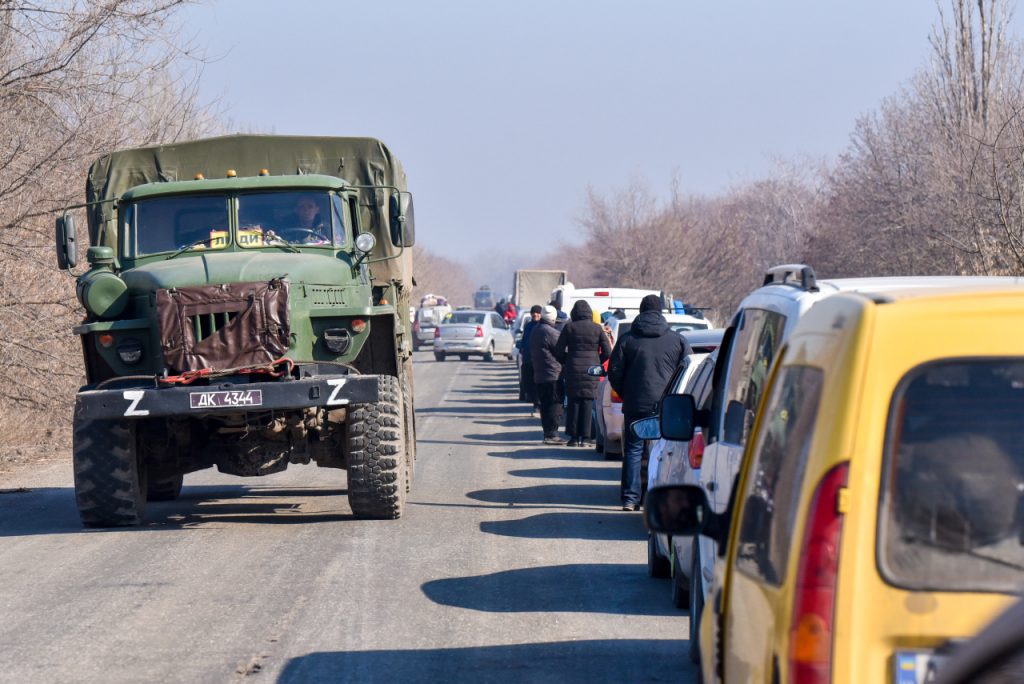
Military with sweets
One of those who entered Russia in early April was a resident of Mariupol Alina Karimova (the name was changed at her request). In the besieged city, she spent 36 days, most of them in hospital No. 4, where she helped to care for the wounded.
April 2, the projectile hit the reception department. “The building shook, there was a terrible explosion, we heard the glasses that still remained. It was immediately clear that the shell came to us, and not in the neighboring building, because a lot of dust from concrete rose, ”says Karimova. Who shot the hospital, she does not know.
Shells generally got into this hospital often. According to Karimova, the fourth floor, where in the past there was a resuscitation, since the beginning of March stood with a hole in the wall. In early April, the shell fell into a pile of bodies folded on the street against the walls of the hospital morgue, and the men stewed them, throwing the earth: by that time there was no longer any water.
There were fewer doctors in the hospital every day. The children's infectious disease doctor died when he moved from the corps to the case: the shell flew, he was killed by fragments. Karimova was especially remembered by the death of an ultrasound specialist: when he sat on the ground floor and talked with his colleagues, a fragment flew out the window and hit him right in his heart. The man, according to the nurse, died on the spot.
When they bombed the reception department on the ground floor, no one was injured. But for Alina, this was the last straw: the shell hit next to the rooms, where she and her relatives lived recently. Karimova decided that it was more impossible to stay in Mariupol. The next morning, a woman with her eleven -year -old daughter, sister and her infants, as well as about a hundred people - people who were hiding in the basement of the hospital, and the wounded who could still walk - went to the DPR checkpoint, from where the military evacuated Mariupol residents into the territory of the self -proclaimed republic. She had to escape from Mariupol without a husband: he remained in another area of the city, and it was impossible to contact him.
Karimova would like to leave towards Zaporozhye and stay in Ukraine, but she did not have such an opportunity. It was April 3-that day, the Deputy Prime Minister of Ukraine Irina Vereshchuk said that the Mariupol residents can get out of the city on the buses that are waiting for them near Berdyansk. From Mariupol, this is an hour and a half drive by car. But the hospital, from where the woman and her relatives got out, is located on the left bank of the Kalmius River, which divides Mariupol into two parts. And the road to Berdyansk is on the right. And on the bridge across the river by that time it was very risky to move.
On this bridge, some residents of the left bank tried to get out of the shelling on their cars. Not everyone turned out. Once, Karimova says, a woman with three children was brought to her hospital. All children had fragmentation wounds: a first-grader boy was wounded in the face, a fartial girl-in the neck, their four-year-old brother-in the back. Parents tried to take them out of Mariupol in their car, but they were fired on the bridge.
After the seams were applied to the children, they departed from anesthesia, and the nurse was talking to them. “What is your name, where do you study, where do you live, what is your mother's name? Open your mouth, ”she recalls. - In order to at least understand what they are conscious, without loss of memory. They did not cry, only all the time they called mom. " The mother at that time was “in complete prostration”: “We asked her some questions, but she was just silent.” After some time, her husband came to the hospital from the scene of the accident. He said that the relative who was driving died: “Half -headed she took off her. She stayed in the car, they did not take her. "
Before the DPR checkpoint Alina and his family and a hundred more people from her hospital walked past the corpses that lay on the roads and in the yards. Karimova recalls that while they were waiting for the bus, military equipment was driving by, which was going to bomb her city. The Donetsk military man, according to her, at that time told the Mariupol residents how good it will be when Russia wins: “You do not worry, you will return home, you will have its own republic. And we will restore the city, we will do everything better than it was. ”
To see how he smiles, offers the children of refugees sweets, “it was terrible,” but Karimova did not dare to argue with him. “Say something in response-to sign yourself a death sentence on the spot. We were just silent. After we went from the hospital to this post, I just wanted to drink vodka and forget. ”
Swim, according to reeds, crawling to Ukraine
“We had rumors that the Ukrainian military in Mariupol would have surrendered in two or three days. It is said that many cities that surrendered did without special losses. But “Azov” does not give up. Azov fighters sat in houses, dug up in the yards. There were some guns between the houses-they shot at the fields and left, and then in response the shells flew to us. I believe that these are the Ukrainian military, “Azov”, provoked. Hid behind people. "
So another resident of Mariupol, who left for Russia, says about the war - Svetlana Abramenko (the name of the heroine was changed). She herself during the time that she spent in the city, she did not see Azov’s fighters: the neighbors told her that they were to blame for destruction.
Abramenko, together with her husband, an elderly mother and two children, evacuated by the Russian military. She crossed the border in a cheerfully-ascension in mid-March. While the family was traveling on the bus, the 11-year-old daughter of Abramenko began diarrhea and vomiting. Soon the same symptoms began in her eight -month -old son, and then from herself. “We lived [in Mariupol] in unsanitary conditions for a month, there was no water,” she explains. -We left children more or less clean water, and we ourselves drank rain. They put the buckets, walked snow, recruited. Our grandfather was stocked with rainwater, he had a couple of tanks - we boiled it and drank it. ”
Abramenko and her relatives did not go down to the basement - they were afraid to die under the rubble and therefore hid in the vestibule next to the apartment. It was impossible to understand from there which side of the shells fly and who sends them: the woman simply waited for the shelling to end and silence would come.
In early March, she went to the center of Mariupol, to the building of the drama theater - the townspeople said that from there the Ukrainian authorities evacuate people. “The Drama Theater was standing,” recalls Abramenko. - People in it told us that there was no evacuation, and when it begins, they will ride the streets and report to the loudspeaker. But this never happened. ” A few days later, she met the Ukrainian military near the house: “I asked, evacuate at least those with children. One of them said: “Bech two or three days”. ”
Some of Abramenko’s acquaintances were able to leave Mariupol to other Ukrainian regions, but only on their own cars - centrally, the woman claims, the Ukrainian authorities proposed to be selected only from Berdyansk. He and his family, according to her, could not get there: they fired at their car.
Seeing in mid -March on the street of the Russian military, Svetlana asked about evacuation from them. A few days later, Abramenko and her family, along with other refugees by the bus, were taken to the Ukrainian village of Nikolskoye 24 kilometers from Mariupol. From there, according to Svetlana, it was possible to get to Berdyansk to stay in Ukraine. She found a driver who was ready to bring her family to Berdyansk for 3 thousand hryvnias (about 9 thousand rubles). “We had money. But the people who were with us in Nikolsky said that it was dangerous to go: they may not miss men, because they will call right away, ”the woman explains. - And we decided that we would not go. And they evacuated to Russia. ”
One of the relatives of Svetlana Abramenko managed to leave Mariupol and stay in Ukraine. Now he "began to press" loved ones: "calls us traitors." Alina Karimova also says that many Ukrainians write on social networks to those who fled to Russia: “It was necessary to swim, by reeds, crawling, but go to Ukraine. And you went to the side of the aggressor and spend your money there, you raise the economy.” “But we have small children,” explains Svetlana Abramenko. - Okay, we would be without children - we could sit in the basements and show our patriotic. Of course, they expected from their country that we were evacuated, but no. Therefore, we went with those who saved us. ”
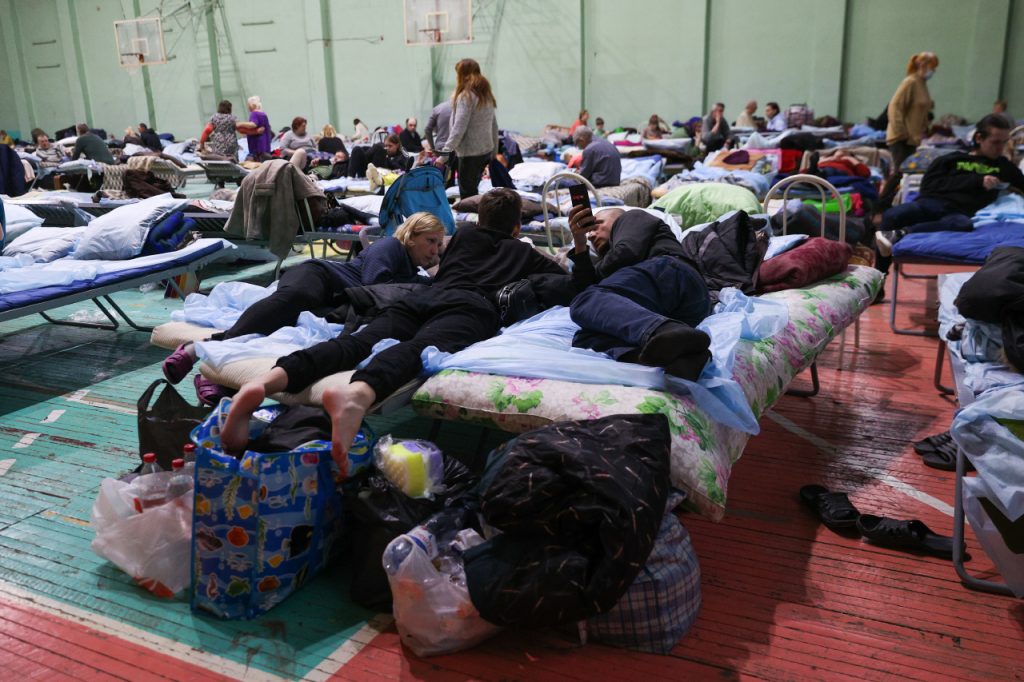
Blood plays the boys of young
Mariupol mayor Vadim Boychenko claims that Ukrainians are taken to the territory of Russia and the DPR “under the muzzle of a machine gun”, then to send to “filtration camps”. The Ukrainian Ombudsman Lyudmila Denisova accused the Russian authorities of "intimidating" refugees and forcing to apply for Russian citizenship.
The Russian authorities deny this. “There have never been a violent movement of refugees to Russia, it is a lie,” said Tatyana Moskalkova, Commissioner for Human Rights. The Russian government ordered each refugee to issue 10 thousand rubles and promised free medical care. Ukrainians are distributed in different regions; Somewhere they are placed in hotels and sanatoriums, and in the Penza region, for example, in the buildings of the former military town.
“All people from Mariupol to Russia are taken by force in principle. From the point of view of the fact that humanitarian aid from Ukraine is not allowed to get there [Russian troops], ”says Diana Zviruk, a volunteer who helps refugees leave Russia to Europe. The Deputy Prime Minister of Ukraine Irina Vereshchuk states that Russian troops do not miss Ukrainian buses to Mariupol, which could take civilians. In Mariupol itself, according to the mayor of the city, there are no more communal buses at all - they are destroyed.
The “filtration camp” is an expression that the Russians are accustomed to hear in the context of the Great Patriotic War. So called the NKVD institutions, where they kept people released or fled from German captivity. Now, some media calls the “filtration camps” in Ukraine and the DPR, where refugees are temporarily settled before taking them to Russia.
Alina Karimova, who decided to flee from Mariupol after shelling the hospital, was taken to the village of Guselshchikovo, which is under the control of the DPR. There she and other refugees were settled in the building of the kindergarten. According to Karimova, everyone who was in kindergarten had fingerprints and photographed from different angles: “Without this it is impossible to cross the border of the DPR and Russia. No one explained anything. And we did not ask. They have their own rules and laws that we do not know. ”
On the border with Russia, says Karimov, the security forces interrogated her and checked the phone: “The groups in Vaiber and Telegram were woolly. They asked why we read Ukraine news. They asked questions about my husband, who remained in Ukraine - supposedly he is fighting there. The interrogation lasted about 15 minutes, they seemed eternity. "
Svetlana Abramenko, together with her husband and children, was taken out in another direction - not towards the DPR, but to the West, to the Ukrainian village of Nikolskoye (now Russian troops control it), so that from there to the mariupol bypass to the border with Russia. At the exit from Mariupol, they had to go through a checkpoint, which was installed by the Russian military. At this checkpoint, a bus with refugees was stopped and all men under 42 years old were ordered to go outside and undress to the waist, says Svetlana’s husband Boris Abramenko (the hero’s name was changed).
“The guys on the platoon were, of course, a little,” he recalls. -They tell me: “Yes, you are an APU-Snik, we will go to the prosecutor right now, we will deal with you ...” I say: boys, there are no problems, let's go, but I have a family here, then I’ll be far behind the family. I say, look, here is a pass to the factory: I work as a master. Let me ask the military: how much do they earn there at the factory? I replied - he kind of calmed down. " The Russian military justifies the Russian military: “Maybe I looked suspiciously. I am a bearded - I did not shave how much. Maybe blood plays with the boys of young people. Blood is probably hot. ”
На российской границе мужчин снова попросили раздеться, продолжает Абраменко: «Смотрели, есть ли татуировки, есть ли синяки на плечах от прикладов». Допрашивали его недолго: «Спросили, где работаю, с какого района, имею ли отношение к вооруженным силам Украины или к националистическим батальонам. Записали номер телефона, и больше ничего».
Семью Абраменко сначала перевезли в Таганрог, а затем в Тульскую область — чтобы освободить места в приграничном городе для новых беженцев. Там людей поселили в гостинице, а Бориса Абраменко допросили в третий раз: «Пришел сотрудник — не знаю, какого ведомства, — и спрашивал, что происходило в Мариуполе за то время, пока я там находился. Знаю ли я, кто стрелял, видел ли бойцов “Азова”, видел ли, чтобы они стреляли в людей, применяли ли они насилие ко мне. И вообще, разжигал ли “Азов” межнациональную рознь в Украине». Силовик, по словам Бориса Абраменко, спросил его, хочет ли тот участвовать в «судебном процессе над украинской властью». «Я ответил: а почему нет, — говорит беженец. — Считаю, что наше государство нас, если честно, кинуло».
«Когда мы только приехали в Тулу, русские нас встречали, а мы сидели и думали: “Вы ж разбомбили наш город”. В душе где-то мысли: “Россия бомбила, они напали”, — рассказывает Светлана Абраменко. — В Туле с нами общались психологи, все такие позитивные, добрые люди. А у меня какое-то чувство: как так можно? Как вы можете на нас смотреть, разговаривать так спокойно? Тут дома стоят, а у нас домов нет. Здесь люди живут, ходят, улыбаются, а у нас…». Но через несколько дней Светлана «более-менее успокоилась»: «Подумала: а при чем тут люди? Они же не виноваты, что все это происходит. Нас приняли, накормили, напоили».
Беженцам из Украины оформлять российское гражданство не обязательно — вместо этого они могут получить временное убежище на год. Но к началу апреля уже 18 тысяч человек, которые бежали из Украины, стали россиянами: украинские граждане имеют право получить российский паспорт в упрощенном порядке.
Алина Каримова становиться россиянкой не собирается — они с семьей уже выехали из России в одну из европейских стран, чтобы переждать войну там и вернуться в Украину. «По поводу того, что мы попали в Россию, у меня в душе печаль, — говорит она. — Но нам просто нужно было выбраться. Это был единственный путь, чтобы потом вернуться домой».
Светлана Абраменко, в свою очередь, планирует оформлять российское гражданство и искать работу в Тульской области. В Украину она возвращаться не хочет: «На данный момент тут тихо, а на Украине сейчас везде громко — бомбят. Второй раз переживать это все желания нет никакого».
О том, что она будет жить в государстве, которое начало войну, Светлана старается не думать. «Я особо политикой не интересуюсь, не люблю, — объясняет она. — К российской власти у меня двоякое чувство. Я не понимаю, когда говорят, что пришли нас освобождать. От чего освобождать? Не знаю, кто конкретно бомбит, от кого к нам прилетало, но мы, мирные жители, не должны страдать, погибать не должны. Понимаю, если бы они все вышли в поле и стреляли друг по другу. А когда стреляют по мирным жителям, по людям, детям перепуганным, этого я не понимаю».
Тем не менее, Абраменко допускает, что действия российских властей были оправданы. «Может быть, действительно нас освобождали от этих “Азовцев”, этих нацистов, — говорит она. — Может, это и правильно — эта война. Я в политику не лезу».