
Translated material
From the life of a dying generation. Russia 2010s in the film "How to Save a Dead Friend"
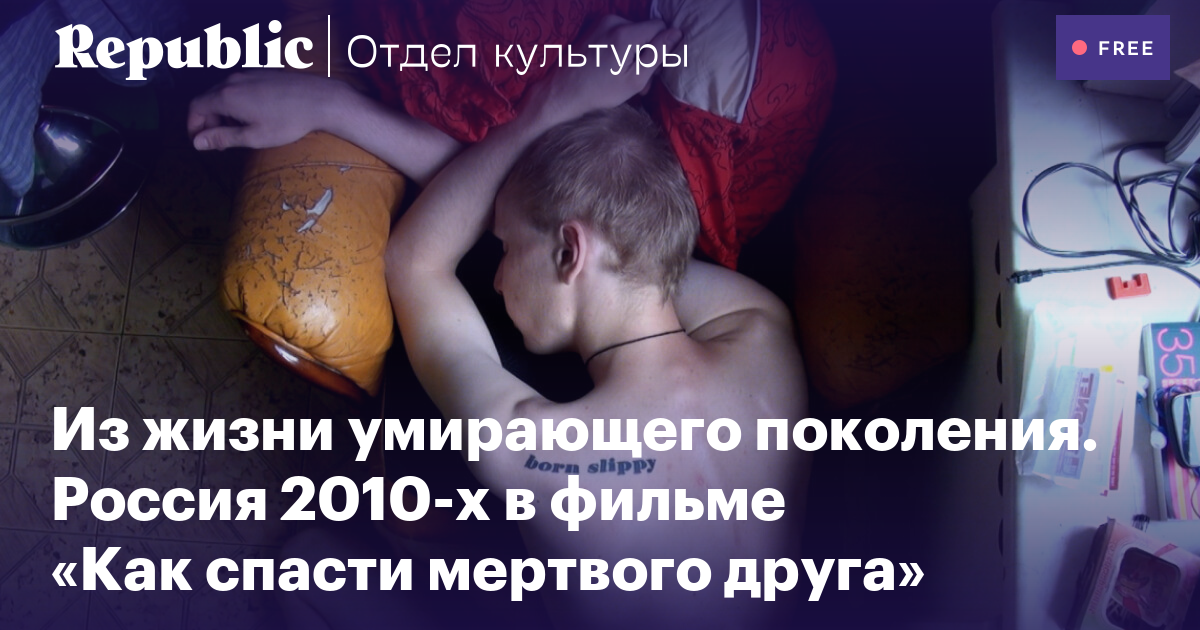
“How to save a dead friend” - this is the name of the documentary film by Marusi Syrochkovskaya, graduates of the documentary cinema school Marina Razbuzhkina, recently awarded one of the awards of the prestigious Vision Du Réel international festival. And in May the film will be shown in one of the programs of the Cannes festival.
Is it possible to save a dead friend? - You ask. Director Marusya Syrochkovskaya decided to make a friend live alive for her, for her relatives.
Maroussia met Kimi (Cyril) when she was sixteen. Kimi, a young intellectual-narcoman, was older than Marusi. They fell in love with each other, agreed, got married. Both are catastrophically unhappy - Kimi drug addict, Maroussia practices Selfharm (deliberate infliction of injuries to himself). Having picked up an amateur camera, Maroussia endlessly takes off Kimi, himself, together, fixing their general growing up. Then they will divorce, but will remain best friends, the girl will continue to shoot Kimi - the main person in her life - until his end. When Kimi does not become, Marusya will not be able to touch the notes for a long time, but then he decides: Kimi cannot leave, dissolve in eternity, as if he had not been. Kimi should survive eternity.
Director Marusya Syrochkovskaya with Kimi, the hero of her film "How to Save a Dead Friend." Photo: Docs Vostoko
And a huge amount of material shot over 12 years gradually turn into a film about life, love, self -destruction and death. It hurts from the film - the viewer knows in advance that Kimi hasn’t been in the world for a long time, and a detailed story about his tragic path to the point of no return acts as a tool of the very self -harm - it seems that you, looking at the screen and living an hour and a half with the heroes, cut yourself in the blood.
Maroussia explores the history of his relationship with Kimi and the history of his self -destruction fearlessly, frankly, desperately. Kilometers of records are mercilessly cut and mounted in a dense, without the slightest tightness and extra frames, a video with the orders of the director herself. The voice of Marusi is almost the main character of the film along with Kimi. Her voice is not just a narrator, he is a kind of demiurge, creating space and film, and the world in which a couple of loving people live.
Because “how to save a dead friend” is not only a history of mutual love and self -destruction. At some point, a private plot suddenly acquires new meanings and other coloring. The episodes of the “home” life of Kimi and Marusi, their adventures in the country of a narcotic dope, long conversations in the company “On the nature of things” begin to interrupt with the scenes of protests that Moscow was still rich in the 10th. Kimi involuntarily becomes a character whom the director trusts to speak on behalf of the generation.
The dramatic history of the disease and death of the guy grows to the size and forms of the symbol of the fate of the whole generation.
A smart smart unlucky blond, which ended his life path unforgivably early, without having time to leave offspring, grows into a sonorous metaphor, saying without knowing it, almost programmatic for his generation that grew up in Russia, the words, primarily in scenes where Kimi talks about life in a psychiatric hospital, where he enters with sad regularity. He recalls that you need to behave approximately in the hospital - it’s not possible to quickly get off with you, and you risk never getting out of there at all or you will be defended with medicines to a complete unconscious, or they will give a certificate with which you can’t go beyond your own entrance.
Today, when the Russian state directed weapons to a neighboring country, and inside its country is rapidly introducing repressions, these stories of Kimi surprisingly accurately describe our situation. And then the drug addiction of the hero no longer seems to be independent of him, but he see a well -thought -out escapism.
Frame from the movie "How to Save a Dead Friend." Photo: DOCS VOSTOK
Of course, this picture has little chance of going out into Russian rental - who will allow you to show on the big screen how the heroes follow the “bookmark”, who will allow the viewer to hear the exorbitantly long list of drugs that Kimi consumes, who will allow the scenes of protests? Marusya and producer of the film Ksenia Gapchenko understood this from the very beginning, because they did not even attempt to acquire state financing, realizing that the “gratuitous” state subsidies would have to pay too high the price in the form of fierce self -censorship ( negotiations on shows in Russia are still underway - Republic ).
Of course, Western producers and foreign financing had to be sought for a long time ( Gapchenko Docs Vostok became the Swedish Sisyfos Production - Republic) . But it turned out a great example for those who whimper - they say, without state money now in Russia, you can’t make a movie in Russia. How to remove it!
You can argue for a long time and reasonably about whether it is necessary to take Russian films to international festivals at the moment when Russia is waging a aggressive war. Someone is actively against it, someone believes that it is impossible to throw Russian culture to the mercy of fate. But even the most ardent opponents in this matter will probably converge in one thing: if you show our cinema outside the country, then only this is independent, free, without looking at “no matter what happened”, explosive, desperate. And infinitely tragic.