
Translated material
Why is Iskander telegraphed Kosygin
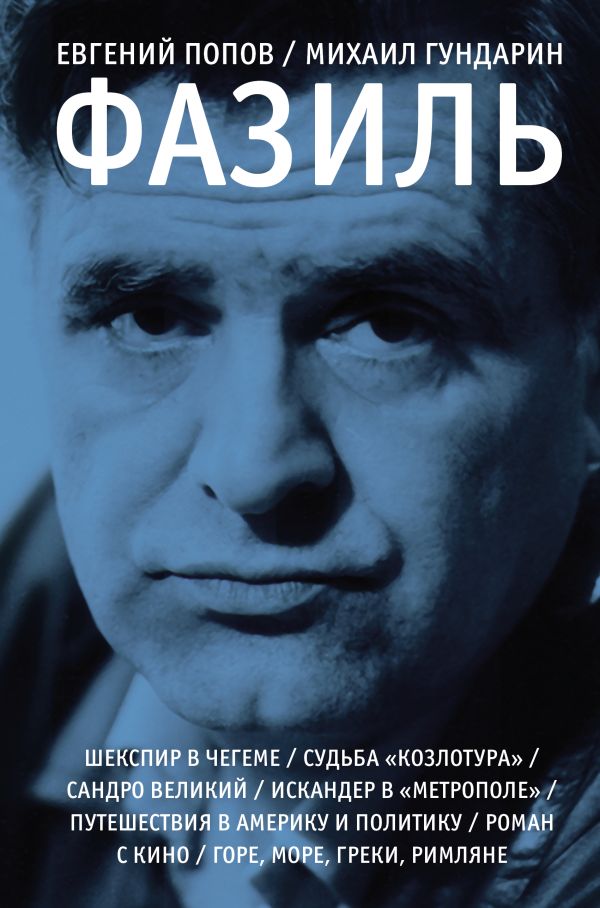
Fragment of the book "Fazil: the experience of artistic biography"
The book “Fazil: the experience of artistic biography” is not quite usually written. Its authors, Mikhail Gundarin and Evgeny Popov (by the way, knew Iskander personally), along with a description of the main stages of his hero’s life, talk to each other, and their dialogue occupies a significant place in it. Gorky publishes the chapter describing how, in the late 1960s, the future author of “rabbits and boas” tried to influence Soviet power.Starting from February 24, 2022, we were all in the face of the advancing barbarism, violence and lies. In this situation, it is extremely important to preserve at least the remnants of culture and support the values of humanism - including for the sake of the future of Russia. Therefore, the editorial office of Gorky will continue to talk about books, reminding our readers that the world remains in the world and fiction.
Mikhail Gundarin, Evgeny Popov. Fazil: the experience of artistic biography. M.: AST: Editorial Elena Shubina, 2022. Content
 Against the authorities
At the same time, Iskander did not flirt with the authorities, but it was not openly opposed to her. In the eyes of the public, and his colleagues, he belonged to representatives of the modern, progressive circle of writers who could not but be moderately opposition - but everyone determined the measure of measure of both moderation and opposition.
In 1967, to the widely celebrated anniversary of the Great October Socialist Revolution, Oleg Chukhontsev wrote a collective initiation full of ideological meanings.
Bulat, Camille, Fazil,
What a happy wind
You were brought here
In an inaccurate speech?
Tell me what a shir
Did you burn you with a loan?
What a breadth
Dumped heaviness from the shoulders?
Is there a blood of fathers
Is the son’s debt paid?
Is there a kind of hardships
The white light is bought?
Like a flight of starlings
Get over the ashes
Your belated lie
Above the ashes of years.
Fazil, Bulat, Camille,
Why is heating nonsense
Who is from what land -
You have one knead!
God chopped the steppes
On the pine tree and from the borus,
And you went to the vine
How the Birnamo forest went.
And you went to the vine.
And you became branches.
Make noise of the bolder
thorny foliage,
so that from another give
Dali came out to meet
foliage of other branches
Bringing over your head.
Take up, friends,
And let you wave your joy!
We are all one family
And I am a coniferous brother to you.
Here's my hand
on our light
And here's my life,
Camille, Fazil, Bulat!
Kamil is Kamil Ikramov, the son of the first secretary of the Republican Committee of the CPSU (b) of Uzbekistan, shot in 1937. Camil himself left the deadline in the camp, then became a popular writer for adolescents (“Braudnikov Street”, “a birdhouse in which the starlings did not live”, etc.). Okudzhava, like Ikramov, was a major party and economic figure. Iskander fell into this series absolutely “not according to the rank” - the son of Iranz, albeit expelled, but not executed. We believe that it was important for the Russian Chukhontsev to form an “international” for revenge (of course, with his own participation - “and I am a coniferous brother to you”): “What to whitish, who is from what land - you have one knead!” And the Birnamo forest is mentioned as a harbinger of the fall of a tyrant and the murderer of Macbet.
In any case, from the listed Trinity Iskander, in our opinion, had the lowest desire to get even with anyone. Yes, and Oleg Chukhontsev, whose father was the head of the Pavlovsky Pavlovsky Pavlovsky Pavlovsky Pavlovsky stable and the deputy chief of the local police, always lived quietly, secludedly, was not seen in a special dissident, breathing only with poetry. Continues today, for our happiness.
However, it was in the late sixties - early seventies that Fazil Iskander took part in opposition activities. He signed letters of protest. He talked with disgraced writers and publicists, with the same Alexander Galich. With Galich, who also lived “at the“ airport ”, he came to say goodbye right on the eve of his forced emigration, on June 24, 1972. Many years later, at the evening of Galich’s memory in the recreation center of the Ilyich Plant Iskander recalled:
“It was necessary to see him at that moment - he seemed to be reclaimed, huge, open, beautiful, but completely extinguished. He tried to invigorate, of course, but the more he was awake, the more it felt that something was terrible, and I did not want to admit to myself that he was leaving for dying ... "
And by the way: Fazil will be among the few participants in the first, in fact the semi -underground evening of Alexander Galich (not yet rehabilitated then), which took place at the beginning of perestroika in the summer of 1987.
Iskander signed many letters in defense of dissidents. Immediately began troubles - so far insignificant. Alexei Kondratovich recalls how his chief Alexander Tvardovsky was outraged by the fact that Glavlit automatically delete from the work preparing to print the work and the surname of the “signatures”, including Iskander. So soon there would be no one to publish, Tvardovsky was angry. Something-and the stories of Iskander, too-still managed to conquer: it turns out that censorship still did not consider him a dangerous and irreconcilable enemy of the Soviet regime.
It was in intellectual circles (primarily metropolitan) such a “thaw” towers - to write and sign various letters addressed to the leadership of the USSR, Prosecutor General’s Office, etc. This wave lasted about three years and ended mainly in 1969. Many quite “legal” cultural figures signed. A kind of fashion arose - especially since the “signatures” have seriously threatened. There were an open letter of 25 prominent figures of science and culture, written by Brezhnev in February 1966, about attempts at rehabilitation of Stalin. Among the signed are academics, famous directors, artists, artists, writers, old Bolsheviks with pre -revolutionary experience. D. D. Shostakovich, P. L. Kapitsa, I. E. Tamm, M. A. Leontovich, V.P. Kataev, K. G. Paustovsky, K. I. Chukovsky; M. M. Plisetskaya, O. N. Efremov, I. M. Smoktunovsky ... what names! According to today's researchers, the arguments against restroilization were sustained in the spirit of loyalty, but the protest against the revival of Stalinism is vigorously expressed. We also mention the letter to the Central Committee of the CPSU of 43 children of the Communists repressed in Stalin's times (September 1967).
The surname Iskander is among those who signed a letter in defense of the arrested Yuri Galanskov. For Iskander, Yuri was practically “his own”, a writer, and even a young one - born in 1939. Galanskov participated in an informal poetic movement, read his poems with others at the Monument to Mayakovsky back in the early sixties, wrote a petition to Sholokhov himself “On Basic Literature and its role for the social development of Russia” (he actively went to Samizdat). And he was arrested because, together with Alik Ginzburg, he was preparing a collection of documents on the process of Daniel - Sinyavsky. He will die in the camp, without living until forty years. The letter did not help.
Iskander himself subsequently spoke about this like this:
“I have never been the initiator of compiling such letters. But if the letters fell into my hands and I saw that the requirements set in them are fair, I signed unconditionally ... "
His public indignation is known to Tvardovsky's resignation. Iskander did not think to hide their emotions about the actions of the authorities who forced the best editor of the country.
Much later, in the essay “Letter to Friends”, he will remember what happened after his personal indignation about the shift of the editor -in -chief of the “New World”:
“When the“ New World ”was closed, I gave a telegram in the name of Kosygin. I wrote that the magazine is closed for what he thinks. I wrote that not every criticism is a thought, but all thought is criticism. Public thought cannot exist outside the critical context. The fact that I wrote a telegram in the name of Kosygin meant that I was tired of signing the letters converted to the Central Committee. There, this kind of letters either did not react or forced to shut up, exerting economic pressure (for example, not allowing to be printed, that is, depriving the fee. - E.P., M. G. ). However, they still called me to the Central Committee, and not to the Kosygin office. A comrade, who, incidentally, argued quite kindly with me, claimed that the whole point is that I do not know the articles on agriculture that they tried to print in the New World, but censorship stopped them. Like, if I knew these articles, I would not send such a telegram. I answered him with full knowledge that our agriculture is in a catastrophic state. In response, he explained to me that the party knows about this very well and in the very near future the most appropriate measures will be taken. ”
Fazil Abdulovich showed remarkable courage, turning upstairs - at a time when those who were also indignant at the “arbitrariness of the authorities”, cowardly silent.
He was not afraid for his high status, for his "elitism." Anyway - he was not afraid of anything. Iskander always knew how to go to the end, remaining faithful to his friends and his views. And by the way, the case with a telegram Kosygin was left without consequences. For the time being, the authorities treated Iskander favorably.
As for the dissidents, one of the most famous, recently departed, human rights activist Sergei Kovalev, later recognized with bitterness:
“We turned out to be much larger Westerners than the Western elite itself. We attributed to Western political civilization the ability that it did not possess at all. <...>
We did not just believe in the universal value of law and freedom; We were convinced that it was these values that is the driving power of the free world ...
Alas, this benevolent picture was incorrect, generated by our tendency to take the desired for the real one. It was a sad discovery ... "
It is clear that the dissidents did not have the slightest chance to change anything in the country. In one of the interviews, Iskander said his “dissident activity”, as well as the subsequent political activity in perestroika, said this:
“... The basis of writing activity is concluded in his very work, in accordance with what he thinks, feels, what he speaks and to what he calls on ... it is inextricably linked with how a person solves the problem of the internal editor, if only it has it.”
Golden words! The main for him in the late sixties - early seventies was the ripening of the main work of his whole life - the epic “Sandro from Chegem”.