
Translated material
"If we lower his hands, blackness will devour us." Artist and her anti -war action
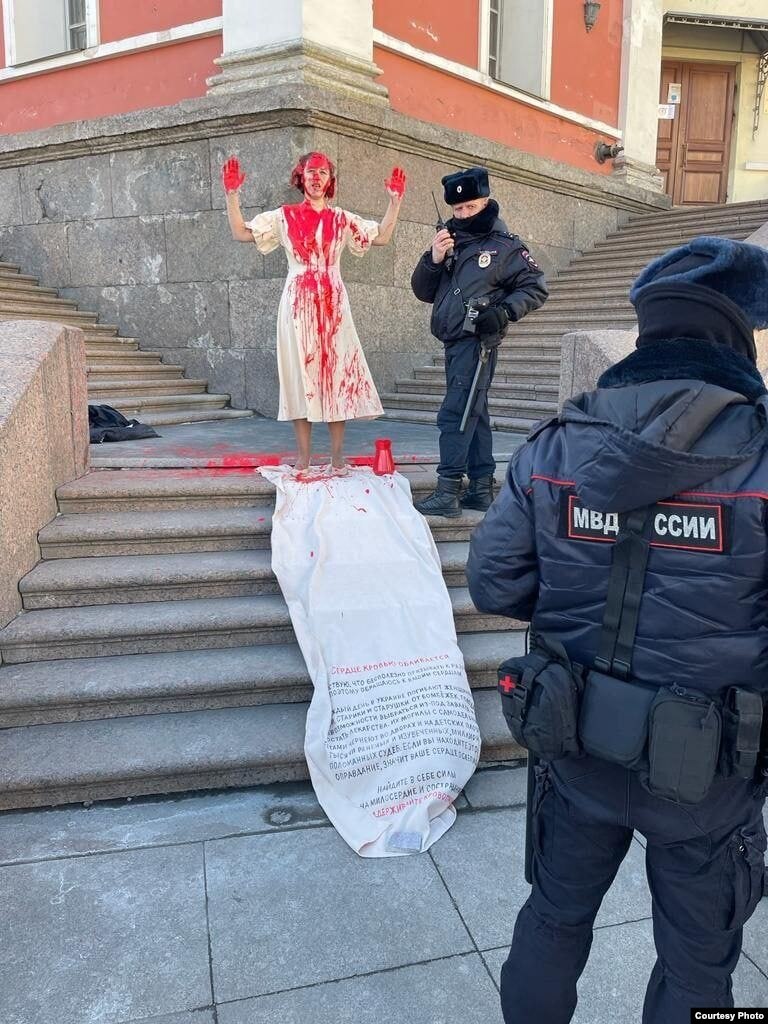
The St. Petersburg artist Yevgeny Isaeva at the end of March in the city center held a promotion in disagreement with the Russian war in Ukraine "The heart is doused with blood": the girl stood on the steps of the City Duma, dressed in a "bloodied" white dress. For the action, the artist was arrested for 8 days. North. Realia talked with Isaeva about the arrest and whether to leave now people who are opposed to the war.
After the start of the war with Ukraine, Isaeva arranged a performance in the center of St. Petersburg. She dressed in a white dress, doused with "blood". On the steps of the City Duma where Isaeva stood, she spread the canvas on which it was written: “ I feel that it is useless to call for the mind. Therefore, I turn to your hearts. Every day women, children, old people and old women die in Ukraine. From bombing, hunger, inability to get out of the blockages or get medicines. They blame their graves with homemade crosses and blackened in the yards and blackes in the yards and they are in the yards. On the playgrounds, millions of broken fate.
The action lasted only 10 minutes, the police detained Isaev, then the court arrested it for 8 days under the article on petty hooliganism. She was serving a sentence in a special -reception on Zakharyevskaya Street in St. Petersburg.
- My action "my heart is doused with blood" was for me a certain experience of freedom. Since February 24, I could not live normally, I felt bad, the first time in many years panic attacks returned to me. And this gesture, in fact, helped me myself, like a ritual - it became easier for me, ”says Evgenia Isaeva to the correspondent of the North. Realia.
-Someone continues to live as a vein-makes his projects, tries not to notice what is happening, because we do not fall rockets on the houses. How to communicate with those who have a "heart does not dousise"?
- I do not communicate with those who are not close. I am a categorical person, now for me there is black and white. My president was shot on a bridge 7 years ago ( politics of Boris Nemtsov. - SR ). I have a feeling that we live in an ancient or biblical myth, where there is a certain crystallization, the display of truth - relationships, understanding, truth. I am sure that we will survive this horror. If until February 24 it seemed to me that all this would last forever, now I am sure that no. 25 percent of Russians do not support what is happening - this is almost 35 million. And this is a lot. Propaganda is trying to convince society that people like us have gone crazy. But I did not go crazy. And the police in the department said that history would judge us and all this will happen quickly enough.
-Is art able to change something in life?
- Artists are always outrageous of public peace, even when they later become classics. Here is Dürer, for example. He was the first to make a self -portrait of Anfas. Now it is perceived for granted, and after all, only the faces of saints, not people, wrote ANFAS. He was the first to portray himself. And it was a challenge. People of art are those who set the discourse and make them indignant, think. Art and science are looking for answers to unnecessary questions. It seems to me, of course, that the imagination is still very important: people work in the system without imagination, without abstract thinking - and this is very noticeable. In the department, they tried to convince me of the one -linearity of what was happening. And I told them that there is your opinion, but there is mine, and it is different, and this is normal. And in general, it’s normal to live in a world in which different opinions - this, it seems to me, everyone needs to understand. My generation has grown in this freedom.
-Is it possible to do any projects in Russia now and not be afraid?
- We are all like hostages of the system, but if we lower our hands, then all this blackness and gray will absorb us, devour us. But there are absolute truths that we can and should talk about. Yes, to some extent, the theory of small deeds suffered a fiasco-we did, but did not do enough, since now we have it all. So you need to do it now. Now the best moment to do and not give up, help each other, and digging in yourself and a feeling of guilt, in my opinion, is unproductive.
- What are the conditions in the temporary detention center?
- In the IvS on Zakharyevskaya there was a double camera. Compared to the police department, where I spent two days, it was very good there. My neighbor was a girl who received an administrative arrest for a fight with her husband, she had a bruise under her eye. She shouted with her husband, who was given 10 days of administrative arrest. She was given seven-they fought together. We had walks there. When we walked with the girls and talked, she says: "And here we are sitting together." Girls immediately: "Did you detain you together at an anti -war rally?" She was even fastened - she was one non -political among us.
- Tell us about your family.
- On my mother’s line we have our place in the Volkovsky cemetery. The oldest grave is Apollo Apollonovich Aleksandrov, he died in 1866, and in life there was something like a manager in the Alexandrinsky Theater. In general - near art, and I have a great family story in the maternal line. Some of the relatives are from Ukraine, for example, my ancestor is the famous artist Ivan Semenovich Makukho-Makushenko, the People's Artist of Ukraine. Then the surname broke up into Makukha and Makushenko. According to my father’s ancestors ( Zhenya’s father, Maxim Isaev, artist, director, actor, playwright, founder and regular participant of the Ahe Engineering Theater. - SR ) We have a Jewish line, graves in the Preobrazhensky cemetery. There is a family legend that a young girl, the daughter of a wealthy rabbi, and a revolutionary poor Jewish young man, fled from Gomel to Petersburg - so this line began here. Family albums have been preserved at home, you look at the pre -war photographs and see how less and less men became men - repressions and war, people disappeared, died. I feel very well a two -hundred -year story of my family relations with St. Petersburg. Sitting in the IVS, I read the texts of Joseph Brodsky, he had the idea that in St. Petersburg they showed the house where Dostoevsky lived, and immediately show the house of Rustolnikov. And this is all equal - life and literature. I was lucky with teachers at school, with a teacher in literature - the Silver Age poetry was and is with me. A novel with the city is part of my myth, I draw Petersburg, I write about it, he is a friend, beloved, interlocutor for me, I feel like his part. And I have no passionarity of departure: where I was born, it came in handy there.
- To stay or leave - did you ask yourself this question?
- After the collapse of the Roman Empire, dark centuries came when writing disappeared: everything was so collapsed that people forgot how to write, forgot these signs. But then the writing returned, came again. And now it is very important to carry light through dark times. Not everyone will leave. There are children here, they will become young people. I grew up on the culture of the free nineties, the word "freedom" was everywhere, and it was a great value. And it is very important to carry this freedom. Even if everything is banned, you have to remain free.