
Translated material
"Ukraine is emerging from the slavery of the Russian world, like Jews from slavery in Egypt"
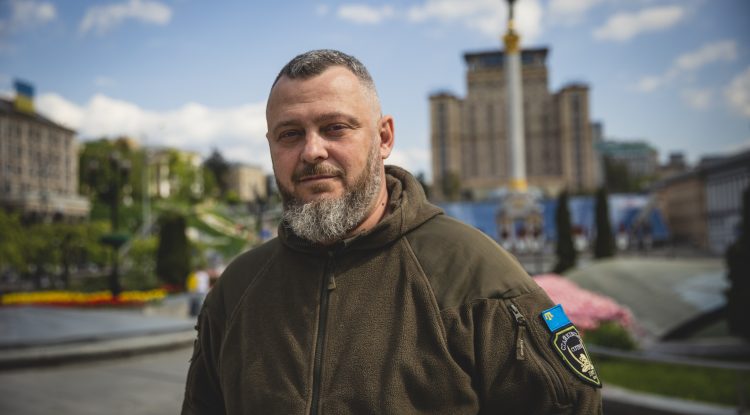
Interview with Pavel Feldbamum. He used to be the head of the Jewish community in Moscow, and now he joined the Terboron of Ukraine
After an interview with the Russian Foreign Minister Sergei Lavrov, in which he accused Jews of anti -Semitism and said that Hitler had Jewish blood, a scandal continues between Israel and Russia. Representatives of countries exchange sharp statements; The Russian Foreign Ministry, among other things, accused the Israeli authorities of not noticed "terry anti -Semitism" in Ukraine. 51-year-old Pavel Feldbbum used to be the Executive Director of the Russian Jewish Congress and the chairman of the Moscow Jewish community. In 2017, he left for Ukraine and accepted citizenship there, and after the outbreak of war he entered the territorial defense and delivered equipment through the Ukrainian troops. Taisiya Bekbulatova talked with him about the attitude towards Jews in Russia and Ukraine, friendship with Vladimir Solovyov and about the methods by which the administration of Vladimir Putin cultivated the loyal Jewish community.
You grew up in Kharkov. How was your family there?
- Both father and mother came from Kyiv - they both were born there. Father-in 1938. He was three years old when the Second World War came to the city. Two to three weeks before the events in Babi Yar ( mass executions of the civilian population, mainly Jews-approx. "Cold" ) his mother managed to evacuate with him-she was then pregnant with his younger sister. Father remembered the bombing during the evacuation and the train for life, [on which he was driving]. He got to the Urals, in Magnitogorsk, and his childhood passed there. My mother’s family was also evacuated in Magnitogorsk - there they met her father. Then they left for Kharkov - my father graduated from the institute there, I and my younger sister were born there.
We lived in Kharkov until I was nine years old. It was an ordinary childhood, mother-teacher, father-a engineer engineer. We had a Jewish family, but completely assimilated. We did not speak at home at home - dad knew him, but his mother was not.
Then the father was offered to go north to the village of Harp. So we were in Russia with the whole family. Then, of course, this was not perceived as moving to another country - they simply left north. There I graduated from school and entered the Medical Institute in Tyumen.
And how did you move to Moscow then?
- While still a student of the medical institute, I created a rather successful society of Jewish culture. In 1991-I was not even 20 then-I was elected the chairman.
We were able to build many beautiful stories. Thanks to one of them, we became quite famous in the Jewish world not only in Russia, but also beyond. It was the Khanuka festival in Siberia - I was its general producer. So I got a name, reputation. And when in 1996, Vladimir Gusinsky created the Russian Jewish Congress, I was called to the position of the executive director. So moved.
Have you encountered anti -Semitism at that time?
- I came across from childhood, as, probably, all the Jews in Soviet times. I had to prove with fists that Jews were no worse than others. At school, almost all the fights were because of this.
It was always important for me to understand what is behind this, why we meet such an attitude towards ourselves, not provoked by anything. It was strange to cause rejection, hatred, anger in the fact of its origin. Maybe if I had not encountered anti -Semitism, I would not have become all this activity.
But you nevertheless considered Russia to be the homeland?
- I come from Soviet childhood and for a long time believed that my homeland is the Soviet Union. But at the same time I always remembered that I was from Kharkov.
Then there was still a feeling of a single country. Yes, I considered Ukraine my homeland, but the fact that I lived in Russia was no problem.
And then the feeling that Russia and Ukraine disappeared is one country?
-I would say differently. The feeling of your country disappeared. In general, the feeling of the country has disappeared.
In fact, from the very arrival of Putin, I understood that we were on a very cool fracture. I no longer worked in the Russian Jewish Congress, but was the chairman of the Moscow Jewish Religious Community. And when Putin won the election, [the creator of the Russian Jewish Congress, businessman Vladimir] Gusinsky was under blow, like all his structures. We all were in the center of the confrontation.
There was a lot. For example, attempts by the raider seizure of the Jewish community of Russia. From the very beginning, the methods that they used to solve pressing problems seemed unacceptable to me. I thought we live in a free country where there are laws.
But you used to live in the USSR.
-That's the point. The Yeltsin period has become a window for us to the New World. We left Egypt, threw off the shackles of the Soviet past. It seemed to us that we live in a country that, along with the entire civilized world, goes to the future.
Many in the 1990s were faced with trials. But for me it was still an incredible life that I could not imagine in my youth. It seemed that I knew exactly why I live, there was an understanding of my mission. I was engaged in the revival of Jewish culture, self -awareness - what we were deprived of before. We wanted to create such conditions that our children could know that they are Jews, to feel like Jews, unlike us.
I could not understand how it could be that the state intervenes in our internal affairs. Not only takes a position within the Jewish conflict between different organizations, but also clears the competitive environment.
Do you mean Berla Lazar? ( In 2000, at the Congress of Jewish communities, Lazar was elected the main rabbi of Russia, although many rabbis and representatives of the communities protested and stated that he received this rank thanks to the government - approx. “Cold” ).
- Well, of course. It was the story of dirty, ugly.

That is, in the early 2000s, you all understood about the Russian authorities?
“I understood everything about her from the very beginning, from the first day.” It began in 2000. I remember how we then came to Surkov ( Vladislav Surkov worked in 2000 in 2000 - the deputy head of the presidential administration - approx. "Cold" ), along with the main rabbi of Russia Adolf Shaevich. There was still the main rabbi of Moscow Goldschmidt with us, a couple of people. And I, as the head of the Moscow community, tried to appeal to Surkov. He showed him a list of seven points that indicated that the state was roughly interfering in the life of the denomination. For some reason, it seemed that we could convey to him what was happening, he was a sane person, not so long ago was a manager in Yukos.
Surkov listened carefully and with a grin, with a cynical grimace said: “Yes, you are absolutely right, everything is so. And this is our position, so it will be. We do what we consider necessary, and we will do what we consider necessary. ”
Have you once announced about this story publicly?
- Of course not. What could we declare? I probably tell you about this meeting first. But we publicly spoke about the intervention of the state, it was openly discussed in the media, there was a scandal. But this did not lead to anything, they really did what they wanted. Alexander Voloshin was then the head of the presidential administration, and he called the governors and demanded that they solve issues, transferred the property to “correct” Jewish organizations.
Why did the authorities pay such attention to Jews?
- Putin was very serious about this from the very beginning.
Because you considered them force?
- Certainly. I remember how in 1999 the cadence of the Israeli ambassador Zvi Magen ended. Then they arranged a solemn reception in some hotel-maybe in National. And Putin comes to this event. One, without protection. It was important for him to come for this farewell, the last appointment at the ambassador. He modestly looked at the door, invited the ambassador, and they stood for a long time about something together.
I don’t know how much this is a sign story, but it seemed strange to me. What can the director of the FSB want from the Israeli ambassador? I think the Jewish theme has always had some kind of sacred meaning for him.
What happened to you later, after 2000?
- By 2003, I was already a famous Jewish figure, the head of the community. We implemented many successful projects, worked on a large -scale reconstruction of the synagogue and on the project of a large communal complex - it remained unrealized.
Once the guys came in gray overcoats [from Russian special services]. We generally supported the communication on security issues with them. For example, when they held a giant rally in support of Israel in the center of Moscow, they talked with the police and the FSB on how to avoid provocations.
But that time they came after another. They wanted me to sign a document that I would cooperate with them. They said: "This does not mean anything, just a formality." I replied that, of course, I would not sign anything like this. That, given the whole history of this department, our interaction is possible only in line with specific safety issues.
After some time, they came already with some of their bosses. All this was in a friendly manner, with a bottle of a plum. And again they say: "Sign, please." I refused them already in a stronger form. And after some time, a campaign began to remove me from office - in the best traditions of this department. Anonymous letters, collection of signatures of employees with claims, accusations. What was not accused of me. It was a dirty, vile campaign, and it naturally led to the fact that I was forced to leave.
What then did you do, business?
- No, I created my public projects. It was always more interesting to me than business. For me, money has never been a goal. The meanings were much more important. I headed the Moscow McCabi - this is such a Jewish sports club.
Among my friends at that time there were cannibalists such as [Prochrevsky political scientist Evgeny] Satanovsky or, for example, in my football team for many years was played by an evening mudin.
Vladimir Soloviev played in your team?
- Yes. He is a Jew, he constantly emphasizes this, trumps it. He was my friend, he did not look like a cannibal then.
What's happened?
- Greed, apparently. I quickly realized that he, of course, was not a journalist and would take any position for which he will be paid well. But what he has turned into today is just misfortune.
When was the last time you talked?
- Many years ago.
Was all your projects tied to Jewry?
- Not only on him. But one way or another they were connected with him, yes. This is what I have been living for many years for many years. It was important for me not so much the creation of Jewish institutions as the image of the Jewish community in the non -Jewish environment. Therefore, the things that I tried to do were directed not only to Jews, but also to non -Jews.
I do the same here in Ukraine. It is very important for me today that people perceive Jews - at least Ukrainian Jews - as those who protect the country shoulder to shoulder with Ukrainians. It was always significant for me what the Jewish community looks like from an image point of view.
In 2017, we went to the ATO zone in Passah, brought Matsu. We talked with Jewish fighters. Including Tyira, she has Jewish roots ( Julia Paevskaya - a famous paramedic and Ukrainian volunteer. Thaira - her call sign. - Approx. "Cold" .). All these years, she took the wounded from the battlefield - under bullets, under shelling. And now she is captured, and this is a huge trouble. They will not let her go so easily. You have to do something with this. Taking this opportunity, I want to turn to the leaders of international Jewish organizations-maybe they will somehow affect the situation.
By the way, today, too, I have a box with Matsu with me. At Pesas, I handed it to our soldiers who came for body armor. They arrived right with the advanced. Today, the parallels that we always carried out have become obvious to all. Parallels with exit from slavery in Egypt. So Ukraine emerges from the slavery of the Russian world, throwing off the terrible heritage.

Therefore, you signed up for the forces of territorial defense?
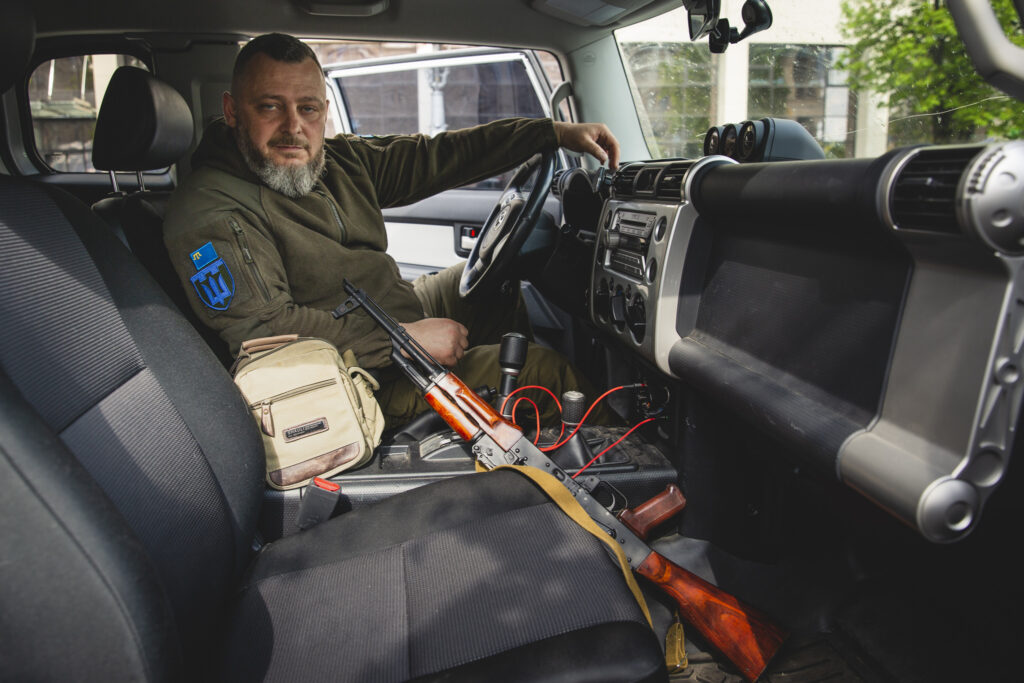
-I signed up simply because I can’t do otherwise. Now I have to do something every minute. I never had to work so intensively on any task. But I am not involved in the fighting directly, although I always have a weapon with me.
Do you supply body vests and equipment for soldiers?
- We will not discuss why this happened, but today there is a tremendous lack of the most elementary things necessary for those who are in the trenches. This is a disaster. Therefore, everyone who can do something is trying to do something. This is not only my condition, but also most Ukrainian patriots.
You are not talking about the causes of deficiency, because now is not the time to criticize the authorities?
- Yes.
And how did you relate to Zelensky before?
- Extremely negative.
And now?
- Let's just say, in my attitude to him little has changed. But I do not consider it possible to talk about it today.
Do you collect money for deliveries or use income from your business?
-Firstly, I already invested my money in this-everything that was. Secondly-as they say, never ask for anything, they will come and give them themselves. I have no need to contact someone, people call me and offer support-financial and any other.
The Heritage of the Future is my fund. Many people know me, so they are ready to help me through me. Today my task is to physically have time to use the resources that we receive. Today it is not so easy to buy the necessary things - even for money. Each step is given with a creak, with the tension of strength. But we continue to supply cars, body armor, drones. More than two hundred bulletproof vests have been put. We bought four cars for the front, two serious drones - one for 24 thousand dollars, the second for 12 thousand. More radio stations, thermal imagers that already save lives. Israeli funds for the treatment of wounds for 220 thousand euros.
Can you talk about your departure from Russia? It was in 2017, that is, not immediately after the Crimea? Why did you still stay for some time?
- It was a difficult compromise. Of course, I wanted to leave right away, for me the annexation of Crimea became a point of no return. But I myself then agreed with myself that I would stay. Including because of children.
Is your ex -wife a Russian woman?
- Yes. She is now in Moscow.
Have you had to get a divorce due to departure?
- When I left, we had an agreement that the family would come to me later. But then the wife decided to stay. Then it turned out that we have radically different views on the world.
Does she support Putin?
- She is not that for Putin, but she is part of the Russian world, she is for Russia. He believes that the state is one thing, and the country is another.
Do you think so?
- Of course not. I used to think: maybe really, there is such a power in propaganda that makes people go crazy, lose human appearance, dignity. And then I wondered what was primary - the power of propaganda or a request from society?
Today I have no doubt that I know the answer. If there were no Putin, there would be someone else. There was a public request for what is happening now. We see total support.
Why do you think it is total?
- I see it.
But you do not live there.
- Yes, but I communicate with people from there. I see social networks, discussions, humiliating silence of people. Even those who would like to make a protest experience animal horror before saying a word, with a very rare exception.
But you know that in the dictatorship people are afraid for themselves, for their loved ones.
- There was always the opportunity to leave. Who prevents you from leaving today?
Don't you think this is a question of privileges? Someone has parents, for example.
- These are all excuses. You can explain anything.
Well, but if all this is a request from society, then how did society come to this?
- It has always been. Russians are a white race. The rest are chocks, crests, Jews. This is fascism, which is in the blood of Russians.
I have a friend, Auder Muzhdabaev ( the former deputy head of the Moscow Komsomolets, now works in Ukraine on the Crimean Tatar television channel ATR - approx. “Cold” ), who says that those who remain in Russia are like a cucumber in brine. You can be the hardest and most pimpled, but you still suck in the same way as the rest.
There are those who are not sucked.
“But do we see people who say something out loud?”
Yes.
- By the way, this was the meaning of my compromise with me in 2014. I said that I stay, but on condition that I will speak loudly, aloud everything that I think about Russia, war, annexation, Ukraine. I have a blog on Echo of Moscow. By that time, I had already moved away from any social activity, since somewhere since 2010 it was clear that it was possible only on condition that you were ready to become part of the system.
And what have you done these seven years-from 2010 to 2017?
- Just went to business, went to work in a large American biotechnological company. I am a doctor by education, graduated from a medical institute. I did not work as a doctor for one day, but my diploma turned out to be in demand. I had a good job, in material terms everything became better than ever.
What was your position?
- I was engaged in promotion - it was what is called the Market Access in the farm.
It is close to GR. Have you had to communicate with the local authorities, governors?
- It was necessary, but mainly with the heads of regional administrations who are responsible for social policy. But there were no moral and ethical problems, we were not talking about politics.
And yet I felt terribly. Firstly, because he remained in Russia and saw everything that was happening. И, конечно, у меня не было удовлетворения от работы.
В то время публицистическая активность для меня была отдушиной. Я получал удовольствие, когда мог высказаться и видел, что кто-то меня читает, реагирует. А вот все остальное было невыносимо, и в какой-то момент я понял, что нужно принимать решение. Потом я дал интервью [украинскому журналисту] Роме Цимбалюку, пошли какие-то перепечатки, публикации про это…
Угроз не было?
— Были какие-то завуалированные. Но в целом мне было понятно, к чему все идет. У меня не было сомнений, что рано или поздно все закончится именно тем, что мы сейчас переживаем.
War?
- Yes.
Где вы были, когда она началась?
- At home. Я купил дом в Киевской области за две недели до этого.
Вы радуетесь, когда видите на фото убитых русских военных?
— Как можно не радоваться, когда погибает твой враг? Это люди, которые пришли за твоей жизнью, жизнью твоих друзей, твоих родных и близких. На твою землю. Какие могут эмоции, какие могут быть сантименты?
У вас не осталось вообще никакой симпатии к России, к тем местам, где вы жили?
— Нет, абсолютно, у меня нет никаких сантиментов к этой стране. К счастью, моя старшая дочь давно в Израиле, средняя дочь — в Латвии. Уже даже внучка в Израиле. У меня пятеро детей, но от разных браков.
В Украине не осуждали вас за то, что вы не уехали сразу после аннексии Крыма?
— Нет, такой вопрос не стоял. Все знали мою позицию. Я до 2017-го постоянно сюда приезжал. И мое окружение здесь — это во многом россияне, которые тоже уехали. Всем было понятно, что я — часть Украины, даже когда оставался в России.
Через год-полтора после переезда я уже говорил на украинском, хоть и с большим трудом. К тому моменту я уже был гражданином Украины — сразу подал документы, когда приехал, и отказался от российского паспорта.
Вы сталкивались с антисемитизмом в Украине?
— Есть какие-то отдельные проявления, как и везде. Может, пару раз кто-то что-то сказал. Для меня слово «жид» всегда как красная тряпка, я готов бить в морду. Несколько раз его слышал. Но сегодня я понимаю, что, например, в Польше это слово никакой негативной коннотации не имеет. Его может произнести израильский посол на мероприятии в память о Варшавском гетто.
В Западной Украине это слово тоже часто употребляется без негативной коннотации. Но я его не могу воспринимать спокойно — видимо, в силу каких-то рефлексов.
Но реального антисемитизма в Украине нет. Есть только попытки представить Украину антисемитской, ксенофобской, фашистской страной.
В каких местах после оккупации вы были?
— Я бывал в Буче, в разных селах. Конечно, это страшно. Помню, как я раньше приезжал в Освенцим и задавался вопросом: как вообще это могло происходить, почему всевышний это допустил? И мне казалось — может быть, это было для того, чтобы общество осознало, что подобное никогда не должно повторяться. Может, эти люди ушли, чтобы у следующих поколений была возможность жить мирно.
А теперь мы видим, что все вернулось. Те же методы, тот же геноцид, тот же Холокост. Когда тебя убивают за то, что ты еврей или украинец, и нет ни одной другой причины. Что это, если не геноцид?