
Translated material
Transnistria is not the DPR and LPR. What scenarios can develop the situation in an unrecognized republic
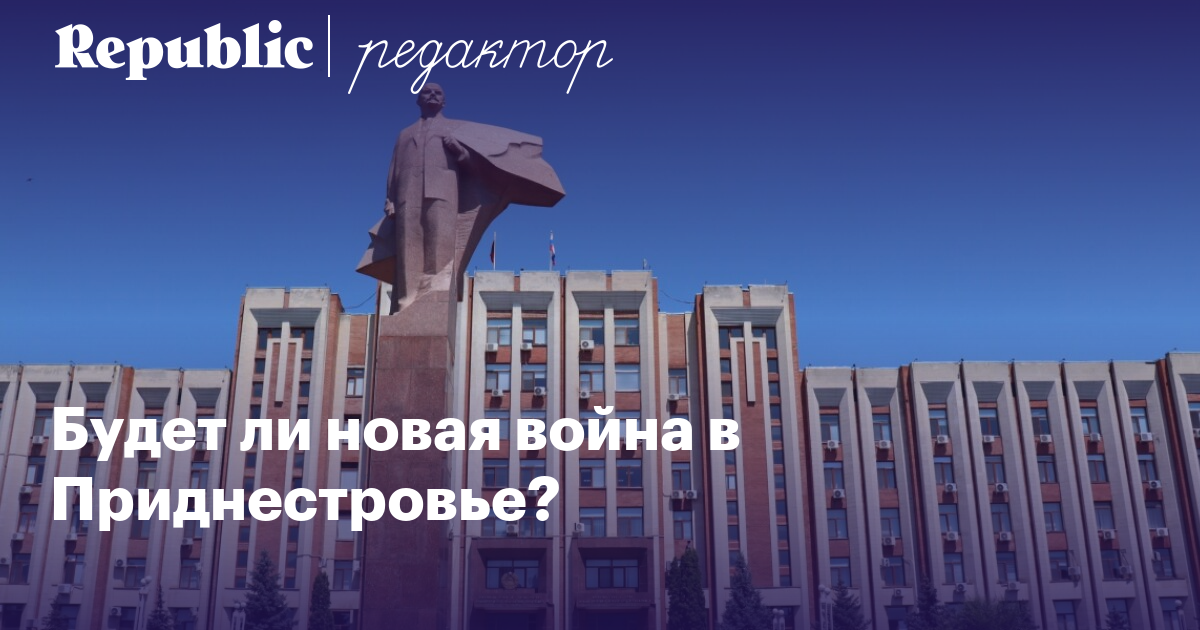
Three explosions per day - the Easter holidays in Transnistria ended so anxiously. On April 25 and 26, on the territory of the unrecognized Transnistrian Moldavian Republic, unknown people fired from the RPG building of the Ministry of State Security of Transnistria, mined and blew up two radio operating towers in the village of Mayak, and the drone dropped an explosive device into a military airfield next to the village of Parkana. Fortunately, there are no victims: in the MGB there was a day off that day, the inhabitants of the Mayak village were frightened, but not indifferent, even the runway is not damaged. The method of conducting “terrorist attacks” and the very goals of attacks cause a number of perplexed questions from the series “What was it?”. In the region, the “red code” of the terrorist threat was announced for 15 days, mass celebrations on May 9 were canceled, checkpoints and inspection of cars at the entrance and exit were strengthened. For more than 30 years, explosions of shells have not announced this territory. To whom and for what reasons does the world interfere with the banks of the Dniester and - most importantly - what can these events lead to? Let's try to figure it out.
From the first days of the war in Ukraine, the official positions of the leadership of Moldova and the unrecognized Transnistria sounded in unison: military neutrality, the priority of the peaceful political settlement of the Transnistrian issue, the reception of Ukrainian refugees and all -round assistance to the victims. However, two months lived next to the flaming Ukraine clearly laid out a heavy imprint on the long history of the ideological confrontation of Chisinau and Tiraspol. The nerves are handed over, the situation is aggravated. Foreign allies of Moldova - the United States and the UK, as well as Ukrainian politicians and Russian “unofficial speakers” like the CVO of Rustam Minnecaev, add oils into the fire. A series of explosions in Transnistria has not yet become an impetus for the real exacerbation of the conflict, but the situation is actually intense.
"Transnistria - not Donbass"
So anyone will tell you in Transnistria. For the inhabitants of the region, from their point of view, there is a similarity, but only one thing - the consonance of the names of the self -proclaimed republics of the PMR (Transnistrian Moldavian Republic), the DPR and the LPR. All similarities end on this, because from the point of view of the Transnistrians, the military intervention of Russia in 1992 really became a salvation. And this intervention was not initial: in the early days of the conflict, the Russian military units, based in Transnistria, were inactive. Locals recall that BTRs and tanks sent Chisinau to his own region. In the collective memory of local conflict, this is a terrible time when the Baltic snipers shot from the roofs of high -rise buildings on civilians (historians and journalists argue about the reality of this episode. - Republic ), and part of the Romanian elite succumbed to nationalist fever and used slogans like “Satyodan, Station, Russia”. For 30 years, official Chisinau did not apologize for the policy of Mirchi Snegur regarding the civilian population of the left bank, so distrust has been preserved.
No matter how emotional the “popular” Transnistrian discourse about the causes of the war on the Dniester, the truth, as always, is somewhere nearby. To begin with, more than 30 years ago, the situation in the region and in the world was different. The Moscow elites, apparently, did not plan the creation of Transnistria, and the trigger for the separation of the Left Bank from Moldova became an avalanche developing Moldavian nationalism - the most paradoxical in the entire post -Soviet “parade of sovereignty”. While the small peoples of the USSR energetically began to build their national states, Moldova decided to join Romania, at that time one of the poorest countries in Europe. By the way, to this day, Moldovan political elites are not so united in this zeal, there are rather strong “centrists”, confident that Moldova is an independent state and should remain such.
Monument to Russian soldiers in Transnistria
Hannah Wagner / DPA / Global Look Press
The movement towards Independence from Chisinau arose as a protest against Romanization, and it seems that the leaders of the “resistance” themselves did not have the original goal to create a state. The redistribution of industrial assets of the Left Bank took place in a chaos situation, which came after unexpected collapse of the USSR for many. Natives oriented to Moscow from Russia, the “director” from the left bank - Smirnov and Ko - without much enthusiasm reacted to the idea of the Romanian -speaking Chisinau to join Romania. They also did not want to give a jointly acquired property. Everything else is just ideological lace on the ugly sundress of a banal economic deed, coupled with the uncertainty of wartime.
The conflict ended largely due to the personal intervention of General Alexander Lebed, he is considered a hero in an unrecognized republic. Since then, the shots on the Dniester fell silent for a long 32 years, which cannot be said about mutual reproaches, accusations and endless “antipaganda” on both sides. The Left Bank is used to living in an atmosphere of constant threat from the Romanian nationalists. This stamp is part of the local political culture, official state rhetoric with the classic image of an external enemy, forever protest elections and the philosophy of survival.
The syndrome of the besieged fortress is also reinforced by real, which took place in the history of the region, economic locks from Ukraine and Moldova. Official Chisinau is contradictory: on the one hand, he believes that Transnistria is Moldova, on the other hand, with the opinions and moods of the Transnistrians, he does not consider direct negotiations with the territory. The author had to hear and read private opinions about the PMR as a fragment of a scoop that prevents Moldova’s entry into the EU.
Official Chisinau receives European and American grants and loans to resolve the conflict, building democracy, and is also periodically alarming that Russia will begin to save a small but proud Transnistrian people. It should be noted that all these fears concern the most popular political discourse, propaganda, and at the household level, people who speak different languages get along well with each other. Moreover, the level of distrust of their own politicians is equally high on both banks of the Dniester, although, for obvious reasons, you will not see any surveys on this topic.
Coat of arms of the Transnistrian Moldavian Republic
Hannah Wagner / DPA / Global Look Press
Subscribe to read the whole
Make a subscription Redefine.media to read Republic
Subscribe [you can pay for a Russian or foreign card. The subscription is extended automatically. You can unsubscribe at any time.]
Where are the money subscribers going