
Translated material
Now you know how life works
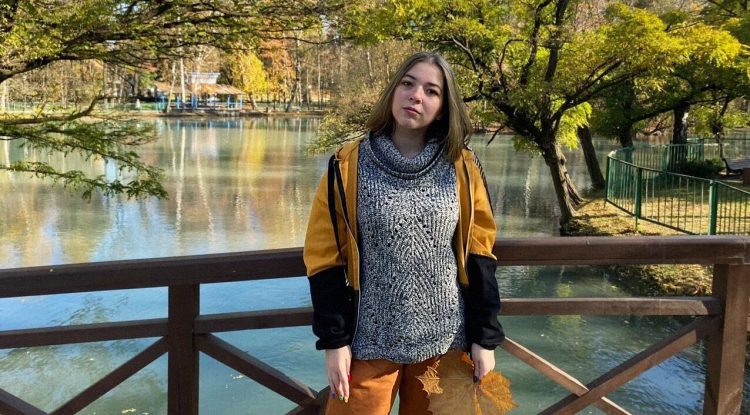
A denunciation was written on a student at the journalism department of Moscow State University. It turned out that she knew the author
With the outbreak of war in the educational environment, they began to more closely monitor the dissenters. Dessions of teachers and political pressure on students became frequent. In April, the 22-year-old teacher of the Media Class project at the Moscow school, Maria Gabisova, found out that she complained about her at the Department of Education. A certain “Ivanov Ivan Ivanovich” wrote that she communicates with schoolchildren on political topics and conducts sex loser. "Cold" tells the story of a young teacher and a person who came to her.
They wrote to you
On April 12, the 22-year-old teacher Maria Gabisova was called to the school to sign documents. The request looked so typical that she does not even remember what papers were talking about-teachers are all the time asking to sign something. Atypical, however, was the tone of the administration. According to him, the girl realized that she had a "serious conversation." She went to school with her best friend Nikita Kulikov.
Back in the fall of 2021, Gabisova, being a fourth -year student at the Faculty of Journalism of Moscow State University, got a job as a specialist in public relations in one of the Moscow schools ( we know her number, but at the request of the heroine we do not call him. - approx. “Kholoda” ). At that time, the Moscow Education Department launched the Media Class project, and they began to involve journalists in schools in schools. So Gabisova began to combine the work of a specialist in public relations with teaching journalism to students of the sixth and eight classes. Kulikov was engaged in the same school.
“Maria Sergeevna, they wrote to you,” a colleague met Gabisov with such words when she came to school on April 12 to sign documents.
They put the papers in front of her: two sheets with the order of the Moscow government that the authorities should notify schools when complaints about teachers come to the Department of Education, the text of the complaint and prints of Gabisova tweets about work at school.
In one of the tweets, she wrote that she spoke with a seventh grader about contraceptives. According to Maria, somehow in her free time from lessons, she talked with students-they talked about the series, and one student asked: “How do they show sex without pregnancy in the series? My parents told me that after any sexual intercourse there was a pregnancy and there is no other option. ”
“And all the schoolchildren looked at her like that, they say,“ well, what are you, ”the teacher recalls. - And one of the girls began to tell her about contraceptives. I added that there are contraceptives [drugs] and that it is extremely important to make sure that any romantic experience is to make sure that next to you is a person whom you can trust. It is not known which guy will come across to her in the future and that he will say to her. She will know better about this now, at 13-14, from an authoritative person, what she does not recognize at all. ”
Gabisova emphasizes that this conversation was not injured, there were no details in it. “Seventh graders are girls who watch the series“ Euphoria ”,“ Sexual Education ”, they have“ Netflix ”at hand. Not that I am the first to share this information with them, ”she adds.
The remaining tweets that quoted in a complaint to Gabisov were devoted to personal and school issues. For example, in one she wrote that teachers “need to lag behind children with claims about hair color, long nails and so on, give them freedom of expression, and not drive into strict framework”. In another, she was indignant that on March 24 they and Kulikov were reduced from the post of specialists in public relations to teachers in additional education, reducing the salary from 40-50 thousand rubles to 6-10 thousand per month.
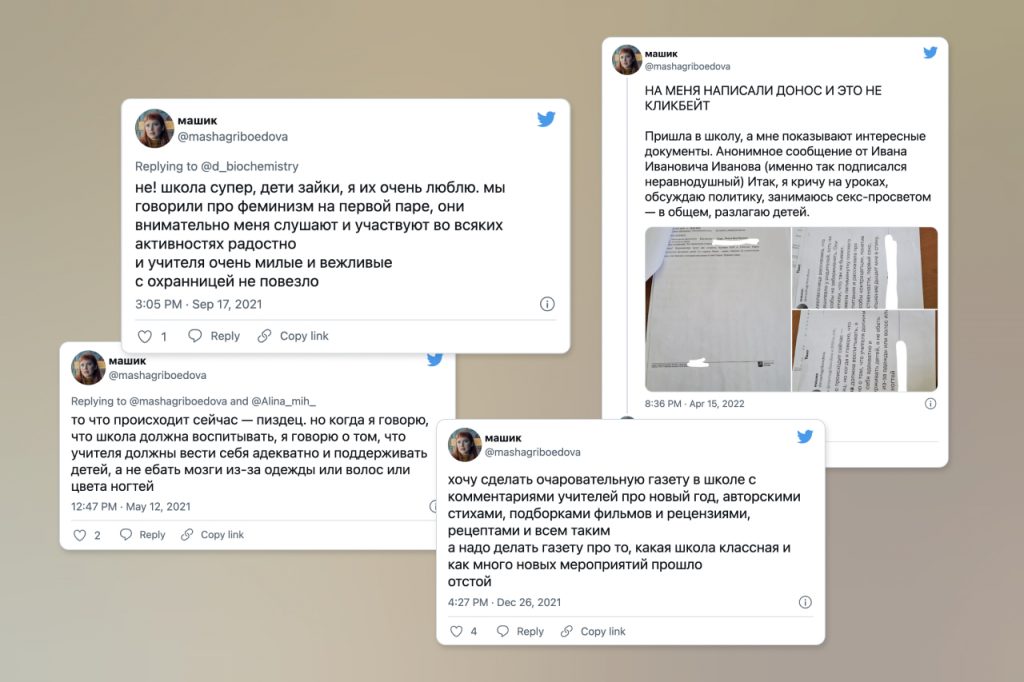
In addition to the prints of Twitov, a certain “Ivanov Ivan Ivanovich” wrote: “What is happening at the Moscow school? Two students of Gabisova Maria and Kulikov Nikita lead journalism, they practically decompose children. From Masha-screams, communication on political topics, a sex loser, which she writes about on Twitters. Take measures. "
Gabisova asked a colleague who showed her a denunciation what this means, and then began to laugh. “I have such a protective reaction - I begin to giggle. But I look at my best friend, and he looks at me in a wisely, ”she says.
The teacher was asked to write an explanatory. She wrote that the information indicated by Ivan Ivanovich is slander. The representative of the school administration advised her to change the avatar on Twitter, on which there was her photograph, and to rub the records, and also said that, perhaps, the scammer would begin to look after her, "he would still look for something to annoy."
About who was hiding behind the name “Ivanov Ivan Ivanovich”, Gabisov had no idea.
Act on fan
With the outbreak of war, the Russians began to convey more often to each other. The reason for denunciations, as a rule, is a different opinion about the war in Ukraine. The Russians are handing over to the security forces of neighbors who decorate the balconies with yellow and blue ribbons, complain of colleagues that break the letters Z, which are pasted in public spaces. It comes to denunciations for relatives.
In April, the artist and activist Sasha Skochilenko was arrested after the elderly customer of the “Crossroads”, in which Skochilenko replaced the price tag with information about the bombing of the art school in Mariupol. The buyer informed the supermarket for this, but, not seeing any reaction from them, went to the police with this leaflet. Now Skochilenko is accused of spreading fakes about the Russian army. She threatens from 5 to 10 years in prison.
Democents are not just a private initiative, in Russia there are projects that stimulate them. On March 21, the Party “Fair Russia - For Truth” launched a site where citizens can complain about actions that harm the country. The initiator of the project, State Duma deputy Dmitry Kuznetsov, announcing the launch of the resource, said that the site was needed to “configure the state’s personnel policy to the patriotic wave”. “This is not about cleaning, this is about love for the country,” he explained.
Another initiative is from the authorities of the Kaliningrad region. On March 16, residents of the region began to receive SMS from the Ministry of Emergencies, signed by the Government of the region, in which citizens were called to convey fakes to the distributors of Russia about the military operations of Russia in Ukraine. Complaints were proposed to be sent through a bot in a telegram. Similar bots "Mediazona" found in several other regions of Russia.
The head of the legal department of the OVD-Info, Alexander Baeva, says that the idea of the possibility of denunciation does not occur to people in itself-it is broadcast by the authorities, and people read it as a call to action: “We understand that repressive practices are created not only by the hands of law enforcement officers and people working in state structures. Ordinary citizens also participate in this-someone sincerely, someone under pressure, but repressions are also made by their hands too. ”
The media have already written a lot about denunciations in schools and universities. For example, in Penza, eighth graders complained about English teacher Irina Gene. Explaining the student athletes why she could not go to the Czech Republic, the gene said that in Russia a totalitarian regime. Pupils handed over to the police an audio recording of the lesson, and a criminal case of "fakes" was brought to the teacher.
And in the RANEPA, one of the elders proposed to report to teachers with an anti -war position. As an example, she cited a situation in which the teacher, in response to the question of the development of biological weapons in Ukraine, hinted that these were fairy tales.
Schools are lowered to the manuals on how to talk about the war in Ukraine, and demand from teachers to report on conducting such lessons. They have not agreed with such a policy.
The site Radio France Internationalale, citing an anonymous sociologist, teacher of a large Moscow university, wrote that children do not report for ideological reasons, but act simply “fan”. “This is an insufficient, situational action, and this is terrible. Any conscious political position can be opposed to something as an argument. And it is impossible to interact with this behavior, nothing is worth it, ”said an anonymous sociologist.
Very strong self -censorship
Maria Gabisova, according to her, always wanted to teach. She learned to get along with her children back in her native Vladikavkaz: she raised her younger brothers, fiddled with cousins and sisters. Work at school for her was a "naive return to childhood."
“Communicating with children, you can return yourself at that time. We somehow arranged a free letter session in the classroom-we had to write the first thing that came to mind. And one girl wrote: “Everything is fine with me, I am glad for everything, I look out the window - there are the sun, birds sing.” I read this and almost burst into tears - such a bright person, ”says Gabisova. -Someone in such texts was worried about the fact that he makes the bridge the worst of all or older than everyone else in the classroom. So charming children, constant tenderness. ”
The seventh grade student, where Maria’s journalism, Aika taught ( we know her last name, but we do not call her ethical reasons. - Approx. “Cold” ) says that none of the children complained about the lessons of Gabisova and Kulikov: “I liked to sit in their lessons - you feel with them in the same wavelength, everything is always clear and affordable. You are never ashamed to ask or express something. They will understand and support. ” Only once in half a year of teaching Gabisov, she said in her class, “usually everything ended on her signature gaze,” after which the tramples fell silent. There were never screams about which were written in denunciation.
“Maria Sergeevna asked us whether it is interesting for us to plunge into the world of media, whether we want to hear about it at all. The students always reacted calmly. And why are they afraid or angry? Everything is neutral and delicate. There were times when we did not want to discuss politics, because we talked about this from each iron. We asked - we heard us. And while there was some kind of kipish around the world, we had a pleasant atmosphere in our lessons, ”says Aika.
Gabisova believed that the teacher not only teaches the subject, but also becomes a conductor, a translator of life wisdom. When in her fourth year of undergraduate she turned up the opportunity to work at school, she "was very happy, was happy, almost ran, jumped and jumped with joy."
She was already familiar with some children from school - she was invited to talk about Tiktok, which she studied in Novaya Gazeta. “I understood that this was working with adolescents and I need to restrain myself, did not impose my opinion on them, filtered the information. I could say: “Read the independent media and then draw independent conclusions,” says Gabisova.
According to her, she has a “very strong self -censorship”: “I am now making one podcast, and colleagues suggested calling the guys from Doxa to recording. I say: “They are political prisoners. How will we talk to them?” They answer me: "Normally." And I understand that I’m no longer at school and not at the journalism faculty, and I can offer any guest whom I want and will accept him, but this thought does not fit in my head. ” She realizes that at the school “selected words” - “Especially after February 24, every word went with a creak.”

Even before they reported to Gabisov, she listened to the lectures of political scientist Ekaterina Shulman about reporting. She understood that after February 24, people constantly complain about each other, and she was afraid that they could also tell something about her.
“I recently interviewed the historian, and she said that [gloomy Seven -age] (https://ru.wikipedia.org/wiki/%D0%9C%D1%80%D0%B0%D1%87%D 0%BD%D0%BE%D0%B5_%D1%81%D0%B5%D0%BC%D0%B8%D0%BB%D0%B5%D1%82%D0%B8%D 0%B5#: ~: Text =%D0%9C%D1%80%D0%B0%CC%81%D1%87%D0%BD%D0%BE%D0%B5%20%D1 %81%D0%B5%D0%BC%D0%B8%D0%BB%D0%B5%CC%81%D1%82%D0%B8%D0%B5%20 (1848%E 2%80%941855%20%D0%B3%D0%BE%D0%B4%D1%8B,%D1%83%D1%81%D0%B8%D0%BB%D0% B5%D0%BD%D0%B8%D0%B5%20%D0%BF%D0%BE%D0%B4%D0%B0%D0%B2%D0%BB%D0%B5%D 0%BD%D0%B8%D1%8F%20%D0%B8%D0%BD%D0%B0%D0%D0%D0%BE%D0%BC%D1%8B%D1%81 %D0%BB%D0%B8%D1%8F%20%D0%B2%20%D0%A0%D0%BE%D1%81%D1%D0%B8%D0%B8.) I thought: “My God, however, it seemed to me that the denunciations are something distant, for others, for people, more significant than me, I still have a small one, that I am almost a child. She considered herself an adult - this is when the children approached me with questions, ”she says.
Better to quit now
Questions children asked Mary often. In journalism lessons, he and Kulikov had a tradition: in order to teach children to read news, teachers every Thursday asked who the news liked the most in a week. “They discussed the source that there was a fact and what is an opinion. They dismantled the bones, ”recalls Gabisova.
Once, after discussing news, students began a dispute about whose Crimea. “I did not tell them my position, only explained that before you conduct some discussion, you need to find out a sufficient amount of information to use it, and not just screaming at each other, based on someone’s beliefs. I respect your every position, it makes no difference to me, but I don’t need to talk just like that - it's strange and stupid. Some of the children came to the lesson with the words: “So we read in Meduza,” and someone sacredly believed RIA Novosti, RT, the first channel, ”she says.
However, despite the pleasant emotions that teaching was given to her, against the backdrop of the war, Gabisov was thinking about dismissal, because "it is impossible to look in the eyes and say things that you do not believe in, and the things you believe in can not be pronounced." The abbreviation through which he and his colleague passed at the end of March was also embarrassed. The explanatory that had to be written after a letter from the Moscow Department of Education became the last straw and pushed the teacher to dismiss.
According to Maria, the denunciation hit her strongly. Since the beginning of the war, she already had a “dumb feeling that nobody should be trusted at all.” Having quarreled with the mother, who works in the Ministry of Internal Affairs, because of various political positions, she felt unsafe, she was afraid that her mother could inform someone about this conversation. “But now I realized that I was in vain offended by my mother, she supported me in the situation with a denunciation,” she says.
It is usually not easy to quit the state institution: the administration of schools, as a rule, asks employees to be finalized before the end of the year, since it is difficult to find a replacement and issue all the necessary documents. Nevertheless, the head teacher hinted at Gabisova that she was better off to quit now, because she “needs to be taken out of the review” of the scammer. Maria took a hint and wrote a letter of resignation of her own free will. She does not believe that at school she was somehow crushed, she says that "she herself was in such a state that she readily wrote this statement."
“The salary was still reduced. I have a graduation year at the university. It is difficult to stay at school when terrible things happen in the world, and besides, after this complaint, I wanted to leave, close in the room and do nothing else. I had the feeling that they would begin to pursue me and everything will be very bad that I need to go somewhere very far-to another country, ”says Gabisova. It seemed to her that she was being haunted by a “male state ”, or she would soon start a FSB.
At the same time, at the school, according to Gabisova, they reacted to the complaint adequately: the colleagues supported her and said that probably not teachers and parents, but one of her friends reported her. “I immediately thought one person, but then I threw this idea. I was sure that I did not have such people surrounded that could convey, ”she recalls.
Ivan Ivanovich Ivanov - this is me
All this time, Maria continued to go to the university. The academic year at the journalism faculty was drawing to a close, but Gabisova had obligations as the head of the student council. After dismissal, she spoke in the Studsite about the situation at school.
“My reaction to experience is to throw out everything, tell everyone. I need to share so many times so that on the 20th it becomes easier for me. Among those who listened to my story, there was a student to whom I thought he could convey, but discarded this idea. We were friends with him before, and then the relationship was greatly deteriorated. He joked something that day about the denunciation, I did not pay attention, ”she says.
In the evening of the same day, Gabisova, along with Nikita Kulikov, watched the series. Suddenly, that student - Anton called her ( his name was changed at the request of the heroine. - Approx. "Cold" ). “I was taken aback because we had such a relationship that he would just not call me. While I was thinking whether to take or not pick up the phone, the call broke off. But I decided to call back, because there could be something urgent-suddenly someone is going to make a suicide in the hostel, and he calls me as the chairman of the student council. It was the most probable alignment, because in order for him to call me, there should be a situation of life and death, ”continues Gabisova.
Having called back, she heard: “Sorry, I decided to admit. Ivan Ivanovich Ivanov, who wrote a report on you, is me. ”
From the shock, Gabisov did not remember how Anton explained his act, she only remembers that he apologized and that he was saying something about anxiety for schoolchildren. “And I, to be honest, is grateful for this call. Во-первых, я не хочу, чтобы люди попадали в неприятные ситуации, и мне его даже жалко в какой-то мере. Во-вторых, если бы он не позвонил, я бы продолжала думать, что меня пасут, все плохо. Я себя накрутила по полной. Но он признался, и я такая: “Окей, это просто междусобойчик из-за прошлых событий”».
Осенью 2021 года, когда Мария пошла преподавать в школу, у нее с Антоном случился конфликт. «Звучит как несчастная история любви, но на самом деле я просто обошла его на выборах в студсовет», — шутит она.
Антон до начала учебного года 2021/2022 был председателем студсовета журфака и на очередных выборах выдвигался на второй срок. На факультете о нем говорят как об очень серьезном, собранном человеке, для которого важны «всякие бумажки, правила и регламенты». По словам зампреда студсовета Майи Шкапиной, и администрация факультета, и его однокурсники считали Антона хорошим студентом, который много делает для факультета. При этом студсовет при нем чаще соглашался с мнением администрации журфака, чем со студентами.
Габисова хотела преобразить студсовет, сделать его либеральнее и поэтому решила выдвинуть свою кандидатуру. У нее были хорошие отношения с Антоном и поэтому она решила, что будет этично предупредить его о своем выдвижении. Габисова позвонила ему, но, по ее словам, Антон воспринял ее выдвижение как оскорбление.
На выборах большинство студентов проголосовало за Габисову, и она стала новым председателем. Антон остался в составе студсовета и продолжил общаться с Марией по учебным делам, но их отношения стали напряженными.
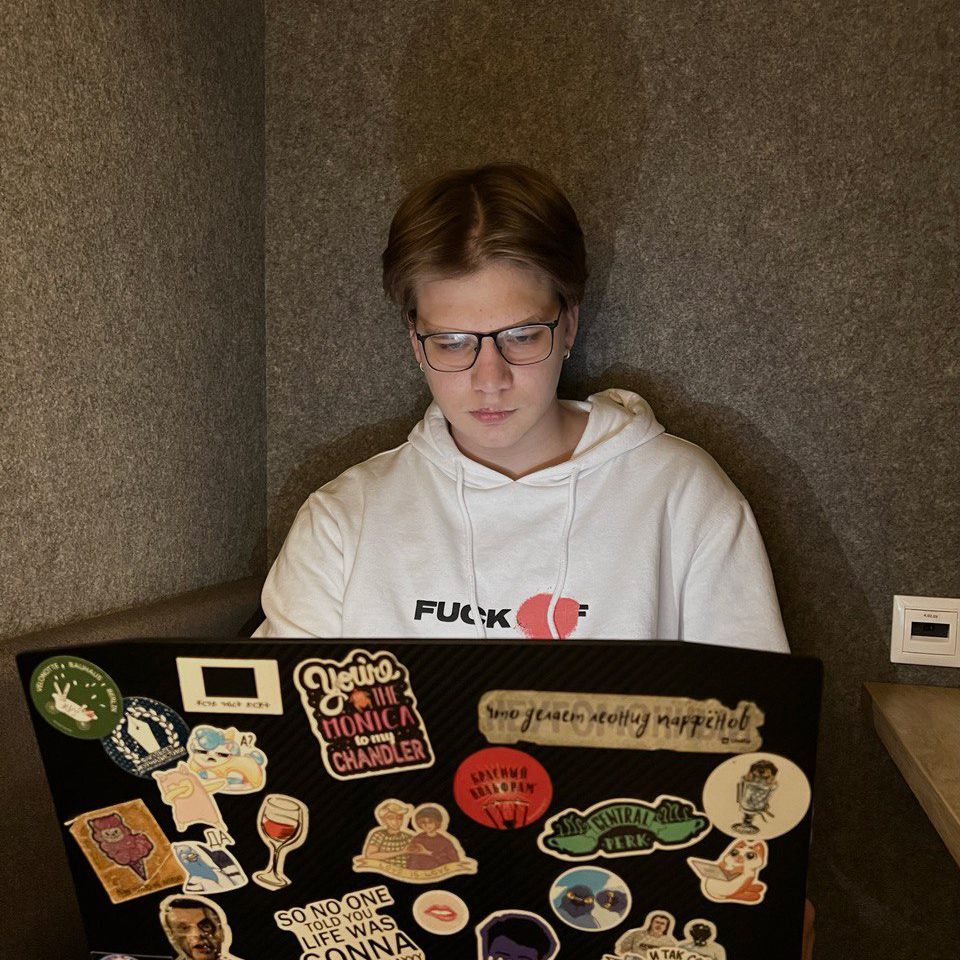
Никита Куликов знал, что Антон злится — он не понимал, почему студенты проголосовали за Марию и почему она решила выдвигаться. «Он считал, что все делает правильно, и это задело его самолюбие, я полагаю, — говорит Куликов. — Позже в студсовете они стали занимать две полярные позиции. Антон больше ушел во взаимодействие с администрацией факультета. Маша, конечно, по должности тоже взаимодействовала [с ней], но, можно сказать, что Антон был более провластным, а Маша — более оппозиционной. Две крайности в идеологическом смысле оказались».
Куликов не уверен, какие именно политические взгляды были у Антона, но говорит, что тот «точно не оппозиционер и не ура-патриот». «Он, скорее, молчит по провокационным поводам, и, возможно, поэтому он выбирает писать доносы, а не разговаривать в открытую. Потому что сделать анонимно и тихо проще, чем что-то открыто заявлять», — говорит Куликов.
Что-то, что уже было
Хотя перед тем, как признаться, Антон и просил Габисову никому не рассказывать об их разговоре, она все же рассказала о нем близким. Также она написала тред о ситуации в твиттере, но не назвала имени доносчика. Однако студенты догадались, о ком идет речь, и информация быстро распространилась на журфаке. «Я сначала свято верила, что смогу никому не говорить, раз попросили. И я себя жрала до недавнего времени из-за того, что я кому-то рассказала, написала тред», — говорит Габисова.
Некоторые студенты и преподаватели журфака поддержали Габисову. Часть студентов обратилась в учебную часть с просьбой разобраться в этой ситуации, так как, по их мнениею, своим поступком Антон нарушил этический кодекс университета. Преподавательница, к которой обращались студенты, объяснила «Холоду», что, по ее мнению, к учебному процессу конфликт отношения не имеет, а комментировать личные конфликты студентов она не вправе.
Зампред студсовета Майя Шкапина считает, что учебная часть наверняка была удивлена, что Антон решился на такой поступок. Он, по ее словам, постоянно говорил членам студсовета, что нужно быть демократичнее и понимать, что каждый поступок имеет последствия и нужно уметь нести ответственность за них.
«Мне кажется, абсолютно все были удивлены, шокированы и очень сильно злы», — добавляет она. Шкапина, как и некоторые другие студенты, теперь хочет, чтобы на журфаке созвали комиссию по поводу поступка Антона.
Впрочем, далеко не все студенты считают, что это разбирательство необходимо. «Есть немало людей, которые говорят, что не все так однозначно. Он же извинился, значит, все нормально и можно в целом его простить. Не знаю, для меня это слом всего, потеря веры в человечество. Как мне сказали взрослые люди, с которыми я поговорила: “Ну, теперь ты повзрослела, теперь ты знаешь, как устроена жизнь”. Для них это что-то понятное, что-то, что уже было», — говорит Габисова.
Тем не менее студсовет инициировал разбирательство в связи с доносом Антона. Габисова сказала, что не будет в нем участвовать, потому что она — заинтересованное лицо. Сейчас на факультете решают, будут ли по этому поводу созывать комиссию по студенческим делам. А пока студенты голосуют в онлайн-опросе по поводу того, нужно ли убрать Антона с должности старосты курса.
Как студенты сказали «Холоду», из 331 учащегося в голосовании уже приняли участие 253. Большинство — 167 человек — выступили за замену старосты, 126 сказали, что нужно провести комиссию, 36 считают, что нужно оставить все, как есть.
Антон отказался отвечать на вопросы «Холода», но сказал, что хочет обратить внимание на «два принципиальных пункта, которые потерялись в общей канве»: на то, что Габисова сама приняла решение об увольнении из школы и задумывалась об этом задолго до всей этой ситуации, и на то, что он сам деанонимизировал свою жалобу, когда позвонил ей и во всем признался. Антон также добавил, что эта ситуация — «личное дело двух людей». Он жалуется, что после того, как информация о его доносе распространилась по факультету, на журфаке «ходят сплетни, перевирающие все, начался буллинг».
Такая красивая мечта
Сначала Габисова не хотела говорить о случившемся с журналистами: ей хотелось побыстрее забыть о ситуации, перестать ассоциировать себя с ней. «Я ни в коем случае не обесцениваю опыт жертв изнасилований, но я немного стала их понимать. В том плане, что они часто не раскрывают имя человека, который это сделал, потому что не хотят в этом вариться, не хотят, чтобы им миллион раз задавали вопросы. Мне точно так же хочется просто закрыть глаза, чтобы со мной об этом больше никто не разговаривал, чтобы вообще больше никогда об этом не вспоминать. С этим человеком не говорить, чтобы он пропал из моей жизни. Но так не бывает», — говорит она.
После звонка Антона Габисова видела его на журфаке. Он пытался здороваться, но она говорит, что молчала в ответ, игнорировала его.
Раньше Мария хотела продолжить учиться в магистратуре журфака, построить карьеру преподавателя. «Но сейчас мне хочется просто закончить год, и, из-за того, что он [Антон] планирует оставаться на факультете, мне хочется уйти восвояси. Я очень люблю преподавание и с первого курса журфака грезила о том, как буду заходить в класс в красивой одежде со стаканчиком кофе, буду говорить: “Извините, я немного опоздала, ждала кофе” и объяснять журналистику или античную литературу — какую-то тему, которая мне будет интересна, с которой я пойду в аспирантуру. Это такая красивая мечта. А теперь я думаю: как вообще с этим жить?» — говорит Мария.
Сейчас она не понимает, как «сосуществовать с человеком, который совершил такую подлость, в одном пространстве» — ведь Антон планирует остаться работать на журфаке. «Да еще и общаться с кучей людей, которые его оправдывают и говорят, что не все так однозначно», — добавляет Мария.
Она опасается, что жалоба в департамент образования в принципе закрывает для нее возможность работать в государственных учебных заведениях. «И страшно, что, если даже я найду работу в школе, такая история снова может произойти. Поэтому буду искать работу в медиа», — говорит Габисова.
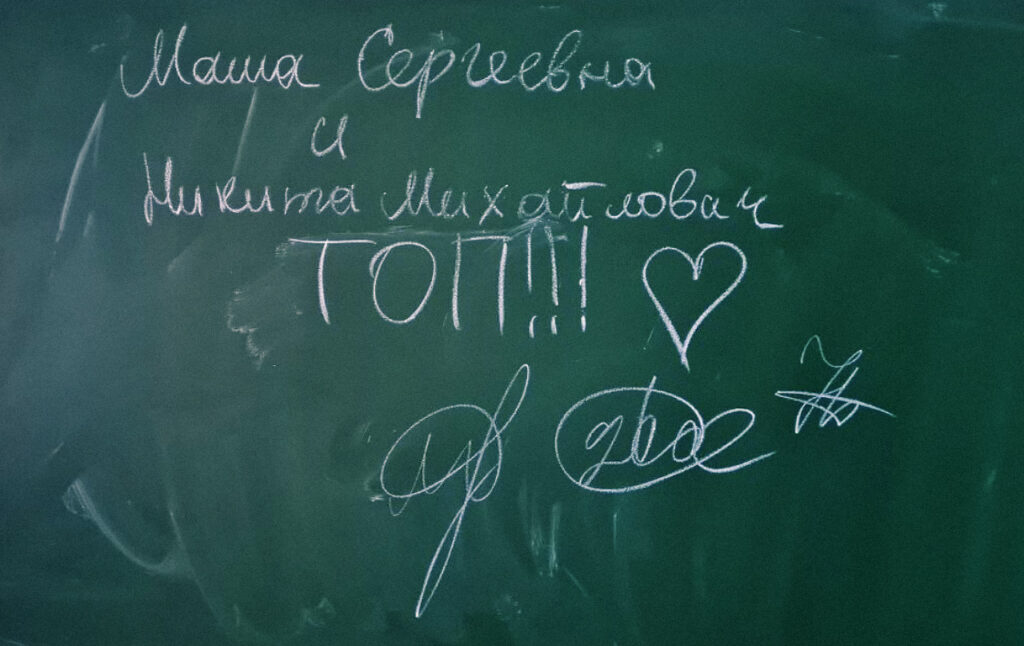
После увольнения из школы Габисова попрощалась с учениками. Старшим написала сообщение, что они молодцы. Сказала, что ушла, «не выдержав напряга, потому что оканчивает вуз», пожелала им, чтобы они в 11-ом классе не перенапряглись. «Мне написали несколько человек, что очень жалко, они меня любят и будут очень скучать».
С младшими она смогла попрощаться вживую. «Я сказала, что если вы вдруг захотите поговорить, мы можем встречаться онлайн, я буду вам какие-нибудь лекции читать по любому предмету, по которому вы захотите, хоть по геометрии. Буду специально для вас ее учить. Поэтому для них это не звучало как расставание, меня не хоронили. Они сказали, что я устало выгляжу в последнее время, попросили спать побольше. Дали мне наставления. Недавно мы с ними переписывались, они спросили, как дела, я похвасталась, что написала много страниц диплома, они меня похвалили».
Ученики Габисовой узнали из СМИ, что ее увольнение было связано с доносом. «Холоду» школьники сказали, что скучают по учительнице и считают, что доносчик поступил плохо и некрасиво.