
Translated material
Is there a Victory cult outside Russia?
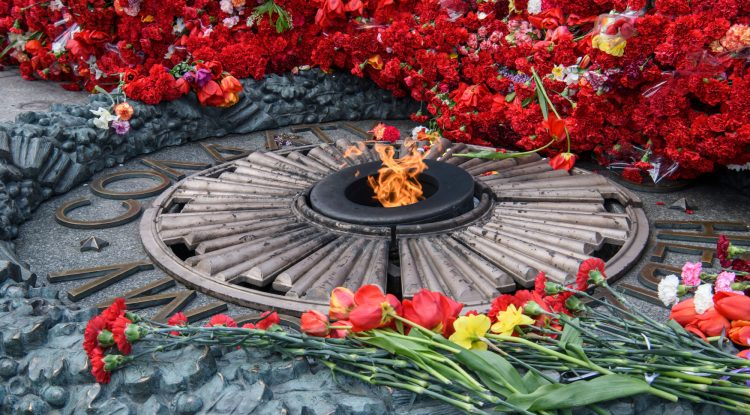
We explain how the countries of the former USSR treat the holiday
In Russia, on May 9, victory parades will be held in 28 cities, and at the “Immortal Regiment” event they are going to honor participants not only of the Great Patriotic War, but also of the war with Ukraine. At the same time, five countries of the former USSR banned the St. George ribbon; Victory parades and Immortal Regiment events are being canceled in some CIS countries. “Cold” tells how attitudes towards this day have changed in post-Soviet countries.
Ukraine: Russia is trying to take credit for the victory over Nazism
In Ukraine, May 8 is considered the Day of Remembrance and Reconciliation, and May 9 is the Day of Victory over Nazism in World War II. This year the authorities will not celebrate them due to martial law, but the Kiev city council allowed residents to bring flowers to the monuments.
On May 2, the Verkhovna Rada issued a statement about the inadmissibility of Russia trying to take credit for the victory over Nazism. The document says that the victory was “a common achievement of the Anti-Hitler coalition and liberation movements, and the war itself was a common tragedy of the peoples of the world.” Prior to this, a group of deputies gladly proposed to move the celebration of Victory Day from May 9 to May 8 and rename it “Day of Remembrance and Victory over Nazism in the Second World War.” But the faction of the ruling Servant of the People party blocked this bill.
Previously, Ukraine annually celebrated Victory Day on May 9. In Kiev, the festive ceremony took place on Glory Square: President Vladimir Zelensky laid flowers at the Eternal Flame. Across the country, people gathered at memorials and military graves, and before the pandemic, authorities allowed marches of the Immortal Regiment to take place . Since 2015, according to decommunization laws, it is prohibited to bring St. George ribbons and Soviet symbols (except for veterans’ awards) to commemorative events, and the term “Great Patriotic War” is not officially used .
Since 2014, the authorities have not held victory parades, and instead of the St. George ribbon, the official symbol of the holiday has become a red poppy, which also symbolizes the bloody trail of a bullet.
It seems that Belarus will not hold a victory parade. But Belarusian veterans will come to Moscow for the holiday
Belarus held a parade (that is, a display of military equipment and a procession of military personnel and other security officials) for the 75th anniversary of the Victory in the midst of a pandemic. But this can be called an exception: usually military parades take place in Minsk on Independence Day on July 3, and on Victory Day they are limited to processions and concerts. This year, on May 9, Minsk will host the “Procession of Generations,” of which the “Immortal Regiment” will be part. A festive concert and fireworks display are planned in the city in the evening. In addition, a group of Belarusian veterans will attend the parade on Red Square and participate in the Immortal Regiment procession in Moscow.
Tajikistan is going to hold a victory parade. Kazakhstan and Kyrgyzstan canceled it
Tajikistan is the only country other than Russia that plans to hold a victory parade on May 9. Women soldiers from the Russian military base will take part in it. Last year, President Emomali Rahmon was the only foreign leader to come to Moscow for Victory Day.
Kazakhstan is canceling the May 9 victory parade for the fourth year in a row. Previously, the Ministry of Defense explained this by the pandemic, but this year it said it was saving budget funds. In addition, the “Immortal Regiment” action in Kazakhstan was renamed “Let’s Bow to the Heroes.” The procession will take place only in Almaty - in Nur-Sultan, Aktau and Petropavlovsk the authorities refused to hold it. There will also be no fireworks in the capital. Meanwhile, a parade, an “Immortal Regiment”, and a fireworks display are planned at the Baikonur Cosmodrome, which Russia leases from Kazakhstan.
There will also be no parade in Kyrgyzstan on May 9 for the third year in a row. In the previous two years, the Ministry of Defense canceled it due to the pandemic, but this year it did not explain its decision. Instead of a parade, a “meeting-requiem” will be held in Bishkek, at which soldiers of the capital’s garrison will march, and an “Immortal Regiment” action.
The Baltic countries ban almost all protests on May 9
Victory Day was not a public holiday in Latvia: as in other European countries, May 8 is considered the day of remembrance and the end of World War II. Before the pandemic, on May 9, people gathered for rallies at monuments to the Soviet army and held processions of the “Immortal Regiment.”
This year, the Latvian Seimas banned the celebration of Victory Day and declared May 9 the Day of Remembrance for those killed and injured in Ukraine. Local residents will not be able to gather in groups within 200 meters of memorials to Soviet soldiers, but they will not be prohibited from bringing flowers to them privately.
Until May 10, the Estonian authorities banned rallies in honor of Victory Day at which USSR flags, St. George ribbons and Soviet military uniforms are used. The ban applies in Tallinn, Harju County and Ida-Viru County. “The Estonian state has so far been tolerant of the May 9 events, but Russia’s current actions in Ukraine exclude the possibility of holding public meetings in Estonia,” Elmar Vaher, head of the Police and Border Guard Department, told BNS. At the same time, local residents will be able to lay flowers at the cemetery and light candles.
In Lithuania, the celebration of May 9 is not officially prohibited. But the mayor of Vilnius, Remigijus Šimašius, announced that on this day the city administration would not allow a festive rally to be held at the monument to Soviet soldiers at the Antakalnis cemetery. “We will not provide a legal basis for this; what the police will do is a separate matter,” the mayor said.
In Georgia it was proposed to celebrate Victory Day on May 8, but parliament did not support the initiative
Georgia celebrates Victory Day on May 9. The official ceremony this year will take place in Tbilisi at the monument to Meliton Kantaria, who, together with Mikhail Egorov, installed the Victory Banner on the roof of the Reichstag. Until 2021, flowers and wreaths were brought to the Tomb of the Unknown Soldier in Vake Park, but for now it is closed for renovation. Last year, despite the pandemic, small rallies of the Immortal Regiment took place in Tbilisi and Batumi , but the organizers are not planning any this year.
In April, a group of Georgian deputies proposed moving the celebration of Victory Day from May 9 to May 8. But parliament refused to consider this initiative. Chairman of Parliament Shalva Papuashvili said at the meeting that Victory Day is celebrated on May 9 not only in Georgia and Russia, but also in Romania, which is a member of NATO, and Israel, which suffered from the Holocaust.
Armenia and Azerbaijan have not announced their plans for May 9. Over the past two years, due to the pandemic, authorities have limited themselves to laying flowers at memorials. Before the pandemic, the republics organized processions of the “Immortal Regiment”; In Armenia, the event is being held online for the third year in a row.
For Armenia, this date is associated not only with the Great Patriotic War: on May 9, 1992, during the Karabakh War, it took control of the city of Shushi. Every year, the country's leadership celebrated two victories: some officials stayed in Yerevan for the holiday, and the other part went to Shushi. But in November 2020, the city again came under Azerbaijani control. Last year on May 9 acting. Prime Minister Nikol Pashinyan said that Armenia celebrates Victory Day “with bitterness, mixed feelings, and regret.” On the same day, an opposition rally was held in Yerevan: according to various estimates, it attracted more than 10 thousand participants.