
Translated material
Bring back memory - Layout
Bring back memory
How the state appropriated the holiday of the Soviet people for years, but not everyone agreed with it
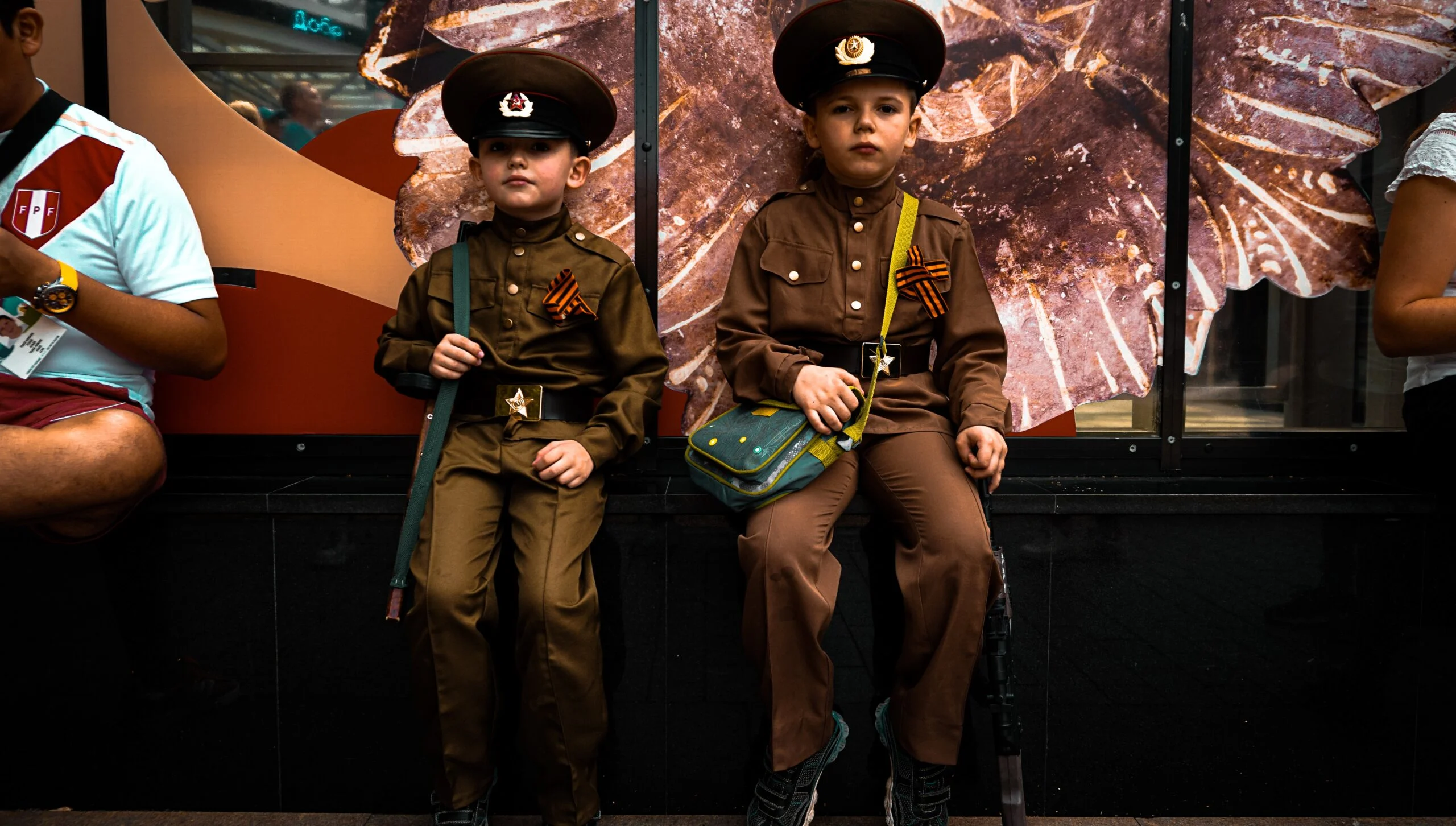
Once upon a time, May 9 was a day of remembrance and a “holiday with tears in our eyes.” Now it is a day of demonstration of Russian military power and a propaganda tool. Putin’s speeches are becoming more and more aggressive, and delegations from other countries appear at the festival less and less often—even representatives from Belarus did not come this year. And yet there are Russians who are trying to return Victory Day to its original meaning and are fighting to once again make it a day of peace and remembrance. Elena Dolzhenko explored how May 9 became a day of military bravado and who and how is trying to make it a peaceful date again.
Refusal to demonstrate “imperial ambitions”
Parades, and especially the demonstration of military equipment, have not always been a traditional attribute of the May 9th celebration. In Soviet times, parades were held only in anniversary years, and even then not every time. In total, only five of them took place: in 1945, 1965, 1975, 1985 and 1990.
Only in 1995, a law was passed in Russia that ordered parades to be held annually “in hero cities, as well as in cities where the headquarters of military districts, fleets, combined arms armies and the Caspian Flotilla are stationed.” That year there was a big celebration on Red Square in honor of the 50th anniversary of the victory, but the review of heavy equipment was not in front of the Kremlin, as is customary now, but on Kutuzovsky Prospekt.
Since then, every year on Victory Day, Russian troops marched through Red Square. But military equipment did not participate in the processions, although the possibility of using it was prescribed in the law of 1995. In 2007, the commander of the Moscow Military District, Vladimir Bakin, said that the refusal of equipment was due to a lack of finances.
On the other hand, in 2005, an expert of the Chairman of the Supreme Council of the RSFSR, Pavel Voshchanov, in an interview with Novaya Gazeta, said that President Yeltsin did not want to “demonstrate imperial ambitions” and rattle weapons. According to Voshchanov, the president’s task at that time was to show the West that the confrontation from Russia was over.
Defense Minister Sergei Ivanov emphasized in 2005 that since 1991 there was “no equipment at parades and there will never be any more.” According to him, their demonstration was abandoned in order to preserve underground structures in the center of Moscow.
Return of tanks and vodka with ribbons
At the end of Vladimir Putin’s second presidential term - in January 2008 - at a meeting of the Ministry of Defense led by Anatoly Serdyukov , it was decided to resume the display of equipment at parades. It was that year - after the first inspection of military equipment in many years - that the Russian-Georgian war took place in August.
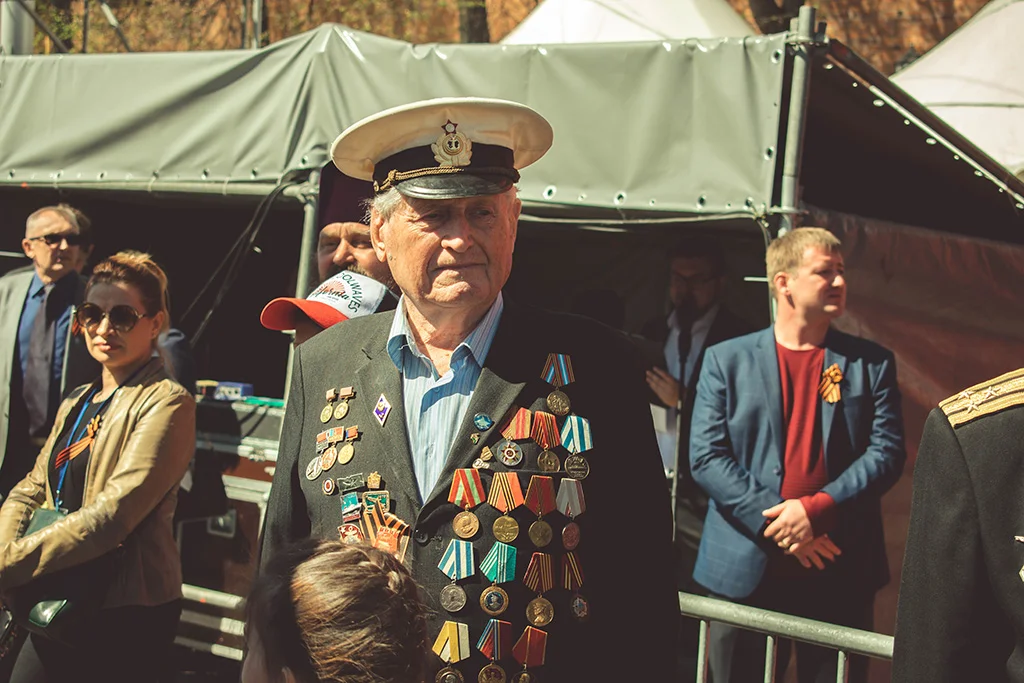
After this, a whole infrastructure began to grow around Victory Day, which was used by politicians, the media, and marketers for their own purposes. One of the typical examples is the “St. George’s Ribbon” campaign, which was invented in 2005 by RIA Novosti employee Natalya Loseva . Russians began tying black and orange ribbons to cars and clothes, and stores began selling vodka and even slippers with St. George ribbons.
This symbol of victory also became a political instrument. In May 2014, Novaya Gazeta columnist Yulia Latynina called the distribution of ribbons Russia’s response to the revolution in Ukraine: “Instead of the word “Ukrainians,” they say “Bendery.” Those who overthrew the corrupt dictator Yanukovych are equated with fascists, and Putin, therefore, with the new winner of the “fascists.” The reception is so successful that the question arises: wasn’t the orange and black ribbon from its very beginning, 9 years ago, invented as a means of fighting against popular revolutions?”
Over the course of 17 years, the symbol of memory gradually turned into a symbol of Russian military aggression. This year, the display of the St. George ribbon, along with the letters V and Z, was banned in Lithuania, Ukraine and Moldova.
From “if only there was no war” to “we can repeat it”
Gradually, the tone of Vladimir Putin’s statements about the war changed. In 2000, at the May 9 parade, the young president said that peace is “the strength of the economy and the well-being of people.” On June 22, 2001 - the Day of Remembrance and Sorrow - he said : “If only there was no war.”
20 years later, in an interview with TASS, Putin said that no country in the world suffered such a loss as the USSR because of the war. And he added: “If someone dares to do something like that, we will repeat it.”
At the same time, his attitude towards the contribution of the allied countries to the common victory also changed. In 2004, the president said that “the world could strike a blow against Nazism only by joining forces.” And even in 2012, when the screws were already being tightened in Russian domestic politics, Putin thanked his allies on May 9 and stated that “strict adherence to international norms, respect for state sovereignty and the independent choice of each people is one of the unconditional guarantees that the tragedy of the past war will never happen again.”
In 2014, after the annexation of Crimea, there was no longer any talk about respecting state sovereignty. But words appeared that it was on May 9 that it was important to “be loyal to the Motherland” and “defend its interests.”
In 2015, in honor of the 70th anniversary of the victory, Putin openly accused Western countries of allegedly ignoring the basic principles of international cooperation in “attempts to create a unipolar world.” In 2021, the president did not thank allies in his speech. He also stated that “in the most difficult time of the war, in the decisive battles that determined the outcome of the fight against fascism, our people were alone.” Moreover, in that speech, the president blamed the Nazis not only for anti-Semitism, but for some reason also for Russophobia.
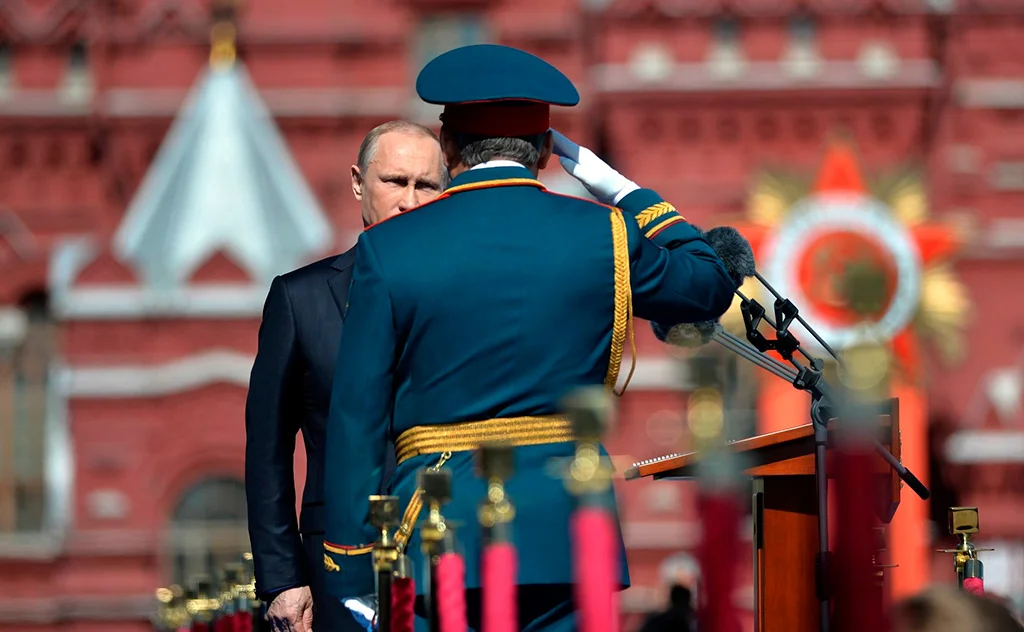
Photo: press service of the Russian Presidential Administration / kremlin. ru
At the same time, he hinted that the ideas of Nazism were allegedly being revived: “Today we see a gathering of half-dead punitive forces, their followers, attempts to rewrite history, to justify traitors and criminals, who have the blood of hundreds of thousands of civilians on their hands.”
But at the same time, he still mentioned that new attacks are unacceptable. “The war brought so many unbearable trials, grief and tears that it is impossible to forget it,” said the president. “And there is no forgiveness or justification for those who are again plotting aggressive plans.”
A year later, St. Petersburg resident Artur Dmitriev wrote this phrase from the president on a poster and went out on a solo picket. He was detained and fined . The court found that the quote from Vladimir Putin's speech discredits the Russian army.
Victory Day without guests
As the president's rhetoric became more aggressive, fewer foreign delegations attended the May 9 parades. In 2000, 2005 and 2010, dozens of politicians from different countries, representatives of the UN and UNESCO arrived in Moscow for the parade.
The situation changed dramatically in 2014, after the annexation of Crimea and the outbreak of hostilities in Ukraine. Representatives of the United States and European countries began to massively refuse to attend the Moscow parade. In 2020, on the day of the 75th anniversary of the victory, foreign guests at the celebration included the head of Serbia, several CIS republics and the “presidents” of Abkhazia and South Ossetia - unrecognized republics on the territory of Georgia (Georgia calls these territories occupied - editor's note).
The meaning of Victory Day became even more blurred when, since 2015, the Russian authorities began to celebrate the holiday in territories where Russian troops are illegally present: in the so-called LPR and DPR, as well as in Abkhazia, South Ossetia and Transnistria.
In 2016, even the Syrian Khmeimim base in Latakia joined the celebration. The Syrian parade was hosted by Alexander Dvornikov - later, in April 2022, it was he who became the commander-in-chief in the war with Ukraine.
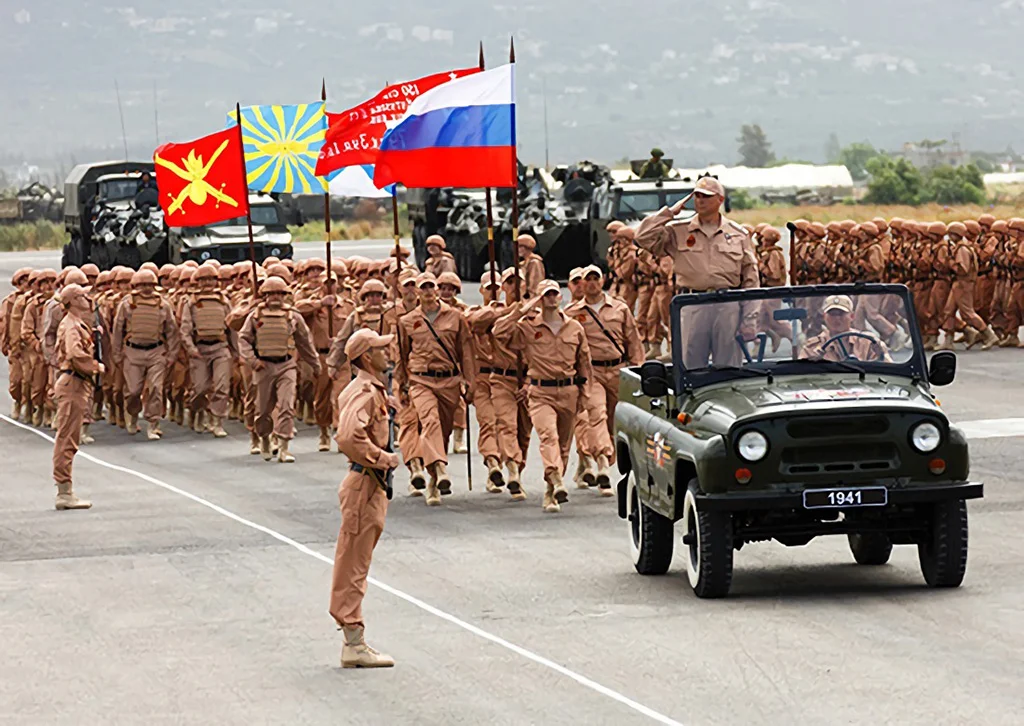
Photo: Russian Ministry of Defense
Insult to veterans
In 2021, the memory of the war was finally formalized into a punitive instrument: Putin signed the law on insulting veterans and amendments to the existing law on the rehabilitation of Nazism. Now you can go to prison for making critical statements regarding Russia's military exploits.
The most famous slanderer of veterans was Alexey Navalny, who was fined 850 thousand rubles for allegedly insulting Ignat Artemenko, a participant in the Great Patriotic War. The fact is that Navalny left an angry comment under the video about voting for amendments to the Constitution, calling the participants “corrupt lackeys.” One of the people in the video was a war veteran.
Navalny, in turn, in his last word stated that it was not he, but the authorities who insulted Artemenko and other veterans: “With this process, you humiliated and insulted all veterans <...> For this, you will all burn in hell.”
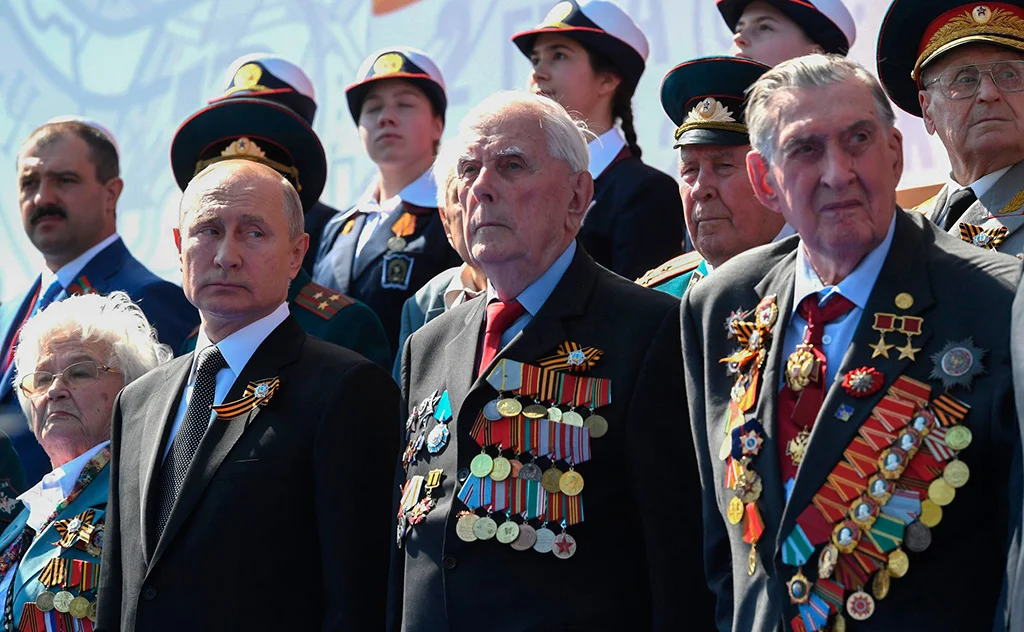
Photo: press service of the Russian Presidential Administration / kremlin. ru
Now we can say that the new laws have become one of the stages of preparation for a big war against Ukraine. It was after February 24 that they began to be used especially often to initiate cases against those who criticize the Russian regime and military aggression.
For example, against a journalist and a player in “What? Where? When?" Rovshan Askerov was opened a case for the rehabilitation of Nazism because of his post on Facebook, where he spoke harshly about the personality of Marshal Zhukov.
Stolen Immortal Regiment
It is not only Navalny who dislikes the way the Russian authorities use the memory of the war for their own purposes. For years, opposition politicians and activists have tried to return the holiday to its original meaning and reappropriate the memory that the state is trying to monopolize. But sometimes it only gets worse.
In 2012, three Tomsk activists came up with the “Immortal Regiment” campaign - they invited people to take to the streets with portraits of their relatives who participated in the war. One of the authors of the action, Tomsk TV2 journalist Sergei Lapenkov, later recalled : “It was an honest and some kind of very human patriotism. It was like everyone came out with their family.”
The “Immortal Regiment” action had its own charter, and it stated that this initiative was non-profit, non-political and non-state. And yet the state quickly picked up the idea and politicized it. In the following years, the ONF began to hold marches of the “Immortal Regiment”. In some cases, participation in the action became voluntary-compulsory; sometimes schoolchildren appeared in the crowd with portraits of strangers, which were handed to them before the start of the procession.
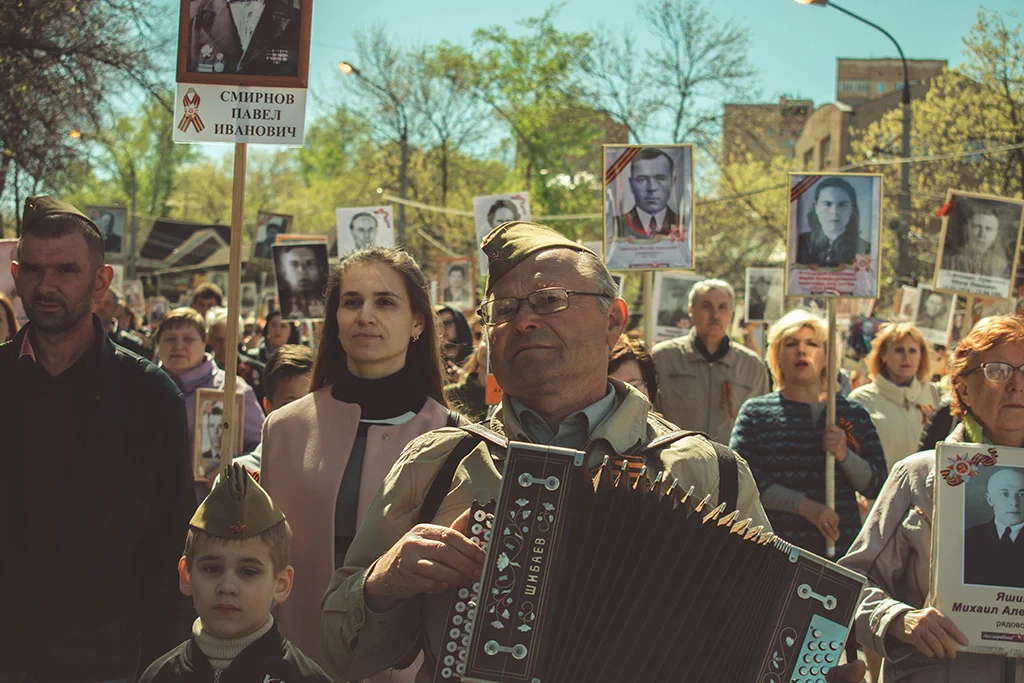
The initiative was also used to fight dissent. For example, shortly after the start of the war, a case was opened against a St. Petersburg resident who published a photograph of Stepan Bandera on the Immortal Regiment Online website.
In 2022, the creators of the “Immortal Regiment” asked not to be associated with the actions that are planned to be held on May 9, 2022.
Get your memory back
And yet, there are Russians who continue to oppose the appropriation of the holiday by politicians. For example, this year activists of the youth democratic movement “Spring” decided to recapture the “Immortal Regiment” from the state andcame up with the action “They didn’t fight for this.” The point is to get into the thick of the Immortal Regiment procession, holding a photograph of a veteran in your hands for cover, and then, once in the crowd, unfurl an anti-war poster or an image of the horrors of war.
In addition to organized activist resistance, there is also targeted civil resistance. For example, every year parents across the country rebel against their children's school dressing up in military uniforms and militaristic celebrations on May 9th.
Recently, a resident of the Tula region became known throughout the country after she tore the letter Z from the window of the kindergarten where her son goes. In a conversation with “Vestka”, she said that the day before she had been in conflict with the management of the kindergarten because she did not want her child to celebrate Victory Day in the kindergarten: “For me, May 9 is a day of memory and sorrow, and I cannot interpret this holiday in any other way.”
From the editors of “Layout”: shortly before the release of the text, we learned about the most important anti-war action on May 9, which we cannot fail to mention .
Journalists from Lenta. Ru” Egor Polyakov and Alexandra Miroshnikova published protest materials about the war with Ukraine on the main page of the publication - dozens of news items and an analytical article about “dictator Putin,” who is leading Russia into the abyss. Before each publication they placed a disclaimer: “This material has not been approved by the management, and for its publication the Presidential Administration will give the publication stars. In other words, take a screenshot urgently before it’s deleted.”
Polyakov and Miroshnikova told Vestka that they prepared the action together. The editor-in-chief of Lenta only expressed the hope that they “won’t go to the top ten” and said that the publication is unlikely to be able to continue cooperation with them. The posts disappeared from the site after about three hours. Now on the main page there is again material about how “The Red Army put an end to the Great Patriotic War.”
Cover photo: Felipe Simo / Unsplash
Elena Dolzhenko